PitchBook reviews: a $30,000 median contract, 12.3M company profiles and a 1.7 on Trustpilot
 By Jan Suski. I go deep on every review, checking every number against its source and digging up details other coverage misses, a habit from six years of SEO and link building for tech companies. Bylines at Brand24 and Senuto. How the scoring works.
· Prefer this source on Google
Best for
Private equity, venture capital and M&A teams that screen companies, investors and funds every day and can expense a five-figure license. Capterra users rate it 4.4 out of 5, and Morningstar counts 113,451 licensed users.
Not for
A founder raising one round, or a sales team that needs verified email addresses. PitchBook publishes no price, trials sit at its discretion, and Vendr's lowest tracked contract is $20,000 a year.
What it costs
Quote only. Vendr's median is $30,000 a year, and a 2022 UK government order form priced added seats at $7,000 each.
- Published price
- None, quote only
- Vendr median
- $30,000 a year
- Vendr range
- $20,000 to $124,500 a year
- Added seat, 2022 UK order form
- $7,000 a year
- Free integrations
- Excel, PowerPoint, Chrome
- Paid add-ons
- Direct Data, CRM integration
- Companies
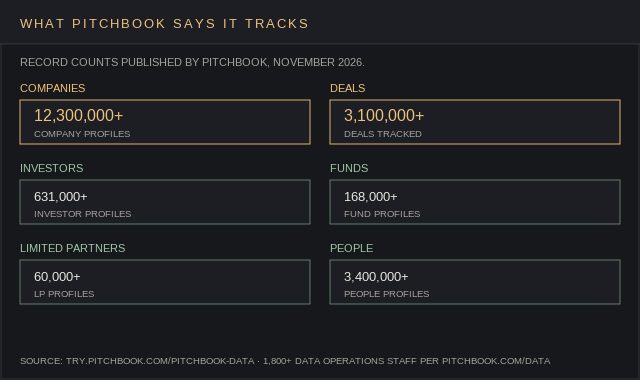
- 12,300,000+
- Deals
- 3,100,000+
- Investors
- 631,000+
- Funds
- 168,000+
- Data operations staff
- 1,800+
- Owner
- Morningstar, since December 2016
- 2025 revenue
- $671.8 million, up 8.6%
- Licensed users
- 113,451
- Renewal rate
- 103% in 2025, down from 108%
- Capterra
- 4.4 from 41 reviews
- Trustpilot
- 1.7 from 24 reviews
- Export cap on the UK form
- 1,000 rows a day per user
Crunchbase
Not forA PE or VC team that needs fund performance and LP records.
Preqin
Not forA buyer who can fund only one private-markets database.
Sources for the facts above
Coverage counts come from PitchBook's data page, contract figures from Vendr and a 2022 UK order form, and business figures from Morningstar's 2025 10-K, checked 21 November 2026. Ratings are Capterra's and Trustpilot's own aggregates.
PitchBook is a private market data platform owned by Morningstar and run from Seattle, Washington. Investors, bankers and corporate development teams use it to screen companies, track deals and find the funds and limited partners behind them. Its data page lists 12,300,000+ companies, 3,100,000+ deals and 631,000+ investors.
These PitchBook reviews pull together what the platform covers, what a seat costs when the vendor won't print a price, how accurate users say the data is, and how it compares with Crunchbase, CB Insights and Preqin. Every figure links to its source, checked 21 November 2026. The user reviews quoted below come from Capterra and Trustpilot, where the people who pay for PitchBook and the people profiled on it leave scores 2.7 points apart.
The timing matters for anyone at renewal. Morningstar told shareholders in March 2026 that PitchBook seeks "expansion at renewal, including price increases where appropriate," and its renewal rate slipped from 108% to 103% in 2025. Both numbers point at the same negotiation. A $30,000 median contract makes PitchBook one of the larger data line items a deal team signs, so this review leads with what you pay and what you get for it.
What PitchBook is used for, and what's in the platform
What do people use PitchBook for? Mostly to answer three kinds of questions: who owns a company, who invested in it and at what valuation, and which investors might write the next check.
The platform covers venture capital, private equity, M&A and public markets in one place, and its differentiators page says it tracks "the entire lifecycle of private capital across the globe." Its desktop page calls it "the most comprehensive, accurate, and timely source of private capital market data."
The license bundles several tools. The pricing page FAQ lists desktop access, a mobile app, Excel and PowerPoint plugins and a Chrome extension:
- Desktop: search and filter companies, deals, funds and LPs, then build benchmarks and track trends, per the desktop page. Most analyst work happens here: analysts create screens in advance of a pitch and save them to stay current on a sector.
- Excel and PowerPoint plugins: pull financials and deal data into models and decks. PitchBook's integrations page says these, plus Chrome, are free to all clients.
- Mobile app: included with the license, per the pricing FAQ, for checking a company or investor profile away from the desk.
- Direct Data and CRM integration: "premium additions priced according to seats and firm type," per the same page.
An AI layer sits on top. PitchBook's AI page lists PitchBook Navigator, a natural language search box that answers questions and can create deal and company screeners, plus a VC Exit Predictor and AI-driven valuation estimates. AI summaries condense company profiles that average more than two hundred data points each.
PitchBook also integrates with CRM and AI platforms: Desktop data syncs with your CRM, and enterprise LLMs reach it through "Essential and Premium Connectors."
A Capterra reviewer, a junior analyst at a 2 to 10 person investment manager, June 2025, described the daily payoff: "I use it regularly, making my life a lot easier than if I had to manually search for investors."
For a deal team, finding the right investors fast is the point of the whole subscription, and that's the work PitchBook makes shorter. Its pricing page says the product is aimed at "sophisticated investment professionals," though it adds that anyone who works with capital market data could find it useful.
Where the data comes from, and how accurate it is
PitchBook puts a great deal of staff behind its claims. Its data page credits a data operations team of 1,800+ professionals and says the data is "updated multiple times a day," with over one million news events analyzed each week.
PitchBook combines automated data gathering with human verification. Primary research teams in Seattle, Washington, and London connect with firms for additional information, per its research process page. The same page says web crawlers and secondary sources feed AI and machine learning tools, and the team improves that output before it reaches the platform.
Users who work with the data every day report where it lags. A business development manager at a 10,001+ person financial services firm wrote on Capterra in August 2026 that "the contact information and details about the funds and investors can be slightly out of date."
Coverage gets thinner away from the core deal types. A senior family office strategist at an 11 to 50 person firm wrote on Capterra in September 2026 that for illiquid and alternative investments "the breadth and depth of data is pretty lean." Teams that work in illiquid or alternative assets should test those screens during any trial, before they sign.
The angriest PitchBook reviews come from companies profiled on the platform. On Trustpilot, where PitchBook scores 1.7 from 24 reviews, a US reviewer wrote in May 2026: "They have my company listed as being purchased by a competitor." The same reviewer says they couldn't create an account to fix it and found staff unhelpful by phone. Another US reviewer, September 2025, put it in six words: "Your data is completely inaccurate."
"PitchBook is displaying incorrect company information and, more alarmingly, personal details"
Trustpilot, reviewer SV, Belgium, 22 February 2024
That Belgian reviewer says a removal request got no response, which raises a GDPR compliance question about personal data: the regulation lets people in the EU request erasure of their own data. These Trustpilot complaints run from February 2024 to May 2026, so the pattern has lasted more than two years.
A profiled company that finds something wrong can ask for a correction, since the research process page invites firms to keep their profiles up to date. If a profile is wrong, ask early, keep a record of the email, and ask PitchBook to clarify which source the wrong figure came from. A good correction request names the deal, the date and a public filing.
How much does it cost to use PitchBook?
PitchBook doesn't publish a figure. Its pricing page says "Pricing options vary depending on how many seats you need and your firm type," and every button leads to a sales form, so every buyer has to request a quote from PitchBook's sales team. To find what buyers pay, you have to read other people's paperwork.
Two sources fill the gap. Vendr's anonymised buyer data puts the median PitchBook contract at $30,000 a year across 123 purchases on its chart, with subscriptions ranging from $20,000 to $124,500 a year and 14% average savings. A UK government order form for April 2022 to March 2023 lists 18 users at $126,000 and a committed total of $100,800, about $5,600 a seat.
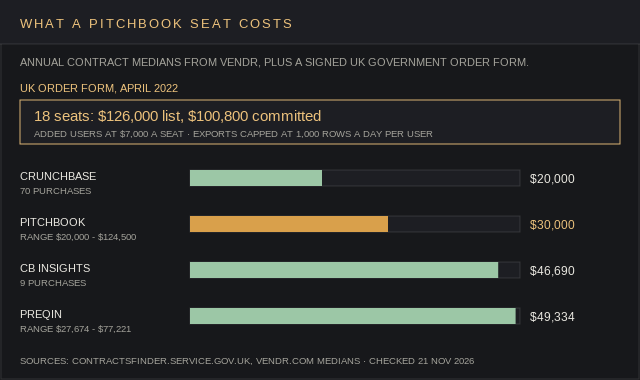
The same form says added users come "at an annualized cost of $7,000 per seat" and caps exports at 1,000 rows of company, deal or fund data a day per user. Those caps matter more than the seat price for a team that builds lists in Excel. A subscription finance analyst at a 10,001+ person bank wrote on Capterra in August 2026 about "the inability to download bulk information from lists that include both investors and portfolio companies."
Expect the price to move at renewal. Morningstar's March 2026 investor answer says pricing is set contract by contract, based on how deeply a client uses the platform, and that revenue per client rose in 2025. The UK order form covered a one-year licensing term, so ask by email if a two- or three-year license buys a cap on renewal increases. The full breakdown, with every order form, is in the PitchBook pricing report.
Is PitchBook free to use? No public tier exists. The pricing page says PitchBook will decide "if a free trial might be right for you," and that gap between the advert and the sales call drives a cluster of complaints. A UK reviewer wrote in May 2024 that "the "Free Trial" is not a trial its a forced demo and getting bombarded with call and emails." An Italian reviewer described the same experience in March 2025.
Before you book a demo, ask the rep in writing to state the trial length and what you'll be able to export, so the claims in the advert and the terms in the account match. Good questions for that email: how many seats the quote assumes, which add-ons it includes, and what the renewal increase was for similar accounts last year.
For small buyers, the price is the dealbreaker. A chairman and CEO of a 2 to 10 person biotech wrote on Capterra in July 2025:
"High cost of a database subscription for small early stage companies or individuals is a roadblock to progress"
Capterra, Thomas K., Chairman and CEO, Biotechnology, 8 July 2025
A US reviewer on Trustpilot went further in September 2025, citing "Highly inaccurate data, and extremely overpriced with aggressive billing practices." For a seed-stage founder, $20,000 a year at the bottom of Vendr's range is a bitter pill to swallow.
What users praise: support, research and time saved
Paying customers rate PitchBook far above the Trustpilot crowd. Capterra shows 4.4 from 41 reviews, with 4.3 for customer service and 4.4 for ease of use. Support gets credit in plain words: a trainee solicitor at a 1,001 to 5,000 person law firm wrote in July 2025 that "the customer service is timely and responsive." PitchBook also offers a free Core Foundations certification to help new users start.
The Capterra experience reads differently from the Trustpilot one because the people writing those reviews are customers. The good Capterra reviews describe the same work: finding investors, reading research and getting answers to questions in one place, which makes the license easier to defend at budget time.
The research arm earns a separate kind of praise. PitchBook's institutional research team publishes reports such as the quarterly PitchBook-NVCA Venture Monitor, cited in its venture capital database page. The same biotech CEO who called the price a roadblock also wrote:
"The Pitcbook [sic] investment market reports and newsletter is a vital source of business intelligence"
Capterra, Thomas K., Chairman and CEO, Biotechnology, 8 July 2025
The improvement requests ask for more service. A government relations director at a 51 to 200 person organization asked on Capterra in April 2026 for "continued training, stronger account engagement, and more proactive support." Read together, the reviews describe a good product whose users want more help getting value from it in the first months.
Who owns PitchBook, and how the business is doing
Is PitchBook owned by Morningstar? Yes. Morningstar bought the remaining stake in December 2016 for a net cost of about $188 million, per its 2016 annual report. PitchBook runs as its own segment, with offices in Seattle, WA, San Francisco, New York and London, and an Emerging Technology Research team inside its institutional research group.
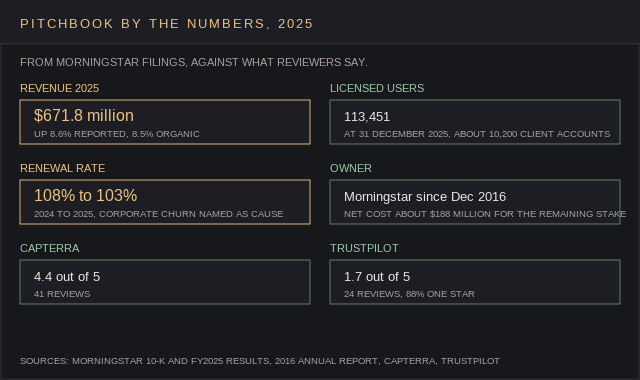
The segment grew 8.6% to $671.8 million in 2025, per Morningstar's full-year results. The 2025 10-K counts 113,451 licensed users and about 10,200 client accounts. It puts the renewal rate at about 103%, down from 108% in 2024, and blames higher churn and lower expansion among corporate clients.
That churn is the elephant in the room for corporate buyers. Morningstar said fourth-quarter licensed user counts were roughly flat year over year, with new logos offset by corporate churn. A corporate development team at the moment of renewal has a good case for a flat price in 2026, so the ball is in its court.
Security reviews should ask for the audit report directly. A PitchBook security job listing on Greenhouse describes a role that will "lead our first SOC 2 Type II audit," so procurement teams should confirm the current attestation status in writing and ask for SOC 2 Type II and ISO 27001 evidence before the work starts.
PitchBook vs Crunchbase, CB Insights and Preqin
Who are PitchBook's main competitors? Crunchbase, CB Insights and Preqin cover the same private market data, and each wins a different buying situation.
Crunchbase wins on entry price and self-serve buying. Its help center lists Pro at $99 a month billed monthly, and Vendr tracks a $20,000 median across 70 purchases, and G2 rates it 4.4 from 422 reviews. It loses for teams that need fund and LP records, which PitchBook counts at 168,000+ funds and 60,000+ limited partners. The PitchBook vs Crunchbase comparison scores the pair, and the Crunchbase review covers its own data gaps.
CB Insights costs more per contract. Vendr's median is $46,690, $16,690 above PitchBook's, though it rests on only 9 purchases with a range up to $184,986. It loses on price for any team that can only fund one database. Its case rests on its own research, so compare a sample report from each vendor before buying; the site's guide to market mapping covers what to test.
Preqin sits in the same band. Vendr puts its median at $49,334, with a range of $27,674 to $77,221, so its cheapest tracked contract costs $7,674 more than PitchBook's. It loses on price at every point Vendr tracks, and G2 shows a 2.7 rating from only 3 reviews. It wins as the second quote in a PitchBook renewal, since a $19,334 gap at the median gives a buyer a number to put on the table.
For public-market work, FactSet and Bloomberg sit in another price band, compared in Bloomberg alternatives.
The investment research platforms ranking scores all of these on the same criteria, and the market intelligence platform pricing report lines up their seat costs.
Verdict
Built for: PE, VC and M&A teams that screen companies, investors and funds daily and can carry a $30,000 median contract. The 12.3M company profiles, the 1,800+ person data team and Capterra's 4.4 rating make it a great fit for people who work in it every day, and the PitchBook reviews from that group are good.
Wrong fit: a founder raising one round, or a sales team after verified contacts, which is the work a contact database such as ZoomInfo is built for. With no published price, a trial at the vendor's discretion and a $20,000 floor in Vendr's range, a solo buyer has better options in Crunchbase Pro at $99 a month.
Worth a trial, with caveats: corporate development and strategy teams. Ask for a written trial, test the 1,000-row daily export cap against your list sizes, and quote the 103% renewal rate when price increases come up. Profiled companies should check their own page and file corrections in writing.
The scores trace to the same facts. Price transparency gets 20 and self-serve buying 10 because the pricing page prints no number and trials are at PitchBook's discretion. Export freedom gets 45 for the 1,000-row daily cap and the bulk download complaint.
Support gets 70 from Capterra's 4.3 customer service rating, held down by the phone and trial complaints on Trustpilot. Enterprise fit gets 80 on 113,451 licensed users and a $30,000 median that a procurement budget absorbs. Solo fit gets 15 on the $20,000 contract floor.