PitchBook vs Crunchbase (2026): Deal Research Seat or Prospecting List
 By Jan Suski. I go deep on every review, checking every number against its source and digging up details other coverage misses, a habit from six years of SEO and link building for tech companies. Bylines at Surfer, Brand24, and Senuto. How the scoring works.
| WHAT EACH ONE DOES | PITCHBOOK | CRUNCHBASE |
|---|---|---|
| Core job | Deal and fund research | Prospecting lists |
| Companies tracked | 13.4M+, incl. public* | 4M+ private |
| Benchmarked funds | 175K+ funds* | None |
| LPs tracked | 67K+* | None |
| Prediction models | Valuation and exit | Seven, from Pro up |
| Verification | Calls to deal parties | 30M+ updates a year |
| Onboarding | 4.5-hour certification | Self-serve, AI search |
| CRM sync | Paid add-on, 5 CRMs | In Business plan |
| Bulk data | API, Parquet feed | API, 200 calls a min |
| Skip it if | You only build lists | You run fund diligence |
| WHAT YOU GET | PITCHBOOK | CRUNCHBASE |
|---|---|---|
| Entry price | Quote only | $49 a month, year one |
| Seat on record | $7,000, 2022 UK form | $588 a year, Pro |
| Monthly option | None | $99 a month |
| Vendr avg contract | $30,000, 114 deals | $20,000, 73 deals |
| Vendr avg savings | 13.72% | 21.41% |
| Free trial | On request | 7 days, self-serve |
| Renewal | 1-yr auto, 30-day exit | Monthly: cancel anytime |
| Export cap | 2,000 rows a month | 2,000 rows a month, Pro |
| Owner | Morningstar | VC-backed, private |
| Revenue filed | $671.8M, 2025 | None filed |
StrongerWeakerNo edge
Thirty-two further documented limits sit behind the button below: record counts by entity type, update cadence, CRM and feed formats, AI connectors, export caps and Crunchbase’s own forecast claims. Test scenario: one analyst seat bought for a year, list price, no multi-year commitment.
PitchBook price is the $7,000 added-seat rate on a 2022 UK Department for International Trade order form (Contracts Finder); PitchBook publishes no rate card. Crunchbase prices are from Crunchbase’s support articles (monthly $99, read 17 Oct 2026; 38% first-year annual discount, article updated 5 Oct 2026) and its plan page as recorded in the site’s Crunchbase pricing report ($199 Business, checked 11 Aug 2026).
Vendr figures are each marketplace page’s header stat block, read 17 Oct 2026. Coverage counts are each vendor’s own published figures. PitchBook revenue is Morningstar’s 2025 10-K.
| PitchBook | WHAT IT DOCUMENTS |
|---|---|
| Service providers | 130K+ |
| Credit data points | 450K+ |
| Lenders | 15K+ |
| News events analyzed | 1M+ a week |
| Update cadence | Every six hours, routinely |
| Research coverage | 80+ niche segments, 10 emerging tech industries |
| Proprietary reports | 100+ a year |
| Included with license | Desktop, Mobile app, Excel and PowerPoint plugins, Chrome extension |
| Analyst access | Direct consultation with analyst team |
| Supported CRMs | Salesforce, Microsoft Dynamics, HubSpot, DealCloud, Affinity; 3 PitchBook-managed plugins |
| CRM sync objects | Companies, deals, investors, funds |
| Data feed formats | .dat, .csv, Parquet |
| API billing | Per data request |
| AI connector partners | 13, incl. Anthropic, OpenAI, Google Gemini, Perplexity |
| Data MCP scope | “Select” company, deal, investor, fund data |
| People export cap | 500 rows a day per user (2022 order forms) |
| Headcount | 3,000+ team members (May 2024) |
| Crunchbase | WHAT IT DOCUMENTS |
|---|---|
| Free search results | 5 per search |
| Business export cap | 5,000 rows a month |
| Free-tier alerts | Company Activity Alerts on “My First List” only |
| CRM enrichment | Business, 10+ seats |
| Business-only features | Salesforce, HubSpot, Zapier, PDF export, SSO |
| MCP access | Base on Pro, higher on Business |
| Outreach integration | Push contacts into existing sequences; push to Salesforce as contact or lead |
| Starter plan | Discontinued as paid plan 12 Jul 2024 |
| Prediction refresh | 15M predictions a week |
| Growth forecast | 81% of growing companies predicted (vendor claim) |
| IPO precision | 74% (vendor claim) |
| Risk signals | Layoff and closure indicators, 3.5M organizations |
| Venture partnerships | 4,000+ direct |
| Competitive mapping | 2.8M organizations |
| Customers | 60,000+ (Series D post, 2022) |
*A marked figure is one the vendor states two ways on its own domain. PitchBook’s data page (pitchbook.com/data) reads 13.4M+ companies, 175K+ funds, 67K+ limited partners and 3.2M+ deals, while its comparison page (pitchbook.com/compare/pitchbook-vs-crunchbase), updated 19 August 2026, reads 12M+ companies, 164k funds, 63,000+ LPs and 3.1M+ deals. The data-page figures are used above because it’s the product page a buyer licenses against and the newer of the two.
Where the PitchBook and Crunchbase figures come from, and what each keeps to itself
PitchBook’s seat price, export caps and renewal clauses come from order forms and the subscription agreement published on the UK’s Contracts Finder, dated 2022 and 2024. Revenue, licensed users and the renewal rate are from Morningstar’s 2025 10-K on sec.gov. PitchBook coverage counts, integrations, AI connectors and verification methods were read off pitchbook.com on 17 October 2026.
Crunchbase prices, plan limits and integrations come from support.crunchbase.com articles read the same day and from the plan page as checked in August 2026, and its prediction accuracy and rival counts are Crunchbase’s own claims on about.crunchbase.com.
Contract averages are the header stats on each vendor’s vendr.com marketplace page, read 17 October 2026, and review counts are G2’s and Trustpilot’s, dated in the text. PitchBook publishes no rate card or add-on prices, Crunchbase publishes no price for Custom Data Access and no revenue, and neither publishes an error rate for its own records.
PitchBook is built for investment professionals whose work ends in an investment committee decision: deal data, fund performance, valuations and ownership structures. Crunchbase is built for sales teams, founders and analysts whose work ends in a sales outreach list of recently funded startups. The price gap tracks that split, from $49 a month to a quoted seat.
A PitchBook seat listed at $7,000 a year on UK government order forms, and Crunchbase Pro costs $49 a month in its first annual year, so one PitchBook login costs as much as 12 first-year Pro subscriptions. Picking wrong is expensive to undo. PitchBook orders renew in one-year terms, so a mismatched seat stays on the books for 12 months.
Both sell private market data, and the key differences sit in depth, price and who does the verifying. This crunchbase vs pitchbook comparison is for private equity firms, venture capital firms, investment banks, corporate development teams, and the sales and marketing teams that sell to funded companies. Every price below traces to a vendor page, a Morningstar filing, a UK order form or Vendr's tracked contract data, checked 17 October 2026.
The two vendors also publish pages attacking each other, and those claims sit side by side further down. Read between the lines and each page tells a buyer what its author can't match.
↑ COMPARISONKey differences: an investment committee memo against an outreach list
Crunchbase and PitchBook both track private companies, investors and funding rounds across the private capital markets. They split on where the work ends. PitchBook's own comparison page, updated 19 August 2026, names PE, VC, investment banks, corporate development and LPs as its buyers and files Crunchbase under sales prospecting and startup discovery. Crunchbase's rival page lists GTM teams, investors, product developers, analysts, wealth managers and entrepreneurs.
| What the buyer needs | PitchBook | Crunchbase |
|---|---|---|
| Core focus | PE, VC, M&A, debt and fund records | Startup company profiles, funding rounds, growth signals |
| Typical seat holder | Deal associate, banker, LP analyst | SDR, founder, business development rep |
| Where the work ends | IC memo, valuation model, LP report | CRM sequence, investor outreach list |
| Entry price | Quote only; $7,000 a user on 2022 order forms | $49 a month, Pro, annual, year one |
| Funds tracked | 175,000+ | None |
| Limited partners tracked | 67,000+ | None |
| Self-serve signup | No, form and sales call | Yes, 7-day Pro trial |
PitchBook is better for deep investment research and for understanding deal terms. A deal record carries the round, the valuation where known, the investors, the debt and the exit, and the fund side adds fund performance benchmarks against peers. That's the private market data and financial data a buyout associate drops into financial modeling for an IC memo, with historical data on prior rounds and exits behind it.
Crunchbase's core focus is discovery. It's strongest on young startups, funding announcements and milestones such as acquisitions and leadership changes, and Company Activity Alerts flag a new round on a saved list, so it's the usual starting point for investor outreach and company discovery in venture capital and sales. The Crunchbase review covers the Pro and Business tiers on their own.
↑ COMPARISONWhat PitchBook and Crunchbase cost: a published $49 against a quote
Crunchbase publishes its rates and PitchBook doesn't, which is par for the course in deal-data software. Crunchbase Pro costs $99 a month on the monthly plan, per Crunchbase's support documentation, and the annual plan carries a 38% first-year discount for new users, which lands at $49 a month. Business starts at $199 a month billed annually. That's accessible pricing for individual users and small teams, paid on a card with no sales call.
PitchBook's pricing page prints no figure. It says options "vary depending on how many seats you need and your firm type," plus premium add-ons such as Direct Data and CRM integration. The public record fills the gap. A UK Department for International Trade order form priced added users at "an annualized cost of $7,000 per seat" in 2022, and an 18-user block closed at $100,800, or $5,600 each. The PitchBook pricing report walks through every order form.
| Cost line | PitchBook | Crunchbase |
|---|---|---|
| One user, first year | $7,000, 2022 order-form rate | $588, Pro annual with 38% off |
| One user, month to month | No monthly plan | $1,188, at $99 a month |
| Team plan floor | Quote only | $2,388 a year, Business at $199 a month |
| Vendr average contract | $30,000, 114 deals | $20,000, 73 deals |
| Vendr average buyer savings | 13.72% | 21.41% |
| Revenue per client account | About $65,900, 2025 | Not disclosed |
Vendr figures are the header stats on the PitchBook and Crunchbase marketplace pages, read 17 October 2026. Third-party posts quote a $20,000 PitchBook floor and a $30,000 to $100,000 Crunchbase Enterprise band. Vendr's tracked contracts put PitchBook's average at $30,000 and Crunchbase's at $20,000, so the posts have the two vendors close to backwards.
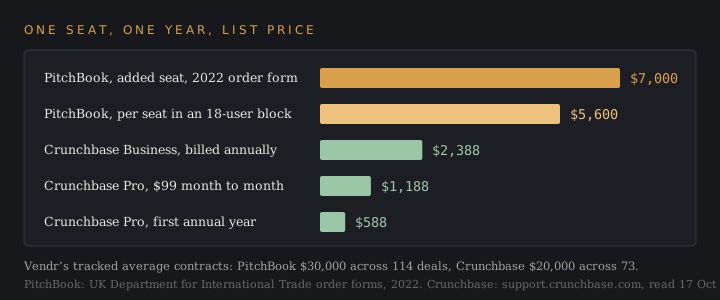
The per-account figure comes from Morningstar's 10-K for 2025: 113,451 licensed users across about 10,200 client accounts, against $671.8 million of PitchBook revenue. For enterprise budgets that's a real line item. For a two-person fund, a single seat costs an arm and a leg, and Crunchbase's pro or enterprise plans start far lower. The Crunchbase pricing breakdown covers Custom Data Access, the quote-only API tier.
↑ COMPARISONCrunchbase vs PitchBook: each vendor's claims about the other
Crunchbase and PitchBook both publish a page naming the other, and each one argues the private market is its home ground. PitchBook's was updated 19 August 2026. Crunchbase's carries no date beyond a 2026 copyright line. Read both as marketing, since neither page explains how it counted the rival's records.
| Topic | PitchBook says | Crunchbase says |
|---|---|---|
| Company count | 12M+ companies against Crunchbase's ~4.7M private companies | 264,112 early-stage companies, 16% more than PitchBook's 227,071 |
| Data sourcing | Crunchbase is user-submitted and AI-assisted; outdated entries "a known issue" | 30M+ verified updates a year; PitchBook mixes confirmed and unconfirmed data |
| Deal coverage | 3.1M+ deals across M&A, PE, VC, debt and IPO; Crunchbase is primarily VC rounds | 453K post-money valuations against PitchBook's 423K |
| Predictions | Not addressed | Seven models; PitchBook has two, valuation and exit |
| Acquisition forecasts | Not addressed | 90% precision across 2.3M organizations; PitchBook 64% across 12K |
| Fund benchmarks | 164k funds with benchmarks; Crunchbase has none | Not addressed |
| Integrations | Native Excel and PowerPoint; Crunchbase has limited export options | Native Snowflake, Databricks, Salesforce, HubSpot, BigQuery; PitchBook's Data Feed shifts integration work to the customer |
Talk is cheap on both pages, and each one picks the ground it wins on. Crunchbase's page skips funds and limited partners. PitchBook's page skips predictions.
Crunchbase's fund data is limited compared to PitchBook's 175K+ funds, and PitchBook's forecasting is limited compared to Crunchbase's seven models. The counts also drift inside PitchBook's own domain. Its comparison page claims 12M+ companies and 164k funds, while its data page reads 13.4M+ companies and 175K+ funds the same week.
↑ COMPARISONData coverage and data depth, by each vendor's own counts
Crunchbase and PitchBook count different things, so a headline private company total says little on its own. An impressive database figure matters only where it covers the records a deal or a pipeline needs.
| Dataset | PitchBook | Crunchbase |
|---|---|---|
| Companies | 13.4M+, private and public | 4M+ private companies |
| Deals | 3.2M+ | Funding rounds, no total published |
| Investors | 667K+ | Investor profiles, no total published |
| Funds | 175K+ | None |
| Limited partners | 67K+ | None |
| Professionals | 5.1M+ | Contact data on Business only |
| Debt financings | 572K+ | None |
| Products mapped | None published | 19.8M across 5,200+ micro-industries |
PitchBook's figures come from its data page. Crunchbase's 4 million-plus company count is from its pricing page, checked August 2026, and the products figure from its rival page. PitchBook's coverage of public companies comes through Morningstar data, which lets an analyst run one comp set across private and public companies.
Crunchbase stays private-company first, with financial data limited to funding totals, revenue signals and round details. Across the private capital markets, that split decides which private market data a team gets for its money.
PitchBook pulls ahead on data depth in private equity work. Its deal data, valuation data, debt financings and fund performance records serve deal analysis that Crunchbase's company growth metrics don't attempt. PitchBook also publishes 100+ proprietary reports a year on industry trends, and its emerging-technology research splits 10 industries into 80+ niche segments for analysts tracking technology adoption.
Crunchbase's depth runs the other way. Heat Scores and Growth Scores turn usage signals into growth signals, and Pro adds funding, acquisition and IPO predictions, per the plan comparison Crunchbase updated on 5 October 2026. Crunchbase claims its model correctly forecasts 84% of real funding rounds. That's a forecast for prospecting, built on the funding history of emerging companies.
↑ COMPARISONData quality and data accuracy: how each one collects records
PitchBook sells its research operation. Its data page says a Data Operations Team of 1,800+ professionals collects records from survey requests, regulatory filings and FOIA responses, analyzes over one million news events a week, and updates the data multiple times a day. Its differentiators page says research teams in Seattle and London "communicate directly with the people involved in deals to validate information."
Crunchbase pulls from multiple sources and leans on volume and automation. It cites 30 million-plus verified updates a year, 4,000-plus direct venture partnerships and engagement signals from 80 million-plus users. It also accepts profile edits from its user community, the community-contribution model PitchBook's page calls user-submitted.
Data quality complaints reach both in practice. On G2, PitchBook draws 36 mentions of outdated information and 20 of inaccurate data, read 6 October 2026. Kathleen B. wrote on G2 on 16 March 2026 that a private equity firm's ownership of a company "may be listed even though it was sold a couple of years ago." Crunchbase's G2 page logs 17 mentions of missing information and 15 of outdated information against 28 praising accuracy.
For due diligence, the devil's in the details. Ownership structures change after an exit, and both databases lag. Check a cap-table claim or a fund's holding against regulatory filings before it goes into an IC memo, the same due diligence step a private equity deal team runs on any private company record.
↑ COMPARISONEase of use: advanced search, a user friendly interface and a steeper learning curve
Crunchbase is designed for accessibility. Its advanced search filters companies by industry, geography and funding stage, and the AI Search Builder writes the query from a plain-English prompt, so a list of Series A fintech companies in Germany takes just a few clicks. A free account's basic search stops at 5 results, and Pro raises that to 1,000 results per search and adds 2,000 export rows a month.
PitchBook has a steeper learning curve, and the vendor's own onboarding proves it. Its Core Foundations certification for new users runs 4.5 hours across eight courses. Advanced search in PitchBook screens 3.2M+ deals and 175K+ funds at once, and its filters assume the financial expertise of the institutional financial professionals it's sold to. G2 still logs 44 ease-of-use mentions for PitchBook.
A sales rep can hit the ground running on Crunchbase in an afternoon. A first-year analyst on PitchBook needs training to use the advanced analytics.
↑ COMPARISONIntegrations: CRM systems, data feed and MCP
Crunchbase and PitchBook both aim to cut manual research by pushing records into the tools a team already uses. They gate it differently.
Crunchbase Business adds Salesforce, HubSpot and Zapier integrations, PDF export and SSO, per Crunchbase's plan comparison article, updated 5 October 2026. CRM enrichment, Crunchbase's data enrichment add-on, is available on Business for 10+ seats.
Its Outreach integration pushes contacts into existing Outreach sequences for cold campaigns, which suits lead generation teams running outreach tools. MCP access comes at a base level on Pro and a higher level on Business, and the API tier promises actionable insights at 200 calls a minute.
PitchBook includes its Excel, PowerPoint and Chrome integrations free with every license. Its CRM integration is a premium add-on that connects to Salesforce, Microsoft Dynamics, HubSpot, DealCloud and Affinity. Direct Data delivers the PitchBook API, billed per data request, and a scheduled data feed in .dat, .csv or Parquet files covering companies, deals, investors and funds.
On AI access, PitchBook's AI page lists a PitchBook Data MCP and 13 premium connector partners, Anthropic, OpenAI, Google Gemini and Perplexity among them. Data access through those connectors still sits behind a PitchBook license. The MCP tools list compares both vendors' MCP servers with other data providers.
↑ COMPARISONContracts, renewals and what it costs to leave
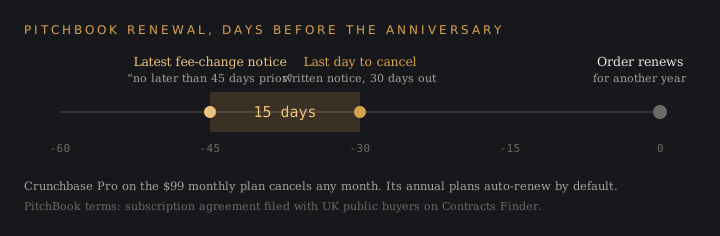
PitchBook's renewal terms carry a red flag. The subscription agreement filed with UK buyers renews each order for successive one-year terms unless either side gives written notice at least 30 days before expiry, and PitchBook can change fees with notice "no later than 45 days prior" to the anniversary. That leaves 15 days between a price notice and the cancellation deadline.
PitchBook licenses are named-user, and the order forms state that "User IDs are not permitted to be shared." The 2022 forms cap each user at 1,000 rows a day and 2,000 a month of company, deal or fund data, plus 500 daily rows of people data. A Crunchbase Pro seat carries the same 2,000-row monthly ceiling, and Business raises it to 5,000.
Crunchbase's monthly Pro plan cancels anytime. The annual plans auto-renew by default, and the 1.5 out of 5 Trustpilot score across 48 reviews is dominated by renewal and refund complaints. Morningstar reported a 103% revenue renewal rate for PitchBook in 2025, down from 108% in 2024, and tied the drop to churn among corporate clients.
Leaving costs less on Crunchbase. A Pro export of 2,000 rows a month covers a small pipeline. A PitchBook team rebuilding its deal history elsewhere hits contract language that bars compiling downloads into a dataset "that has significant independent commercial value."
↑ COMPARISONOwnership: Morningstar's PitchBook and venture-backed Crunchbase
PitchBook belongs to Morningstar, a listed company that files its segment revenue with the SEC. Crunchbase is venture-backed and privately held, so its revenue and renewal rate stay private.
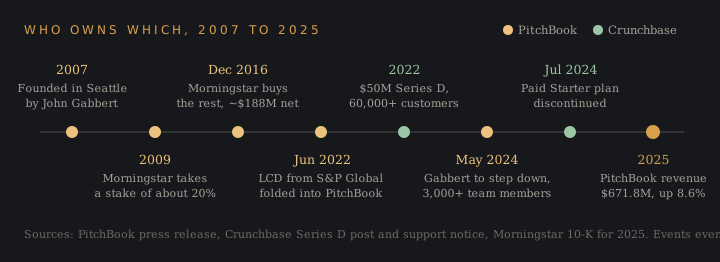
- 2007: John Gabbert founds PitchBook in Seattle, per PitchBook's press release announcing his departure plans.
- 2009: Morningstar takes a stake of about 20%.
- December 2016: Morningstar buys the rest of PitchBook at a net cost of about $188 million.
- 1 June 2022: Morningstar completes its purchase of Leveraged Commentary & Data from S&P Global and folds it into PitchBook.
- 2022: Crunchbase raises a $50 million Series D led by Alignment Growth, with Mayfield Fund, OMERS Ventures and Emergence, per its own announcement, and cites 75 million unique users a year and 60,000+ customers.
- May 2024: Gabbert announces he will step down as PitchBook CEO, with the company at more than 3,000 team members.
- 12 July 2024: Crunchbase stops selling its Starter plan as a paid subscription.
- 2025: Morningstar acquires Lumonic, a portfolio monitoring tool, and PitchBook segment revenue reaches $671.8 million, up 8.6%.
PitchBook's comparison page says Crunchbase began as a TechCrunch project tracking startup funding announcements. Jager McConnell is listed as Crunchbase CEO on the Series D post.
↑ COMPARISONCrunchbase and PitchBook: which one fits which team
The choice comes down to which data the job needs, and a team that buys the wrong one is barking up the wrong tree for a year.
- Private equity firms and buyout funds: PitchBook. Fund performance, debt financings and exit data feed the screen and the model.
- Venture capital firms: PitchBook for fund and LP work, with Crunchbase as a cheap second seat for venture capital deal flow on early stage companies.
- Investment bankers and investment teams building comps: PitchBook, for valuation data across private and public companies.
- Corporate development teams: PitchBook for acquisition screening. Morningstar's own filing names the corporate segment as the one that churned most in 2025.
- Sales teams and sales and marketing teams: Crunchbase. Funding triggers, CRM pushes and a $199 Business floor fit a pipeline.
- Founders raising a round: Crunchbase Pro for an investor list, plus a dilution calculator to model the round.
- Limited partners and the wider investment community: PitchBook, the only one of the two tracking LP commitments.
For small teams the math is blunt. Crunchbase covers all the data a three-person sales pod needs for $588 a seat in year one. PitchBook is a valuable resource for a fund that runs deals every week, and a drop in the bucket next to a deal team's diligence budget, which the virtual data room pricing report sizes.
The third option people pick
Buyers comparing crunchbase vs pitchbook often settle on a third private capital markets database. Vendr's tracked medians, read 6 October 2026, put Preqin at $49,334 a year (BlackRock has owned it since 3 March 2025), CB Insights at $46,984 and SourceScrub at $14,569. Preqin competes with PitchBook on fund and LP data, CB Insights on emerging-tech research and SourceScrub on deal sourcing.
Crunchbase's competitors sit on the contact side. ZoomInfo, Apollo and Cognism sell the verified emails and direct dials Crunchbase Pro leaves out, and the ZoomInfo alternatives hub routes between them. For public-market depth, the FactSet vs Bloomberg comparison prices the terminals. The investment research platforms ranking and the company data providers ranking score the wider field.
↑ COMPARISONCrunchbase vs PitchBook: frequently asked questions
Is PitchBook worth it?
For investment professionals at a buyout or venture firm running several deals a year, yes: $7,000 a user buys 13.4 million company records maintained by a 1,800-person team. For a solo founder or a small sales team, G2 reviewers flag the price as the main complaint, with 20 mentions tagged expensive.
Who owns PitchBook, and who is its parent company?
Morningstar is PitchBook's parent company. It took a stake in 2009 and bought the remaining shares in December 2016 at a net cost of about $188 million. PitchBook reports as its own segment in Morningstar's SEC filings.
Who are PitchBook's main competitors?
Preqin, CB Insights, S&P Capital IQ, FactSet and Crunchbase. Preqin is the closest on fund and LP data. Crunchbase is the cheapest, at $49 to $99 a month for Pro.
Who are Crunchbase's main competitors?
PitchBook and CB Insights on private company research, and ZoomInfo, Apollo and Cognism on prospecting contact data. Crunchbase holds 4.4 out of 5 on G2 from 413 reviews against PitchBook's 4.5 from 261, read 6 October 2026.
What is Crunchbase used for?
Prospecting funded companies, building investor lists, pulling company data on target accounts, tracking competitors and monitoring funding rounds. Users filter company profiles by industry, location and funding stage, then export rows or push them to a CRM.
PitchBook or Crunchbase for a startup founder?
Crunchbase. A founder needs a list of likely investors and their recent funding rounds, and Pro sells that for $49 a month. Many business schools also license PitchBook for students, and MIT Sloan provides it through its Career Development Office.
Does either one have a free plan?
Crunchbase has a free account capped at 5 search results with no exports. PitchBook offers free company profile pages on its site and a trial on request through its pricing form.
Verdict: which one to buy
Buy PitchBook if the output is an investment decision. Fund performance benchmarks, LP commitments, debt financings and an 1,800-person research team justify $7,000 a seat for a deal team, provided someone keeps an eye on the 45-day fee notice.
Buy Crunchbase if the output is a list. At $49 to $199 a month with published plans, it fits sales teams, founders and small teams who need funding signals, company data and a CRM push without a procurement cycle.
A team that needs both Crunchbase and PitchBook can run Crunchbase for pipeline and buy one named PitchBook seat for the person doing private market research, then add seats once the work proves the case. On the crunchbase vs pitchbook question, an IC memo points to PitchBook and a prospect list points to Crunchbase.