Unicorn companies: 1,928 on Crunchbase, 1,680 on PitchBook and 1,603 on Hurun
 By Jan Suski. I go deep on every review, checking every number against its source and digging up details other coverage misses, a habit from six years of SEO and link building for tech companies. Bylines at Brand24 and Senuto. How the scoring works.
The numbers Global unicorn trackers, checked 17 November 2026
The 670-company gap between Crunchbase and CB Insights comes from definitions and refresh dates, so any unicorn count needs its source and date beside it.
Ten companies hold 41.3% of all unicorn value on PitchBook's Q1 2026 count, which makes the herd a list of a few giants and a long tail near $1 billion.
2026 passed 2025's full-year count of new unicorns by mid-August, with AI accounting for 622 of PitchBook's 1,680.
I'll write a 2,500+ word report on the market you name, with counts and valuations linked to the tracker behind each one. Yours to publish, from $200.
The world has somewhere between 1,258 and 1,928 unicorn companies, depending on whose list you read. The Crunchbase Unicorn Board counted 1,928 private companies valued at $1 billion or more on 16 November 2026, worth a combined $9.9 trillion. Hurun's index counts 1,603, PitchBook 1,680, and the public CB Insights tracker 1,258.
This report sets the four unicorn trackers side by side, explains why they disagree, and lists the largest unicorns, the countries and cities that produce them, the investors behind them and the rate at which new ones appear. Every figure carries its publisher and date, because the same startup can sit at $380 billion on one list and $965 billion on another.
It's for founders, investors, venture capital analysts and entrepreneurs who need a number they can defend. How many unicorn companies exist depends on the definition, so each count below comes with its rules. The term itself is 13 years old: Aileen Lee coined it on TechCrunch on 2 November 2013, when her count of U.S. software unicorns came to 39.
What is a unicorn company
A unicorn is a privately held, venture-backed startup valued at $1 billion or more. CB Insights puts it in one sentence: "A unicorn company, or unicorn startup, is a private company with a valuation over $1 billion."
The valuation is the post-money figure from the company's latest priced round. It says nothing about profit, revenue or cash on hand, so a company can reach unicorn status while losing money, and many do. A company leaves the list when it goes public, gets acquired or raises at a valuation below $1 billion.
- A unicorn is a private company valued at $1 billion or more.
- A decacorn is valued at more than $10 billion.
- A hectocorn is valued at more than $100 billion, a group of eight names on Crunchbase's board in November 2026.
Aileen Lee picked the word because the companies were rare. Her 2013 study found that about 0.07% of venture-backed consumer and enterprise software startups reached a $1 billion valuation, roughly one in 1,538, and that four were born a year in the preceding decade. Facebook, worth more than $100 billion, made up nearly half of the 39-company club's combined value of about $260 billion.
How many unicorn companies are there in 2026
Four trackers publish a count, and the four figures differ by up to 670 companies. The table gives each one's latest figure, date and definition.
| Tracker | Unicorns | Combined value | Date | Who counts |
|---|---|---|---|---|
| Crunchbase Unicorn Board | 1,928 | $9.9 trillion | 16 Nov 2026 | Private companies with a post-money valuation of $1 billion or more |
| PitchBook Global Unicorn Tracker | 1,680 | $8.6 trillion | End of Q1 2026 | Venture-backed companies that raised at $1 billion or more post-money |
| Hurun Global Unicorn Index | 1,603 | $8 trillion | 1 Jan 2026 cut-off, published 25 Jun 2026 | Unlisted companies founded after 2000 and worth $1 billion or more |
| CB Insights unicorn tracker | 1,258 | About $4.4 trillion | Page as served on 17 Nov 2026 | Private companies valued over $1 billion |
Copy these lines into an email, fill them in and send. I reply with scope and a price within 2 to 3 business days.
Open the email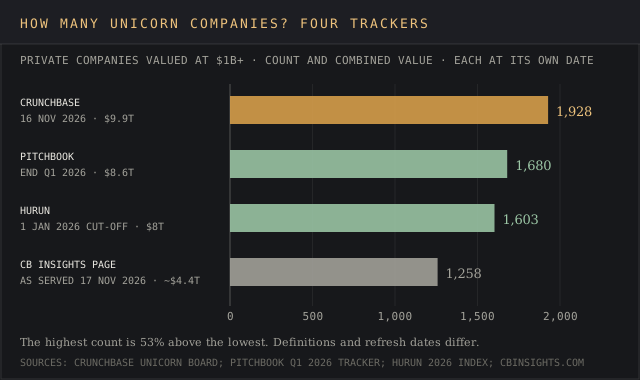
PitchBook's unicorn tracker article gave 1,590 active unicorns on 2 February 2026, a month before its own Q1 report reached 1,680. That's 90 companies added or revalued in about eight weeks, and it shows how fast any single figure goes stale.
The count has grown 49-fold since the first study, though the definition has widened from U.S. software startups to private companies anywhere in the world.
| Date | Unicorns | Source and scope |
|---|---|---|
| November 2013 | 39 | Aileen Lee, U.S. software startups founded since 2003 |
| 2023 data, published January 2024 | 532 | Cowboy Ventures, U.S. only |
| 1 January 2025 cut-off | 1,523 | Hurun Global Unicorn Index 2025, 52 countries |
| 1 January 2026 cut-off | 1,603 | Hurun Global Unicorn Index 2026 |
| 2 February 2026 | 1,590 | PitchBook, active unicorns |
| End of Q1 2026 | 1,680 | PitchBook Global Unicorn Tracker |
| Mid-2026 | 1,839 | Crunchbase private unicorn list |
| 16 November 2026 | 1,928 | Crunchbase Unicorn Board |
Why the unicorn counts diverge
Hurun, PitchBook and Crunchbase define a qualifying company differently, freeze their counts on different dates and refresh valuations at different speeds. Each tracker's figure is correct for its own rules, and none of them is the full list of every privately held company worth $1 billion.
Hurun admits only companies founded after 2000 and values them at a 1 January cut-off, with large revaluations added up to release. That leaves out older private giants and anything priced after New Year. PitchBook drops a company as soon as it lists, is acquired or falls below $1 billion. Crunchbase builds its board by collecting disclosed funding rounds and uses each company's most recently disclosed round, so the board moves every time a new round is announced.
CB Insights' public table is the outlier. The version served on 17 November 2026 still listed SpaceX at $350 billion and OpenAI at $300 billion, valuations from rounds that predate 2026, and SpaceX listed on Nasdaq on 12 June 2026, per the record of its IPO. Its total of about $4.4 trillion is less than half of Crunchbase's $9.9 trillion for the same reason.
SpaceX shows how one company can sit in three states at once. PitchBook's Q1 report valued it at $1.25 trillion after it bought xAI in February 2026, a deal worth 72.8% of the $343.1 billion in unicorn exits that quarter. Crunchbase's November board no longer lists it. CB Insights still does. If a number matters to a decision, read between the lines of the date stamp before you quote it, and run the checks in our source credibility guide.
How a company valuation makes a unicorn
A startup reaches unicorn status the day a priced round values it at $1 billion post-money. Post-money means the company valuation after the new cash goes in, so a startup valued at $900 million before raising $100 million is a unicorn once the round closes. Our dilution calculator works out what a priced round does to existing shareholders’ ownership.
The lead investors in that round set the price, and the figure stays on the trackers until the next round, a listing or an acquisition. Companies on Crunchbase's board have raised $1.64 trillion between them, against a combined current valuation of $9.9 trillion, about six times the capital put in. The 195 companies that joined in the first half of 2026 raised $80 billion and added roughly $440 billion in value, per Crunchbase News, the company's news platform.
Profit doesn't enter the test. Unicorns depend on venture capital funding to grow before the revenue arrives, and PitchBook's definition counts only venture-backed companies. A unicorn can burn cash for years and keep its status as long as no round prices it below $1 billion.
Biggest unicorns in the world
The ten largest unicorn companies on Crunchbase's board on 16 November 2026 are worth $3.34 trillion between them, 34% of the board's $9.9 trillion. AI companies hold the top two places, and four of the ten are AI labs or AI data platforms. These are the biggest unicorns in the world by current valuation.
| Rank | Company | Current valuation | Country |
|---|---|---|---|
| 1 | OpenAI | $1 trillion | United States |
| 2 | Anthropic | $965 billion | United States |
| 3 | ByteDance | $480 billion | China |
| 4 | Databricks | $190 billion | United States |
| 5 | Stripe | $159 billion | United States |
| 6 | Ant Group | $150 billion | China |
| 7 | Waymo | $126 billion | United States |
| 8 | Revolut | $115 billion | United Kingdom |
| 9 | DeepSeek | $91 billion | China |
| 10 | Ramp | $62 billion | United States |
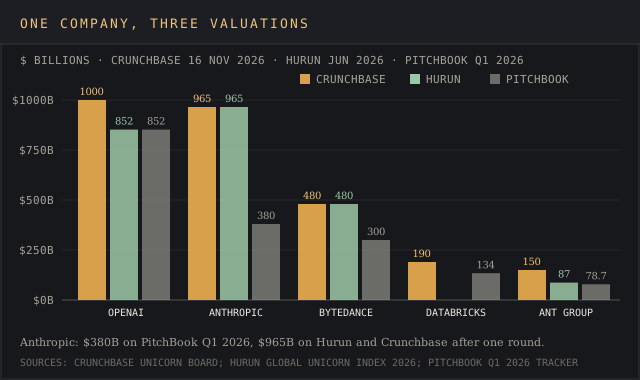
The largest unicorns are also where the trackers disagree most. Anthropic sat at $380 billion in PitchBook's Q1 2026 report and at $965 billion on both Hurun's index and Crunchbase's board, a gap that came from one funding round. OpenAI is $852 billion on Hurun and PitchBook and $1 trillion on Crunchbase.
Want a valuation chart like this for the companies your buyers follow? Send the names.
Email a brief| Company | Crunchbase (16 Nov 2026) | Hurun (Jun 2026) | PitchBook (Q1 2026) | CB Insights page (17 Nov 2026) |
|---|---|---|---|---|
| OpenAI | $1 trillion | $852 billion | $852 billion | $300 billion |
| Anthropic | $965 billion | $965 billion | $380 billion | $61.5 billion |
| ByteDance | $480 billion | $480 billion | $300 billion | $300 billion |
| Databricks | $190 billion | Not in top 10 | $134 billion | $62 billion |
| Ant Group | $150 billion | $87 billion | $78.7 billion | Not listed in top 15 |
| SpaceX | Listed on Nasdaq, off the board | Not in top 3 | $1.25 trillion | $350 billion |
Hurun's chairman, Rupert Hoogewerf, called Anthropic's climb from eighth to first "the most dramatic valuation rise we have ever recorded across eight years of this index," per DealStreetAsia's report on the release. On the same index, ByteDance ranked third at $480 billion, Ant Group came in at $87 billion and Shein at $50 billion.
The 30 largest unicorns on Crunchbase's full list
Ranks 11 to 30 on the same board run from $61 billion down to $25 billion. The mix shows where venture capital went in 2025 and 2026, with defence technology, AI data centres, AI coding tools, prediction markets and payments all in the top 30.
| Rank | Company | Valuation | Country |
|---|---|---|---|
| 11 | Anduril Industries | $61 billion | United States |
| 12 | Moonshot AI | $50 billion | China |
| 13 | Cognition | $48 billion | United States |
| 14 | Prometheus | $41 billion | Not shown |
| 15 | Checkout.com | $40 billion | United Kingdom |
| 16 | Ripple | $40 billion | United States |
| 17 | Kalshi | $40 billion | United States |
| 18 | Figure | $39 billion | United States |
| 19 | Axiom Solutions International | $38 billion | United States |
| 20 | DayOne | $35 billion | Singapore |
| 21 | Safe Superintelligence | $32 billion | United States |
| 22 | Fanatics | $31 billion | United States |
| 23 | Crusoe | $31 billion | United States |
| 24 | VAST Data | $30 billion | United States |
| 25 | Alibaba Bendi Shenghuo Fuwu Gongsi | $30 billion | China |
| 26 | Scale | $29 billion | United States |
| 27 | Shield AI | $29 billion | United States |
| 28 | Cohere | $26 billion | Canada |
| 29 | Reflection AI | $25 billion | United States |
| 30 | Devoted Health | $25 billion | United States |
- The country, sector or investor set to cover
- Regions, years and segments
- Where it runs: blog, white-label, gated or lead magnet
- Whose byline goes on it
- Deadline
- 2,500+ words, human-written
- Every figure linked to its source
- Yours to publish, under your name or none
- Hosting here for +$200, with your sponsored links
Fourteen of those 20 companies are American. Devoted Health is the one healthcare business in the top 30, and Figure and Shield AI bring robotics and defence hardware into a list software has dominated since 2013.
Unicorns by country and city
The United States holds about half of the world's unicorn companies on every tracker. PitchBook counted 853 American unicorns on 5 January 2026, 53.6% of its global total, and Hurun counted 806.
| Country | Hurun 2026 | PitchBook (5 Jan 2026) |
|---|---|---|
| United States | 806 | 853 |
| China | 381 | 330 |
| United Kingdom | 70 | 53 |
| India | 61 | 56 |
| Germany | 38 | 28 |
China's count shows the widest split between trackers, 381 on Hurun against 330 on PitchBook, a 51-company gap. Hurun says China added 38 unicorns in a year, per the South China Morning Post's report, and its Chinese-language release puts the pace at one new Chinese unicorn every five days.
Germany's count is 38 on Hurun's index, per Munich Startup's report on the Hurun Germany Unicorn Index 2026, against 28 on PitchBook. The UK count runs from 53 on PitchBook to 70 on Hurun.
Further down the table, Hurun's 2025 index counted 30 unicorns in France, 28 in Canada, 20 in Israel and 18 each in South Korea and Singapore. Israel's unicorns cluster in Tel Aviv and lean toward cybersecurity. South Korea's sit mostly in Seoul.
Cities concentrate the herd further. San Francisco had 222 unicorns on Hurun's 2026 index, New York 141 and Beijing 86. San Francisco alone holds more unicorns than any country except the United States and China.
Unicorns in the UK and Europe
The United Kingdom has Europe's largest group of unicorn startups, with 70 unicorns on Hurun's 2026 index. Its two biggest are financial technology businesses. Revolut is valued at $115 billion on Crunchbase's board, with Index Ventures, DST Global and Ribbit Capital among its investors per CB Insights, and Checkout.com at $40 billion.
Germany counts 38 unicorns worth a combined €118.9 billion on Hurun's Germany Unicorn Index 2026. Helsing, a defence AI company in Munich, tops it at €16.6 billion five years after its founding. France had 30 unicorns on Hurun's 2025 index.
Put together, the UK, Germany and France hold 138 unicorns on Hurun's latest figures, about a sixth of the U.S. count. Europe's largest unicorn startups are worth tens of billions of dollars, while the top three American ones are worth hundreds of billions each.
China's unicorn companies
China has the second-largest group of unicorn companies on every tracker, and its biggest unicorns are consumer internet, finance and AI businesses. Hurun counted 381 Chinese unicorns at its 1 January 2026 cut-off, up 38 in a year, and Beijing's 86 make it the third unicorn city in the world.
- ByteDance, owner of TikTok and its Chinese sister app Douyin, is valued at $480 billion on Crunchbase and Hurun. Yicai put its Hurun valuation at CNY3.3 trillion, up 60% in a year. CB Insights lists Sequoia Capital China and SoftBank Group among its investors.
- Ant Group, the finance group behind Alipay, ranges from $78.7 billion on PitchBook to $87 billion on Hurun and $150 billion on Crunchbase.
- DeepSeek, the AI lab, is valued at $91 billion on Crunchbase and entered Hurun's global top 15 in 2026.
- Moonshot AI sits at $50 billion on Crunchbase's board.
- Alibaba Bendi Shenghuo Fuwu Gongsi, whose name translates as Alibaba local life services company, is valued at $30 billion.
Two of the biggest unicorns in the world are Chinese, and a third, the e-commerce company Shein, appears in Hurun's top ten at $50 billion. CB Insights lists Shein's country as Singapore, which is one more reason the China counts differ from tracker to tracker.
India's unicorn companies
India fell from third to fourth on Hurun's 2026 index, with 61 unicorns against 64 a year earlier. The United Kingdom passed it with 70. PitchBook's January 2026 count gave India 56 and the UK 53, so the order between the two depends on the tracker.
Bengaluru is India's unicorn capital with 25, followed by Mumbai with 13, per Hurun. The same index counts 156 unicorns co-founded by Indians outside India, more than twice the number headquartered in the country.
New York unicorn startups and their founders
New York is the second unicorn city in the world on Hurun's count, and its largest unicorn startups are fintech and data businesses built by founders with finance and infrastructure backgrounds. Failory's New York list names 135 unicorn startups in the city.
- Ramp, the corporate card and spend platform and New York's most valuable unicorn startup, was founded by Eric Glyman, Gene Lee and Karim Atiyeh. It sits at $62 billion on Crunchbase's board, with Khosla Ventures, Sequoia Capital, Lightspeed Venture Partners and General Catalyst among its investors.
- VAST Data, a data-storage company co-founded by Renen Hallak, Jeff Denworth and others, is at $30 billion. Its backers include NVIDIA, New Enterprise Associates, Goldman Sachs and BOND.
- iCapital Network, an alternative-investments platform for wealth managers, lists Goldman Sachs, Bank of America, BlackRock and Temasek Holdings among its investors.
- Chainalysis, a blockchain-analysis company, counts Accel and Benchmark among its investors.
- Bilt Rewards and Polymarket both list General Catalyst among their investors, and Polymarket also counts Founders Fund.
Those names share a pattern, a finance or data product sold to businesses with a bank or two on the cap table beside the venture firms. Goldman Sachs appears on two of the city's ten largest cap tables.
How many companies reach unicorn status each year
2026 is the busiest year for new unicorn companies since 2021. Crunchbase counted 195 new unicorns in the first half, more than it recorded in all of 2025, and 250 by 15 August. Its board lists 102 new unicorns for 2023 and 117 for 2024.
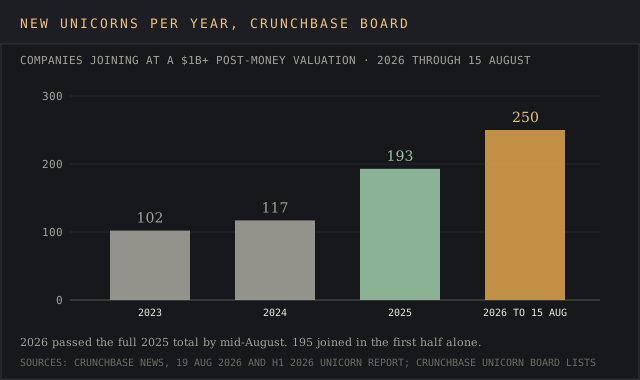
PitchBook's numbers run close: 197 new unicorns in 2025 and 95 in the first quarter of 2026 alone. In the first half of 2026, North America produced 115 of Crunchbase's 195 new unicorns, Asia 50 and Europe 27, per Crunchbase News.
Most startups never get there. Aileen Lee's 2013 study put the odds at about 0.07% for venture-backed software startups, and Cowboy Ventures' 2024 follow-up puts the share of venture-backed startups that become unicorns at less than 1%. Unicorns stay a long shot even in a record year.
The new cohort is also younger. Crunchbase counted 47 seed- and early-stage companies joining the unicorn ranks in the first quarter of 2026 alone, which it said put the year on track for the largest cohort of young unicorns to date. In October 2025, 20 companies joined the board and added $44.5 billion in value, the highest value added by a monthly cohort in three years at that point, per Crunchbase News.
Unicorn startups by sector: AI, fintech and e-commerce
CB Insights files each unicorn under one industry label, which gives a quick read on where the most valuable startups sit. Its top 15, as served on 17 November 2026, breaks down like this.
| CB Insights industry | Companies in its top 15 | For example |
|---|---|---|
| Enterprise Tech | 7 | OpenAI, Databricks, Anthropic, xAI, Canva, Safe Superintelligence, Miro |
| Financial Services | 3 | Stripe, Revolut, Chime |
| Consumer & Retail | 2 | Shein, Fanatics |
| Media & Entertainment | 2 | ByteDance, Epic Games |
| Industrials | 1 | SpaceX |
Enterprise Tech, the label CB Insights uses for software and AI sold to businesses, holds almost half of the top 15. Financial services businesses take three places, and two consumer brands sell through e-commerce and retail.
AI moved from a tenth of unicorn value to almost half in a decade. PitchBook puts AI at 47.6% of aggregate unicorn value in Q1 2026, $4.1 trillion of $8.6 trillion, against 9.7% in 2016. By count, AI companies are 622 of its 1,680 unicorns, 37%. OpenAI, Anthropic and ByteDance alone hold 42% of the AI value. Our AI statistics report covers adoption and spending outside the private markets.
PitchBook puts AI companies at 47.6% of aggregate unicorn value in Q1 2026, against 9.7% in 2016.
AI's share of aggregate unicorn value, Q1 2026
Source: PitchBooke.g. unicorn value by sector in your region
Source: linked, checked, datedHurun's index counts 215 AI unicorns, 87 more than a year earlier, and puts AI at 36% of total unicorn value. Its release adds that AI unicorns are valued at three times the level of fintech unicorns.
Fintech and payments are the second-largest group by value at the top of the list. Stripe at $159 billion, Ant Group at $150 billion, Revolut at $115 billion, Ramp at $62 billion and Checkout.com at $40 billion are all payments or banking businesses. E-commerce has one name in the global top ten on Hurun, Shein at $50 billion.
Healthcare, biotechnology, gaming and robotics hold smaller shares of value. CB Insights' table lists Epic Games, the video-gaming company, at $22.5 billion from an earlier round, and Crunchbase's top 30 includes Figure, a humanoid robotics startup, at $39 billion.
Venture capital firms behind the most unicorns
Sequoia Capital made more investments in 2026's new unicorns than any other investor, per Crunchbase News' 19 August 2026 analysis by Gené Teare. The top ten by number of investments in the 2026 cohort were:
- Sequoia Capital
- Khosla Ventures
- Y Combinator
- Lightspeed Venture Partners
- Founders Fund
- Andreessen Horowitz
- Bessemer Venture Partners
- Lux Capital
- General Catalyst
- BoxGroup
At Series A, Khosla Ventures, Spark Capital and Sequoia Capital each invested in six of the 2026 unicorns. At seed, Soma Capital led with five, and South Park Commons, Lux Capital and Founders Fund had four each.
Older cap tables tell the same story with different names. CB Insights' table lists Founders Fund as an early investor in SpaceX, New Enterprise Associates in Databricks, Index Ventures in Revolut and Temasek Holdings in Fanatics.
It names Khosla Ventures, Thrive Capital and Sequoia Capital as OpenAI investors, and Sequoia Capital again on the cap tables of xAI and Safe Superintelligence. Index Ventures also backs Fireblocks, and B Capital is an investor in Reflection AI, per Failory's New York list.
Cowboy Ventures, the seed firm Aileen Lee co-founded in 2012, gave the category its name and still tracks it. Aileen Lee's own firm invests at seed, years before most of its companies could reach unicorn status. Its 2024 update counted 532 U.S. unicorns, 14 times the 39 of 2013.
Unicorn companies then and now, 2013 against 2023
Cowboy Ventures ran its count a second time a decade later, which makes the clearest before-and-after in the field. Both studies cover U.S. companies.
| Measure | 2013 study | 2024 update (2023 data) |
|---|---|---|
| U.S. unicorns | 39 | 532 |
| Consumer share | 22 of 39 (56%) | 20% |
| Enterprise share | 17 of 39 (44%) | 78% (416 companies) |
| With a female co-founder | 5% | 14% |
| With a female founding CEO | 0% | 5% |
| Average age | 7 years | 7 years |
| Capital efficiency, enterprise | 26x | 7x |
| Capital efficiency, consumer | 11x | 7x |
The 2024 update labels 60% of the herd "ZIRPicorns," companies last valued between January 2020 and March 2022, when interest rates sat near zero. Those valuations haven't been tested by a new round, so the count includes companies whose current valuation is a dated price. The update also named OpenAI as likely "the 1st superunicorn of the decade."
The 2013 study's consumer tilt has reversed. Consumer internet companies such as Facebook made up the majority of the first club, while 78% of the 2023 list sells software or services to businesses.
Unicorn success rates and superunicorns
Reaching $1 billion is the first test, and the second is getting out at a price at or above it. Of Aileen Lee's original 39 unicorns, 24 had gone public or been acquired by November 2013, and those took seven years on average to get there. Cowboy Ventures' 2024 update puts the average time from founding to IPO or acquisition at six years.
A few unicorns become superunicorns, worth $100 billion or more. Lee's 2013 article said one to three were born in each recent decade, from Intel in the 1960s to Apple, Oracle and Microsoft in the 1970s, Cisco in the 1980s, and Google and Amazon in the 1990s. Facebook was the superunicorn of the 2000s. The 2026 trackers already list eight private companies above $100 billion, and Cowboy Ventures named OpenAI as the likely superunicorn of this decade.
How unicorns exit the list
Unicorn companies exit by listing or by being acquired. PitchBook recorded 27 unicorn exits worth $343.1 billion in Q1 2026, and the median company took 7.4 years from founding to exit, down from a record 9.2 years in 2025. Crunchbase keeps a separate list of exited unicorns, which held 643 companies at mid-year.
The largest IPO on record came in June 2026, when SpaceX listed on Nasdaq at a valuation of about $1.77 trillion. PitchBook's Q1 report named SpaceX, OpenAI and Anthropic as three companies worth over $3 trillion combined that were all targeting listings in 2026. If the other two follow, the two largest unicorns on every tracker would leave the herd within a year.
For the companies that stay private, investors set the price in each funding round. The median time between unicorn venture rounds was 1.0 year in Q1 2026, per PitchBook, so most valuations on these lists are less than a year old and a dated one is a red flag.
For the data behind these counts, our Crunchbase review covers the funding database that runs the Unicorn Board, the PitchBook pricing report covers what a seat on PitchBook costs, and the company data providers ranking compares the wider field.
How to check a unicorn's current valuation
No tracker is complete, so an analyst checking one company should look in three places and compare the dates, a basic form of data triangulation.
- Find the company's latest priced round in a funding database such as Crunchbase or PitchBook, and note the post-money valuation and the date. Crunchbase publishes its board free. PitchBook's full data needs paid access.
- Check for a later tender offer or secondary sale. SpaceX's valuation moved from a December 2025 tender to its February 2026 merger with xAI to its June 2026 listing, and each step changed the number trackers showed.
- Compare the figure with Hurun's annual index and CB Insights' table, and treat any figure more than a year old as stale.
For example, a check on Anthropic in November 2026 returns $965 billion on Crunchbase and Hurun and $380 billion on PitchBook's Q1 report. The gap comes from one funding round, closed between the two dates, and the newer figure is the current valuation. Our Crunchbase pricing report covers what API access to the board's data costs for users who need it in bulk.
Delivered for your site and your byline. Hosting here is optional.
Frequently asked questions
What are the top 10 unicorn companies?
On Crunchbase's board on 16 November 2026: OpenAI ($1 trillion), Anthropic ($965 billion), ByteDance ($480 billion), Databricks ($190 billion), Stripe ($159 billion), Ant Group ($150 billion), Waymo ($126 billion), Revolut ($115 billion), DeepSeek ($91 billion) and Ramp ($62 billion).
How many unicorn companies are there?
Crunchbase counted 1,928 on 16 November 2026, PitchBook 1,680 at the end of Q1 2026 and Hurun 1,603 at its 1 January 2026 cut-off. The figures differ because each tracker uses its own definition and date.
Which country has the most unicorns?
The United States, with 806 on Hurun's 2026 index and 853 on PitchBook's January 2026 count. China is second with 381 on Hurun, and the UK, India, Germany, France, Canada, Israel, South Korea and Singapore follow.
Who coined the term unicorn?
Aileen Lee, founder of Cowboy Ventures, in a TechCrunch article published on 2 November 2013. She counted 39 U.S. software companies valued at $1 billion or more.
How long does it take to become a unicorn?
Cowboy Ventures puts the average age of a U.S. unicorn at seven years, the same in 2023 as in 2013. PitchBook measured a median of 7.4 years from founding to exit in Q1 2026.
What is a decacorn vs unicorn?
A unicorn is a private company valued at $1 billion or more. A decacorn is valued at more than $10 billion, and a hectocorn at more than $100 billion. Eight companies on Crunchbase's November 2026 board clear the hectocorn line.
What is considered a unicorn company?
A privately held startup with a post-money valuation of at least $1 billion from its latest funding round. Hurun adds two conditions of its own, a founding date after 2000 and no listing on any exchange.
Which is the biggest unicorn company in the world?
It depends on the tracker's date. OpenAI leads Crunchbase's board at $1 trillion on 16 November 2026. Anthropic led Hurun's 2026 index at $965 billion, and SpaceX led PitchBook's Q1 2026 report at $1.25 trillion before it listed in June.
What is a unicorn startup?
The same thing as a unicorn company. Aileen Lee used the term for U.S. software startups founded since 2003 and valued at $1 billion or more, and the trackers have since widened it to private companies of any sector and country.
What is an example of a unicorn company?
Stripe, the payments company, became a unicorn in January 2014 per CB Insights and sits at $159 billion on Crunchbase's board. Ramp, founded in New York, joined the list in March 2021 and is now valued at $62 billion.
Bottom line
There are 1,603 to 1,928 unicorn companies in the world, worth $8 trillion to $9.9 trillion, depending on the tracker. The counts differ because Hurun requires a post-2000 founding date and a 1 January cut-off, PitchBook counts venture-backed companies at quarter-end and Crunchbase refreshes with every new round. CB Insights' public page lags all three.
The herd is top-heavy. The ten largest unicorns hold 41.3% of the value on PitchBook's count and 34% on Crunchbase's, and AI companies hold almost half of it. Quote the tracker, the date and the definition with any unicorn figure, because the same company can carry a valuation 2.5 times higher on one list than another.
VC firms, accelerators and data vendors publish reports like this one as lead magnets and LP material.
A report on your topic for a blog page, gated content or a lead magnet.
Written for your client and published under their brand, with my name left off.
Your report on marketintelligencetools.com, with 2 to 3 CTAs carrying your sponsored links.
Default terms: the report is yours to publish, and I keep the right to republish it on this site behind a gate, outside Google's index.
The four trackers behind every unicorn count, and the valuations nobody audits
Counts, valuations, rankings and new unicorns: news.crunchbase.com (Unicorn Board, read 16 November 2026; first-half 2026 analysis; investor analysis of 19 August 2026), pitchbook.com (Q1 2026 Global Unicorn Tracker, May 2026; unicorn trends article, 2 February 2026) and cbinsights.com (unicorn tracker page as served on 17 November 2026).
Hurun Global Unicorn Index 2026 (published 25 June 2026) as reported by dealstreetasia.com, scmp.com, yicaiglobal.com and drishtiias.com; the Hurun Germany Unicorn Index 2026 via munich-startup.de; the Hurun 2025 index via barchart.com.
History and context: techcrunch.com (Aileen Lee, 2 November 2013), cowboy.vc (ten-year update, 2024), failory.com (New York unicorn list) and en.wikipedia.org (SpaceX IPO record). Combined values, shares and counts across trackers are our calculations from those figures.
Every figure was checked against its source on 17 November 2026. No tracker publishes a complete list of every private company worth $1 billion or more, and none audits the post-money valuations it carries.