Notion revenue 2026: past $500 million in 2025, with estimates near $865 million
 By Jan Suski. I go deep on every review, checking every number against its source and digging up details other coverage misses, a habit from six years of SEO and link building for tech companies. Bylines at Brand24 and Senuto. How the scoring works.
Notion passed $500 million in annualized revenue in September 2025, the company told CNBC, and that's the only revenue figure Notion Labs has publicly disclosed. Everything after it is an estimate: Forbes reported more than $600 million in annual recurring revenue in December 2025, and Sacra puts ARR at $865 million in July 2026.
The growth comes from AI. Notion's CFO wrote in January 2026 that more than 50% of its ARR at the end of 2025 came from AI-enabled customers, a share that more than doubled in a year. The same month, an employee tender valued the company at $11 billion.
This report separates what Notion has disclosed from what analysts estimate, and covers users, pricing, funding, acquisitions and profit. It's written for investors, analysts and competitors sizing Notion, and for the millions of people using Notion pages and databases who want to know how big the company behind them is.
The figures matter because Notion is one of the largest productivity software companies still private, and its revenue is the clearest public test of how much AI add-ons earn a software maker.
The numbers Notion revenue, users and funding, checked November 2026
Notion's revenue at least doubled between 2023 and 2025: Forbes estimated $250 million for 2023, and Notion reported more than $500 million annualized in September 2025.
AI is the engine: the share of customers paying for AI rose from 10% to 20% in 2024 to more than 50% in 2025, according to co-founder Akshay Kothari.
The valuation has lagged revenue: $11 billion in 2026 is 10% above the $10 billion of 2021, on a business several times larger.
I'll write a 2,500+ word report on the company you name, built from its own statements, funding records and named analyst estimates. Yours to publish, from $200.
Notion revenue by year
Notion Labs is a private company, so there's no income statement, and no one metric covers the whole business. The record is one company statement and a run of press and analyst estimates, and the table below keeps them apart.
| Period | Figure | Type | Source |
|---|---|---|---|
| 2021 | $31M | Estimate | SaaStr |
| 2023 | $250M revenue | Estimate | Forbes |
| September 2025 | $500M+ annualized revenue | Company statement | Notion to CNBC |
| December 2025 | $600M+ ARR | Reported from people familiar | Forbes |
| End of 2025 | $610M ARR | Estimate | Sacra |
| July 2026 | $865M ARR | Estimate | Sacra |
The anchor is the September 2025 statement. Notion told CNBC it had passed $500 million in annualized revenue, and CNBC ranked it 34th on its 2025 Disruptor 50 list, according to the syndicated CNBC report. Kothari said revenue growth had accelerated every month since Notion launched AI meeting notes and enterprise search in May 2025, and declined to give growth rates.
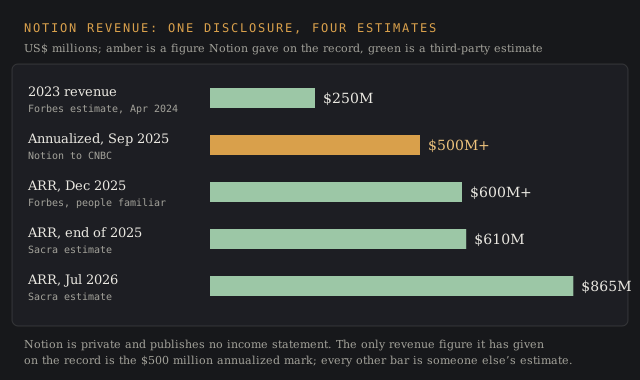
Sacra's July 2026 estimate of $865 million is up 82% year over year, with $610 million at the end of 2025. Forbes reported in December 2025, citing people familiar with the company, that ARR had passed $600 million, half of it from AI products. The two figures sit $10 million apart and point the same way.
Why Notion revenue estimates disagree
The numbers in circulation run from $40 million to $865 million, and most of the spread is age. The oldest published figures sit far below today's: SaaStr put 2021 revenue at $31 million, and Forbes estimated $250 million for 2023.
Metric is the second split, and the devil's in the details. Forbes's $250 million for 2023 is revenue for a calendar year. The $500 million from Notion is annualized revenue, a monthly figure multiplied by 12. Sacra's $865 million is ARR, recurring subscription revenue on an annual basis. A company growing 50% to 80% a year shows a calendar-year revenue well below its run rate at year end.
Sourcing is the third. Notion itself confirms only the $500 million mark and the AI share of ARR, and its own blog post on the tender gave no revenue total, so any precise figure for 2024 or 2026 is a third party's model. Treat Sacra and Forbes as the best estimates available, and quote them as estimates.
Notion AI and the revenue mix
Notion AI launched in private alpha in November 2022, two weeks before ChatGPT, which put Notion ahead of the curve, and the bet is now most of the business. Kothari told CNBC that 10% to 20% of customers paid for AI add-ons in 2024, 30% to 40% did early in 2025, and the share had just crossed 50% by September 2025, as TechBuzz summarized the interview. Our AI adoption statistics show how that compares with business AI use overall.
Notion's CFO wrote on January 26, 2026 that more than 50% of ARR at the end of 2025 came from AI-enabled customers, and that the percentage more than doubled over the year. Growth was strongest in Asia-Pacific, where Notion opened a Singapore office alongside Tokyo, Seoul and Sydney. Our AI statistics cover the wider market.
The product changes followed the money. Notion announced and released Notion 3.0 on September 18, 2025, turning the assistant into an agent that works across hundreds of Notion pages and databases. Custom Agents, which run on triggers inside a team workspace, are priced on consumption: free to try, then $10 per 1,000 monthly Notion credits. That puts usage-based pricing on top of per-seat plans, so the company no longer puts all its eggs in one basket.
Notion pricing: how the company makes money
Notion runs a freemium, product-led model: individuals start on the free plan, teams adopt it, and companies upgrade for admin controls and AI. The free plan costs $0, so adoption spreads inside an organization before anyone buys a seat. Notion's pricing page lists four plans per member per month, with up to 20% off for yearly billing:
- Free: $0, with a trial of Notion AI
- Plus: $10, with a trial of Notion AI
- Business: $20, with Notion Agent, AI Meeting Notes and Enterprise Search
- Enterprise: custom pricing, adding zero data retention with LLM providers
Putting the AI features in the Business plan is what moved revenue. A team that wants the agent pays $20 a seat, twice the Plus price. Enterprise plans add security controls, and Notion's workspace and page analytics show which Notion pages and databases teams use. Custom Agents and Workers then draw on credits, so heavier AI use raises the bill without a new seat, and Business seats include access to the agent features that free accounts only trial.
Templates are the free funnel. People copy habit trackers, reading lists and content calendar templates from the gallery, and Zhao's 2024 post noted creators building businesses on Notion, some of whom made $1 million in 2023. The creators and the community bring new users at no acquisition cost to Notion.
How many people use Notion
Notion passed 100 million users in August 2024, CEO Ivan Zhao wrote in a September 3, 2024 post, which dates the first million users to 2020, "right before Covid," and sets a goal of 1 billion. Forbes put the user base at 20 million in January 2021, when TikTok videos about the app went viral and the demand overloaded Notion's servers.
- 2020: 1 million users
- January 2021: 20 million users
- August 2024: 100 million users
Notion grew under the radar, mostly by word of mouth and outside the US. Forbes reported in April 2024 that 80% of users were outside the US. The 100 million counts registered accounts; Notion doesn't publish daily active users or a count of paying customers.
Notion funding and valuation
Notion has raised little primary capital for its size. Kothari told CNBC the company had raised about $330 million to date and held more cash than that, and Sacra counts total funding of about $344 million in primary capital, with none since 2021. Sequoia Capital and Index Ventures have backed it across several rounds. Our venture capital funding report tracks the wider market for rounds like these.
| Date | Round | Amount | Valuation |
|---|---|---|---|
| April 2020 | Series B, Index Ventures | $50M | $2B |
| October 2021 | Series C, Coatue and Sequoia Capital | $275M | $10B |
| January 2026 | Employee tender, GIC, Sequoia, Index | $270M (secondary) | $11B |
Copy these lines into an email, fill them in and send. I reply with scope and a price within 2 to 3 business days.
Open the emailThe Series C was the jump: SiliconANGLE reported the $275 million round lifted the valuation from $2 billion in April 2020 to $10 billion. Forbes puts that earlier round at $50 million, led by Index Ventures. The January 2026 tender bought shares from current and former employees, so no new money reached the company; Notion waived the one-year vesting cliff so more staff could sell.
Against revenue, the valuation has lagged far behind. At $11 billion, Notion trades at about 18 times Sacra's $610 million end-of-2025 ARR and under 13 times its $865 million July 2026 estimate. In 2021 the same $10 billion sat on a business SaaStr put at $31 million in revenue.
Notion Labs history: from the first version to 100 million users
Ivan Zhao and Simon Last founded Notion Labs in San Francisco in 2013. The first version, a tool for non-coders to build their own apps, didn't work; three years in, the founders scrapped the code and moved to Kyoto, and Notion 1.0 launched in March 2016, a story Sequoia Capital has told in its founder spotlight. Akshay Kothari later joined as the third co-founder and chief operating officer.
The early years were slow. Zhao's 2024 post dates the first signs of traction to the March 2018 launch of Notion 2.0 on Product Hunt, the version Sequoia says added relational databases, and the first million users to 2020. The pandemic did the rest: users went from 1 million in 2020 to 20 million by January 2021, and the Series C closed that October.
The decade since founding has turned a note-taking app into a productivity software platform used by millions. Notion now runs on the web, as desktop apps for Mac and Windows, and as mobile apps for iOS and Android, with Notion Calendar, launched on January 17, 2024, as its first standalone app.
What people build in Notion
Notion pages and Notion databases are the two building blocks of the platform. A page holds writing, an image, a table or an embedded file; a database is a table of pages with properties, views and filters, so a project tracker, a lightweight CRM or a content calendar can be created without code; our CRM statistics cover the dedicated tools. Teams track tasks, sales data and hiring in databases that connect to each other through relations.
Templates spread those structures to millions of people, and millions more open shared pages without an account. A habit tracker with progress bars, a reading list or a team wiki gets copied from the template gallery into a new workspace in one click. Creators build businesses selling them, and the community shares feedback and new versions on Reddit.
Interest has moved toward AI on top of that data. Notion's agent searches across pages, databases and connected apps such as Gmail, and Sacra notes that Notion 3.0's agent uses pages and databases as its memory. Notion's workspace analytics give admins insight into which pages a team reads and edits. Our product analytics tools ranking covers the analytics side of the same category.
Companies Notion acquired
Notion's acquisitions include three companies bought between 2021 and 2024, and two of them became products, according to its Wikipedia entry:
- Automate.io, September 2021: an Indian integrations startup, Notion's first acquisition
- Cron, June 9, 2022: the calendar app relaunched as Notion Calendar on January 17, 2024
- Skiff, February 9, 2024: a privacy-focused email suite whose infrastructure became Notion Mail, released in April 2025
Notion Mail didn't last. Notion is shutting the Notion Mail inbox down on September 22, 2026; email history stays in Gmail, and agents that read, draft and send email through Gmail keep running. Notion said on X, as Engadget reported, that more than half of Notion Mail users already handled email without opening the inbox, which is the same AI bet that drives its revenue.
Does Notion make a profit
Notion hasn't publicly disclosed profit figures, but every report points the same way. Forbes estimated in April 2024 that Notion was profitable on $250 million of 2023 revenue. Kothari's statement that cash on hand exceeds the roughly $330 million raised implies the company has generated cash. Forbes's December 2025 report, from people familiar with the company, described cash flow as positive.
The IPO question is open. Forbes reported in December 2025 that Notion was considering several funding rounds in a short period ahead of an IPO, and the tender gave employees liquidity in the meantime. Notion hasn't announced a listing date, and the jury's still out on timing.
Notion against Microsoft, Google and Coda
Notion sells against the two largest productivity software suites. Microsoft announced Loop, a document collaboration app, weeks after Notion's 2021 round, and now sells Copilot inside Word and Outlook; Google bundles Gemini into Workspace. Our Microsoft Copilot revenue report covers the scale on that side.
Among focused tools, Coda competes for the same all-in-one doc and database use, Obsidian takes users who want local-first markdown files, and Asana and Monday.com compete for project tracking. For users who migrate from Evernote, Notion's importer brings notebooks in as pages and notes as database items.
Notion's pitch is to replace several of these tools with one workspace, and the 100 million user base is the evidence it has worked for individuals around the world. The AI share of ARR is the evidence for companies, and Notion's analytics and admin features are built to win the organization-wide deals behind it.
Delivered for your site and your byline. Hosting here is optional.
Frequently asked questions
What is Notion's revenue and profit?
Notion passed $500 million in annualized revenue in September 2025, and Sacra estimates ARR at $865 million in July 2026. Profit isn't disclosed; Forbes reported the company profitable in 2024 and cash-flow positive in December 2025.
How many people use Notion?
Notion passed 100 million users in August 2024. That counts registered accounts across the web and apps; the company doesn't publish daily or monthly active users or its number of paying customers.
Is Notion going to IPO?
Notion hasn't set a date. Forbes reported in December 2025 that it was preparing funding rounds ahead of a possible IPO, and the January 2026 tender at $11 billion gave employees liquidity while it stays private.
Is Notion a unicorn startup?
Yes. Notion has been valued above $1 billion since its April 2020 round at $2 billion, reached $10 billion in October 2021, and was valued at $11 billion in January 2026. See our unicorn companies report for the wider list.
Who is Notion's biggest competitor?
Microsoft, with Loop and Copilot in Microsoft 365, and Google, with Gemini in Workspace. Among standalone tools, Coda is the closest match.
Is Notion still widely used?
Yes. Millions of people and teams use it: Notion passed 100 million users in 2024, and since then Notion released Notion 3.0 and Custom Agents. Templates still bring in new users, and companies track projects, CRM data and wikis in Notion databases created by their own teams.
Is Notion still relevant in 2026?
By the numbers, yes: more than 100 million users, revenue past $500 million in 2025 and an $11 billion valuation in January 2026, with AI-enabled customers producing more than half of ARR.
Which is better, Excel or Notion?
They solve different problems. Excel handles calculation, formulas and large data sets; Notion databases link records to pages, docs and tasks in a shared workspace, with access set per page. Teams that need both often keep the model in Excel and the project tracking in Notion.
Bottom line
Notion's revenue passed $500 million annualized in September 2025, the one figure the company has confirmed, and the best outside estimates put ARR between $600 million and $865 million since. The figure moved fast because AI turned free users into paying Business seats, and AI-enabled customers now account for the lion's share of ARR.
Read every Notion revenue number with its source and metric attached. A company on a roll from $31 million to more than $500 million in four years makes any undated estimate stale within months, which is why our SaaS statistics carry the publisher and date on every figure.
Investors, analysts and software vendors use reports like this one in investor decks and competitive briefs.
A report on your topic for a blog page, gated content or a lead magnet.
Written for your client and published under their brand, with my name left off.
Your report on marketintelligencetools.com, with 2 to 3 CTAs carrying your sponsored links.
Default terms: the report is yours to publish, and I keep the right to republish it on this site behind a gate, outside Google's index.
Notion's own disclosures, the estimates around them, and what Notion keeps private
Notion's own figures come from its blog posts of 3 September 2024 (100 million users) and 26 January 2026 (tender offer), its pricing page and its help center. The $500 million figure is Notion's statement to CNBC on 18 September 2025, read from a syndicated copy of the article.
Revenue estimates are Forbes (April 2024 and December 2025) and Sacra (July 2026); SaaStr supplies the 2021 figure. Funding comes from SiliconANGLE (8 October 2021), Sacra and Notion's tender post. History follows Sequoia Capital's founder spotlight, Wikipedia and Notion's help center. The valuation multiples are our arithmetic from those figures.
All figures were checked on 19 November 2026. Notion publishes no income statement, no profit figure, no count of paying customers and no active user count.