Microsoft Copilot revenue: what Microsoft discloses and what 30 million seats are worth
 By Jan Suski. I go deep on every review, checking every number against its source and digging up details other coverage misses, a habit from six years of SEO and link building for tech companies. Bylines at Brand24 and Senuto. How the scoring works.
Microsoft doesn't publish a Microsoft Copilot revenue line, and Microsoft Copilot spans more apps than any single segment. What it does publish is enough to build one: over 30 million paid Microsoft 365 Copilot seats as of July 2026, a $30 per user per month enterprise list price, and an AI business that passed a $37 billion annual revenue run rate in April 2026, per its fiscal 2026 earnings calls.
At list price, 30 million seats would bill about $10.8 billion a year. Discounts, bundles and promotions pull the real figure lower, and Microsoft stopped updating the seat count in October 2026. This report collects every Copilot figure Microsoft has put on the record, the pricing behind them, the copilot users and copilot adoption data, and the third-party estimates that fill the gaps.
It's for analysts, investors and IT buyers who need a number they can defend. Every data point links to the earnings call, pricing page or Microsoft Learn document it came from, so you can check the data yourself.
The numbers Microsoft Copilot seats, pricing and usage, checked November 2026
Paid Microsoft 365 Copilot seats doubled in six months, from 15 million in January 2026 to over 30 million in July 2026.
Even at 30 million, paid Copilot covers under 7% of the 450 million commercial Microsoft 365 seats Microsoft could sell it to.
The $10.8 billion list value is a ceiling that assumes every seat pays full price, and Microsoft runs both negotiated enterprise discounts and published promotions.
I'll write a 2,500+ word report on the vendor you name, built from its earnings calls, pricing pages and documentation, with every figure sourced. Yours to publish, from $200.
Does Microsoft report Copilot revenue?
No. Copilot revenue is spread across Microsoft's reporting lines: Microsoft 365 Copilot licenses sit in Microsoft 365 commercial cloud, consumer Copilot subscriptions in Microsoft 365 consumer cloud, and GitHub Copilot in GitHub's results. The 2026 annual report breaks out none of them as a Copilot line.
What Microsoft does give is direction. On the October 28, 2026 call for the first quarter of fiscal 2027, CFO Amy Hood said Copilot revenue growth accelerated quarter over quarter across Microsoft 365, GitHub and security, and that average revenue per user growth was led by premium seat offerings, "including M365 Copilot, E5, and E7" (Microsoft Q1 FY27 earnings call).
- Microsoft 365 commercial cloud revenue grew 17% as reported in Q1 FY27, 18% in constant currency
- Paid Microsoft 365 commercial seats grew only 5%, so most of that growth came from revenue per user
- Microsoft 365 consumer cloud revenue grew 17% in constant currency
- Guidance for the December 2026 quarter: Microsoft 365 commercial cloud growth of about 19% in constant currency
Read between the lines and the story is upselling. Paid seats in Microsoft 365 apps grow about 5% a year, so Microsoft grows Microsoft 365 revenue by moving existing customers to Copilot, E5 and the new E7 bundle, which Hood said had already reached millions of paid seats.
Microsoft 365 Copilot paid seats, quarter by quarter
Microsoft first gave a paid seat count in January 2026, then raised it twice before going quiet. The run of numbers comes straight from the earnings calls.
| Earnings call | Paid Microsoft 365 Copilot seats | What else Microsoft said |
|---|---|---|
| Q1 FY26, Oct 29, 2025 | Not disclosed | Copilot family passed 150 million monthly active users; 900 million monthly active users of AI features across products |
| Q2 FY26, Jan 28, 2026 | 15 million | Seat adds up over 160% year over year; daily active users up 10 times |
| Q3 FY26, Apr 29, 2026 | Over 20 million | Seat adds up 250% year over year; Accenture at over 740,000 seats |
| Q4 FY26, Jul 2026 | Over 30 million | Net seat adds more than doubled quarter over quarter; customers with 50,000+ seats up 7 times |
| Q1 FY27, Oct 28, 2026 | Not disclosed | Daily users up nearly 50% quarter over quarter and over 5 times year over year; customers with 50,000+ seats up 8 times |
Copy these lines into an email, fill them in and send. I reply with scope and a price within 2 to 3 business days.
Open the email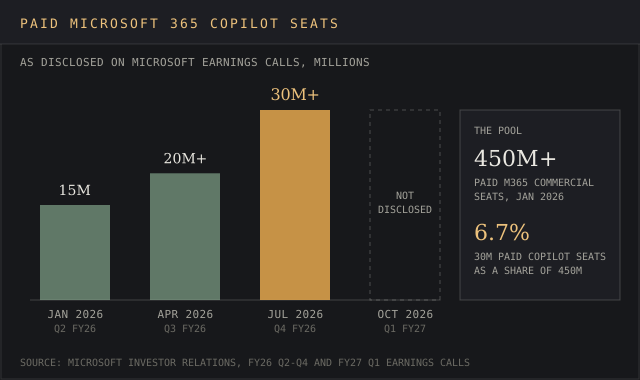
When an analyst asked for the seat number in October 2026, Hood answered that Microsoft "did not disclose, to answer your direct question, an update on the Copilot number this quarter." Usage metrics took its place: daily users, automated tasks, which nearly doubled since July, and Copilot customers using usage based billing credits, up over 75% in the quarter.
Large deployments drive the count, and they give whole workforces access at once. Accenture passed 740,000 seats, and Bayer, Johnson & Johnson, Mercedes and Roche each committed to 90,000 or more, per the April 2026 call. In October 2026 Microsoft named Volkswagen, with a planned rollout to more than 330,000 employees.
What 30 million seats are worth: a Copilot revenue estimate
With seats and a list price on the record, the arithmetic is short. 30 million seats at $30 a month is $900 million a month, or $10.8 billion a year. That's the ceiling for the Microsoft 365 Copilot license alone in mid-2026.
Three things pull the real figure under it:
- Business pricing. The Microsoft 365 Copilot Business add-on lists at $21 per user per month, with a promotional $18 on annual terms from July 1 to December 31, 2026, per Microsoft's business pricing page.
- Enterprise discounts. Large agreements of the Accenture kind are negotiated, and Microsoft doesn't publish the discount.
- Bundles. E7 folds Copilot together with E5, Microsoft Entra and Agent 365, so part of each E7 seat's price belongs to other products.
Two things push revenue above the seat math, and both follow the shift to value-based pricing across SaaS. Usage based billing for Copilot Cowork, Code, Autopilot and the Work IQ APIs is charged through Copilot Credits on top of the license, and GitHub Copilot and consumer subscriptions bill separately.
Our working range for annualized Microsoft 365 Copilot license revenue at the July 2026 seat count is $6.5 billion to $10.8 billion, the low end assuming an average 40% off list. We built that range from Microsoft's figures by triangulating seats, prices and discounts; Microsoft hasn't confirmed it. Investors who want to make informed decisions should treat it as a bracket.
For scale, Microsoft's whole AI business, which also counts Azure AI services, ran at $37 billion a year by April 2026, up 123%. Copilot licenses are one slice of that figure, and Microsoft doesn't split it further.
Copilot pricing and the license stack
Every Copilot revenue stream starts with a Copilot license or a credit. These are the prices Microsoft publishes for business users in November 2026.
| Plan | Price per user per month | Notes |
|---|---|---|
| Microsoft 365 Copilot (enterprise) | $30, annual commitment | Add-on to an eligible Microsoft 365 or Office 365 license |
| Microsoft 365 Copilot Business (add-on) | $21 list; $18 promotional yearly; $25.20 monthly | For Microsoft 365 Business plans |
| Microsoft 365 Business Standard with Copilot | $23.50 yearly; $28.20 monthly | Up to 300 users |
| Microsoft 365 Business Premium with Copilot | $32.00 yearly; $38.40 monthly | Up to 300 users |
| Copilot Chat | $0 | Included with eligible Microsoft 365 plans, web-grounded |
| Copilot Cowork, Code, Autopilot | Usage based billing | Charged in Copilot Credits |
| Copilot Studio | Included for internal agents with a Copilot license | Standalone license priced separately |
- The vendor, product line and quarters to cover
- Regions, years and segments
- Where it runs: blog, white-label, gated or lead magnet
- Whose byline goes on it
- Deadline
- 2,500+ words, human-written
- Every figure linked to its source
- Yours to publish, under your name or none
- Hosting here for +$200, with your sponsored links
The bundles are the cheapest route for a small firm starting from nothing: Business Standard with Copilot costs $23.50 a month on annual terms, base plan included. Copilot Chat costs nothing, which is the point: it gives every Microsoft 365 user free access to a chat interface across the apps and makes the paid upgrade a click away. Access to company data is what the paid license adds.
On the consumer side, Copilot Pro launched on January 15, 2024 at $20 a month with priority access to new features and faster responses during peak usage periods. In February 2025 Microsoft gave all users unlimited access to Copilot Voice and Think Deeper for free. The enterprise price of $30 per user was set in July 2023, and general availability on November 1, 2023 required enterprise customers to buy more than 300 licenses, as the Microsoft Copilot history records.
GitHub Copilot: the coding assistant that sells itself
GitHub Copilot was Microsoft's first paid copilot and remains the clearest revenue story. The coding assistant had over 4.7 million paid subscribers in January 2026, up 75% year over year, per the Q2 FY26 call.
- October 2025: over 26 million GitHub Copilot users
- April 2026: nearly 140,000 organizations using GitHub Copilot; enterprise subscribers nearly tripled year over year
- July 2026: 50 million GitHub Copilot users
- October 2026: agent-generated pull requests up 6 times in six months; credit consumption from agentic features more than doubled since usage based billing began
Microsoft said its September 2026 quarter ran ahead of expectations on stronger GitHub Copilot adoption and usage, per Zacks' summary of the results. GitHub Copilot moving to credits means revenue now rises with how much agents run as well as with how many developers hold paid licenses.
Copilot users and copilot adoption: free against paid
Microsoft's most recent all-product user data for Microsoft Copilot is from October 2025: the first-party Copilot family passed 150 million monthly active users, and 900 million people used AI features across Microsoft products each month. It hasn't published a newer monthly active users figure since.
Microsoft's first-party Copilot family passed 150 million monthly active users in October 2025, the last all-product figure it published.
Copilot family monthly active users, October 2025
Source: Microsofte.g. monthly users of the AI tools in your category
Source: linked, checked, datedThe gap between free users and paid licenses is the elephant in the room. In February 2026, The Register reported analysis from Directions on Microsoft's Mary Jo Foley that only 3.3% of Microsoft 365 and Office 365 users who touch Copilot Chat pay for Microsoft 365 Copilot: 15 million paid seats against a base of roughly 450 million. At 30 million seats the share is about 6.7% of Copilot's total addressable market inside Microsoft's own base.
- Third-party tracker First Page Sage estimates 112.1 million monthly users of Microsoft 365 Copilot as of October 2026, a figure Microsoft hasn't confirmed
- Daily users of the consumer Copilot app rose nearly 3 times year over year by January 2026, per Microsoft
- Copilot queries per user rose nearly 20% quarter over quarter by April 2026
- 90% of Copilot queries ran in Auto mode by October 2026, which picks the underlying model for each request
Copilot adoption varies by industry. Professional services firms such as Accenture and PwC, which had over 200,000 seats by October 2025, deployed early and at scale, while many organizations buy a pilot block for a few hundred licensed users first. Copilot usage data inside those pilots, read from the admin center or Viva Insights, is what decides the renewal and how many more employees get access.
The free tier: Copilot app, Copilot Chat and Copilot in Windows
Most Microsoft Copilot users never pay Microsoft a cent for it. The free tier spans the Copilot app on Windows, the web and mobile, Copilot in Microsoft Edge, and Copilot Chat inside Microsoft 365 apps for anyone with a work account. Microsoft uses that free access to build habits, then sells the paid upgrade on top.
- Copilot app: the consumer Copilot app on Windows, iOS, Android and the web, used for chat, search queries and to generate images
- Copilot Chat: free web-grounded chat for Microsoft 365 business users, with the Copilot icon pinned in Outlook, Word, Excel, PowerPoint and Teams
- Copilot search: Copilot answers inside Bing and Microsoft Edge, where web search queries turn into chat answers
- Microsoft 365 Copilot: the paid tier, which adds Microsoft Graph grounding across Word, Excel, PowerPoint, Outlook and Teams
The difference between Copilot Chat and the paid license is access to company data. Copilot Chat answers from the web; Microsoft 365 Copilot reads the files, emails and meetings a user already has access to through Microsoft Graph. That's the feature companies that hold paid licenses are paying for, and it's why Microsoft copilot usage on the free tier is the main sales funnel for the paid one.
Jared Spataro, Microsoft's chief marketing officer for AI at Work, authored the March 2023 announcement of Microsoft 365 Copilot, and the pitch has stayed the same since: one assistant across Word, Excel, PowerPoint, Outlook and Teams. Data analysis in Excel and meeting recaps in Teams are two of the copilot features Microsoft leads with in its own documentation.
From Bing Chat to the Copilot app: a short history of the Copilot name
The Microsoft Copilot name covers more copilot products than most buyers realize, across apps, web and mobile, which is one reason copilot users figures get mixed up. The dated history:
- February 7, 2023: Bing Chat launches in Microsoft Edge and the Bing mobile app
- March 16, 2023: Microsoft 365 Copilot announced, tested by 20 initial users
- May 2023: about 600 paying customers in the early access program
- July 2023: Bing Chat Enterprise launches for work accounts with commercial data protection, and Microsoft 365 Copilot is priced at $30 per user
- November 1, 2023: general availability for enterprises buying 300+ licenses; Bing Chat Enterprise is later folded into what is now Microsoft 365 Copilot Chat
- January 2024: the Copilot key arrives on Windows keyboards and Copilot Pro launches at $20 a month
- August 2026: Microsoft announces the consumer Copilot app will merge with Microsoft 365 Copilot
- October 2026: Chat, Cowork, Autopilot and Code combined into one Copilot experience, per Satya Nadella
The Copilot icon now appears in Windows, Microsoft Edge, Microsoft 365 apps, Teams and mobile apps, and each surface counts users and usage data differently, which makes Microsoft Copilot user data hard to compare across copilot products. Back to square one for anyone trying to add them up: the brand is shared, the metrics aren't.
Copilot features in Word, Excel, PowerPoint and Outlook
The paid license earns its price inside the Microsoft 365 apps, where Microsoft Copilot sits next to the work: Outlook, Excel and PowerPoint first. Microsoft 365 Copilot grounds answers in a company's emails, files, chats and calendars through Microsoft Graph, and in web data through Bing, inside the Microsoft 365 apps people already use, according to Microsoft Learn.
- Outlook: draft emails and summarize long email threads
- Teams: transcribe meetings, summarize content and list action items
- Word: draft and rewrite documents, and turn a Word document into a PowerPoint deck
- Excel: data analysis, formulas and charts from plain-language requests
- PowerPoint: build slides and generate images from a prompt
- Business chat: Copilot Chat with work grounding searches across Microsoft 365 data and external data sources connected through Graph connectors
These AI features run on large language models from OpenAI and Microsoft's own MAI large language models. Copilot Studio lets IT pros and business users build copilot agents on top, and Microsoft counted over 50 million agents in its registry by October 2026, up over 30% in a quarter. That's what Microsoft hopes will turn a $30 seat into a meter that keeps running.
How companies measure Copilot usage
Microsoft copilot usage inside a company is visible to admins, which is why renewal decisions lean on it. The Microsoft 365 Copilot usage report lives in the Microsoft 365 admin center under Reports, then Usage.
- It covers the last 7, 28, 90 or 180 days
- A user counts as active after an intentional action, such as submitting a prompt; opening the Copilot pane in Word doesn't count
- It tracks apps including Teams, Outlook, Word, Excel, PowerPoint, OneNote, Loop, Microsoft Edge, the Copilot app and Copilot Chat on the web
- Data for a day usually appears within 48 hours, and Word, Excel and PowerPoint data is incomplete before January 25, 2024
The audit log is a different tool. Audit log data feeds Microsoft Purview for security and compliance, and Microsoft warns that prompt counts built from the audit log may not match the official usage report. Purview had audited over 50 billion copilot interactions by July 2026, a figure that measures security events.
The Viva Insights Copilot Dashboard uses the same active-use definitions but can cover a different user population, so Viva Insights numbers can differ too. Some companies push adoption news through Viva Engage communities, and admins assign each Copilot license to licensed users through Microsoft Entra groups. For more detail on any one user, the usage data table lists prompts submitted and last activity date per app.
Teams comparing Copilot with other AI assistants for research work can find the alternatives in our AI adoption statistics report and the market data in our chatbot statistics report.
Why published Copilot revenue estimates disagree
Published Copilot revenue figures vary by an order of magnitude because they answer different questions:
- Seat math. Paid seats times a list price, like our $10.8 billion ceiling. Sensitive to which seat count and which price you pick.
- AI business run rate. Microsoft's $37 billion figure counts Azure AI services alongside every Copilot product.
- User counts read as revenue. The 150 million Copilot family figure and 900 million AI feature users include free users of Copilot Chat and Windows.
- Stale counts. Pages still citing 600 paying customers or 20 initial users are describing 2023.
The devil's in the details: most estimates pair a 2026 seat count with a 2023 price and ignore promotions, the same kind of mismatch our software pricing errors study found in AI answers. Microsoft's own description of revenue drivers, upselling to E5 and E7 plus usage based billing, says the future number depends less on seats than on how much each seat consumes.
Microsoft, OpenAI and the cost of Copilot
Microsoft Copilot runs largely on OpenAI's large language models, and Microsoft's stake shapes its economics. After OpenAI's recapitalization in October 2025, Microsoft said its investment in OpenAI Group PBC was worth about $135 billion, roughly 27% on an as-converted diluted basis, in its announcement of the new partnership terms.
Serving Copilot isn't cheap. Microsoft said it raised throughput for Copilot workloads by over 50% quarter over quarter in Q1 FY27, and 90% of queries now run through Auto mode, which picks the underlying model for each request. Microsoft doesn't disclose Copilot's margin, so there's no public answer to how much profit Copilot makes.
Delivered for your site and your byline. Hosting here is optional.
Frequently asked questions
How much money has Microsoft made from Copilot?
Microsoft hasn't said. At its July 2026 count of over 30 million paid Microsoft 365 Copilot seats and the $30 list price, the license alone would bill up to $10.8 billion a year, before discounts.
How many people use Microsoft Copilot?
Microsoft's last all-product figure was 150 million monthly active users across the Copilot family in October 2025. Paid Microsoft 365 Copilot seats passed 30 million in July 2026, and GitHub Copilot had 50 million users.
Is Microsoft Copilot growing?
Yes. Microsoft Copilot paid seats doubled between January and July 2026, and daily users rose nearly 50% quarter over quarter in the September 2026 quarter.
How does Copilot make money?
Microsoft Copilot makes money from per-user subscriptions (Microsoft 365 Copilot, GitHub Copilot, consumer plans), bundles such as E7, and usage based billing through Copilot Credits for agents and advanced features.
Does Microsoft own 27% of OpenAI?
Roughly. Microsoft said in October 2025 that its stake in OpenAI Group PBC was about 27% on an as-converted diluted basis, valued at about $135 billion.
Does Copilot track user activity?
Yes, for work accounts. Admins can see per-user Microsoft Copilot usage data, including prompts submitted and last activity date, in the Microsoft 365 admin center. Usernames are hidden by default, and audit log data records each interaction for compliance teams with access to Purview.
Can Copilot have multiple users?
Each Microsoft 365 Copilot license covers one user. Companies buy licenses per seat and assign them to users through the admin center or Microsoft Entra.
Bottom line
Microsoft Copilot revenue isn't a line in Microsoft's accounts, but the disclosed pieces put Microsoft 365 Copilot licenses at up to $10.8 billion a year at list price on 30 million paid seats. GitHub Copilot, consumer plans and usage based billing sit on top.
The figure to watch is the one Microsoft stopped publishing. Until the seat count returns, Microsoft 365 commercial cloud growth and Hood's commentary on revenue per user are the best public data on how far Copilot pays its way across the Microsoft 365 apps.
Microsoft partners, AI startups and IT consultancies use reports like this one in pitches, analyst briefings and budget calls.
A report on your topic for a blog page, gated content or a lead magnet.
Written for your client and published under their brand, with my name left off.
Your report on marketintelligencetools.com, with 2 to 3 CTAs carrying your sponsored links.
Default terms: the report is yours to publish, and I keep the right to republish it on this site behind a gate, outside Google's index.
Where each Copilot number comes from, and what Microsoft does not disclose
Seat counts, usage growth and the AI run rate come from Microsoft's earnings calls for the first quarter of fiscal 2026 (29 October 2025) through the first quarter of fiscal 2027 (28 October 2026), read from Microsoft Investor Relations. Prices are Microsoft's business pricing page and Microsoft Learn as of November 2026. Usage reporting details are the Microsoft 365 Copilot usage report documentation on Microsoft Learn.
The 3.3% paid share is Directions on Microsoft analysis reported by The Register on 2 February 2026. The 112.1 million monthly user estimate is First Page Sage's, unconfirmed by Microsoft. Launch history follows the Microsoft Copilot article on Wikipedia, and the OpenAI stake is Microsoft's 28 October 2025 partnership announcement.
The $10.8 billion list value and the $6.5 billion to $10.8 billion range are our calculations from Microsoft's own figures. Microsoft does not publish Copilot revenue, Copilot margins, enterprise discount levels or a paid seat count after July 2026. Every figure was checked in November 2026.