Value-based pricing: setting a price from what the customer gains
 By Jan Suski. I go deep on every review, checking every number against its source and digging up details other coverage misses, a habit from six years of SEO and link building for tech companies. Bylines at Surfer, Brand24, and Senuto. How the scoring works.
The short version 12 points · 50 seconds
- 01Value-based pricing starts from the buyer’s gainCosts set the floor, rivals the reference
- 02Only 17% of companies priced on customer value44% on competitors, 37% on costs
- 03Customer value is reference plus differentiation valueNagle and Holden’s working formula
- 04The price sits below the ceiling so buyers switchOne chemical maker priced 105 against 108
- 05A $47,400 ceiling supports a $24,000 priceCost-plus would have charged $12,000
- 06Interviews, usage logs and surveys each fill a gapEvery input gets split by segment
- 07Outcome pricing ties the bill to the customer’s resultFin charges $0.99 per outcome
- 08Price fences keep high-value buyers on the right tierSwiss Post’s A mail costs 18% more
- 09Unjustified discounts hand the gain back to buyersSales force management, 81 executives
- 10A 1% price rise lifts operating profit by 8%McKinsey, S&P 1500 average, 2003
- 11At a 30% margin, a 10% cut needs 50% more volumeA 10% rise can lose 25% before profit falls
- 12Commodities leave no differentiation value to pricePrice-sensitive segments get priced out
Value-based pricing sets a price from the perceived value a product creates for the customer, measured against the customer's next best alternative, with production costs as the floor and competitor prices as the reference.
This guide is for product marketers, founders and pricing analysts who price B2B or subscription products. It shows how to put a dollar value on what a customer gains, turn that into price points, and check the result against costs and rivals.
It matters because price moves profit more than almost any other lever: at the average S&P 1500 company, a 1% price rise lifts operating profit 8%, by McKinsey's count. To understand value based pricing, start with what the buyer would do without the product.
It builds on the Van Westendorp price sensitivity meter, which measures what buyers say a price should be. This page works out what the product is worth to them.
What value-based pricing is, and the methods it replaces
Three pricing methods cover most of what companies do. Cost plus pricing, the simplest of the pricing methods, adds a fixed markup to production costs: a part that costs $40 to make, priced at a 50% markup, sells for $60. Competitor based pricing, also called competition based pricing, sets the selling price relative to what rivals charge. Value-based pricing sets it from what the customer gains by buying, and only then checks it against both.
Value-based pricing is the least common of the three. Andreas Hinterhuber's paper in the Journal of Business Strategy (2008, vol. 29, no. 4) pulled together nearly two dozen studies from 1983 to 2006. Competition-based approaches took the lion's share at 44% of respondents, cost-based approaches followed at 37%, and customer value-based approaches came in at 17%, even though researchers rate it the best of the three.
Utpal Dholakia of Rice University called value pricing "the most misunderstood" pricing concept in a 2016 Harvard Business Review guide. The confusion is that value-based pricing gets read as charging whatever the market will bear. Value-based pricing is narrower than that: it prices the difference between the product and the buyer's best alternative.
Other pricing methods, such as dynamic pricing, sit beside these three, and the input is what separates them. Cost based pricing reads the ledger, competitive based pricing reads rival price lists, and a value-based pricing model reads the customer.
Competitor pricing gives every seller a level playing field, and it also gives none of them a reason to charge more. That makes a value-based pricing approach the only one of the three that needs customer research before a price exists, and the only one that asks what customers perceive the product to be worth.
| Pricing method | Price set from | Data it needs | Main risk |
|---|---|---|---|
| Cost plus pricing | Production costs plus a markup | Unit costs | Ignores how much customers would pay |
| Competitor based pricing | Rival list prices | Competitor pricing data | Ignores what the product does better or worse |
| Value-based pricing | Customer's gain over the best alternative | Customer research, usage data, rival prices | Research cost, harder to explain |
| Good value pricing | Same quality at a lower price, or more for the same price | Rival offers, cost structure | Margin squeeze |
| Value added pricing | Extra features or service priced above the base | Feature-level willingness to pay | Paying for extras nobody uses |
How customer value is calculated: reference value plus differentiation value
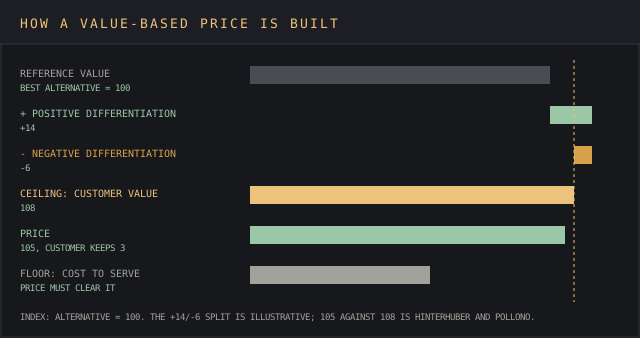
The working formula comes from Thomas Nagle and Reed Holden's pricing textbook. As Hinterhuber and Evandro Pollono summarise it in a 2014 ICAEW article, customer value is the price of the customer's best alternative, the reference value, plus the value of whatever separates the offering from that alternative, the differentiation value.
In value-based pricing, differentiation value can be positive or negative. Faster setup, lower error rates and fewer support tickets add to it. A missing integration, a longer contract or a weaker brand subtract from it. The sum is the perceived customer value: the most a rational buyer would pay before switching to the alternative stops costing them money.
Hinterhuber and Pollono's chemical company case shows the next step. Small advantages in logistics, product quality, ordering costs, vendor competence and customer knowledge added up to a differentiation value of 8%. The firm could in theory charge 8% above the best alternative. After competitive simulations and estimates of customer reaction, it priced at 105 against the alternative's 100, three points under the ceiling of 108.
That gap below the ceiling is deliberate. A price set at the full ceiling gives the buyer no reason to switch, and switching software costs an arm and a leg in staff time, so value-based pricing hands part of the gain back as the incentive to buy. How much to hand back is the judgement call that decides where to set prices, and it's where the profit margin is won or given away.
A worked example with real arithmetic
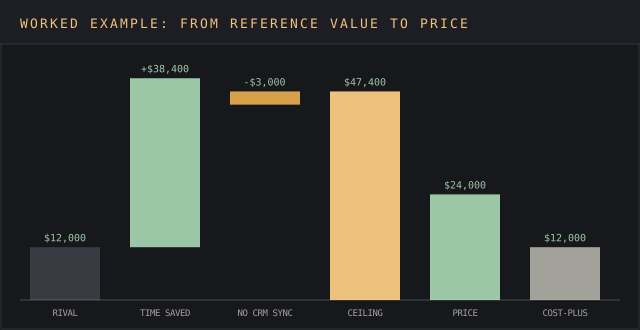
Every figure in this value-based pricing example is an illustrative assumption, chosen so each step can be checked. Take a B2B data enrichment tool sold to a sales team of four. The team's best alternative is a rival tool at $12,000 a year, so the reference value is $12,000.
Positive differentiation comes from time. Suppose the tool saves each rep 5 hours a week of manual research, across 48 working weeks, at a loaded cost of $40 an hour. That's 4 × 5 × 48 × $40 = $38,400 a year. The negative differentiation is a missing CRM integration that costs the customer an assumed $3,000 a year in manual exports.
The ceiling is $12,000 + $38,400 − $3,000 = $47,400. A value-based pricing decision at $24,000 captures about half the gain over the rival and leaves the customer $23,400 better off than buying it. Cost plus pricing on the same tool, the usual alternative pricing method, at an assumed $6,000 cost to serve and a 100% markup, would have set the price at $12,000 and matched the rival while handing over the whole $35,400 difference.
The devil's in the details here, and the weakest number is the 5 hours. It's the input most worth checking before the price goes live: collect customer data from product logs and analyze data on time per lookup, because a 2-hour saving cuts the differentiation value to $15,360 and the ceiling to $24,360.
Where the value data comes from
Value-based pricing requires data a cost sheet doesn't hold, and the research starts from customer needs.
Customer interviews find the alternatives a buyer considered and the costs they carry today. Product usage logs, the behavioral layer of a customer intelligence framework, show which features get used, which tells the team where the differentiation value sits. Customer surveys measure customers' willingness to pay across a larger sample of current and potential customers, and customer feedback from support tickets shows where the product falls short.
Each source covers a different gap in value-based pricing research. Interviews give the reason behind a number and are thin on sample.
Surveys give scale and pick up the response bias that any stated-price question carries. A willingness-to-pay study such as Van Westendorp, or a conjoint study run with one of the conjoint analysis tools that price features against each other, turns customer perceptions into ranges a team can test before it sets prices. Win-loss notes from the sales team add the alternatives that buyers chose over the product.
The data also has to be split by segment, and buyer personas carry the split into the price list. Buyer personas and customer segmentation decide whose perceived value is being measured, so the personas need to exist before the survey goes out, or the survey can't separate one segment's perceived value from another's.
Hinterhuber's 2008 survey listed market segmentation as one of the five obstacles, alongside value assessment and value communication. A single price based on the average customer overcharges the low-value segment and undercharges the high-value one. Different price points for each segment fix that, and the target customers for each tier should come straight out of the data analysis, the step market intelligence analysis covers.
Collecting customer data on this scale costs money, and extensive market research is the obstacle Stefan Michel of IMD lists first among implementation costs: IMD's 2013 article names the cost of market research to assess differentiated customer value. A team that already runs secondary market intelligence has part of the reference value covered, since rival list prices and feature sets are published, and the target market sizing is often done already.
Good value pricing, value added pricing and pricing by outcome
Value-based pricing comes in several shapes, and most value based pricing examples fall into one of them. Investopedia's split into two types is the one most guides repeat.
Good value pricing offers the same quality at a lower price, or more for the same price. Value added pricing adds features or service and charges more for them.
Designer apparel companies and premium brands that sell to big screen TV buyers are the usual value-added examples, where brand value and brand loyalty carry part of the price. Brand loyalty is perceived value the buyer brings to the counter before reading the spec sheet. A buyer who pays for the label is paying for brand value the maker spent years building.
Versioning is how value-added pricing shows up in a price list, with price points spread across versions. Stefan Michel's IMD article gives two from the Swiss market: an Apple iPod range running from CHF 119 to CHF 379 and a VW Golf IV range from CHF 22,900 to CHF 43,800. Each range is one product line at different price points, priced by the perceived value of each version to a different buyer.
Pricing by outcome is value-based pricing tied to the gain itself. Rolls-Royce introduced Power-by-the-Hour in 1962 for the Viper engine on the de Havilland/Hawker Siddeley 125 business jet, charging operators a fixed cost per flying hour for a complete engine and accessory replacement service. The operator pays for engine hours that work, which is what the engine is worth to them.
Software companies run the same value-based pricing logic today, and perceived value there is easier to count. Intercom's Fin AI agent charges $0.99 per outcome, with a resolution counted when no further help is requested after Fin's last answer, and a conversation handed to a human with no outcome isn't charged. The price tracks a support ticket the customer didn't have to staff, which keeps customer loyalty tied to results.
Outcome pricing also protects customer loyalty when budgets tighten. A support team that handles fewer tickets in a slow quarter pays a smaller bill with no renegotiation, and customer loyalty built that way tends to outlast a discount. It's a pricing model where the seller's revenue and the customer's gain move together, which is the whole point of a value based strategy.
How to implement value-based pricing, step by step
To implement value based pricing, run the steps below in order. Skipping one tends to show up two steps later as a price the sales team can't defend, and the pricing process loops back to step one at every review.
- Segment the target market by customer needs and write buyer personas around how each group gains from the product.
- Name the reference alternative for each segment of the target market: a rival, an in-house process or doing nothing.
- Quantify positive and negative differentiation value in dollars, from customer interviews and usage data.
- Determine price points for each tier from the buyer personas: how much of the gain to capture, and how much to leave as the customer's incentive.
- Build tiers and fences so each segment pays for the value it gets, with lower prices for segments that gain less.
- Test the pricing model with a sample of customers and gather customer feedback before the full launch.
- Train the sales team to sell on value and set rules on who can approve a discount.
- Monitor market trends, customer feedback and win rates, and adjust prices on a fixed review cycle.
Fences are the step most teams cut corners on when they implement value based pricing. Swiss Post's A mail costs 15 centimes more than B mail, 18% above it, for next-day delivery, while B mail can take up to three days, according to Michel. The letter is identical, and the fence is the delivery date. Without one, a high-value buyer reads the room and picks the cheaper version.
Training matters because the sales force is where the price meets the customer and where value-based pricing most often breaks. Hinterhuber's survey of 81 executives in Germany, Austria, China and the USA named sales force management as an obstacle: reps who grant discounts the value can't justify hand the differentiation value back.
Discount approval authority and sales compensation tied to price realised are his suggested controls. Talk is cheap in a pricing deck, and the discount approval form is where the value-based pricing strategy holds or leaks. Sales success under this model gets measured in price realised, alongside deals closed.
Checking the price against costs and competitors
A price based on value still has to clear the cost floor, so teams that determine price points from value still need a unit cost. If the value ceiling sits below production costs plus a minimum profit margin, the product has a problem no pricing method fixes. The cost check comes after the value number as a floor under the value-based pricing strategy, and it sets no ceiling.
Competitor pricing does double duty. It supplies the reference value, and it shows if rivals have moved since the research was done. A team running pricing intelligence keeps an eye on rival price points and sees a price cut the week it happens, which changes the reference value and the ceiling with it.
The arithmetic of margin explains why getting the number right pays. Marn, Roegner and Zawada wrote in McKinsey Quarterly in 2003 that for the average S&P 1500 company, "a price rise of 1 percent, if volumes remained stable, would generate an 8 percent increase in operating profits."
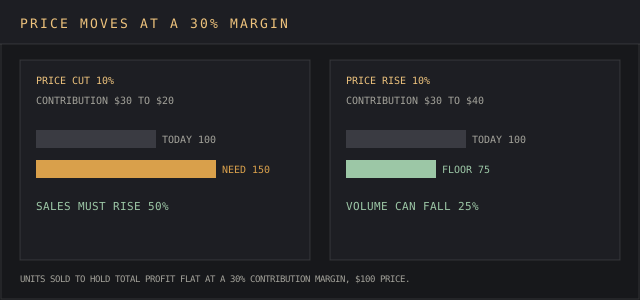
The same logic runs in reverse for cuts. A product with a 30% contribution margin earns $30 on a $100 sale. Cut the price 10% and the contribution falls to $20, so sales must rise 50% to keep total profit flat.
Raise it 10% and contribution rises to $40, so volume can fall 25% before profit drops. Price points above the old list price look risky until that arithmetic is on the table. Lower prices to attract customers carry that asymmetry every time, which is why raising prices toward value usually beats discounting toward volume for a company trying to maximize profits.
Where value-based pricing fails
Value-based pricing needs something to price. On identical products, such as a commodity chemical or a standard bolt, differentiation value is close to zero and the price collapses to the reference, which is the competitor's price. Value-based pricing depends on a real difference the buyer can see, and perceived value close to the reference leaves nothing to charge for.
Price-sensitive customers get priced out, and a seller who builds the whole pricing strategy on the top segment puts all its eggs in one basket. A price built on the high-value segment excludes buyers whose gain is smaller, and if that segment is the bulk of the competitive market, revenue shrinks. Tiers soften it. They don't remove it.
Perceived value also moves, which is why a value-based pricing strategy needs a review date.
Customer perceptions shift when a rival ships the same feature or when a budget gets cut, and the customer value from last year's research no longer matches this year's buyer. Michel's IMD list adds customer resistance due to perceived unfairness, and Amazon's 2000 episode is the case he cites: a book's price fell from $26.24 to $22.74 when a customer deleted a cookie, and thousands of complaint emails followed.
Communication is the last gap: a buyer who doesn't see the differentiation value won't pay for it, so the sales team has to show it in the customer's own numbers. A price based on value the buyer can't see reads as a markup. The unique value proposition, the value proposition sales repeats, and the price have to say the same thing, and marketing strategies that pair one value proposition with a price set from another confuse the buyer.
When the two disagree, it's back to the drawing board on one of them.
FAQ
What is value-based pricing and cost-based pricing?
Cost based pricing starts from what the product costs to make and adds a markup. Value-based pricing, a different pricing strategy, starts from what the customer gains over their best alternative and checks the result against cost. The first protects margin, and the second captures more value where the product is differentiated.
What are the four types of pricing?
Most pricing guides name four: cost plus pricing, competitor based pricing, value-based pricing and dynamic or demand-based pricing, which moves the price with demand in real time. Many companies mix them, using value to set the list price and cost as the floor.
How do you calculate value-based pricing?
Add the reference value, the price of the customer's best alternative, to the differentiation value, the dollar worth of every way the product is better or worse. The total is the ceiling. Set the price below it so the customer keeps part of the gain.
How does a company determine the value of its product to a customer?
It interviews customers about the alternatives they'd use, measures usage to find which features save time or money, and runs willingness-to-pay surveys across segments. The three together show how customer perceptions of the product compare with the reference alternative, and in what dollar terms.
Which companies use value-based pricing?
Rolls-Royce has priced engine maintenance per flying hour since 1962, a value-based pricing example now more than 60 years old, and Intercom prices its Fin AI agent per outcome at $0.99. Versioned ranges such as Apple's iPod line and VW's Golf trims price each version by the buyer it targets.
Is value-based pricing the best pricing strategy?
It's the best pricing strategy for differentiated products with a gain the buyer can count, where it captures more profit than cost plus pricing. For commodities and price-sensitive markets, competitor based pricing is often the only workable choice.
Does value-based pricing always mean a higher price point?
No. When differentiation value is negative, the method sets a price below the rival's. It produces a higher price point only where the product does more for the customer than the alternative.
Bottom line
Value-based pricing prices the gap between a product and the buyer's best alternative, and its pricing model has three parts: reference value plus differentiation value, with the price set below that ceiling and above the cost floor. Only 17% of companies in Hinterhuber's review used value-based pricing, which is the opening for anyone who does the research and keeps the profit margin it earns.
Getting the pricing strategy wrong is expensive in both directions. Price at cost plus a markup and the customer keeps a gain the company created; at a 30% margin, the discount that follows needs 50% more volume to break even. Price above the ceiling, or ignore how customers perceive the product, and the buyer switches to the alternative.
Bite the bullet on the research, and the price that comes out of it has perceived value behind every dollar. Once the price and the value behind it are settled, they have to read the same way in the market. The positioning statement template puts the target customer, the alternative and the difference into four lines the sales team can repeat.