Price optimization tools: 10 platforms ranked for 2026
 By Jan Suski. I go deep on every review, checking every number against its source and digging up details other coverage misses, a habit from six years of SEO and link building for tech companies. Bylines at Surfer, Brand24, and Senuto. How the scoring works.
· Prefer this source on Google
Quick comparison of the 10 price optimization tools
Ten price optimization tools in ranked order, with the result each vendor publishes, its review count, its entry price and the buyer it fits. Rows marked Quote only route buyers to a sales call for pricing.
| Rank | Provider | Number the vendor publishes | G2 reviews | Entry price | Best fit |
|---|---|---|---|---|---|
| 1 | Pricefx | Mabe: +2.5 margin points in a year | 133 at 4.4 | Quote only | B2B manufacturers on SAP or Salesforce |
| 2 | Zilliant | 134 bps margin lift across customers | 61 at 4.4 | Quote only | Industrial B2B on SAP, Oracle or Dynamics |
| 3 | Conga POM (ex-PROS) | +120 bps on $7.2B of distributor revenue | 198 at 4.2 | Quote only | Distributors with millions of SKUs |
| 4 | Competera | US retailer: +40% revenue | 14 at 4.9 | Quote, billed per data point | Enterprise retailers with big catalogs |
| 5 | Vendavo | Dell: 100+ bps of margin | 68 at 4.3 | Quote only | High-tech B2B with deal desks |
| 6 | ToolsGroup | Event Network: +5.5 margin points | 49 at 4.5 (SO99+) | Quote only | Retailers planning price & inventory together |
| 7 | RELEX | +3 pp gross margin, +10% sales | 39 at 4.6 | Quote only | Grocery and fresh retail already on RELEX |
| 8 | Quicklizard | +11% average profit | 32 at 4.7 | Quote, by assortment size | Omnichannel retailers with shelf labels |
| 9 | Intelligems | 1 price test a month on Limited | 198 at 4.8 (Shopify) | $69/mo | Shopify brands testing price live |
| 10 | Prisync | 3% to 20% margin gain claim | 171 at 4.7 | $99/mo | Small ecommerce teams matching rivals |
Review counts read from G2 and the Shopify App Store on 14 October 2026. Vendor numbers are each vendor's own, unaudited.
Where these figures come from
Customer results are each vendor's own published claim, read on 15 October 2026, with the customer named where the vendor names one. Review counts and ratings come from G2, and from the Shopify App Store for Intelligems. Eight of the ten publish no price, so their rows read Quote only, and none of the ten has its margin figures audited by a third party.
Competera and Prisync also sit on the pricing intelligence ranking, which judges them as monitoring tools. RELEX and ToolsGroup appear on the demand forecasting ranking for their forecasts, Pricefx on the revenue growth management ranking, and Competera on the retail analytics ranking. This page judges the engine that sets the price.
Price optimization tools turn sales history, costs, competitor prices and stock levels into a recommended price, then push it to a quote, a shelf label or a storefront. The output is a set of AI-driven pricing decisions a pricing team can accept, edit or reject.
The category splits in two, and so does the pricing software market. B2B suites like Pricefx, Conga POM and Zilliant price quotes and price lists for manufacturers and distributors, while retail platforms like Competera, RELEX and Quicklizard reprice SKUs against demand & competitors several times a day.
This page ranks ten price optimization software platforms on six tests a buyer can run before signing: a named demand model, a customer result with a number, time to go live, a price on record, review volume and named connectors. Every figure links to the vendor's own page or to the review platform that published it, so you can compare pricing solutions on evidence.
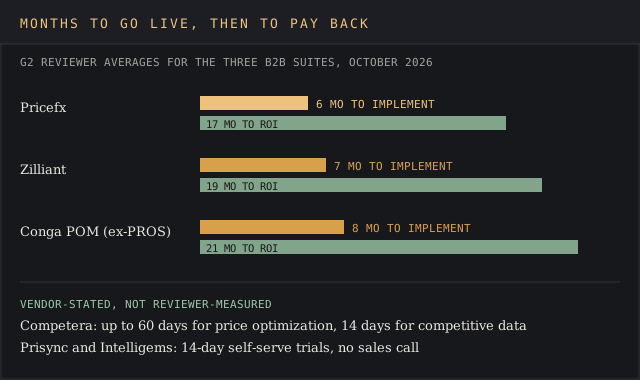
It's written for pricing managers, pricing teams, sales teams and ecommerce owners who need a shortlist with numbers attached. Enterprise contracts here cost an arm and a leg, with G2 placing Conga POM in its top perceived-cost band, and they take six to eight months to implement, per G2 reviewer averages, so picking the wrong suite burns most of a fiscal year.
The timing matters. Thoma Bravo agreed in September 2025 to buy PROS for $23.25 a share and fold its B2B pricing business into Conga, and ToolsGroup bought the AI pricing firm Evo in September 2023. At two of the ten vendors, the pricing product changed owners within two years. If you only need to watch rival prices, the pricing intelligence tools ranking covers monitoring; this page covers the engines that set the price.
Evaluation criteria for price optimization software
Six criteria decide the shortlist, and the ranking below applies them in this order. The first two are gates: a tool that names no demand model ranks below every tool that does, and a tool with no numbered customer result ranks below every tool that has one. Among tools that clear both gates, the order follows how many of the other four tests each one passes, with ties broken by the measured value in criterion order.
Each test returns a yes, a no or a number from a vendor page or a review platform, so a buyer can rerun it on a seventh vendor in an afternoon. Each one maps to a step in the pricing process, from the model to the connector that delivers the price, and each one separates pricing software that sets prices from software that only reports them.
A named demand model on the product page
Gate one. Does the vendor name how it computes a price: a price elasticity model, machine learning, a neural network, scenario simulation, price-range guidance or a live A/B price test? A page that claims AI-driven pricing with no named model behind it fails. Price optimization models built on elasticity score full marks. Rule-based pricing engines that copy a competitor's price minus 1% count as rules, and pricing rules alone sit at the bottom of this list.
A customer result with a number on the vendor's domain
Gate two. Basis points of margin, percent of revenue or hours saved, attached to a named customer where possible, so the result traces to real pricing decisions. Read between the lines here: every number on this list is vendor-reported, and a named customer outranks an anonymous one.
Time to the first live price
G2 publishes reviewer averages for months to implement and months to ROI. Where no average exists, a vendor-stated go-live window or a self-serve free trial counts as a pass. A suite that takes eight months to deploy pays for itself later than one that takes six.
A price on record
A published rate card or self-serve plan passes, and a contact-sales button fails. Only two of the ten tools pass this test, which is why it sits fourth in the order.
Review footprint
Count and rating on G2, or on the Shopify App Store for a Shopify-only app. Forty reviews is the pass mark; under that, the sample is thin and the rating means less.
Named connectors to existing systems
Pricing software has to read cost and transaction data from an ERP and write prices into a CPQ, a CRM, billing systems or a storefront. A vendor that names at least one ERP, CRM, CPQ or storefront product on its own site passes, and a generic integrations promise fails.
The 10 best price optimization tools, ranked
Pricefx
Best fit
B2B manufacturers and distributors running SAP or Salesforce that need price lists, quotes and rebates on one platform.
Pricefx was founded in 2011 and lists 190+ customers, 375+ employees and $645 billion in annual revenue managed through its platform. SAP made it the only SAP Endorsed App for pricing in 2020, so the SAP connector is built by the vendor. Manufacturers use it to optimize pricing across price lists, quotes and rebates, and its price management module centralizes the pricing process so pricing decisions stay consistent from headquarters to each rep.
That matters for the pricing strategies set at headquarters, which reach each quote without a spreadsheet in between. Our Pricefx review walks through the full module list of this price optimization software.
Its price optimization page names the method: machine learning estimates price elasticity, an optimization engine solves the constrained price, and every change runs as a simulation before deployment.
Its newest layer is a set of 125 AI agents that, per the Pricefx pricing page, go live in five days. One distribution deployment of the Negative Margin Transaction Agent surfaced 709 below-cost transactions worth $300K+ in margin, which is the kind of pricing error that manual pricing in spreadsheets lets through for years. Teams that already run Pricefx can hit the ground running with these agents.
Key features
- Price Optimization, Price Management, Rebates and CPQ modules on one data model
- 125 specialized AI agents, including Margin Leakage and Unprofitable Product agents
- SAP Endorsed App since 2020; quoting inside Salesforce CRM
- Negotiation Guidance on the Salesforce AppExchange, launched June 2025
- Price list runs: Calumet moved market-wide list price increases from a month to one day
Pricing
Pricefx publishes no rate card; the pricing page lists customer outcomes and routes buyers to sales. G2 reviewers put implementation at 6 months and ROI at 17 months, the shortest of the three B2B suites ranked here.
Pros
- Mabe lifted net sales margin 2.5 points in a year and cut quote turnaround from five days to one hour
- Ford cut its price-approval cycle by more than 70% across 2.5 million aftermarket parts
- Fastest G2 time to implement of the B2B suites, at 6 months
- National Instruments posted a 6.7% margin increase in 2022
- 133 G2 reviews at 4.4
Cons
- No public price, so budget planning starts with a sales call
- Reporting beyond the defaults pulls in developers, per G2 reviewers
- Filtering multi-million-row tables slows to minutes
“Simple filtering in tables with several million entries sometimes takes several minutes.”
Philipp K., enterprise reviewer (1,000+ employees), G2, 27 March 2026
“We often need to get our developers involved to provide the level of reporting that's required”
Bryan P., Director of Pricing, enterprise, G2, 22 May 2025
Why it's ranked #1. Pricefx and Zilliant each pass three of the four ordering tests, and Pricefx wins the tie on time to a live price: 6 months to implement on G2 against Zilliant's 7, and 17 months to ROI against 19.
Zilliant
Best fit
Industrial B2B sellers on SAP, Oracle or Microsoft Dynamics that want price guidance inside the quote.
Zilliant sells Price IQ, Price Manager and Deal Manager. Across customers, the Price IQ page reports a 134 basis point margin lift, 50% fewer below-floor transactions, 80%+ adoption and 20x+ ROI, and it models pricing scenarios side by side before anything ships. Distributors use Price IQ to optimize pricing by customer and segment, then publish AI-driven pricing decisions into the CPQ.
The connector list is the most specific of the ten: the integrations page names 10 systems, from SAP CPQ and Oracle CPQ to Salesforce Sales Cloud and Microsoft Dynamics. That's how pricing software integrate claims should read, with product names attached, so pricing teams and sales reps end up on the same page.
Key features
- Price IQ scenario modeling across products, customers and segments
- Price Manager for global price lists and customer segments
- Deal Manager guidance inside CPQ
- 10 named connectors, including SAP, Oracle, Salesforce and Microsoft Dynamics
- Named a Leader in the 2025 QKS Group SPARK Matrix for B2B price optimization, per Zilliant
Pricing
Quote only. G2 reviewers average 7 months to implement and 19 to ROI.
Pros
- 134 bps average margin lift on its own product page
- Most named connectors on this list
- UPS, Pirelli, US Foods and Thyssenkrupp among logos shown
Cons
- 61 G2 reviews, under a third of Conga POM's count
- Setup needs technical staff, per G2 reviewers
- Price IQ results carry no named customer
“single source of pricing truth focused on accuracy”
Julien O., CPQ consultant, G2, 6 November 2024
“It can take a while to get the updated information you need.”
Anthony I., Planner, enterprise, G2, 27 June 2022
Why it's ranked #2. Zilliant passes three ordering tests to Conga POM's two, because its integrations page names 10 systems, but it loses the tie with Pricefx on time to implement, 7 months against 6.
Conga POM (formerly PROS)
Best fit
Large distributors and manufacturers with complex pricing across millions of SKUs whose sales reps override list prices on most deals.
Conga POM is PROS Smart Price Optimization and Management under its new owner. Thoma Bravo paid $23.25 a share, a 41.7% premium, and merged the B2B unit into Conga, which says it serves 10,000+ businesses and runs 100,000-line price lists in sub-second time using neural network price optimization.
The best evidence is a Fortune 500 distributor with 300 distribution centers and about 2 million SKUs. Per the Conga case study, it optimized pricing on $7.2 billion in revenue and grew margin 120 points after projecting a 50-basis-point decline from inflation; before the rollout, sales reps overrode guidance 60% to 70% of the time. Guidance now covers about 75% of its business, so AI-driven pricing decisions reach most quotes.
Key features
- Neural network price optimization by market segment and customer
- Real-time price delivery, about 300ms responses per Conga
- Rebate management with real-time accruals and claims
- Combined with Conga CPQ and CLM after the 2025 merger
- SOC 2 Type 2 and ISO 27001, per the PROS product page
Pricing
Quote only. G2 tags its perceived cost at five dollar signs, its top band, and reviewers average 8 months to implement and 21 to ROI. The PROS page says customers often reach 100 to 300 basis points of margin improvement.
Pros
- Largest review base of the B2B suites: 198 G2 reviews
- Case study at $7.2 billion of revenue, the largest documented deployment on this list
- Claims one trillion pricing transactions a year across the platform
Cons
- Slowest G2 implementation of the three, at 8 months
- Product roadmap now sits inside Conga after a 2025 change of owner
- The PROS page promises ERP and CRM integration without naming a product
“The implementation process has been more difficult than anticipated.”
Aaron H., enterprise reviewer, G2
The jury's still out on how much of the PROS roadmap survives inside a CPQ company. Buyers signing multi-year terms in 2026 should ask for it in writing.
Why it's ranked #3. Conga POM passes two ordering tests, time and reviews, against Competera's one, and its 198 G2 reviews are the most here, but it names no connector, where Zilliant names 10.
Competera
Best fit
Enterprise retailers with large catalogs that want demand-based optimal prices and competitor feeds from one vendor. Retail pricing teams at enterprise retailers are Competera's stated market.
Competera says it serves 50+ retailers and models "true demand elasticity" across 20+ demand factors with 95%+ accuracy. For Lyreco it matched 180,000 items across 150+ competitors at 95%+ accuracy, and it feeds Sephora 20 daily pricing updates on competitor prices. Retailers use it to optimize pricing on every SKU daily, and its AI-driven price optimization weighs competitor prices against elasticity before a price moves. Our Competera review covers the setup in detail.
The retail case numbers are large: a US retailer posted 40% revenue growth and a cruise operator a 30% rise in profit per passenger with an 80% cut in pricing workload. Those are Competera's figures, and the lion's share of them come from unnamed customers.
Key features
- Demand elasticity model with predictive scenario planning
- Competitive data: matching, scraping and crawling
- Markdown optimization, promo management and omnichannel pricing
- ISO 27001:2022 certified
Pricing
The Competera pricing page lists three offerings (Competitive Data, AI Pricing Platform, and both) with no numbers. Billing covers only data points delivered within SLA, a proof of concept runs before contract, and go-live takes up to 14 days for the competitor feed and up to 60 days for price optimization.
Pros
- 60-day stated go-live, against 6 to 8 months for the B2B suites
- Elasticity and competitor price tracking under one contract
- Pay only for competitor data points delivered within SLA
Cons
- 14 G2 reviews, the thinnest sample on this list
- Biggest case results come from unnamed retailers
- Built for enterprise catalogs; small stores won't qualify
“It is a powerful AI driven system hence it can be a bit complex to implement”
Verified mid-market reviewer, G2
Why it's ranked #4. Competera passes one ordering test, a stated 60-day go-live, and wins the tie with Vendavo because time comes first in the order, but its 14 G2 reviews leave it one pass behind Conga POM.
Vendavo
Best fit
High-tech and electronics sellers with a deal desk that approves discounts quote by quote.
Vendavo's flagship proof is Dell, a $60 billion company that the Vendavo price optimization page credits with 100+ basis points of margin improvement. A Dell executive quoted there says 90% of quotes go out within 4 hours and 75% need no pricing approval at all.
The engine returns target, floor and stretch price ranges plus a minimum profitable price inside the quoting workflow, so sellers optimize pricing deal by deal with AI-driven guidance and make informed pricing decisions before a discount request reaches the deal desk. The devil's in the details on rollout: both G2 excerpts below describe implementation or big-data performance problems.
Key features
- Target, floor and stretch price guidance per deal
- Margin Leakage, Rebates & Incentives and Agreement Management modules
- High-Tech Revenue Management and Channel Data Management
- AI Pricing Assistants and Vendavo Voice
Pricing
Quote only, with no rate card on the vendor site. G2 shows 68 reviews at 4.3 and no time-to-implement average.
Pros
- Named Fortune 500 customer with a basis-point result
- Deal guidance cut Dell's approvals to 25% of quotes
- Reviewers praise the newer interface
Cons
- No named ERP or CRM connector on the optimization page
- Customization leans on paid consultants
- Performance drops on large data sets
“The main challenge is the complexity of implementation and customization.”
Davide C., Head of Sales at a consulting firm, G2, 11 October 2025
“when you throw big data at it? Ugh. Slows down like an old laptop, or just straight-up crashes.”
Abhishek C., Associate Software Engineer, enterprise, G2, 5 August 2025
Why it's ranked #5. Vendavo passes one ordering test with 68 G2 reviews and beats ToolsGroup's 49 on that tie-break, but it states no go-live window, the test Competera passes with 60 days.
ToolsGroup
Best fit
Retailers and wholesalers that want price, promotion, markdown and inventory planning on one platform.
ToolsGroup was founded in Boston in 1993 and serves 400+ customers in 45 countries. It added pricing by buying Evo, a firm operating since 2015 that says it has generated over $300 million in profit for clients, and now sells price, promo and markdown optimization as one PPMO suite.
The ToolsGroup price optimization page states a 3 to 5 point margin increase, 12% to 15% more revenue, 15% to 30% less waste and 55% to 70% better planner efficiency. Event Network posted +5.5 margin points and MOBO +6.3% revenue.
Planners use it to optimize pricing and stock together and run promotional and markdown pricing strategies on the same forecast, which ToolsGroup frames as inventory intelligence. The pitch is inventory aware optimization: pricing without stock data puts all your eggs in one basket, and ToolsGroup reads both from one forecast.
Key features
- Price, promo and markdown optimization (PPMO) from the Evo acquisition
- Elasticity modeling with real-time demand sensing
- Continuous price experimentation through scenario planning
- Probabilistic demand forecasting and multi-echelon inventory optimization
Pricing
Quote only. The supply chain product, SO99+, carries 49 G2 reviews at 4.5; the pricing module has no separate G2 listing.
Pros
- Two named customer results with numbers: Event Network and MOBO
- Prices and inventory read the same demand forecast
- Laithwaites credits it with a £5.5M initial margin gain
Cons
- Pricing came by acquisition in 2023, so it's the newest module
- No stated go-live window for pricing
- Reviewers report lag with many concurrent users
“Server issues in terms of perfomance, lag, frozen screen happens when multiple users work at the same time.”
Vishal S., planning and master data SME, mid-market, G2, 28 June 2023
Why it's ranked #6. ToolsGroup passes the review test with 49 G2 reviews, which RELEX misses at 39, but trails Vendavo's 68 on the same test and states no go-live window to lift it.
RELEX
Best fit
Grocery, fresh and franchise retailers already planning replenishment on RELEX.
RELEX lists 600+ customers and 1,500+ planning specialists, with Lowe's, Sprouts and PetSmart among the logos. Its price optimization software page claims +10% sales, +3 percentage points of gross margin and a 2% to 5% profitability gain, using predictive analytics and price elasticity models.
Price optimization and promotion planning share one system with demand forecasting & replenishment, and franchise chains get store-cluster price recommendations. RELEX sells the result as inventory intelligence for pricing decisions: AI-driven price optimization that knows what's on the shelf. For a RELEX planning customer, adding pricing is par for the course; anyone else buys a supply chain platform first.
Key features
- Price elasticity models with predictive analytics
- Integrated price optimization and promotion planning
- Fresh markdowns and seasonal planning
- Store-cluster pricing for franchise and company-owned locations
Pricing
Quote only. RELEX shows 39 G2 reviews at 4.6, most of them about forecasting and replenishment.
Pros
- 600+ customers, the largest base among the retail platforms
- Prices, promotions and stock share one demand forecast
- Named a 2026 Leader by Nucleus Research for supply chain planning
Cons
- Pricing page shows ranges with no named customer
- Pricing is an add-on to a supply chain buy
- Reviewers criticize the data import tool
“The manual data import tool is horrible and has a design that is ten years old.”
Manjunath B., mid-market reviewer, G2
“I really like the UI of RELEX, as it gives me a good overview of everything.”
Andreas H., G2
Why it's ranked #7. RELEX passes none of the four ordering tests and edges Quicklizard on the review tie-break, 39 G2 reviews against 32, but sits one review short of the 40-review mark ToolsGroup clears with 49.
Quicklizard
Best fit
Omnichannel retailers pricing across ecommerce, marketplaces and stores with electronic shelf labels.
Quicklizard stays under the radar next to the suites above, but the logos on its homepage include IKEA, Sephora, Samsung and Whirlpool. It claims an 11% average profit increase, a 15% revenue lift and 300% more output per pricing team, and calls its engine Glass Box AI because every recommendation shows its reasoning.
AI modules cover price elasticity, seasonality, forecasting and an MCP server, and the platform pushes the same price to web, marketplace and ESL channels. Retailers use it to optimize pricing on large catalogs with AI-driven price optimization they can audit line by line, so pricing decisions carry a visible reason. Our Quicklizard review page tracks the product.
Key features
- Dynamic pricing, price automation and promo effectiveness modules
- Price elasticity and seasonality models
- Competitive pricing intelligence that flags which competitor moves change demand
- One price across ecommerce, marketplaces and ESL
Pricing
The Quicklizard pricing page lists standard, enterprise and Revenue Under Management plans priced on assortment size, pricing frequency and execution channels, all by quote.
Pros
- Explainable recommendations, per its Glass Box AI design
- Store shelf labels covered alongside online channels
- 32 G2 reviews at 4.7
Cons
- Headline results carry no named customer
- No published price
- New users struggle to read why prices moved
“There are a lot of parameters which drive our price changes”
Pricing Lead, mid-market, six months on the tool, G2
Why it's ranked #8. Quicklizard clears both gates with a named elasticity module and an 11% profit claim, which Intelligems can't match with no published customer result, but its 32 G2 reviews trail RELEX's 39.
Intelligems
Best fit
Shopify brands that want to measure demand by testing real prices on live traffic.
Intelligems runs A/B tests on product prices, subscription pricing models, shipping rates and offers inside Shopify, so price elasticity comes from your own shoppers. Brands use it to optimize pricing with customer behavior measured at their own checkout before they raise prices across the catalog. Setup takes under 15 minutes, per the Intelligems homepage, and the app holds 198 Shopify reviews at 4.8.
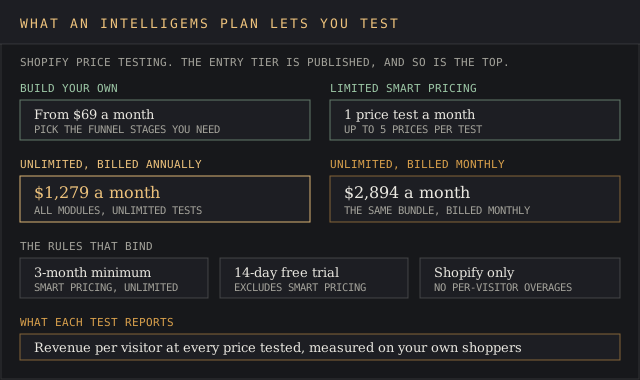
It's quick and dirty compared with an enterprise elasticity model, and that's the appeal: the Limited Smart Pricing plan runs one price test a month with up to five prices, and each test reports revenue per visitor at every price tested.
Key features
- Smart Pricing tests on product, subscription and compare-at prices
- Shipping rate and free-shipping threshold tests (Shopify Advanced or Plus)
- Discounts, quantity breaks and gift-with-purchase offers
- Connections to Klaviyo, Snowflake and Slack
Pricing
The Intelligems pricing page starts Build Your Own plans at $69 a month. Unlimited runs $2,894 a month, or $1,279 a month billed annually, with a 3-month minimum on Smart Pricing and Unlimited. The 14-day trial excludes Smart Pricing.
Pros
- Published price from $69 a month
- No per-visitor charges and no overages
- Measures demand directly from live tests
Cons
- Shopify only
- Price testing locked out of the free trial
- 3-month minimum on any Smart Pricing plan
“Intelligems stands out for its depth of analytics and the variety of tests you can run.”
Prolon Life, United States, Shopify App Store, 10 September 2026
“There have been a few bugs along the way, but nothing major and honestly, the support team has been a highlight.”
Q Sciences, United States, Shopify App Store, 27 July 2026
Why it's ranked #9. Intelligems passes all four ordering tests, including a $69 published price, but fails the second gate with no numbered customer result; it still outranks Prisync, which fails the first gate.
Prisync
Best fit
Small and mid-size ecommerce teams that want competitor price tracking with automatic repricing rules.
Prisync has tracked competitor prices for ecommerce brands since 2013 and claims margin gains of 3% to 20% depending on business size. It connects to Shopify, Google Shopping, Amazon and Magento 2, and lists Samsung, Sony and Schneider Electric as customers. Our Prisync review tests the $99 tier.
Prisync's repricing sets prices from rules you write against competitor data: undercut by 2%, match, or hold a floor. That makes it the lightest pricing software here, a fit for teams who keep an eye on rivals more than on demand, and the rules react to market changes within the 3-times-a-day update cycle. Retailers use it to optimize pricing against rivals without hiring an analyst.
Key features
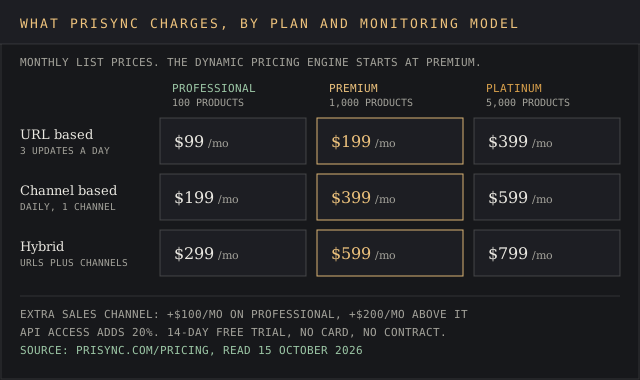
- Dynamic Pricing Engine on Premium and Platinum plans
- MAP monitoring and a Recommended Price module for suppliers
- Price updates 3 times a day on URL-based plans
- Stock availability tracking and price history
Pricing
The Prisync pricing page runs from $99 a month for 100 products to $799 a month for 5,000 on the Hybrid Platinum plan. Dynamic pricing starts at Premium, $199 a month. API access adds 20%, each extra sales channel costs $100 to $200 a month, and the trial lasts 14 days with no card.
Pros
- Cheapest way to automate pricing against competitors on this list
- 171 G2 reviews at 4.7, the second-largest footprint here
- Self-serve trial, no contract
Cons
- Rules follow competitors; no elasticity model
- Product matching leans on GTIN barcodes
- Professional tier excludes dynamic pricing
“the product matching system still heavily relies on standard barcodes (GTINs).”
Hades K., Head of Solutions, mid-market, G2, 8 July 2026
“we can define pricing rules that automatically adjust our prices based on competitor behavior.”
Justin J., Administrator, mid-market, G2, 16 March 2026
Why it's ranked #10. Prisync passes all four ordering tests, with 171 G2 reviews and a $99 price, but fails the first gate: its engine follows competitor rules, where Intelligems measures demand with live tests.
What price optimization software does
Price optimization software exists to optimize pricing at a scale no spreadsheet handles.
The math of price optimization picks the price that maximizes revenue or margin for a goal you set. Most platforms run four stages: data ingestion from ERP, POS and competitor feeds; demand modeling; scenario simulation; and execution into a quote, a price list or a storefront. Pricing analytics sits on top and shows which customers, products and regions drive margin, which is where most pricing decisions get reviewed.
Price elasticity measures how much demand moves when the price changes. AI-driven price optimization estimates that number per SKU and per customer segment from sales history, or, in Intelligems' case, from a live test.
A product with elasticity of -2 loses about 2% of units for every 1% price increase.
The difference from pricing intelligence is direction. Monitoring tools report competitor prices, and optimization tools use those prices as one input when they decide what to charge. The pricing intelligence guide covers the monitoring side, and the demand forecasting software ranking covers the forecasts several of these engines read.
Dynamic pricing, cost plus pricing and promotional pricing
Dynamic pricing adjusts prices on real-time demand and inventory, several times a day for retailers like Sephora, which receives 20 competitor updates daily from Competera.
Cost plus pricing adds a fixed markup to unit cost and ignores demand entirely, which is why manual pricing teams lose margin when costs and market data move at different speeds. Promotional pricing, markdowns and volume discounts are separate pricing strategies that ToolsGroup, RELEX and Competera model as their own modules.
Different pricing strategies need different pricing models. Cost plus pricing needs only unit cost; value-based and segment pricing need customer segmentation, because different customer segments respond to the same price changes in different ways. Elasticity models read customer behavior from transactions, so the engine can find optimal prices per segment and optimal price points per SKU.
Retail pricing runs on a faster clock. Market changes such as a rival's markdown or a cost increase trigger price adjustments within hours on Competera or Quicklizard, and that proactive pricing is the competitive edge these platforms sell. B2B engines move slower and work on competitive positioning per account and on volume discounts that maximize profitability per deal.
Pricing analytics closes the loop. After each round of price changes, the software compares pricing performance with forecast, so pricing managers see which market shifts and market trends moved margin and reset revenue optimization targets for the next cycle. A team can set a goal to maximize revenue on a launch and margin on a mature line, and the engine solves each one separately.
B2B price optimization versus retail
B2B pricing models differ from retail ones, and so does the pricing software that runs them. A distributor's prices sit in contracts and price lists, and that shapes the pricing decisions its engine makes.
B2B price management and pricing engines handle complex pricing: customer-specific price lists, rebates, discount distribution by rep and approval workflows. The goal is to improve pricing consistency, since a distributor's reps overrode guidance 60% to 70% of the time before Conga's rollout.
Retail engines optimize shelf and online prices per SKU against competitor prices and stock, and they pass prices to POS or ESL hardware. Both run the same pricing strategies in different ways.
Pricing across price optimization tools
Eight of the ten price optimization software vendors here quote every deal. Only Prisync and Intelligems publish a rate card, and both sell to ecommerce teams.
A $99 Prisync plan is a drop in the bucket next to an enterprise suite, and it buys competitor rules with no demand model behind them.
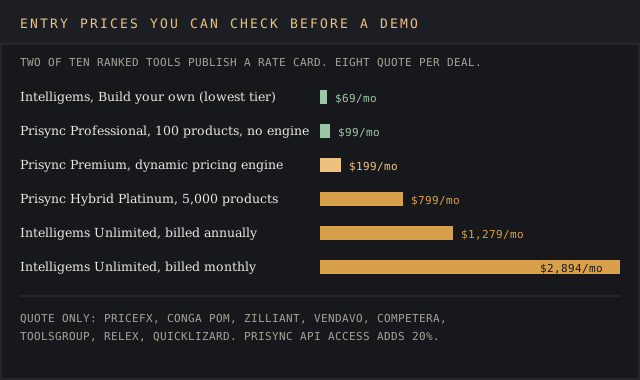
Modern pricing software splits into two billing models. Ecommerce pricing tools charge per product tracked or per module, while enterprise pricing software is quoted on revenue under management, SKU count or seats. Quicklizard names that model outright with its Revenue Under Management plan, and Competera bills per delivered data point. Ask every pricing software vendor which unit it bills on before comparing quotes.
The hidden costs sit in implementation. G2 reviewers average six to eight months to implement the B2B suites, and ROI lands 17 to 21 months after purchase. Budget for integration work with the ERP, data cleanup and change management with sales teams, since reps who ignore guidance erase the margin gain.
Margin claims from price optimization software vendors
Every vendor on this list publishes a margin number, and none of them is audited.
Zilliant's own blog puts the realistic range at 1% to 3% of gross margin, with price optimization software providing the largest gain among pricing software types.
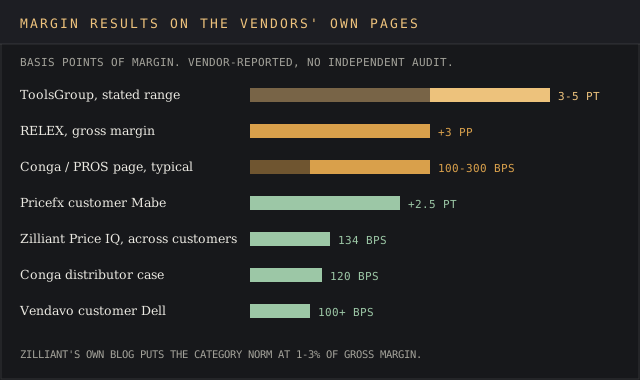
Read the label under each number. ToolsGroup's 55% to 70% figure measures planner efficiency, and its 15% to 30% figure measures waste; its revenue claim is 12% to 15%. RELEX's 10% is a sales increase and its 3 points are gross margin. A red flag is any figure with no unit, no customer and no time window attached.
Common buying mistakes
- Buying an enterprise suite for a 500-SKU catalog that Prisync or Intelligems would price for under $200 a month
- Buying competitor-only pricing tools and expecting them to model demand
- Choosing pricing software before writing down the pricing strategies it has to run
- Skipping the connector check, then paying consultants to build an SAP or Salesforce integration
- Comparing vendors' margin claims across different units: points, percent and basis points
- Rolling out guidance without sales rep adoption targets; Zilliant reports 80%+ adoption as a result worth publishing
How to run a price optimization trial
Bite the bullet and give each finalist the same 90 days of transactions. Ask for recommended prices on 50 SKUs or 50 customer accounts, then compare the recommendations with what your team charged.
Competera offers a proof of concept before contract and Prisync a 14-day trial, so two of the ten let you test for free.
Treat the trial as a test of the pricing software itself, with the vendor's demo team out of the room. Pull the same pricing data into each tool: transactions, costs and competitor prices. A pricing analysis on identical inputs is the only fair test of price optimization software, since every vendor's demo data flatters its own engine.
Give every finalist the pricing strategies you run today, then score it on three numbers: how many recommendations your pricing managers accept, the predicted margin change, and how long the vendor took to load your data. Teams that make smarter pricing decisions in a trial usually make informed pricing decisions in production too, because the data pipeline is the same one.
Then check the pricing process around the engine. Ask how each tool will align pricing across sales channels, how it will align pricing between list and contract prices, and how reps see guidance. Pricing software that can't align pricing with the CPQ your sales reps already use will improve pricing consistency on paper and nowhere else.
Operational efficiency counts too. Track the hours spent on manual pricing before and after, the share of pricing decisions made inside the tool, and how business performance and revenue forecasting change once the price management module runs the price list.
Market context: acquisitions in price optimization
The pricing software category is consolidating. PROS agreed to a Thoma Bravo buyout in September 2025 at a 41.7% premium, with the B2B business folded into Conga and the travel business kept as a standalone platform. ToolsGroup bought Evo in September 2023 to add AI pricing software to its supply chain suite, and Pricefx counts $645 billion in revenue managed after 15 years building from scratch.
For buyers of pricing software, ownership changes affect roadmaps and renewal terms. Ask any vendor that changed hands since 2023 for a written product roadmap and a renewal cap before signing a multi-year contract. Related categories sit on the revenue growth management tools ranking for consumer-goods trade promotion and the retail analytics ranking for store data.
Price optimization tools FAQ
What is price optimization?
Price optimization uses sales history, costs and demand models to set the price that meets a revenue or margin goal, using rival prices as one input. Pricing software enables organizations to run that math across thousands of SKUs or customer accounts, then publish the result to quotes, price lists or storefronts.
What are the main pricing strategies?
Seven pricing strategies cover most of what these tools automate:
- Cost plus pricing: unit cost plus a fixed markup
- Competition-based pricing: match, beat or hold a gap to rival prices (Prisync's rules)
- Dynamic pricing: frequent changes on demand, stock and rival moves (Competera, Quicklizard)
- Value-based and segment pricing: different prices per customer segment (Pricefx, Zilliant, Conga POM)
- Promotions: time-boxed discounts (ToolsGroup, RELEX)
- Markdown pricing: planned reductions to clear stock (ToolsGroup, Competera)
- Test-based pricing: A/B tests of price points on live traffic (Intelligems)
Which AI tool is best for pricing?
For AI-driven price optimization in B2B manufacturing, Pricefx, with 125 AI agents and a 6-month average implementation on G2. For enterprise retail, Competera, with a stated 60-day go-live. For Shopify, Intelligems, from $69 a month.
What is the best software for pricing products online?
Prisync for competitor-based repricing from $99 a month, and Intelligems for testing prices on live Shopify traffic. Both publish prices and both run 14-day trials, which makes them the cheapest price optimization software to test.
Is dynamic pricing still a thing?
Yes. Competera delivers 20 daily competitor pricing updates to Sephora, and Prisync updates competitor prices 3 times a day on its URL-based plans.
Bottom line
Pricefx is the price optimization software pick for B2B manufacturers and distributors that want the shortest path to informed pricing decisions, at 6 months to implement on G2. Conga POM fits the largest distributors that can absorb an 8-month rollout, and Zilliant fits teams that need named SAP, Oracle or Dynamics connectors.
Match the tool to your pricing strategies first. Enterprise retailers should start with Competera for speed or ToolsGroup and RELEX if inventory planning is already on the table. Shopify brands should test prices with Intelligems to make smarter pricing decisions from their own traffic, and small ecommerce teams that mostly react to competitor prices will get the most from Prisync at $99 a month.