Source credibility: how to judge a market figure before you quote it
 By Jan Suski. I go deep on every review, checking every number against its source and digging up details other coverage misses, a habit from six years of SEO and link building for tech companies. Bylines at Surfer, Brand24, and Senuto. How the scoring works.
The short version 12 points · 50 seconds
- 01Credibility splits into expertise and trustworthinessBoth live in the reader's perception
- 02Credible sources moved readers 23.0% against 6.6%Hovland and Weiss, Yale, 1951
- 03Four weeks on, readers kept the claim and lost the sourceAttribution has to travel with the number
- 04The CRAAP test asks five sets of questionsCurrency, relevance, authority, accuracy, purpose
- 05A persuasive site passes CRAAP in its own favorEvery answer comes from the site itself
- 06Fact checkers beat PhD historians by leaving the pageStanford study of 10 checkers, 10 historians
- 07Four checks cover most market figuresAuthority, method, date and motive
- 08Survey statistics need sponsor, sample and fieldwork datesAAPOR lists 11 disclosure elements
- 09Vendor testimonials fall under the FTC Endorsement GuidesUpdated by a 3-0 vote in June 2023
- 10WorldCom's traffic claim fails the method and motive checksClaimed 1,000% a year; measured about 100%
- 11Anonymous sources block the authority checkUSA Today's Jack Kelley case, 2004
- 12Match the checking effort to the decision the figure feedsPricing models need independent confirmation
Source credibility is the degree to which an audience believes a source knows the truth and will tell it. In market intelligence that belief gets tested every time a market-size figure, a vendor statistic or a press release lands in a deck, and most of those figures arrive without anyone asking who produced them.
This lesson gives a structured approach to evaluating sources of that kind: the theory behind credibility, the two checklists most people learn first, and four checks built for market figures. If pulling outside numbers into an analysis is new, and you want an information source map first, start with market intelligence analysis, which covers how that data gets collected.
It's written for analysts, founders and marketers who quote numbers they didn't measure, and who have to decide which ones belong in a research paper, a board update or a pricing model.
What source credibility means in research
The theory of source credibility comes out of the Yale Communication Research Program, where Carl Hovland and colleagues tested how the identity of a communicator changed the way an audience received the same message. The source credibility model from that work, cited in social psychology papers as Hovland et al., splits credibility into expertise and trustworthiness.
Expertise refers to how far the audience thinks the source knows the correct answer. Trustworthiness is how far the audience thinks the source will say it honestly. Both are perceptions, and both can be faked by people who write for a living. Perceived expertise and perceived credibility live in the reader's head, which is why a famous name has enough influence to carry a weak claim a long way.
A 1951 paper titled The Influence of Source Credibility on Communication Effectiveness put numbers on it. Hovland and Walter Weiss gave 223 Yale undergraduates articles on four topics, from atomic submarines to the steel shortage, attributed to either a high-credibility source such as Oppenheimer or a low-credibility one such as Pravda (Public Opinion Quarterly, Vol. 15, No. 4).
Right after reading, high-credibility versions produced a 23.0% net shift toward the communicator's position. Low-credibility versions produced 6.6%. Credible sources changed more minds with identical text, so the label on a claim has a measurable influence on how far readers accept it.
Two other results matter more to an analyst. Recall of the facts didn't depend on the source at all: 84.0% against 81.5%. And four weeks later net agreement had fallen 10.7 points for the high-credibility versions and risen 7.4 points for the low-credibility ones. Readers kept the claim and forgot who made it.
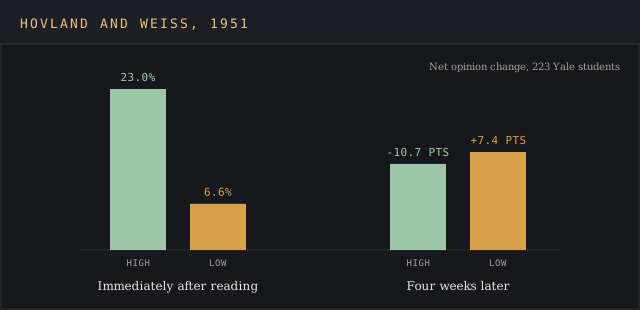
That's the risk in a market deck. A number from a source with an axe to grind gets quoted once, loses its attribution in the second deck, and reads as common knowledge by the third. Social influence does the rest, because a figure that borrows a credible name travels further than one that doesn't.
Evaluating sources with the CRAAP test
The CRAAP test is a library checklist built for student research. Meriam Library at California State University, Chico publishes it as a one-page handout dated 9/17/10, under a Creative Commons Attribution 4.0 license (Evaluating Information: Applying the CRAAP Test). Its five criteria are currency, relevance, authority, accuracy and purpose.
Each criterion is a short set of questions, and the handout is a free library resource on evaluating sources that anyone can reuse under its license. Currency asks when the information was published or posted and if it has been revised. Relevance asks if it answers your question and who the intended audience is. Authority asks for the author, publisher or sponsor, plus author credentials and organizational affiliations.
Accuracy asks where the information comes from and if evidence supports it. Purpose asks if the piece exists to inform, teach, sell, entertain or persuade, and if it's fact, opinion or propaganda. In market research that last question does the most work, since a particular viewpoint usually comes from whoever paid for the study.
Purpose is also where a particular viewpoint hides in plain sight. A site that publishes only research supporting one conclusion fails the purpose check even when every figure on it is accurate.
The test has a known weak spot when you assess websites with it. Every question can be answered from the site itself, and a site written to persuade will answer all five in its own favor. A polished About page, a recent publication date and a list of other articles by the same author all look like authority from the inside.
The split between print and internet sources matters less for market figures than the split between sources that publish a method and sources that keep it private. What matters is how sources present information about themselves, and how that compares with what everyone else says about them.
Lateral reading checks online sources from outside the page
Lateral reading means leaving a site to find out what other sources say about it before reading it closely. Vertical reading is the opposite habit: staying on the site and judging it by its design, citations & tone. The Stanford History Education Group tested both in a study reported in October 2017 (Stanford Graduate School of Education).
Sam Wineburg and Sarah McGrew gave the same tasks to 10 professional fact checkers, 10 PhD historians with full-time faculty posts and 25 Stanford undergraduates. One task compared bullying information on the American Academy of Pediatrics site with the American College of Pediatricians site, two websites run by organizations with near-identical names.
The fact checkers read laterally, opened new tabs and identified the smaller group's position quickly. Historians mostly rated both sites as having similar reliability. Students overwhelmingly judged the American College of Pediatricians site the more reliable one. Vertical reading had sent two groups of educated readers barking up the wrong tree.
Market work takes one lesson from it, the order of operations. Verify who runs a site before you assess what the site says, because the reliability of online sources depends on their owners more than on their design.
The fact checkers also showed what the researchers called click restraint, a habit that reads as caution and works as source credibility screening: they scanned search results before clicking and skipped high-ranked results that didn't fit. For online information that's the critical skill, because a search ranking says nothing about a source's reliability.
A practical version for market work takes three tabs. Search the site's name with the word funding or methodology, assess what independent sources say about the publisher, and check if other websites cite the original measurement or only quote each other. Five minutes of that will identify a source not worth quoting, and lets you assess reliability before you evaluate the claims themselves.
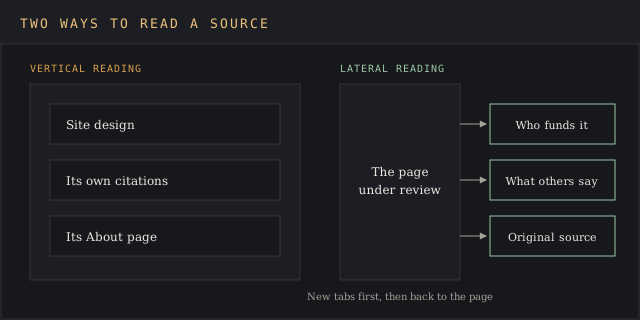
Mike Caulfield turned that behavior into SIFT, published on 19 June 2019 (SIFT (The Four Moves)). The four moves are stop, investigate the source, find better coverage, and trace claims, quotes and media back to the original context. The effectiveness of lateral reading comes from one habit, opening a second tab before trusting the first, and it applies to online information about markets the same way it applies to pediatrics websites.
The trace move matters most for market numbers. They reach you third-hand far more often than straight from the horse's mouth, and each hop strips a little more context. Lateral reading is also the quickest way to identify potential biases in online information, since a publisher's funding and affiliations rarely sit on the site that quotes the figure.
Four checks for a market figure
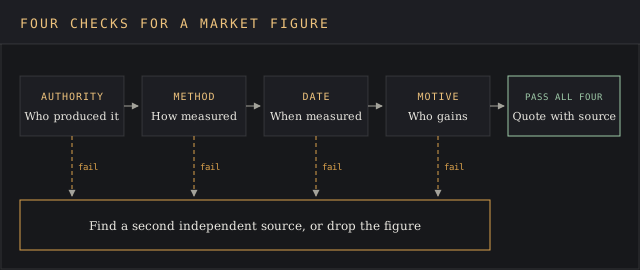
Library checklists were written for a student choosing sources for a research paper, and they assess the quality of online sources in general. A market analyst has a narrower job: deciding if one number is accurate enough to be quoted. Four checks cover most cases, each mapping onto parts of the CRAAP test and SIFT, with a fifth for context once the first four pass.
| Check | Question | Passes when | Fails when |
|---|---|---|---|
| Authority | Who produced the figure? | A named organization measured it and publishes its own data | The figure appears only in other articles quoting each other |
| Method | How was it measured? | Sample, market definition and dates are published | A headline number and growth rate with no method section |
| Date | When was it measured? | Fieldwork dates are stated and recent enough for the market | Only a release date, or older sources quoted as current |
| Motive | What does the source gain if you believe it? | Sponsor and funding are disclosed | The publisher sells what the figure makes look necessary |
| Context | Do independent sources agree? | Multiple sources reach a similar number by different routes | Every citation traces back to a single source |
Authority comes first because it's the cheapest to verify. A figure with no traceable origin fails before method or motive come up, and plenty of market statistics fail here: the same percentage repeated across a dozen blog posts, each linking to another blog post. Following the chain back is the trace move, and the citation side of it sits in data source attribution techniques.
Method is where credible-looking figures fall apart, and it's where the quality of the estimate gets decided. The devil's in the details: a market-size report without a stated definition of the market can't be compared with any other report, because two firms sizing the same category can include different products, regions and years. Read between the lines of the scope note before comparing two totals.
Date and motive are quick. Date asks you to determine the period the data describes, which can sit a year or more before the publication date. Motive asks you to determine who paid, and that's the most important aspect of the whole exercise for vendor content.
A vendor survey finding that most buyers need the vendor's own category can still be accurate. It's a red flag all the same, and it calls for additional evidence from a source with no stake in the answer, since the evidence has to support the claim on its own. Potential biases of this kind show up as a particular viewpoint baked into the question wording.
Applying the checks to vendor statistics and reviews
Vendor statistics usually come from surveys, and survey research has a disclosure standard that lets you assess the quality of the method. The American Association for Public Opinion Research lists 11 immediate disclosure elements in its Transparency Initiative, revised April 2021 (AAPOR Transparency Initiative disclosure elements).
They include who sponsored the research and who conducted it, the population under study, the sampling method, the dates of data collection, the sample sizes, how the data were weighted and a statement of the design's limitations. A press release that gives a percentage with no sample size, population or fieldwork dates fails three of them at once.
Ask the press contact for the methodology statement before you cite the figure, so you can determine what population the percentage describes. A survey that can't produce one can't be verified, and gets the weight of an opinion whatever logo sits on the report.
Reviews and testimonials sit under a separate rule. The Federal Trade Commission voted 3-0 to update its Endorsement Guides, 16 CFR Part 255, announced on 29 June 2023 (FTC press release). The revision added a principle against procuring, suppressing or editing consumer reviews to distort what buyers think, and covers incentivized reviews and reviews by employees.
That changes the weight a vendor's own customer quotes deserve. A testimonial on a vendor site has passed through the vendor's marketing team, and a disclosed material connection tells you why it exists. Talk is cheap: a usage figure from an independent panel carries more credibility than a page of five-star quotes. Reviews can support a buying case once you know who paid for them.
WorldCom's internet traffic claim, checked against measurement
The best-documented market figure to fail a motive check came from WorldCom. Starting in 1998, executive John Sidgmore claimed in public forums and reports that internet traffic was doubling every 3.5 months, roughly 1,000% a year, according to Light Reading's July 2002 reporting.
Kerry Coffman and Andrew Odlyzko of AT&T Labs measured the same thing. Their paper in First Monday, dated 5 October 1998, put growth of public internet traffic at about 100% a year, a doubling each year (The size and growth rate of the Internet). The 1,000% rate had held only between 1995 and 1996.
Run the four checks to evaluate the WorldCom number. Authority looked strong, since WorldCom ran a backbone network through UUNET. Method was never published. Motive was plain: the company sold the capacity the number said the market needed. The measured figure came from researchers who published their method, and later studies kept finding roughly a doubling each year.
Anyone who quoted the faster figure was building on a single source with a stake in the answer. Watch for the same shape in any forecast from a company selling into the market it forecasts.
Anonymous and single-source claims in news stories
News sources follow a rule analysts can borrow: name the source, or explain why it can't be named. Named sources are the first defense against misinformation in a news story. Anonymous sources weaken it because the reader can't run the authority check, and has to trust that editors ran it on the reader's behalf.
USA Today found out what happens when they don't. Reporter Jack Kelley resigned in January 2004, and the paper's review panel found he had faked parts of at least 20 stories and plagiarized at least 100 passages, with deception dating back to 1991 (NBC News). The panel said he had abused the rules on anonymous sources by exploiting his editors' trust.
Top editor Karen Jurgensen retired and managing editor Hal Ritter resigned the week the final report came out. Kelley's stories were misinformation that passed through a national newsroom for 13 years. For an analyst the lesson is narrow: a claim attributed to unnamed industry sources can't pass the authority check, however reputable the publication carrying it.
Quality controls are the outside checks that give a publisher's reputation meaning. Peer review, a published corrections policy and named editorial standards are the quality signals worth looking for before you rely on a site you haven't used before. Reliable sources publish those controls where a reader can find them.
Reputation also depends on where the reader sits. The Reuters Institute's Digital News Report 2025, covering 48 markets and published on 17 June 2025, put Hungary and Greece lowest for trust in news, both at 22% (Digital News Report 2025). An outlet that reads as credible at home can carry less influence with an audience abroad.
How much checking a figure deserves
Evaluating sources costs time, so let the decision the figure feeds determine the effort. A number in a slide caption nobody will act on needs one credible source with a link. A number feeding a pricing change, a market-entry case or a forecast needs multiple sources that reached it independently, since reliability comes from agreement between methods.
Write the attribution into the deck itself: publisher, title, date, and the page the figure sits on. That habit counters the four-week drift Hovland and Weiss measured, because the information source travels with the number. It also lets the next reader verify accurate information in a minute without a wild goose chase through other sources.
Two shortcuts let weak figures through. One is giving a familiar brand the benefit of the doubt on a figure it didn't measure, such as a consulting firm quoting a research firm quoting a survey. The other is jumping on the bandwagon when a number appears in enough articles to feel settled; count the original measurements behind it and the dozen articles often share one.
Keep a short register of the online sources you've already checked. A line per site, with the date, its funding and any potential biases you identify, lets you evaluate a source once and reuse the research. Teams that share the list stop re-checking the same websites and spend the time on articles they haven't read.
Valid information also has a shelf life. Figures from older sources still work as a baseline once the deck labels them with the year they describe. Putting all your eggs in one basket, one source for one critical number, is exactly how the WorldCom figure got through.
Misinformation in market research usually arrives as a clean number with a good logo, and teams that cut corners on the trace move end up repeating it. Using the four checks to evaluate sources takes five minutes per figure, and it will identify most of it before the deck goes out.
FAQ
What are the 5 criteria for evaluating sources?
The CRAAP test's five are currency, relevance, authority, accuracy and purpose, as set out in Meriam Library's handout at CSU Chico, one of the free resources university libraries publish. Evaluating sources for market figures compresses them into four checks: authority, method, date and motive.
How do you evaluate sources of information?
Evaluate the publisher before the claim. Read laterally first: search for the publisher, see what other sources say about it, then go back and read the page. After that, assess the method, the date and the motive behind the figure. If two independent sources reach the same number by different routes, you can quote it with confidence.
How to use CRAAP to evaluate sources?
Answer each of the five sets of questions to evaluate the document in front of you, and note which ones it can't answer. A missing author or a missing method counts as a fail. Use the CRAAP test after lateral reading, since a persuasive site will answer every question in its own favor.
What are the three main factors used to evaluate source information?
Credibility theory names two, expertise and trustworthiness. Practical checklists add a third, the evidence offered in support of the claims. Source credibility research treats them as separate scores. Expertise covers what the source knows, trustworthiness covers its willingness to say it honestly, and evidence is what lets you check both.
What gives a source credibility?
A named author or organization with relevant expertise and author credentials you can verify, a published method, a date, and a disclosed stake in the conclusion if it has one. Credible sources link to the original research behind their figures and publish corrections when they get something wrong, which is what makes their output reliable information.
What is an example of a credible source?
For US market data, a government statistics agency such as the Census Bureau publishes its methods, dates and revisions, which makes its figures easy to verify. A peer-reviewed journal article is another, because reviewers checked the method before publication.
What is source credibility theory?
It's the idea, tested by Hovland and Weiss in 1951, that the same message changes more minds when it comes from a source the audience rates as expert and trustworthy. Their high-credibility sources produced a 23.0% net opinion shift against 6.6% for low-credibility ones.
What are 5 credible sources?
For market work: government statistics agencies, regulators' filings such as SEC annual reports, peer-reviewed journals, research firms that publish their methodology, and a company's own audited financial statements. Each one publishes enough about how its numbers were produced for you to verify them and assess their reliability.
Bottom line
Source credibility comes down to four questions you can answer about any site in a few minutes: who produced the figure, how they measured it, when, and what they gain if you believe it. The CRAAP test and lateral reading are the tools for answering them, and lateral reading goes first.
Skip the checks and the cost shows up later. A figure from a motivated single source moves from deck to deck, loses its attribution on the way, and lands in a pricing model with a credibility it never earned. WorldCom's traffic claim is the documented version of that path.
Source credibility is a property of the evidence trail. Keep the attribution attached to every number, and the next reader can check your work in a minute. For where external market data comes from in the first place, see secondary market intelligence.