Newsletter statistics 2026: 41.24% average opens and 5 million paid Substack subscriptions
 By Jan Suski. I go deep on every review, checking every number against its source and digging up details other coverage misses, a habit from six years of SEO and link building for tech companies. Bylines at Surfer, Brand24, and Senuto. How the scoring works.
The numbers Newsletters, platforms and email benchmarks, checked 7 October 2026
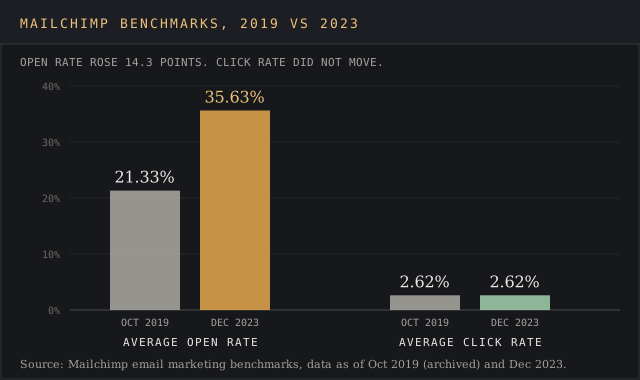
Mailchimp's click rate read 2.62% in both its 2019 and 2023 benchmarks while its open rate climbed from 21.33% to 35.63%, a 14.3-point rise that followed Apple's 2021 privacy change.
Substack writers keep 90% of subscription revenue, Ghost charges 0% payment fees, and beehiiv's paid-subscription revenue rose 138% to $19 million in 2025.
Referrals drive growth, with 42% of newsletter professionals ranking subscriber recommendations first and more than half of Substack's new subscribers arriving through its own network.
Newsletters on beehiiv averaged a 41.24% open rate in 2025 across 28 billion emails, according to the platform's State of Newsletters 2026 report. The same report puts the average click rate at 3.23%, down from 4.74% a year earlier.
Substack counts 5 million paid subscriptions, Ghost says publications on its software earn $100 million+ a year, and Cox Enterprises paid a reported $525 million for newsletter-led Axios in 2022.
These newsletter statistics and newsletter effectiveness statistics cover open rates and click through rates by publisher type, paid newsletter platforms, subscriber growth, B2B use, email automation, send timing, news habits and deals, each figure linked to the body that published it.
They're written for marketers building an email marketing strategy around a newsletter, creators pricing a paid tier and analysts sizing the creator economy. Broad email marketing statistics live in our email marketing statistics report, so this article keeps its focus on newsletters.
Newsletter open rates and click through rates by publisher type
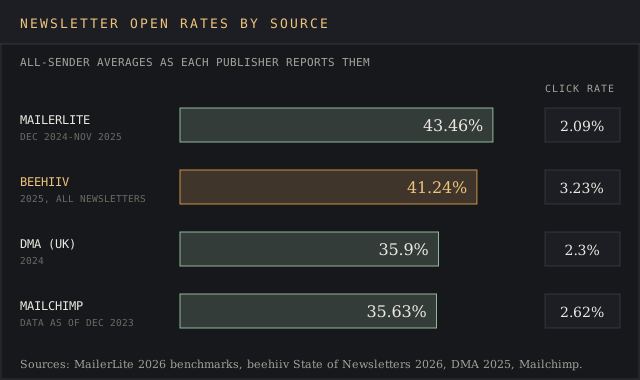
Four email marketing benchmark publishers put all-sender open rates between 35.63% and 43.46%, and each counts newsletter metrics its own way. MailerLite's 2026 email marketing benchmarks, built from 3.6 million campaigns sent by 181,000+ accounts between December 2024 and November 2025, put the all-account open rate at 43.46% and the click rate at 2.09%.
Sender type moves performance across industries. Media senders on MailerLite averaged a 4.10% click rate, nearly double the all-account figure.
| Source | Sender group | Open rate | Click rate | Data period |
|---|---|---|---|---|
| beehiiv | All newsletters | 41.24% | 3.23% | 2025 |
| MailerLite | Media | 42.97% | 4.10% | Dec 2024 to Nov 2025 |
| MailerLite | Authors | 43.14% | 2.75% | Dec 2024 to Nov 2025 |
| MailerLite | Publishing company | 34.24% | 2.82% | Dec 2024 to Nov 2025 |
| MailerLite | Politics | 47.19% | 0.83% | Dec 2024 to Nov 2025 |
| MailerLite | All accounts | 43.46% | 2.09% | Dec 2024 to Nov 2025 |
| DMA (UK) | All senders | 35.9% | 2.3% | 2024 |
| Mailchimp | All users | 35.63% | 2.62% | Data as of December 2023 |
The devil's in the details. Click-to-open divides clicks by opens, so it runs far above the click rate, and it's the measure behind the double-digit newsletter click figures quoted around the web. MailerLite's media senders posted a 12.92% click-to-open rate in the same dataset, against 6.81% across all accounts.
Topic changes engagement too. Podcast, history and parenting audiences were the most responsive on beehiiv, topping the category table with open rates above 51%, and space newsletters led clicks at 9.11%. Audio audiences are covered in the podcast industry statistics report.
Why newsletter open rates diverge between platforms
Mailchimp's benchmark page shows the shift in two snapshots. Its October 2019 data put the average open rate for all industries at 21.33%, and its December 2023 data put it at 35.63%. The average click rate read 2.62% both times. Pre-2021 email marketing statistics such as that 21.33% predate Apple's privacy change.
Apple announced Mail Privacy Protection in June 2021, describing a feature that "stops senders from using invisible pixels to collect information about the user". Mailchimp's current benchmark page warns that the feature affects open rate accuracy, which breaks open tracking as the test marketers used for subject lines.
Apple's share of opens makes the distortion large. Litmus traced 62.26% of over 1 billion opens in July 2026 to Apple Mail, a count that includes opens from Apple's privacy proxy. Read between the lines of any open rate above 40% and part of it is that proxy.
Engagement data by device splits along the same fault line. beehiiv reports 86% of opens on its newsletters happen on desktop and 14% on mobile devices, while Litmus describes mobile devices as the primary reading environment for most subscribers, which keeps responsive templates the default.
The DMA's Email Benchmarking Report 2025 shows the same drift in UK performance data, with opens at 35.9% in 2024 and unique clicks at 2.3%, the third straight annual rise in clicks. So the right metrics for comparing one newsletter with another are clicks, click-to-open and revenue per subscriber, and open rates work best for tracking one list against itself. Click tracking gained importance because a person has to engage with the links.
Paid newsletter platforms Substack, beehiiv, Ghost and Kit
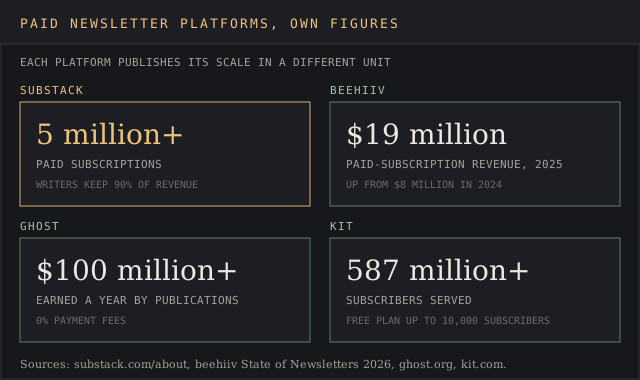
Four newsletter tools publish enough of their own data to size the paid newsletter market, each in its own unit.
| Platform | Scale figure | Creator economics | Growth figure |
|---|---|---|---|
| Substack | 5 million+ paid subscriptions | Writers keep 90% of subscription revenue | 30%+ of paid subscriptions come from Substack's network |
| beehiiv | 65,000+ newsletters, 28 billion emails in 2025 | $19 million paid-subscription revenue in 2025, up from $8 million | Median 66 days to a first dollar for 2025 launches |
| Ghost | $100 million+ earned a year by publications | 0% payment fees | 29,074 new publications started in one week |
| Kit | 587 million+ subscribers served | Free plan up to 10,000 subscribers, Creator plan $33 a month at 1,000 subscribers | Kit cites 40%+ average open rates |
Substack's network does a large share of the selling, and success there is measured in conversions. More than half of new subscribers and 30%+ of paid subscriptions come from inside Substack, per its about page, and its going-paid guide says 5% to 10% of free subscribers typically convert to paying subscriptions, "with 10% being a rate to aim for".
A writer who grows only through the app has put all their eggs in one basket. Investors valued the company at $1.1 billion+ in July 2025, when Substack raised a $100 million Series C, per a Substack blog post, and Axios reported that paid subscriptions had grown from 2 million in 2023.
New newsletters on beehiiv, an email marketing platform built for publishers, hit the ground running. A 2025 launch reached a median 482 subscribers in its first month and 8,314 by the end of year one, and some months saw beehiiv's Ad Network contribute $1M+ to publisher earnings. Newsletter ads sold for a flat fee convert to a cost per thousand subscribers with the CPM calculator, one of the free tools on this site.
Ghost publishes revenue metrics. Publications on it earn $100,000,000+ a year from paying customers with 0% payment fees. Kit, the email marketing platform formerly called ConvertKit, lets businesses and creators send to up to 10,000 subscribers on its free plan and charges $33 a month for its Creator plan at 1,000 subscribers.
Creators running these paid tiers are a slice of the self-employed workforce tracked in the freelance statistics report. For newsletter businesses at that size, paid conversions are the most valuable figure on the dashboard, since 90% of each subscription reaches the writer on Substack.
Where new newsletter subscribers come from
Newsletter professionals rank referrals first. In HubSpot's 2025 State of Newsletters survey of 400+ newsletter professionals, 42% named direct recommendations from current subscribers as the most effective growth strategy.
Platforms focus their growth tools on that word of mouth, and the growth metrics are published.
- Subscriber recommendations: ranked the top growth strategy by 42% of newsletter professionals (HubSpot).
- Recommendation networks: newsletters taking part grow 2.75x faster (beehiiv).
- Paid Boosts: the average newsletter using them gained 84 new subscribers a month (beehiiv).
Social media still carries a share of distribution. HubSpot found 52% of newsletter professionals use LinkedIn and 50% use Facebook to distribute their newsletter, both covered in the social media statistics report.
Signup source shapes engagement and who stays on the email list. Just Women's Sports kept 96% of the people it acquired through event-themed giveaway promotions on its list a year later, per beehiiv. Retention benchmarks for paid products sit in the customer retention statistics report.
Newsletter marketing statistics for B2B and content teams
B2B marketers rate newsletters second only to LinkedIn for thought leadership. The Content Marketing Institute's B2B Content and Marketing Trends: Insights for 2026, a survey of 1,015 B2B marketers run from 24 June to 14 August 2025, found 76% named LinkedIn and 54% named email newsletters among their most effective channels, ahead of speaking events and webinars at 52%.
For B2B companies, a newsletter turns prospects into leads through consistent communication that keeps a brand in front of customers and buyers between sales calls.
Marketers who run one as part of an email marketing strategy can focus on leads passed to sales teams, a leads figure B2B businesses can report upward. The wider channel mix behind that 54% is broken out in the B2B marketing statistics and content marketing statistics reports.
Email marketing budgets are rising. In the DMA Marketer Email Tracker 2026, 66% of 250 UK marketers expected email marketing budgets to increase in the next year, and reported return reached £40.96 per £1 spent, up from £38.33 in 2021. On ROI tracking metrics, the share able to calculate email's value improved from 60% to 62%.
Email marketing ROI varies across industries. Litmus's 2025 State of Email survey of nearly 500 marketers puts media, publishing, events, sports & entertainment senders at 32:1, the lowest of the four industries it lists, against 45:1 for retail, ecommerce & consumer goods businesses. Among all respondents, 35% of marketers reported $10 to $36 back per $1 and 30% reported $36 to $50, and the percentage reporting more than $50 was 5%.
The oldest effectiveness figure still in circulation is McKinsey's. A January 2014 McKinsey Quarterly article called email a better way to acquire customers than social media, "nearly 40 times that of Facebook and Twitter combined".
Email automation, segmentation and personalization
Email automation data from the email marketing platform Omnisend favours automated email campaigns on opens, clicks and conversions. Its 2026 Ecommerce Marketing Report, built from 27 billion emails sent by 150,000 brands to their customers in 2025, found automation accounted for 2% of sends and 30% of email-driven revenue.
The performance gap per send is wide, with automated emails earning 24% higher open rates, 6x stronger click engagement and 19x higher conversion rates than scheduled email campaigns.
Automated abandoned cart reminders, which chase customers who left items behind, and welcome messages drove 76% of automation-generated orders in the same data. For a newsletter, the welcome sequence is the essential automation every new subscriber sees first, and the first chance to connect a signup with a paid tier.
Segmentation data is older. Mailchimp's study of about 11,000 segmented campaigns sent by roughly 2,000 users to nearly 9 million recipients found segmented campaigns earned 14.31% higher open rates and 100.95% more clicks than non-segmented campaigns, with 9.37% fewer unsubscribes. Mailchimp last updated it in February 2017, before Apple's proxy existed.
Personalization is standard among newsletter operators. In HubSpot's survey, 90% of newsletter creators tailor their strategy to the most prominent demographics in their target audience, 28% use AI tools for brainstorming and 25% use them to create content.
For the future, 55% believe earning newsletter revenue will become harder by 2030 and 64% expect newsletters to be AI-generated by 2030. Teams with few resources that want to create advanced segmentation from scratch can start with a customer segmentation template.
Best day and time to send a newsletter
The early bird catches the worm in beehiiv's 2025 timing data. Opens peaked at 44.46% for newsletters that send emails at 5am EST and 42.12% at 6am, and the best day for click through rates fell on the weekend, 3.39% on Saturday and 3.40% on Sunday.
Weekly is beehiiv's default cadence.
- Weekly: 46.67% of newsletters
- Monthly: 27.15%
- Daily: 1.37%
Brands that send emails less often earned more clicks in Mailchimp's peak-season email marketing research, which covered Black Friday sales and holiday campaigns. Its September 2026 report on 31 October to 31 December 2025 covered over 44 billion emails and credited Mailchimp customers with over $1.1 billion in gross revenue, $1.13 billion of it from email, and the top performers by click rate sent 56x fewer emails than the average sender.
Subject lines still shape opens. beehiiv's short subject line group, under 20 words, averaged a 41.56% open rate in 2025.
Email newsletters and news readers
News publishers built much of the format's reach. In the Reuters Institute Digital News Report 2022, 22% of US respondents used newsletters or email alerts for news each week, against 9% in the UK and 17% across the markets measured. More than 80% of US email news users were 35 or older, and the report found email news valued mainly by older, richer and more educated readers, a valuable audience for sponsors.
Email engagement ties to payment in the US. 7% of people paying for online news there subscribed to an email-led news product, against 1% in Germany and Australia, a drop in the bucket outside the US.
The 2026 report names Substack and beehiiv as a route to reader revenue for news creators and cites Heather Cox Richardson's more than 2.5 million Substack subscribers. Publisher revenue sits in the publishing industry statistics report.
The DMA also publishes consumer-side email marketing statistics. Its Consumer Email Tracker 2023, from over 2,000 consumers, found 64% rank email first for discounts, offers and sales and 53% for new products.
Readers interested enough to open engage for longer than a glance. A 2019 Litmus analysis of over 10 billion emails found the average read time rose to 13.4 seconds in 2018 from 11.1 seconds in 2016, and 61% of all emails analyzed counted as read, with a read time of eight seconds or more. A traffic newsletter that sends readers to a website lives on clicks, and an editorial letter read inside the inbox lives on read time and engagement inside the email.
Newsletter acquisitions and funding
Media companies jumped on the bandwagon between 2020 and 2022, buying control of newsletter businesses, and newsletter platforms raised money after them.
| Deal | Date | Value | Figure published by |
|---|---|---|---|
| Insider Inc. buys majority stake in Morning Brew | October 2020 | About $75 million valuation | Axios |
| Informa buys Industry Dive | July 2022 | $389 million in cash | Press Gazette, citing Informa |
| Cox Enterprises buys Axios | August 2022 | $525 million | CNBC, citing people familiar with the deal |
| beehiiv Series B, led by NEA | April 2024 | $33 million raised | beehiiv |
| Substack Series C, led by Andreessen Horowitz | July 2025 | $100 million raised, $1.1 billion+ valuation | Substack, valuation per Axios |
Morning Brew expected over $20 million in revenue and $6 million in profit in 2020 with 3 million email subscribers, Axios reported, and Industry Dive generated $81.9 million in revenue in 2021 across 27 Dive brands with a total audience of 13 million.
B2B trade newsletters like Industry Dive's, whose products span 24 industries per Axios, grew under the radar of consumer media coverage. The budgets behind newsletter ads and sponsorships are sized in the advertising industry statistics report.
Newsletter metrics to start tracking and delivery performance
High delivery metrics are par for the course on modern email marketing tools. The DMA put 2024 UK delivery at 98% overall and 99.2% for B2C senders, and beehiiv reported a 98.90% delivery rate in 2025 with a 1.48% bounce rate and spam complaints at 0.02%, down from 0.04%. Inbox placement runs lower. Validity put 2025 global inbox placement at 87.2%, with 6.6% of mail in spam and 6.1% missing.
More people will use email in future years. The Radicati Group counted 4.4 billion email users in 2024 and forecasts over 4.9 billion by the end of 2028.
These are the essential engagement and revenue metrics worth tracking and keeping an eye on, each with a published email marketing benchmark to measure against.
- Click rate: 2.09% across MailerLite accounts, 4.10% for media senders.
- Click-to-open rate: 6.81% across MailerLite accounts, 12.92% for media senders.
- Unsubscribe rate: 0.22% at both MailerLite and Mailchimp.
- Delivery rate: 98% in the DMA's 2024 UK data.
- Spam complaints: 0.02% on beehiiv in 2025.
- Free-to-paid conversions: 5% to 10% on Substack.
A quarterly review of the email list against the same platform's benchmark gives cleaner insights than comparing numbers across platforms, since each counts opens differently.
Reader replies create the most valuable feedback a list gives, spam complaints the bluntest feedback and surveys the most structured feedback, and the marketing assessment tool scores where email sits among other channels. Small businesses on a free plan can run all of this at no cost up to Kit's 10,000-subscriber limit.
Frequently asked questions
Are newsletters still relevant in 2026?
Yes, by every platform's own count. beehiiv sent 28 billion emails to more than 255 million unique readers in 2025, Substack counts 5 million+ paid subscriptions, and 54% of B2B marketers in CMI's 2026 research named email newsletters among their most effective channels.
What's a good CTR for newsletters?
A click rate between 2% and 4% sits inside the published range for click metrics. MailerLite's all-account average was 2.09% and its media senders averaged 4.10%, while beehiiv newsletters averaged 3.23% in 2025.
Do newsletters make money?
They do at platform scale. beehiiv newsletters earned $19 million from paid subscriptions in 2025, publications on Ghost earn $100 million+ a year, and Morning Brew expected over $20 million in revenue in 2020. For B2B businesses the return arrives as leads and sales.
What is the 80/20 rule for email marketing?
It's a planning convention among marketers. Roughly 80% of sends deliver relevant content the audience signed up for and 20% carry promotions, the messages and campaigns aimed at customers. Mailchimp's peak-season data fits the logic, with its top performers by click rate sending 56x fewer emails than average.
Is email marketing in high demand?
Budgets say yes. 66% of UK marketers in the DMA's 2026 tracker expected email budgets to rise in the next year, and the Radicati Group forecasts over 4.9 billion email users by the end of 2028.
What are the key stats for email marketing?
Three email marketing statistics carry the most weight. Mailchimp's all-user averages were a 35.63% open rate and a 2.62% click rate, and the DMA's 2026 tracker put return at £40.96 per £1. The full set of email marketing stats sits in the email marketing statistics report.
Bottom line
Newsletter open rates read between 34% and 47% depending on platform and sender group, and Apple's proxy inflates all of them. Clicks, click-to-open and paid conversions are the essential metrics and the newsletter stats that hold up across platforms.
Automation, segmentation and personalization lift clicks in every dataset above, and automated welcome sequences carry the most orders. The paid side is a platform business, referrals tie a writer's audience to the platform that hosts it, and HubSpot's respondents expect a harder future for newsletter revenue.
For B2B teams, newsletters rank second to LinkedIn for thought leadership, so the focus belongs on clicks, subject lines that earn them and leads a brand can count, with general email marketing statistics tracking the rest.
The platforms, trackers and surveys behind each newsletter figure
Newsletter platforms: beehiiv.com (State of Newsletters 2026, January 2026), businesswire.com (beehiiv Series B, 29 April 2024), substack.com and post.substack.com (about page, going-paid guide and Series C post, July 2025), ghost.org and kit.com (pricing).
Email benchmarks: mailerlite.com (2026 benchmarks, December 2024 to November 2025 data), mailchimp.com (email marketing benchmarks with December 2023 data, the October 2019 version via web.archive.org, the segmentation study last updated February 2017 and the peak-season report of September 2026).
More email benchmarks: dma.org.uk (Email Benchmarking Report 2025, Marketer Email Tracker 2026 and Consumer Email Tracker 2023), litmus.com (email client market share for July 2026, State of Email 2025 and the read-time report of 2019), omnisend.com (2026 Ecommerce Marketing Report), validity.com (2026 Benchmark Report) and radicati.com (Email Statistics Report 2024-2028).
Surveys, news readers and deals: blog.hubspot.com (State of Newsletters 2025), contentmarketinginstitute.com (B2B Content and Marketing Trends: Insights for 2026, October 2025), reutersinstitute.politics.ox.ac.uk (Digital News Reports 2022 and 2026), mckinsey.com (McKinsey Quarterly, January 2014), apple.com (June 2021), axios.com (29 October 2020, 19 July 2022 and 17 July 2025), cnbc.com (8 August 2022) and pressgazette.co.uk.
Every figure was checked against its source on 7 October 2026. Each platform counts opens its own way and Apple Mail Privacy Protection has inflated open rates since 2021, so open rates on this page compare best within one platform's data.