Printing industry statistics 2026: an $868 billion market that prints less every year
 By Jan Suski. I go deep on every review, checking every number against its source and digging up details other coverage misses, a habit from six years of SEO and link building for tech companies. Bylines at Surfer, Brand24, and Senuto. How the scoring works.
The numbers Global and U.S. print, checked 15 October 2026
Print value holds while print volume falls: Smithers' market rises 2.2% a year to 2030 on fewer A4 pages, so price and mix carry the printing industry's growth.
Packaging and labels are the print segments that grow, at 3.6% a year in value and volume to 2029, against shrinking publication and graphics work.
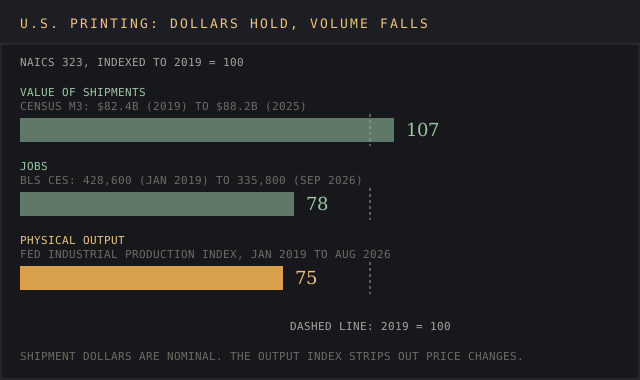
The U.S. prints a quarter less than in 2019 with 22% fewer workers, and still bills 7% more in nominal dollars.
I'll write a 2,500+ word report on the slice you name, from Smithers, BLS and company filings, every figure linked. Yours to publish, from $200.
The global printing industry was worth $868 billion in 2025, according to Smithers' The Future of Global Printing to 2030, and the same report forecasts $969.7 billion by 2030, a compound annual growth rate of 2.2%. Volume in the printing industry tells a different story. A February 2025 Smithers release counted 49.0 trillion A4 prints in 2019 and 44.1 trillion in 2024, a 10% drop in five years.
This report collects the printing industry statistics that research houses, statistics offices and listed printing companies published through October 2026: market size, digital printing against offset printing, packaging and labels, U.S. jobs and output, the largest commercial printers, and the printing industry trends behind each number.
It's written for print buyers, investors and analysts who need a sourced figure, including data hot off the press from 2026 filings, and for commercial printers checking their own year against the printing market. The figures matter to anyone pricing a print contract or a press: U.S. printers bill 7% more than in 2019 on 25% less output, so per-job prices rose while capacity left.
The global printing market in numbers
Smithers values all print products worldwide, from newspapers and books to cartons and labels, at $868 billion in 2025. Its latest forecast puts the printing market at $969.7 billion in 2030 and profiles 50 national markets to get there.
The volume series runs the other way. Global output fell from 49.0 trillion A4 equivalents in 2019 to 44.1 trillion in 2024, while the value Smithers attached to it rose from $887.9 billion to $898.0 billion. Fewer pages, each billed higher: shorter runs, packaging and digital printing carry more value per sheet than the newspaper and magazine pages they replace.
Smithers states its forecasts at constant prices fixed for each report edition (the packaging study uses 2023 pricing), so the $898.0 billion for 2024 and the $868 billion for 2025 come from two different editions and don't chain into a decline.
Why the published estimates of the printing market disagree
Four research houses published a 2025 or 2026 figure for the global market, and they land $548.6 billion apart. The spread comes from scope. Smithers counts all print. Grand View Research and Mordor Intelligence count commercial printing, which they define to include packaging. IBISWorld counts the revenue of commercial printing companies as an industry.
| Publisher | What it counts | Year | Figure | Growth |
|---|---|---|---|---|
| Smithers | All print, global | 2025 | $868.0B | +2.2% a year to 2030 |
| Mordor Intelligence | Commercial printing market | 2026 | $594.24B | +3.45% a year to 2031 |
| Grand View Research | Commercial printing market | 2025 | $510.3B | +3.8% a year, 2026 to 2033 |
| IBISWorld | Global commercial printing industry revenue | 2025 | $319.4B | -3.7% a year over five years |
Copy these lines into an email, fill them in and send. I reply with scope and a price within 2 to 3 business days.
Open the emailGrand View forecasts $675.1 billion by 2033, and Mordor $704.07 billion by 2031. IBISWorld reports revenue falling 3.7% a year for five years, with 197,000 businesses in the industry, down 1.6% a year since 2020.
Two houses see a growing commercial printing industry and one sees a shrinking commercial printing industry, and the devil's in the details: IBISWorld measures what commercial printing companies bill, while the other two size the market for print jobs, packaging included.
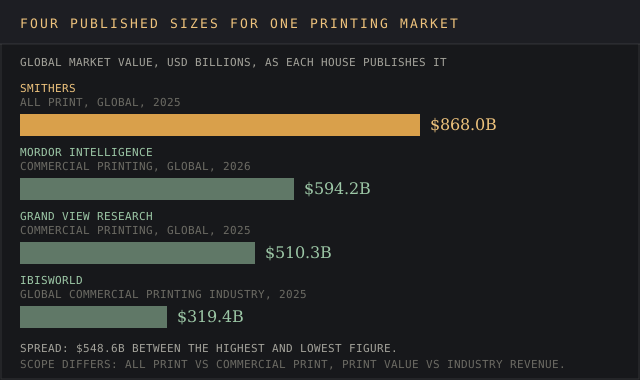
Pick the printing market figure by question. A paper or ink supplier sizing total demand wants Smithers. A buyer of commercial printing services wants Grand View or Mordor, since both count the commercial printing jobs a buyer places. Anyone judging the health of printing companies as businesses wants IBISWorld's revenue series, because it tracks what printers bill.
Commercial printing industry segments
The commercial printing industry covers the jobs a business sends to an outside printer: packaging, labels, catalogs, brochures, direct mail, books, magazines, signage and point-of-sale displays. Packaging takes the lion's share in both houses that split it out, though they disagree on how big a share.
- Packaging: 54.3% of commercial printing revenue in 2025 per Grand View Research; 45.74% per Mordor Intelligence, growing at 4.54% a year.
- Lithography: 44.2% of commercial printing revenue, the largest printing technology segment of commercial printing, per Grand View; Mordor puts offset lithography at 38.62%.
- Paper and cardboard: 61.74% of print materials per Mordor; plastic and synthetic substrates grow fastest at 4.88% a year.
- Large format printing: 41.74% of commercial printing revenue by format per Mordor; direct-to-object printing grows at 4.42% a year.
The publishing industry statistics on this site track the U.S. book trade at $33.4 billion in 2025, and Smithers doesn't expect digital to become competitive for low-value newspaper, magazine and graphics work, where offset printing holds the cost per page on long runs. Traditional methods keep that work.
Digital printing against offset printing
Digital printing technologies, meaning inkjet printing and electrophotography (toner-based laser printing), produced $167.5 billion of print in 2025, according to Smithers. The May 2025 forecast takes that to $251.1 billion by 2035 at constant prices, with volume rising 54.3% from 1.8 trillion to 2.8 trillion A4 prints.
Offset printing still bills more, even with new printing plates to make for every job. The February 2025 Smithers release puts 2025 offset litho revenue at $310.9 billion, with sheetfed litho alone rising from $183.3 billion in 2024 to $194.5 billion in 2029, a 1.4% compound annual growth rate. Digital printing grows at 4.8% a year in value in the same release, to $209.1 billion by 2029.
That release projected 2025 digital printing sales at $175.2 billion, against $167.5 billion in the May release. Set the May figure against the $868 billion total and digital printing sits at roughly 19% of all print.
The economics explain the split:
- Digital printing needs no printing plates, the metal sheets offset makes for every job. A digital file goes straight to the digital printing press, so setup costs fall to near zero and short runs pay.
- Variable data printing, a digital printing feature, changes every sheet: a name, an offer, a barcode. Offset printing can't do that, because its printing plates are fixed once mounted.
- Offset printing wins on cost per page on long runs, which is why long-run magazines and catalogs stay on litho.
- Initial printing equipment costs are steep for small shops. Smithers counts nearly $5.8 billion spent on new digital print machinery in 2025, and small and medium printers face the same cost wall on automation and predictive analytics software.
Inkjet printing is displacing toner as the dominant digital printing process, per Smithers, and it's the printing technology Smithers expects to grow fastest in value. Production printers ran 1,200dpi at 300 metres a minute in 2025, and Smithers expects 2,400dpi by 2030, which brings high resolution output to speeds where offset used to hold the line. Ink and toner sales reached 304,000 tons and $14.5 billion in 2025.
At 2,400dpi, inkjet digital printing delivers high quality prints and high quality images on coated stock, the high quality output brands used to reserve for offset. For high quality prints, the press choice now comes down to run length and the printed materials used.
Digital printing has limits. Some digital prints trail offset and screen work on durability in harsh outdoor conditions, which keeps screen printing in outdoor signage. Specialty inks cured under ultraviolet light dry in seconds without solvent evaporation, and UV-curable printing cuts the volatile organic compound emissions solvent inks release.
Packaging and labels drive the industry's growth
Packaging and label print was worth $517.9 billion in 2024 and is forecast at $618.2 billion by 2029, according to Smithers' Future of Package Printing to 2029. Value and volume both grow 3.6% a year, from 14.3 trillion to 17.1 trillion A4 equivalents. Asia, Western Europe and North America hold 81.5% of the value.
E-commerce feeds that rising demand for packaging print products. Worldwide retail e-commerce sales reached $6.419 trillion in 2025, per the EMARKETER figure in our ecommerce statistics, and every parcel ships in printed corrugated board, one of the print products that grows with online retail, with a printed label on it.
Digital printing is a drop in the bucket of packaging so far. Smithers' November 2025 study puts digital packaging and label print at $22.0 billion in 2025, 1.3% of packaging output by volume and 4.1% by value, growing at 10.9% a year to $36.9 billion in 2030.
| Digital packaging segment | Forecast, 2025 to 2030 |
|---|---|
| Corrugated | Value more than doubles, to $8.2B in 2030 |
| Flexible packaging | 11.6% compound annual growth |
| Labels | 8.0% compound annual growth; 23.3% of digital packaging value; about 8,100 narrow-web presses installed |
| Whole digital packaging market | $22.0B to $36.9B, 10.9% a year |
Sustainable packaging is a separate, overlapping count. Towards Packaging sizes it at $334.43 billion in 2026, rising to $594.46 billion by 2035 at 6.6% a year. Smart packaging, a new printing technology layer with printed QR codes and NFC tags, rides on the same converting lines.
U.S. printing: shipments, output and jobs
U.S. printers shipped $88.2 billion of product in 2025, the sum of the twelve monthly seasonally adjusted values in the Census Bureau's M3 survey. That's 7% above 2019's $82.4 billion. The pandemic year cut it to $76.1 billion in 2020 as print orders were delayed and canceled.
Physical output fell over the same stretch. The Federal Reserve's industrial production index for printing and related support activities read 96.5 in January 2019 and 72.5 in August 2026 (2017 = 100), a 25% drop. The index removes price changes, so the dollar gain reflects higher prices per job.
Want an output-against-shipments chart like this for your country? Send the market and the years.
Email a briefEmployment follows output. The BLS industry profile counts 335,800 jobs in printing and related support activities in September 2026 (preliminary), against 807,000 in January 2000, a 58% fall. Average hourly earnings were $31.54, and the industry ran 27,291 private establishments in the first quarter of 2026.
IBISWorld's U.S. printing report puts 2026 revenue at $81.5 billion, down 4.6% in the year and down 2.1% a year since 2021, across 50,404 businesses. No company holds more than 5% of the market. Most of those printing companies are a print shop with a handful of staff, offering printing services from laser printing of flyers to wide-format signs, which links this market to the small business statistics more than to the listed giants.
Regional breakdown of the printing market
Asia Pacific is the largest region in both houses that publish a split. Grand View gives it over 37.5% of commercial printing revenue in 2025, growing 4.4% a year. Mordor gives it 38.73% and a 4.55% rate through 2031, the fastest of any region.
New markets for the printing industry sit in Asia and in packaging, while North America and Western Europe trade volume for value. That's par for the course in a mature market.
Major commercial printers and their scale
Research houses name the same group of commercial printers when they profile the commercial printing industry. Grand View lists Quad, R.R. Donnelley & Sons, Cimpress, Dai Nippon Printing, Transcontinental, Quebecor and Cenveo. Mordor adds Toppan and Vistaprint. Three publish full-year numbers that show how the industry's growth splits:
| Company | Latest full-year figure | Change | Source |
|---|---|---|---|
| Cimpress (Vista) | $3.7B revenue, fiscal 2026; about 16,000 full-time staff | About +10% | Form 10-K, fiscal year to 30 June 2026; growth per ASI, 30 July 2026 |
| Quad | $2.4B net sales, 2025; about 10,000 staff in 10 countries | -9.4% (-4.8% excluding the European divestiture) | Quad, 17 February 2026 |
| HP Inc. printing segment | $4.3B net revenue, Q4 fiscal 2025 | -4%; hardware units -12% | HP, 25 November 2025 |
- The print segment, region or technology to cover
- Regions, years and segments
- Where it runs: blog, white-label, gated or lead magnet
- Whose byline goes on it
- Deadline
- 2,500+ words, human-written
- Every figure linked to its source
- Yours to publish, under your name or none
- Hosting here for +$200, with your sponsored links
Read between the lines and the split is clear. Cimpress sells customized printing from digital printing presses and web to print solutions to small businesses online and grew; Quad prints long-run catalogs, inserts and magazines and shrank, guiding 2026 sales down another 1% to 5%. HP sells the print devices.
Consolidation is the other lever. Quad divested its European operations, which took 4.6 points off its 2025 sales, and IBISWorld expects mergers to continue as printing companies look for steadier revenue.
Print on demand, cloud printing and web-to-print
Print on demand is the fastest-growing slice of the printing services market and of digital printing, a printing technology business run through web storefronts. Grand View Research sizes it at $10.8 billion in 2025, rising to $57.5 billion by 2033 at 23.6% a year. Apparel holds 39.5% of the market and North America 36.0%. The platforms named are Printful, Printify, Gelato, Gooten, CustomCat, Zazzle, Redbubble, Canva and Vistaprint.
The model reduces overproduction: nothing gets printed until someone orders it, so inventory costs and unsold stock both fall toward zero. The same logic sits behind web to print solutions, where a customer uploads a digital file to a printer's storefront and the order flows into the press queue through workflow automation.
Cloud printing is smaller. Future Market Insights values cloud printing services at $1,827.7 million in 2025 and $4,374.6 million by 2035, a 9.1% rate. Hybrid presses, new printing technologies that combine digital printing and flexo or offset units on one line, were worth $5.5 billion in 2023 and are forecast at $10.2 billion by 2028, per MarketsandMarkets.
Printing industry trends for 2026
Five printing industry trends shape the printing market in the sources above, and these emerging trends rank by money moved. Keep an eye on the first two. Printing technology and customer preferences change, and commercial printing is constantly evolving at both ends.
Personalized printing and direct mail
Personalized printing turns marketing materials into personalized campaigns and personalized marketing materials, and variable data printing is how printers sell it. USPS delivered 56.8 billion Marketing Mail pieces in fiscal 2025, down 1.3% in the year, while revenue from that class rose 2.3% to $15.7 billion, per its fiscal 2025 results.
USPS delivered 56.8 billion Marketing Mail pieces in fiscal 2025, down 1.3%, while revenue from that class rose 2.3% to $15.7 billion.
Marketing Mail pieces USPS delivered in fiscal 2025
Source: USPSe.g. direct mail volume in your country
Source: linked, checked, datedOur direct mail statistics cover the 161% ROI the ANA measured on direct mail campaigns to house lists, the strongest case for print as a channel that lifts customer engagement. Customer engagement on a house list is what the printing solutions behind variable data printing sell, to consumer brands and to the business marketers whose budgets our B2B marketing statistics break down.
Personalized printing solutions from commercial printers, a market of printing solutions sold per item, also cover promotional materials and personalized products: mugs, apparel, labels. They match customer demands for one-off items, and they're the work digital presses win on setup cost.
Sustainable printing and eco friendly practices
Eco friendly printing in practice means recycled materials, tree-free paper from agricultural waste, water-based or vegetable-based inks, UV curing that replaces solvent drying, and print-on-demand runs that cut waste. Each of those sustainable practices removes a measurable input: VOC emissions, virgin fiber or unsold stock. Printers without them risk missing the boat as sustainable packaging grows 6.6% a year, per Towards Packaging.
Consumer preferences and customer preferences for print
Two Sides' Trend Tracker 2025, a Toluna survey of 12,400 consumers run in January 2025, found 65% of European consumers prefer printed books, up from 53% in 2021; magazines rose from 35% to 48% and catalogs from 21% to 33%. Two Sides promotes paper, so treat this consumer behavior data as advocacy research. Customer engagement with printed materials shows up in the same data: 47% of respondents prefer medical leaflets in print.
Automation, AI and augmented reality
Automation is the printing technology answer to the labor gap: workflow automation, automated prepress and quality control software are how printers hit production efficiency targets with fewer staff. PRINTING United Alliance's May 2026 State of the Industry report, built on more than 250 printing companies, gives a full section to AI-powered predictive analytics.
Digital printing technologies also add a layer: augmented reality ties printed materials to video through a phone camera; our augmented reality statistics track 350 million daily AR users on Snapchat alone.
Advertising budgets moving online
The last of the printing industry trends is a loss. IBISWorld attributes most of the global revenue decline to digital media pulling attention and advertising budgets away from print. The advertising industry statistics show where that money went. Traditional printed materials such as retail inserts and catalogs lose the most in the printing market, while packaging gains from the same store and online sales our retail industry statistics track.
Constraints on printing companies
Labor is the first constraint, and no printing technology has closed it yet. U.S. printing employment fell 58% between 2000 and 2026. Australia's Print & Visual Communication Association found 76% of print businesses had job vacancies in its 2023 Industry Skills Report, 58% of them for printing machinist and finishing roles, and 94% were dissatisfied with applicants' skills.
Costs are the second. IBISWorld reports U.S. printer profit squeezed by higher input costs and tariffs, and paper, ink and freight prices pass through the supply chain into every quote. Printing equipment is the third, and it hits commercial printers of every size: a new digital press costs an arm and a leg for a small print shop.
Market dynamics add the fourth constraint on the printing industry. Advertising budgets, postal rates and retailer catalog plans set demand for print products, and none of them is set in stone. Printers that want to remain competitive move into packaging, labels and signage, where rising demand offsets the loss in publication work.
What the forecasts leave out
Every printing market forecast above models value, and most model it at constant prices. None of them publishes a margin. That's the number commercial printers care about, and the Quad and Cimpress filings are the closest public proxy: Quad guided 2026 adjusted EBITDA at $175 million to $215 million on sales falling 1% to 5%.
The forecasts also treat print segments and their market dynamics as fixed. Printing industry trends and future trends show up first in equipment orders and job postings, which none of these houses publish.
Delivered for your site and your byline. Hosting here is optional.
Frequently asked questions
Is the printing industry growing or declining?
Both, depending on the measure. Smithers forecasts global print value rising 2.2% a year to $969.7 billion in 2030, while global volume fell 10% between 2019 and 2024 and U.S. physical output fell 25% between January 2019 and August 2026. Packaging and labels grow; newspapers, magazines and catalogs shrink, and so does commercial printing in IBISWorld's revenue count.
How large is the printing industry?
Smithers puts all print worldwide at $868 billion in 2025. Commercial printing alone runs from $319.4 billion (IBISWorld, 2025) to $594.24 billion (Mordor Intelligence, 2026), depending on how much packaging each house counts. U.S. printers shipped $88.2 billion in 2025.
What are the key trends in the print industry for 2026?
The printing industry trends for 2026 are the move to packaging and labels as e-commerce grows, digital printing and inkjet displacing laser printing toner, print on demand and web-to-print ordering, sustainable printing and eco friendly practices, and automation to cover the labor shortfall.
Are printing jobs in demand?
Fewer jobs exist each year: 335,800 in U.S. printing in September 2026, down from 428,600 in January 2019. Press and finishing roles stay hard to fill: in Australia, 58% of open print vacancies in the PVCA's 2023 survey were machinist and finishing jobs.
What are the top 5 commercial printing companies in the world?
No ranking by revenue is published across all of them, but research houses consistently name R.R. Donnelley & Sons, Quad, Cimpress, Toppan and Dai Nippon Printing. Cimpress reported $3.7 billion in fiscal 2026 revenue and Quad $2.4 billion in 2025 net sales.
Is print-on-demand still profitable in 2026?
The market keeps growing: Grand View Research forecasts 23.6% a year from $13.1 billion in 2026. Cimpress, which runs Vistaprint, grew revenue about 10% in fiscal 2026.
What are some examples of commercial printing?
Print products from commercial printing services include packaging and labels, catalogs, brochures, direct mail, books, magazines, signage, banners, point-of-sale displays, and promotional materials such as branded apparel. Short runs of high quality prints go to digital printing.
Bottom line
The printing industry statistics agree on direction more than on size. Value holds or grows slowly at $868 billion and 2.2% a year, the number of pages falls, and the work moves from publications to packaging, labels and short digital printing runs.
For a buyer, that means more commercial printers chasing packaging and personalized work, and fewer with long-run litho capacity for the commercial printing jobs that still need it. For anyone tracking printing industry trends, in a nutshell: count pages and the industry shrinks, count dollars and it holds.
Printers, press makers and packaging suppliers publish reports like this one as trade content and sales collateral.
A report on your topic for a blog page, gated content or a lead magnet.
Written for your client and published under their brand, with my name left off.
Your report on marketintelligencetools.com, with 2 to 3 CTAs carrying your sponsored links.
Default terms: the report is yours to publish, and I keep the right to republish it on this site behind a gate, outside Google's index.
The research houses, statistics offices and filings behind each printing figure, and the margin nobody publishes
Smithers: smithers.com (The Future of Global Printing to 2030; releases of January, February, May and November 2025 on package printing, offset and digital print, and digital packaging).
Other research houses: grandviewresearch.com (commercial printing market; print on demand market), mordorintelligence.com (commercial printing market), ibisworld.com (global commercial printing and U.S. printing industry reports), towardspackaging.com (sustainable packaging market), futuremarketinsights.com (cloud printing services market) and marketsandmarkets.com (hybrid printing).
Official series: fred.stlouisfed.org (BLS employment series CES3232300001, Census M3 shipments series A23SVS, Federal Reserve industrial production index IPG323S) and bls.gov (industry profile for printing and related support activities, NAICS 323).
Company results: sec.gov (Cimpress Form 10-K, fiscal year to 30 June 2026), members.asicentral.com (30 July 2026), quad.com (fourth-quarter and full-year 2025 results, 17 February 2026), hp.com (fiscal 2025 results, 25 November 2025) and about.usps.com (fiscal 2025 results).
Surveys: paperage.com (Two Sides Trend Tracker 2025, 17 June 2025), printing.org (PRINTING United Alliance State of the Industry 2026, May 2026) and print21.com.au (PVCA Industry Skills Report, 2023).
Every figure was checked against its source on 15 October 2026. Smithers states each edition at its own constant prices, so totals from different editions don't chain into a trend, and no house named here publishes a margin for printers.