Residential proxies pricing in 2026: what 9 providers charge per GB and per IP
 By Jan Suski. I go deep on every review, checking every number against its source and digging up details other coverage misses, a habit from six years of SEO and link building for tech companies. Bylines at Surfer, Brand24, and Senuto. How the scoring works.
The numbers Residential proxies pricing, checked 6 October 2026
The same 100 GB of US traffic through rotating proxies costs $200 a month at Rayobyte and $500 at Oxylabs on published self-serve plans.
Sourcing is a budget line: NetNut's customers lost their proxy network on 2 July 2026, when the FBI seized its domains.
The exit country moves the price as much as the provider does: SOAX bills a US gigabyte at 2.5 times a tier 3 gigabyte on the same account.
Residential proxies cost from €2.90* to $8 a GB at the smallest published tier in October 2026. Aethyn sells 10 GB for €29*. Bright Data lists no-commitment traffic at $8 and halves it to $4 with a coupon code printed on its own pricing page.
Commit to volume and the floor drops to $0.70 at Rayobyte and $2.50 at the two largest pools. This report compares nine residential proxy providers on their own rate cards, the three billing units they use, the commitment rules, and the metering clauses that decide what a gigabyte means on the invoice. At 100 GB a month, the gap between the cheapest and the most expensive published plan is $300, or $3,600 a year, for the same traffic.
It's written for teams buying proxies for web scraping, ad verification, price monitoring and market research. The scraping-API side of the same budget sits in our web scraping pricing report, and the tools that buy this traffic are ranked in our web scraping tools ranking.
*Aethyn publishes its prices in euros only. At the ECB reference rate of $1.1269 per euro on 6 October 2026, €2.90 is about $3.27 and €29 about $32.68.
How residential proxies are priced: per GB, per IP or per concurrent request
Three billing units cover almost every plan on sale, and each one punishes a different workload.
- Per GB. The default for rotating proxies on a residential pool. Bright Data's billing FAQ counts HTTP request headers, request body, response headers and response body, so every byte in both directions is billable. SOAX also counts partial responses, retries and interrupted connections, and defines 1 GB as one billion bytes.
- Per IP. The default for static residential and ISP proxies. Webshare charges $0.30 per proxy a month at 20 proxies and $0.225 at 10,000. Shared ISP proxies on the same 400M-IP network run $1.80 per IP at 10 IPs and $1.30 at 1,000.
- Per concurrent request. Rayobyte's Scale Residential sells 6,600 GB for $100 a month ($0.0150/GB) but caps the account at one concurrent request per $1 of plan, with no geo targeting and a compliance review before access.
The network type sets the price band first. Residential IP addresses are the ones an internet service provider assigns to a home internet connection, so a request routed through one looks like an ordinary household user to the target site.
That pricing-page FAQ says rotating residential IPs keep a scraper from getting "flagged or blocked", points them at "the most sophisticated websites" and calls datacenter IPs "machine-generated", the most cost-effective option for mass crawling.
Datacenter proxies come from server farms. ISP proxies are residential IPs registered to an internet provider but hosted on servers, sold as static IPs that don't rotate. Mobile proxies handle routing through carrier networks, where Rayobyte says each IP is shared by many phone users; its mobile plans start at $3/GB on a $250 monthly plan.
Residential proxy providers compared on published price
Every figure in the comparison below, for rotating proxies on a residential pool, comes from the provider's own pricing page, read in October 2026 in a rendered browser session, since most proxy pricing pages load their numbers with JavaScript. Taxes are excluded.
| Provider | Smallest published option | Around 100 GB a month | Lowest published rate | Billing model |
|---|---|---|---|---|
| Bright Data | $8/GB, no commitment ($4 with coupon) | $499 for 141 GB ($3.50/GB with coupon) | $5/GB list, $2.50 with coupon, 798 GB | Prepaid balance or monthly commitment |
| Oxylabs | $30 for 5 GB ($6/GB) | $500 for 125 GB ($4/GB) | $2.50/GB, 1 TB for $2,500 | Monthly plan plus top-ups |
| Decodo | $4/GB from a wallet; $11.25 for 3 GB | $275 for 100 GB ($2.75/GB) | $2/GB at 1 TB | Monthly plan or wallet credit |
| SOAX | $5/GB (US) on the free Sandbox | $300 for 100 GB (US, Builder) | From $0.85/GB (US), $3,000 plan | Monthly plan, credits expire in 60 days |
| IPRoyal | $7.35 for 1 GB | $5.51/GB at 10 GB, the last listed tier | $1.84/GB from 10 TB | One-off orders, traffic never expires |
| Webshare | $3.50 for 1 GB | $225 for 100 GB ($2.25/GB) | $1.40/GB at 3,000 GB | Monthly, or yearly at 30% off |
| Rayobyte | $3.50/GB, 1 to 49 GB | $200 for 100 GB ($2/GB) | $0.70/GB at 1,000 GB; $0.50 via sales | One-off orders, tiered by size |
| Aethyn | €29* for 10 GB (€2.90*/GB) | Not published | Elite pool: €65* for 10 GB | Subscription or one-off |
Every price in this table is the provider's own list price, taken from its pricing page. *Aethyn publishes prices in euros only: at the ECB reference rate of $1.1269 per euro on 6 October 2026, €29 is about $32.68, €2.90 about $3.27 and €65 about $73.25.
NetNut, the ninth provider, has no rate card to compare. Its pricing page displayed an FBI seizure notice when we loaded it on 6 October 2026.
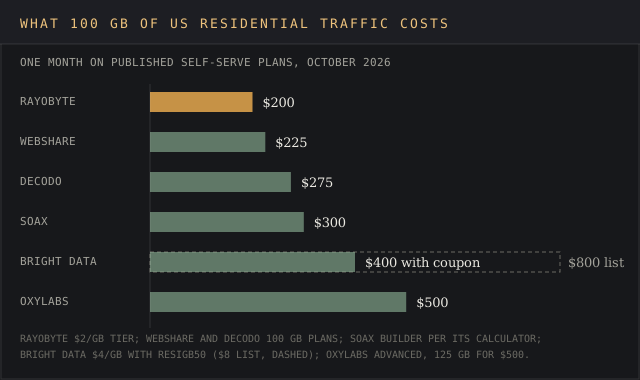
What each provider charges in October 2026
Bright Data
Bright Data's pricing starts at $4/GB with the coupon and $8 at list, and new accounts start on a free trial. The biggest pool claim here, 400M+ IPs in 195 countries, comes with the widest gap between list and sale price. The rotating residential plans, with the 50% RESIGB50 coupon applied:
- No commitment: $8/GB list, $4 with coupon, no strings attached
- $499 a month: 141 GB at $3.50/GB ($7 list)
- $999 a month: 332 GB at $3/GB ($6 list)
- $1,999 a month: 798 GB at $2.50/GB ($5 list); above 1 TB, sales quotes the rate
The devil's in the details. The page's own meta description still says "Starting from $5.88/GB", a third price for the same product and the kind of mismatch our software pricing errors report tracks. An unused monthly commitment doesn't roll over, and the daily spend limit on an account is checked every 15 minutes, so a zone can overshoot its cap by 15 minutes of traffic.

Residential rate card
Check Bright Data's residential pricing
Rotating residential proxies at $8/GB with no commitment, $4 with the RESIGB50 coupon, down to $2.50/GB with the coupon on the $1,999 plan. Residential access requires a business KYC check.
 Visit Bright Data →
May earn a commission if you sign up through this link, at no extra cost to you. Full affiliate disclosure.
Residential and mobile IPs require a KYC check on each account, and the residential FAQ limits them to registered businesses with a corporate email domain. New users get their first deposit matched up to $500, and trial traffic isn't billed. Our Bright Data review covers the scraping API side, and the MCP server review covers agent use. One Trustpilot reviewer described the KYC queue in August 2026:
"we were repeatedly asked for a "Certificate of Incorporation." We submitted our official LLC formation documents (Articles of Organization), yet the compliance team continued to insist"
MoveZilla Office, Trustpilot, 7 August 2026. Read the review.
Oxylabs
Oxylabs sells four monthly plans on its residential page:
- Starter: 5 GB for $30 ($6/GB), top-ups up to 100 GB
- Basic: 20 GB for $100 ($5/GB)
- Advanced: 125 GB for $500 ($4/GB), top-ups up to 2 TB
- Corporate: 1 TB for $2,500 ($2.50/GB)
It claims 175M+ IPs across 195 locations, sticky sessions, HTTP(S), HTTP3 and SOCKS5, 24/7 support and an average 99.95% success rate. Read between the lines of the FAQ: the residential network blocks all Apple domains, banking, some Google domains, government sites, streaming, ticketing and mailing targets.
The refund policy covers requests filed within 3 calendar days of the first transaction, with under 20% of the traffic used. Trustpilot reviewer Kevin J. wrote in June 2026 that Oxylabs first told him his "purchase" fell outside "their 3-day refund period", then refunded him. Our Oxylabs comparison runs the two largest pools head to head.
Decodo (formerly Smartproxy)
Decodo has the flattest ladder of the large providers: $3.75/GB on a 3 GB plan, $3.50 at 10 GB, $3.25 at 25 GB, $3 at 50 GB and $2.75 at 100 GB, then Enterprise plans from $2.50 at 250 GB down to $2 at 1 TB. The no-commitment option costs $4/GB, runs through a prepaid wallet, sells one GB at a time, and can't run alongside a monthly subscription on the same account.
The pool claim is 115M+ ethically sourced IPs in 195+ locations, with HTTP(S) and SOCKS5 support, targeting by country, state, city, ZIP code and ASN, rotating proxies per request or sticky sessions held for up to 30 minutes, and 24/7 tech support.
New users get a 3-day trial with 100 MB, and the chosen plan activates automatically when the trial ends unless it's cancelled first. Trustpilot reviewer Javier Mejia wrote in September 2026: "They charged me after I cancelled the trial".
Decodo, the former Smartproxy, backs its $4/GB no-commitment rate and its plans with a 14-day money-back option on the first order, but the option excludes anyone who took the trial, so the auto-activation is a red flag for teams that sign up to test and forget.
SOAX
SOAX sells rotating proxies on plans, credits and geo tiers. Plans run from a free Sandbox to Builder at $200, Team at $500, Scale at $1,500 and Enterprise at $3,000 a month. One rate covers its residential and mobile networks, and targeting runs to country, regions, city and ISP from the first paid plan.
SOAX's own calculator prices 100 GB connecting through US IPs at $300 on Builder, an effective $3/GB. Credits on a monthly plan expire 60 days after they land, support is basic on Sandbox and 24/7 on paid plans, and payments are "generally non-refundable" under its FAQ. Metering is where buyers dig in. A stitch in time saves nine: keep your own byte counts to prove a dispute, as this reviewer says he did:
"I have every GB logged and they are claiming I used 3x the traffic I really used. What a total waste of $50. Now I understand why the minimum top-up is $25."
Marcelo Trevino, Trustpilot, 15 August 2026. Read the review.
IPRoyal
IPRoyal's residential proxies start at $7/GB on a 1 GB subscription and drop to $1.75/GB from 10 TB, and the traffic never expires. Subscriptions take 5% off; one-off orders run $7.35/GB for 1 GB, $6.25 for 2 GB and $5.51 for 10 GB, falling to $1.84 from 10 TB.
The pool claim is 64M+ IPs in 195+ countries. Among its unique features, no expiry suits a team that buys 10 GB and spreads it across a year, where SOAX credits would lapse after 60 days.
Webshare
Webshare publishes the cheapest 100 GB price after Rayobyte. Rotating residential proxies run $3.50 for 1 GB, $2.75/GB at 10 GB, $2.60 at 25 GB, $2.25 at 100 GB and $1.40 at 3,000 GB, against a struck-through $7 list on each card; yearly billing takes 30% off.
Static residential plans bill per proxy, from $6 a month for 20 proxies. The free account gives 10 datacenter proxies with HTTP and SOCKS5 support and no credit card, a proxy list for testing scripts before paying for residential proxies.
Rayobyte
Rayobyte prices Premium Residential by order size: $3.50/GB for 1 to 49 GB, $2 for 50 to 249 GB, $1.50 for 250 to 999 GB and $0.70 for 1,000 to 4,999 GB, with enterprise rates from $0.50 through sales.
Every tier includes country, city, ZIP code and ASN targeting and sticky sessions. Scale Residential undercuts that more than 70 times over, at $0.0095/GB on the $5,000 plan, with strings attached: concurrency is the meter there. Rayobyte's HTTP/3 proxies run on the same residential network at Premium Residential prices, and every self-serve product, Premium Residential included, has a free trial with no credit card.
Aethyn and NetNut
Aethyn's structured pricing markup lists a Premium Residential starter at €29* for 10 GB and an Elite pool, sold on "higher-trust residential exits and advanced targeting", at €65* for the same 10 GB. That 2.2x markup is the clearest published price on IP reliability in this set. NetNut, owned by Alarum Technologies, sold residential proxies until July 2026; the sourcing section below covers what happened.
What moves the cost: volume, location, targeting and performance
Volume is the biggest lever on every card. A larger bundle cut the rate by 27% at Decodo (3 GB to 100 GB), 60% at Webshare (1 GB to 3,000 GB) and 80% at Rayobyte (first tier to 1,000 GB). The $8 list ladder falls a shallower 37.5%, to $5.
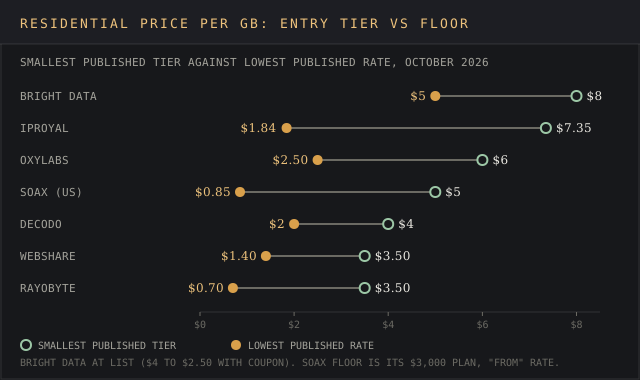
Exit location is the second lever, and only SOAX prices it openly. It sorts countries across the globe into three geo tiers "based on the cost of serving each market", with the United States in tier 1 and India in tier 2. On Builder the same gigabyte costs $3 connecting through a tier 1 country, $2.25 through tier 2 and $1.20 through tier 3.
Targeting by country, regions and city is mostly free. The 400M-IP network includes country, state, city, ZIP and ASN targeting at no charge, Oxylabs lists free geo-targeting down to city and ZIP code, and Decodo includes ASN-level targeting on every plan. SOAX holds ZIP and ASN targeting back for its $1,500 Scale plan, and Rayobyte's Scale Residential has no targeting at all.
Session control decides how much traffic a job burns. Rotating proxies hand out a fresh IP on every request, which lowers block pressure during high-frequency web scraping. Sticky sessions keep one IP for a login, a checkout or a paginated crawl.
Providers sell fast speeds with average response times (under 0.5 seconds at Decodo, 0.6 seconds at Oxylabs) and success rates that sit close together: 99.95% at Oxylabs and 99.92% at Decodo, from a Proxyway test.
Those performance claims matter because SOAX bills retries as traffic. Retry logic that resends a failed HTTP request five times pays for it five times, so reliable routing is a cost line as much as a performance one. Watch the success rate on your own key targets closely during a trial.
Hidden costs in residential proxy billing
The rate card is where the bill starts. Two clauses add to it on top of the expiry and refund terms in each provider section:
- Metering scope. HTTP headers count at Bright Data; retries and interrupted connections count at SOAX. Rotating residential proxies on a JavaScript-heavy web page bill every script and image loaded through the proxy.
- Blocked targets. Oxylabs blocks banking, ticketing and some Google domains on residential, and the 400M-IP network rejects search-engine targets on residential and points users to its separately priced SERP API. A rank tracker needs that budget line, priced in our DataForSEO pricing report and rank tracker pricing report.
Metering disputes recur across providers. An Oxylabs customer, writing on Trustpilot in July 2026 about a team with "extensive background in backends", reported:
"Their proxies will work great for about 1 month and then certain targets will up data usage by 100x+ and then they'll claim it's due to "intensive usage""
Cody Elliott, Trustpilot, 29 July 2026. Read the review.
Product labels cause the other recurring bill. A customer of the 400M-IP network who bought ISP proxies expecting home IPs got this answer from support, in a review posted on 31 August 2026:
"a slow and useless AI responded that 'ISP proxies are server-hosted' so I will be getting data center ip"
RAY, Trustpilot, 31 August 2026. Read the review.
A Decodo reviewer reported the KYC version of the same problem in September 2026:
"You complete KYC, deposit money, but then they tell you that you can't use their services"
AvAv, Trustpilot, 13 September 2026. Read the review.
Where residential IPs come from, and what sourcing does to the price
Residential IP addresses belong to somebody's home internet connection, so a pool is only as clean as the consent behind it. When consent is missing, the cost lands on the buyer the day the network goes dark.
Bright Data's own history starts with a VPN. In May 2015 PCWorld reported that the free Hola VPN sold its users' bandwidth through a separate service called Luminati, and that a hacker had used Luminati to attack the 8chan message board. Luminati Networks is the company's former name, per Vendr's profile. Today its residential page says its IPs come from "peers who have explicitly agreed to participate".
Smart TVs tested that claim in 2026. Krebs on Security reported on 21 July 2026 that the proxy-tracking firm Spur found residential proxy SDKs in more than 42% of apps on LG's webOS and more than a quarter of Samsung Tizen apps, that proxy providers pay app developers to include them, and that Bright Data accounted for a majority of those SDKs on both platforms.
LG said apps that kept the function would be suspended. The company told Krebs: "Every peer opts in through a dedicated screen and receives value in return." Spur's Trevor Sutter disagreed:
"A one-time consent prompt buried in a TV app is not a substitute for meaningful transparency, ongoing control, and platform oversight."
Trevor Sutter, Spur, quoted by Krebs on Security, 21 July 2026.
NetNut shows the downside in dollars. On 2 July 2026 the FBI and IRS Criminal Investigation seized NetNut's domains, and Krebs reported that the network relied on the Popa botnet: at least 2 million compromised smart TVs, streaming boxes and Android devices.
Google's threat intelligence group counted 316 distinct threat-actor clusters using suspected NetNut exit nodes in a single June week. Krebs also reported that Google had seized infrastructure belonging to IPIDEA, NetNut's biggest competitor, earlier in 2026.
Alarum Technologies, NetNut's Nasdaq-listed parent, announced on 4 July 2026 that it would "temporarily pause traffic through the relevant network services for several days". For businesses that had put all their eggs in one basket, every scraper on that network was dead in the water. A pool sold as ethically sourced IPs at a higher rate is partly insurance against that outcome, and the price gap is the premium.
Lawsuits against Bright Data and how they ended
The company has faced two federal suits from the platforms it scrapes. Both ended before trial:
- Meta Platforms v. Bright Data. On 23 January 2024, Judge Edward Chen ruled that its logged-out scraping of public pages didn't breach Meta's terms. Meta dropped its remaining claims in February 2024 and waived its right to appeal, Kieran McCarthy reported on Eric Goldman's Technology & Marketing Law Blog.
- X Corp v. Bright Data, May 2024. Judge William Alsup dismissed X's claims, warning against "information monopolies", CNBC reported.
- November 2024. Alsup let X revive claims that scrapers strained its servers, while still barring claims over users' posts, per MediaPost.
- June 2025. The parties settled on confidential terms; CEO Or Lenchner said the company would keep offering its services, Bloomberg Law reported.
The X case closed with its server-load claim still live and the settlement terms sealed, so the Meta ruling is the only final decision of the two, and on the server-load theory the jury's still out.
What buyers pay in practice
Vendr's profile puts the median annual Bright Data contract at $27,000, with a low of $2,500 and a high of $54,120. That median is about $2,250 a month, a little above the $1,999 plan that includes 798 GB at the coupon rate. A 100 GB month is a drop in the bucket next to it.
For that 100 GB of US traffic, the published self-serve options rank as follows: Rayobyte $200 (the $2 tier), Webshare $225, Decodo $275, SOAX $300 (Builder plus credits, per its calculator), Bright Data $400 with the coupon or $800 at list, and Oxylabs $500 (Advanced, the smallest plan covering 100 GB).
IPRoyal lists no tier between 10 GB and 10 TB, so it's left out. Three providers in the table stop publishing prices at 1 TB a month, and above that the rate comes from a sales call.
Residential proxies against datacenter, ISP and mobile proxies
Datacenter addresses are a dime a dozen next to residential ones: on the same 400M-IP network, datacenter proxies cost $0.60/GB against $8 for residential, or from $1.40 per IP a month for 10 shared IPs on the datacenter pricing page. Webshare's datacenter plans start at $2.99 a month for 100 proxies. Those suit sites with light bot defenses, the mass crawling of non-sophisticated targets that the same FAQ describes.
Static ISP proxies suit accounts that need one stable IP address for weeks, such as ad verification logins. Mobile proxies start at $3/GB at Rayobyte, and SOAX bills mobile at its residential rate.
Market research teams pricing a one-country crawl can start from the 100 GB column. Teams tracking competitor prices or ad placements can price all four from the tables above, alongside our pricing intelligence ranking, ad intelligence software ranking and market research cost report.
Frequently asked questions
How much do residential proxies cost per GB?
Published rates for rotating proxies in October 2026 run from €2.90 to $8 a GB at the entry tier and from $0.70 to $5 at the largest self-serve tier. At 100 GB a month, published plans land between $2 and $4 a GB with current coupons applied, and exit regions move the rate at SOAX.
What does a proxy server cost per month?
A cheap datacenter proxy costs cents: Webshare charges $2.99 a month for 100 proxies. A static residential IP costs $0.225 to $0.30 a month at Webshare and $1.30 to $1.80 for a shared ISP IP on the 400M-IP network.
How do I get a free residential proxy?
Through a trial. Decodo gives first-time accounts 100 MB for 3 days, Rayobyte offers a free trial with no credit card, and the 400M-IP network doesn't bill trial traffic. SOAX offers a free Sandbox plan with no credits included, and Webshare's 10 free proxies are datacenter proxies.
Are residential proxies illegal?
Buying them is a routine commercial purchase from companies such as Oxylabs, Decodo and Webshare. The legal exposure sits in how the IPs were sourced and what the traffic does: NetNut's domains were seized in a botnet case, and the Meta and X suits turned on logged-out scraping of public pages and server load.
Bottom line
The residential proxies price on a rate card is a starting point. The key variables behind the cost per useful page are what the meter counts, how long purchased traffic lives, which targets the network blocks, and how the pool was sourced.
For a 100 GB month of rotating proxies, Rayobyte, Webshare and Decodo publish the lowest prices. Bright Data and Oxylabs charge more for bigger pools and stricter onboarding, and the larger of the two halves its list price with a coupon for now. Paying more per GB for a reliable pool with documented consent buys continuity. Keep an eye on sourcing: the July 2026 NetNut seizure turned a working proxy network into a total loss for its customers overnight.
Where each residential proxy price was read, and the rates nobody prints
Rate cards come from each provider's own domain: brightdata.com and docs.brightdata.com, oxylabs.io, decodo.com, soax.com, iproyal.com, webshare.io, rayobyte.com and aethyn.io. NetNut's pricing page on netnut.io showed an FBI seizure notice on 6 October 2026. The Bright Data contract median, low and high are the header stat block on vendr.com. The success rates come from a Proxyway test.
Customer quotes are Trustpilot reviews on trustpilot.com, posted between June and September 2026 and dated where quoted. Sourcing coverage comes from krebsonsecurity.com (21 July 2026 on smart-TV SDKs, July 2026 on the NetNut seizure), pcworld.com (May 2015, on Hola and Luminati) and Alarum Technologies' statement on globenewswire.com (4 July 2026).
Lawsuit outcomes come from blog.ericgoldman.org (February 2024), cnbc.com (10 May 2024), mediapost.com (November 2024) and news.bloomberglaw.com (June 2025). Euro prices are converted at the ECB reference rate published on ecb.europa.eu for 6 October 2026.
Every figure was checked against its origin on 6 October 2026. Aethyn prints no price near 100 GB, IPRoyal lists no tier between 10 GB and 10 TB, Rayobyte's $0.50 enterprise rate comes only through sales, and three providers send anything above 1 TB a month to a sales call.