Bright Data vs Oxylabs
 By Jan Suski. I go deep on every review, checking every number against its source and digging up details other coverage misses, a habit from six years of SEO and link building for tech companies. Bylines at Surfer, Brand24, and Senuto. How the scoring works.
· Prefer this source on Google
| WHAT EACH ONE DOES | BRIGHT DATA | OXYLABS |
|---|---|---|
| Core job | Proxies + datasets | Proxies + AI Studio |
| Residential pool | 400 million+ IPs | 175 million+ IPs |
| Datacenter coverage | 98 countries, one tier | 38 to 188 by tier |
| Geo-targeting | ZIP, carrier, ASN | Coordinate-level (SERP) |
| AI dev tooling | MCP server, free | OxyCopilot, free |
| Datasets model | Self-serve, $250 min | Sales-gated, $400/mo |
| Status transparency | Marketing bullets | Live %, by component |
| Skip it if | You need EU-first HQ | You need the biggest pool |
| WHAT YOU GET | BRIGHT DATA | OXYLABS |
|---|---|---|
| Entry residential price | $4/GB, promo | $6/GB, Starter |
| Top-tier residential price | $5/GB at 798GB, $2.50 promo | $2.50/GB at 1TB |
| Free trial | 5,000 credits/mo, no card | 2,000 results, no card |
| KYC approval rate | Not published | ~75%, published |
| SOC 2 scope | Full, on request | 2 products only |
| Patent litigation | 2 patents invalidated | Won Fed. Cir. appeal |
| Ownership, HQ | Private, EMK Capital | Private, Vilnius LT |
| Customer base claim | 50,000+ orgs | 15,000+ clients |
StrongerWeakerNo edge
Thirty-three further documented limits sit behind the button below: proxy tiers by product, certification scope, litigation history and what neither vendor publishes. Prices and certification scope are read directly from brightdata.com and oxylabs.io, accessed 6 September 2026. Litigation facts come from Oxylabs' own legal-timeline page, checked against the Federal Circuit and USPTO dates it names; Bright Data publishes no equivalent account.
| Bright Data | WHAT IT DOCUMENTS |
|---|---|
| ISP proxy pool | 1.3M+ IPs |
| ISP proxy pricing | $1.80/IP (10) to $1.30/IP (1,000), shared |
| Datacenter pricing | $1.40/IP (10) to $0.90/IP (1,000); $0.60/GB PAYG |
| Browser API | $8/GB PAYG; 5,000 free credits ≈ 1GB |
| Web Unlocker PAYG | $1.50*/1,000 requests; Scale $499/mo = 383K |
| SERP API PAYG | $1.50/1,000 requests, 195 countries |
| Web Scraper API PAYG | $1.50/1,000 records; Scale $499/mo = 384K |
| Dataset refresh discount | Up to 80% off, monthly refresh cadence |
| ISO certification | ISO/IEC 27001:2022; combined 27017/27018 PDF |
| SOC 3 report | Public PDF, June 2024 to May 2025 |
| CSA STAR listing | Third-party registry, linked from Trust Center |
| PwC assurance report | Independent report, Bright Data-commissioned |
| Founding, ownership | 2014 as Luminati; EMK Capital since 2017 |
| Revenue claim | ARR "surpasses $300M," self-reported, 2025 |
| Patent portfolio | 5,500+ granted patent claims, self-reported |
| Status page | 11 named components, regional datacenter map |
| Mobile proxy history | Launched 2017; absent from current pricing nav |
| Oxylabs | WHAT IT DOCUMENTS |
|---|---|
| Dedicated ISP pricing | $3.20/IP (5) to $2.50/IP (300) |
| Shared ISP pricing | $1.60/IP (10) to $1.20/IP (500) |
| Dedicated datacenter | From $2.25/IP, 1.9M+ pool, 188 countries |
| Mobile proxies | 20M+ IPs, 140+ countries; $7.50 to $3.50/GB |
| Web Scraper API tiers | Micro $49/mo (98K) to Advanced $249/mo (622.5K) |
| Web Unblocker pricing | Micro 8GB $5.64/GB promo to Advanced $4.50/GB |
| Datasets | Custom from $800/mo; standard from $400/mo, sales-only |
| OxyCopilot | Free, bundled into every Scraper API plan |
| AI Studio suite | 5 tools, separate subdomain (aistudio.oxylabs.io) |
| ISO 27001:2022 scope | Certified for Proxies and Scraper APIs specifically |
| EWDCI | Co-founder, Ethical Web Data Collection Initiative |
| Insurance | Tech E&O plus Cyber Insurance, via Lloyd's |
| DSA Transparency Report | Published PDF, annual |
| Founding, ownership | 2015, Vilnius, via Tesonet accelerator |
| Webshare acquisition | Acquired self-service proxy platform, 2022 |
| Migration guide | Dedicated docs for switching from BD's Web Unlocker |
*A marked figure is one the vendor states two ways on its own domain. Bright Data's pricing page lists Web Unlocker at $1.50 per 1,000 requests, while its own Bright Data vs Oxylabs comparison post prices the same product at $1.05 per 1,000 successful requests. The pricing-page figure is used above because it's the one attached to the rate card a buyer signs up against.
Sources, and the litigation account only one side publishes
Every row comes from a vendor property: brightdata.com's pricing, proxy-types, trustcenter and about pages, plus its blog comparison post; oxylabs.io's pricing, products, about-us and trust.oxylabs.io pages, plus its DSA transparency report PDF and uptime.oxylabs.io.
Oxylabs publishes a dedicated legal-timeline page naming every filing, ruling and appeal in its patent dispute with Bright Data, cross-checked against the Federal Circuit and USPTO decision dates it cites. Bright Data has not published an equivalent public account of the same cases.
Neither vendor publishes an independently audited response-time or success-rate benchmark, a contractual uptime SLA with financial remedies, a funding round or valuation figure (Oxylabs), or current standalone mobile-proxy pricing (Bright Data), so no row here claims one.
Bright Data and Oxylabs are the two largest dedicated proxy providers selling residential, datacenter and ISP IP addresses alongside web scraping APIs and pre-built datasets. A shortlist between the two for 2026 comes down to four things beyond price: pool size, what's free before you pay, KYC friction, and legal exposure.
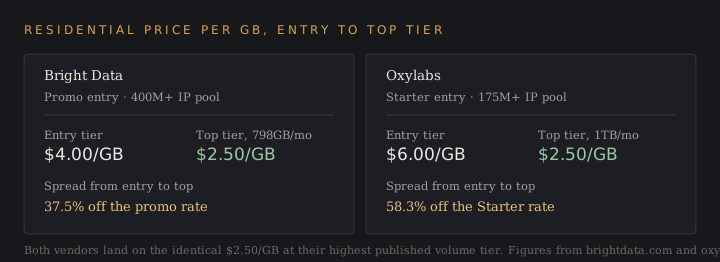
Bright Data runs a 400 million+ residential IP pool across 195 countries; Oxylabs runs 175 million+ across the same 195, and at their highest volume tier Oxylabs lists $2.50 a gigabyte against Bright Data's $5.00, which drops to $2.50 only during a three-month promo. This page covers what each service costs at matching volume, what each one gives away for free before a card is on file, and how each handles compliance.
It also covers a patent fight between the two companies that a rate card won't show you. This is for a team choosing between the two before a contract gets signed, and it matters because the two vendors have sued each other since 2018 over the residential proxy patents both companies still run on.
What Bright Data and Oxylabs sell
Both companies sell multiple proxy types under one account: residential, datacenter and ISP (static), plus web scraping APIs layered on top and a datasets marketplace. Bright Data adds mobile IP addresses to that list historically, though the product no longer appears in its live pricing navigation.
Oxylabs adds AI Studio, a suite of five AI-agent tools on a separate subdomain, and a Fast Search API built for AI workflows that need organic search results in milliseconds.
Evaluating proxy services at this scale means checking price, coverage and compliance as one set of trade-offs. Compared with other proxy providers in the category, both companies publish more of their pricing than the market average, which is the baseline any fair comparison should start from. The web scraping pricing report prices 1,000 rendered pages on both, $1.35 on Oxylabs and $1.50 on Bright Data.
| What you're pricing | Bright Data | Oxylabs |
|---|---|---|
| Residential proxies, entry tier | $4/GB (promo) | $6/GB (Starter) |
| Residential proxies, top tier | $5/GB at 798GB/mo ($2.50 promo) | $2.50/GB at 1TB/mo |
| Datacenter proxies, entry | $0.90/IP at 1,000 IPs | $1.20/IP shared, 38 countries |
| Web scraping API, entry | $1.50 per 1,000 records | $49/mo for 98,000 results |
| Free trial, API | 5,000 requests/mo, no card | 2,000 results, no card |
| Datasets | Self-serve, from $250/100K records | Sales-gated, from $400-$800/mo |
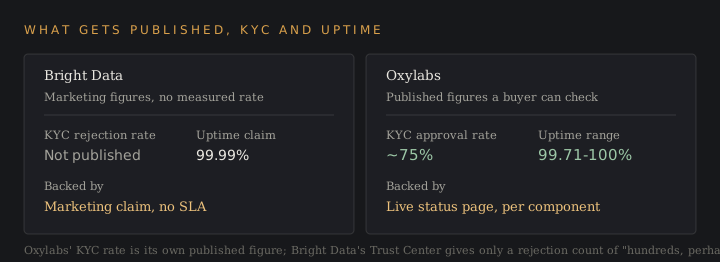
| Uptime disclosure | 99.99% marketing claim, no SLA | Live status page, 99.71-100% by component |
| KYC approval rate | Not published | ~75% published |
Prices and figures pulled directly from brightdata.com and oxylabs.io, accessed 6 September 2026.
Free plans and trials: what costs nothing
"Free trial" means something different at each company, and the gap matters more than either vendor's homepage lets on. Bright Data's free tier is a recurring monthly allowance: 5,000 credits, no card, renewing on the first of every month, spendable across the Web Unlocker API, SERP API, Web Scraper API and Scraper Studio.
Starting 1 September 2026 the Browser API draws from the same pool too, at 5 credits per megabyte of traffic. Unused credits don't roll over, and an unfunded account is capped at 1,000 requests a minute across those products until money is added.
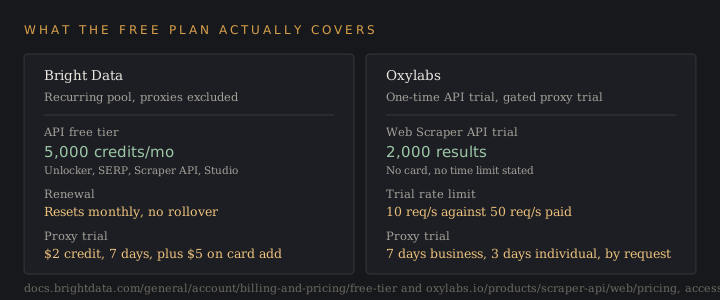
Oxylabs' Web Scraper API trial works differently: up to 2,000 results, no card required, with no stated expiry date on the trial itself, according to Oxylabs' own pricing page. The catch sits in the rate limit. A free-trial account is capped at 10 requests a second against 50 on every paid tier, so the trial proves the API works before it proves the API scales.
Proxies are the one product neither company covers under its main free plan. Bright Data hands new accounts a separate one-time $2 trial credit valid for 7 days, plus a $5 bonus once a payment method is added, both according to Bright Data's own documentation.
Oxylabs treats its proxy trial as a request: 7 days for a verified business account, 3 days for an individual, claimed through a contact form, live chat, or a customer success representative.
A team that wants to prototype against a real API this afternoon gets there faster on Bright Data's self-serve credit pool. A team evaluating residential or datacenter proxy quality specifically waits on a human at both companies, since Bright Data's own proxy trial also runs through account setup before it activates.
Residential proxies: pool size and price
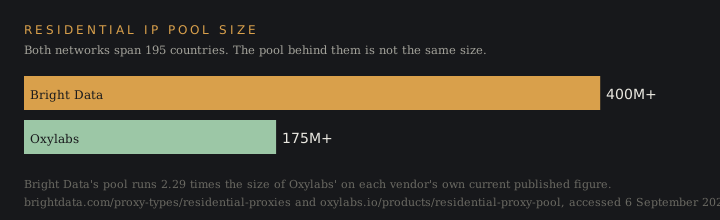
Bright Data's residential network is the bigger of the two: 400 million+ IP addresses against Oxylabs' 175 million+, both spanning 195 countries.
At entry volume Bright Data is cheaper only while its three-month promo runs, at $4/GB against Oxylabs' $6/GB Starter tier, and its $8/GB pay-as-you-go list rate costs more. At the highest published volume tier Oxylabs lists $2.50/GB and Bright Data $5/GB, or $2.50 during the promo. The proxy pricing report sets both cards beside 11 other providers.
Geo-targeting depth runs close between the two. Bright Data resolves down to country, state, city, ZIP code, carrier and ASN. Oxylabs matches most of that and adds coordinate-level targeting on its SERP Scraper API and mobile proxies specifically, though its core residential pool's own pricing page stops at ZIP-code level, the same ceiling Bright Data lists.
Datacenter proxies, control and coverage
Bright Data's datacenter network covers 98 countries on a shared pool of 1.3 million+ IP addresses, priced from $0.90/IP at 1,000 IPs or $0.60/GB pay-as-you-go. Oxylabs splits its datacenter offering by tier: a $1.20/IP shared plan covering 38 countries, up to a dedicated Enterprise tier reaching 188 countries on a 1.9 million+ IP pool.
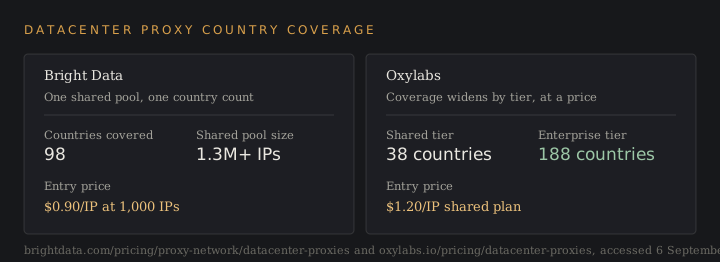
A buyer who needs the widest target country list on datacenter IPs gets there through Oxylabs' top tier; a buyer working from a fixed self-service plan gets more countries per dollar from Bright Data.
Developer tools and AI scraping features
Bright Data ships a Cloud Proxy Manager and an open-source MCP server for AI agents, both free, plus a Scraping Browser for JavaScript rendering. Oxylabs bundles OxyCopilot, a free AI-assisted feature built into Web Scraper API that generates request code and parsing templates from a plain-language description, so developers skip writing XPath selectors by hand.
Both networks support sticky sessions for holding one IP address across a multi-step task within a single session, a baseline feature at this tier, and rotation happens automatically on every call outside a sticky session.
Datasets from either vendor arrive as structured files; a buyer still has to build the analysis layer that turns them into a usable output. Bright Data's ready-made dataset catalog undercuts Oxylabs' custom-only catalog on price and speed to first record; Oxylabs offers a narrower, sales-gated datasets catalog that starts at $400 a month with no self-serve rate published.
KYC, compliance and who gets turned away
Both networks gate residential and mobile proxy access behind know-your-customer checks: company registration, a stated business use case, and in Bright Data's case a live video identity call reviewed by a compliance officer. Oxylabs publishes the harder metric: it approves roughly 75% of KYC applicants, rejecting the rest outright. Bright Data doesn't publish a rejection rate, saying only that it turns away "hundreds, perhaps thousands" of prospective customers a year.
On paper certification the two run close. Both hold ISO/IEC 27001:2022 and a SOC 3 report; Bright Data's SOC 2 is available on request, while Oxylabs scopes its SOC 2 Type 2 to Web Scraper API and Web Unblocker only; its proxy network sits outside that certification. Oxylabs additionally lists a published Data Processing Agreement and co-founded the Ethical Web Data Collection Initiative.
Support channels look similar on paper, live chat and email on both, and each vendor's own website states quick response times with no measured figure attached to test the claim against.
Choose Bright Data if
Pick Bright Data for the largest raw residential pool at 400 million+ IP addresses, a self-serve datasets marketplace priced per record with no sales call, and a free API tier (Web Unlocker, SERP API, Scraper API, Browser API) that needs no card to start. Bright Data also claims the bigger customer base: 50,000+ organizations against Oxylabs' 15,000+.
Choose Oxylabs if
Pick Oxylabs for a public status page reporting real, measured per-component uptime, 99.71% to 100% across services at the time of writing, a stated 75% KYC approval rate where Bright Data gives only a vague rejection count, and Lithuania-based, EU-first compliance framing that matters to teams evaluating data residency.
Bright Data vs Oxylabs by use case
Named use cases are a fair proxy for how broadly each company markets itself, if not for what either network can technically do.
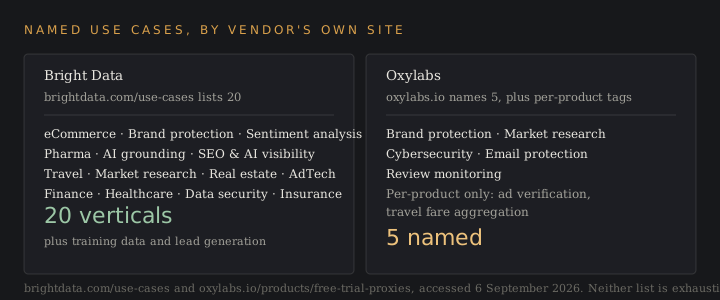
Bright Data's own use-cases page lists 20 named industries and functions: eCommerce and retail, brand protection, sentiment analysis, pharma, AI grounding, SEO and AI visibility, SERP tracking, travel, market research, real estate, AdTech, finance, healthcare, data security, insurance, training data, lead generation, supply chain intelligence, government and public sector, and workflow automation.
Oxylabs names five directly: brand protection, market research, cybersecurity, email protection and review monitoring. It splits the rest across per-product "best for" tags: ad verification and travel fare aggregation on residential proxies, video streaming and traffic-intensive gathering on SOCKS5.
A quant team scraping public financial data at high volume gets more IP addresses per dollar from Bright Data's entry tier, and Bright Data names finance as a dedicated use case with its own landing page. A retailer running MAP (minimum advertised price) monitoring or brand protection across marketplaces finds a named page at both vendors, so price and pool size decide that comparison more than named coverage does.
Travel fare aggregation, pulling live pricing across airline and hotel sites that block generic scrapers, is a named Oxylabs use case tied specifically to its residential proxies. Bright Data covers the same job under its broader travel page, without breaking out fare aggregation as its own line item.
Ad verification, confirming an ad rendered in the geography and placement it was bought for, appears as a named tag on Oxylabs' residential and mobile proxies and inside Bright Data's AdTech page.
An enterprise SaaS team building a stable, low-churn scraping workflow inside the EU gets Oxylabs' narrower but better-documented reliability record. A developer testing before committing budget can run either free option, no card required for the API layer at both vendors, and compare success rates directly on a real workload before choosing.
Neither company runs an independent benchmark of the other's proxies, so treat any vendor-published comparison, including this one's sourced figures, as a starting point for your own test.
Neither company is the right choice for every workload. The choice depends more on volume, named-use-case fit and compliance risk than on any single spec, and matching a plan to your team's specific needs beats chasing the platform with the biggest headline number.
The patent fight behind the price sheet
Bright Data, then still called Luminati, sued Oxylabs for patent infringement in 2018 over residential proxy technology. Oxylabs countersued in 2020 for unfair competition and false advertising; that suit was resolved by stipulation in 2021, without a ruling on the merits. A jury found Oxylabs infringed on other Bright Data patents later that year.
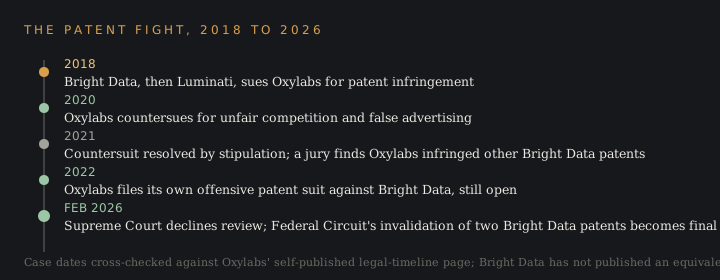
Oxylabs' own offensive patent suit against Bright Data, filed in 2022, is still open. The U.S. Court of Appeals for the Federal Circuit invalidated two of the Bright Data patents underlying an earlier verdict, and the Supreme Court declined further review in February 2026, making that invalidation final.
Several more Bright Data patents were separately cancelled through USPTO review, per the case list Oxylabs publishes on its own legal-timeline page. Anyone wanting to check a cancelled patent's status can look up its legal-status record free on Espacenet, the top pick among our patent search tools. Bright Data has not published an equivalent public timeline of the same cases, a difference worth weighing alongside the uptime and reliability metrics above.
Performance and reviews: what each vendor claims
Bright Data cites a third-party benchmark putting its own success rate at 98.44% across scraping targets; Oxylabs advertises a 99.82% to 99.95% success rate and an average response time near 0.6 seconds on its own product pages. Neither company points to an audit performed by someone else, so both figures are self-reported. Both platforms run automated unblocking APIs that solve CAPTCHAs and bypass anti-bot systems, bundled into the scraping API price.
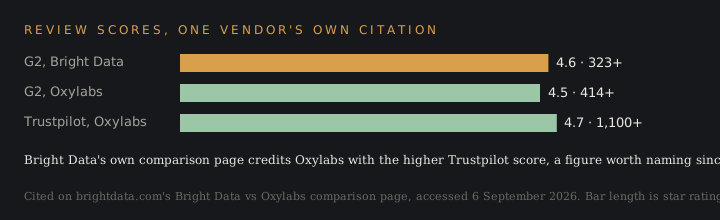
That comparison page puts Bright Data's own G2 rating at 4.6 stars across 323+ reviews against 4.5 stars and 414+ reviews for Oxylabs, and credits Oxylabs with a 4.7-star Trustpilot score across 1,100+ reviews, a source worth naming since Bright Data is citing figures favorable to a competitor.
Its product navigation separately lists 800+ website-specific scrapers and 900+ dataset domains, though its own dedicated Datasets pricing page states a narrower 120+ domains and 190+ datasets, a gap worth checking on brightdata.com before you size a project against either number.

See current pricing and the free tier
Start with Bright Data
5,000 free credits a month, renewing monthly, across the Web Unlocker, SERP API, Web Scraper API and Scraper Studio, no card required. A separate promotion matches your first deposit dollar for dollar, up to $500.
 Start with monthly free credits →
May earn a commission if you sign up through this link, at no extra cost to you. Full affiliate disclosure.
Frequently asked questions
Bright Data vs Oxylabs: what is the difference?
Bright Data runs the larger residential proxy pool, 400 million+ IPs against Oxylabs' 175 million+, and sells a self-serve datasets marketplace with no sales call. Oxylabs publishes a live per-component status page and a stated 75% KYC approval rate, figures Bright Data doesn't put a number on. At their highest residential tier Oxylabs lists $2.50 a gigabyte and Bright Data $5.00, or $2.50 during its three-month promo.
How much does Bright Data cost compared to Oxylabs?
Bright Data's residential proxies list at $8/GB pay as you go, or $4/GB during its three-month promo, and Oxylabs' Starter tier starts at $6/GB. At the highest published volume Bright Data lists $5/GB at 798GB a month ($2.50 on the promo) and Oxylabs $2.50/GB at 1TB. Datacenter entry runs $0.90/IP at Bright Data against $1.20/IP shared at Oxylabs.
Which has the better free plan, Bright Data or Oxylabs?
Bright Data's free tier is the more generous recurring allowance: 5,000 credits every month, no card, spendable across the Web Unlocker, SERP API, Web Scraper API and Scraper Studio. Oxylabs' Web Scraper API trial gives 2,000 results with no time limit stated, but at a 10 request-per-second cap against 50 on a paid plan.
Neither vendor's monthly free tier covers proxies. Bright Data offers a $2, 7-day proxy trial plus a $5 bonus on card add; Oxylabs' proxy trial runs 7 days for a verified business and 3 for an individual, claimed by filling out a contact form.
Which has the bigger residential proxy pool?
Bright Data, at 400 million+ IPs against Oxylabs' 175 million+, both spanning 195 countries. That's roughly 2.3 times the pool size on each vendor's own current published figure.
Is Bright Data or Oxylabs easier to pass KYC with?
Oxylabs publishes the harder number: it approves roughly 75% of KYC applicants. Bright Data doesn't publish an approval or rejection rate, saying only that it turns away "hundreds, perhaps thousands" of prospective customers a year. Neither figure tells you what happens to your specific application.
Who is winning the Bright Data Oxylabs patent lawsuit?
Oxylabs holds the stronger position as of February 2026. The U.S. Court of Appeals for the Federal Circuit invalidated two of the Bright Data patents underlying an earlier verdict, and the Supreme Court declined further review that month, making the invalidation final. Oxylabs' own offensive patent suit against Bright Data, filed in 2022, is still open.
Is Bright Data a legit company?
Yes. It's a private company founded in 2014 as Luminati Networks, owned by EMK Capital since 2017, renamed Bright Data in 2021, and it holds ISO 27001 and SOC 3 certification.
What is Bright Data's parent company?
Bright Data has no single parent; EMK Capital, a London private equity firm, has held it since a 2017 investment. Oxylabs has no outside parent either, founded in Vilnius in 2015 through the Tesonet accelerator.
What are some alternatives to Bright Data and Oxylabs?
Within proxy networks at comparable scale, each is the other's closest alternative. Apify and Firecrawl compete on the scraping-API side without running a comparable proxy network of their own.
Which service fits which team
The Bright Data Oxylabs decision splits along what you're optimizing for first. Choose Bright Data when raw pool size, self-serve datasets and a generous recurring free credit pool outweigh a published KYC number. Choose Oxylabs when a checkable status page, a stated approval rate and EU-first compliance framing outweigh a smaller residential pool.
A team still deciding should run both free options against the same target site before signing anything: Bright Data's 5,000 monthly API credits and Oxylabs' 2,000-result trial both need no card, so the real comparison costs nothing beyond an afternoon.
Sources: brightdata.com/pricing, brightdata.com/trustcenter and brightdata.com/use-cases; docs.brightdata.com's free-tier page; oxylabs.io/pricing and oxylabs.io/products; oxylabs.io/products/free-trial-proxies; trust.oxylabs.io and uptime.oxylabs.io; oxylabs.io's own legal-timeline page, checked against Federal Circuit and USPTO decision dates. Accessed 6 September 2026.