Proxy pricing in 2026: the same GB of residential traffic costs $0.49 or $8
 By Jan Suski. I go deep on every review, checking every number against its source and digging up details other coverage misses, a habit from six years of SEO and link building for tech companies. Bylines at Surfer, Brand24, and Senuto. How the scoring works.
The numbers Proxy pricing across 13 providers, checked 6 October 2026
Oxylabs' residential rate falls 58%, from $6 to $2.50 per GB, between its 5 GB and 1 TB plans.
A dedicated ISP IP on Bright Data's 10-IP plan costs almost 12 times a Webshare static residential IP.
PacketStream keeps $0.90 of every $1.00 a customer pays for a GB of household bandwidth.
Proxy pricing has no common unit, and the same unit still swings 16-fold between two standard plans. On 6 October 2026 one gigabyte of rotating residential traffic listed at $8.00 on Bright Data's pay-as-you-go card and $0.49 on Evomi's 100 GB Core plan. Datacenter proxies switch the meter to the IP, and Webshare bills $0.0299 per proxy a month on its 100-proxy plan.
A team running 100 GB of residential traffic a month pays $49 or $800 for it depending on the card, so the billing unit sets the budget before the vendor does.
This report normalises the rate cards of 13 proxy services into two comparable units for anyone about to buy proxies, cost per GB for residential and mobile traffic and cost per IP per month for datacenter and ISP proxies. It covers each proxy type, the billing rules that inflate a bill, and where residential IPs come from. Scraper APIs billed per 1,000 pages sit in the separate web scraping pricing report.
Market Intelligence Tools earns an affiliate commission from Bright Data, so its sourcing history, KYC rules and lawsuits get the same scrutiny as every other vendor here. Every price below links to the vendor's own page, checked 6 October 2026.
How proxy pricing works across four billing units
Every provider bills one of four meters, and the proxy type decides the meter far more often than the vendor does.
- Per GB of traffic, for rotating residential proxies and mobile proxies. All 11 residential cards below are billed this way.
- Per IP per month, for datacenter proxies and ISP proxies. Bright Data's shared datacenter IPs run $1.40 each at 10 IPs and $0.90 at 1,000.
- Unlimited bandwidth on a fixed number of IPs or ports, capped by a fair-use clause. Rayobyte's static ISP proxies cost $5 per IP for 5 to 99 IPs and list "Unlimited bandwidth*", asterisk included.
- Prepaid credits priced by country. SOAX sells credits worth "about $1 of usage" each and charges more per GB for a Tier 1 country such as the US than for a Tier 2 country such as India.
Unlimited plans move the limit somewhere else. Bright Data's datacenter and ISP pages state that "each IP includes a 100 GB fair usage allowance per month." Oxylabs lets its shared ISP proxies run up to 100 concurrent sessions per proxy until an account has used 50 GB that month, then 10 concurrent sessions for the rest of the billing cycle.
The rate card is also the wrong number to compare. Divide a per GB rate by the success rate on your own targets to determine the effective rate. At $4 per GB and a 50% success rate on protected targets, each GB of usable data costs $8, so test how a provider's IPs perform on the exact targets you plan to scrape before you commit.
Rotating residential proxies priced per GB at 11 providers
Rotating residential proxies send each request out through a different consumer connection, every provider in the table bills them per GB, and volume discounts are par for the course. The complete table shows the smallest purchase, the rate near 100 GB a month, and the lowest rate on the public card.
| Provider | Smallest purchase | Near 100 GB | Lowest published rate |
|---|---|---|---|
| Bright Data | $8.00/GB pay as you go ($4.00 promo) | $499 for 141 GB on promo, $3.50/GB ($7.00 list) | $2.50/GB at 798 GB on promo ($5.00 list) |
| Oxylabs | $30 for 5 GB, $6.00/GB | $500 for 125 GB, $4.00/GB | $2.50/GB, 1 TB for $2,500 |
| Decodo | $4.00/GB pay as you go | $275 for 100 GB, $2.75/GB | $2.00/GB at 1 TB |
| IPRoyal | $7.35 for 1 GB pay as you go | $5.25/GB at 10 GB, subscription | $1.75/GB from 10 TB |
| Webshare | $3.50 for 1 GB | $225 for 100 GB, $2.25/GB | $1.40/GB, 3 TB for $4,200 |
| Infatica | $4.00/GB pay as you go | $360 for 100 GB, $3.60/GB | $2.60/GB, 1,000 GB for $2,600 |
| Massive | $80 for 10 GB, $8.00/GB | $490 for 100 GB, $4.90/GB | $4.90/GB |
| SOAX, US traffic | $5.00/GB on the free Sandbox | $2.20/GB on the $500 Team plan | From $0.85/GB on $3,000 Enterprise |
| Rayobyte Premium | $3.50/GB for 1 to 49 GB | $2.00/GB for 50 to 249 GB | $0.70/GB for 1,000 to 4,999 GB |
| PacketStream | $1.00/GB, $50 to start | $1.00/GB | $1.00/GB |
| Evomi Core | $0.99/GB pay as you go from 15 GB | $49 for 100 GB, $0.49/GB | $0.49/GB |
Vendor list prices, read on each provider's pricing page on 6 October 2026. The Bright Data cells marked promo carry the RESIGB50 code's 50% discount, which lasts three months, and show the list rate beside them.
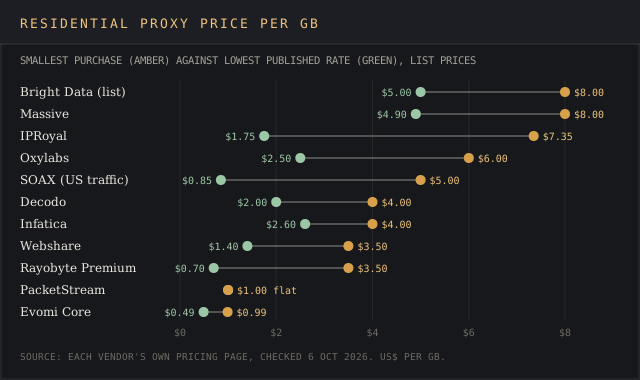
Two cards advertise a discount on every visit. The RESIGB50 code on Bright Data's page gives "50% OFF Residential Proxies for 3 months", which takes the 141 GB Starter plan from $7.00 to $3.50 per GB and returns it to list in month four. Webshare prints a crossed-out $7.00 per GB anchor beside every residential tier and labels its 3 TB plan "SAVE 80%". Read between the lines and a promo price is a three-month price.
One outlier sits off the table. Rayobyte lists a separate bulk Scale Residential line at $0.0095 per GB on a $5,000 monthly plan for 526,000 GB, a volume no small buyer reaches.
Pool size is the other number vendors lead with. Bright Data advertises 400M+ residential IPs in 195 countries at its $8.00 list rate, and IPRoyal 64M+ IPs in 195+ countries at $7.35, so the two largest advertised pools carry two of the three highest entry rates.
Pay as you go against a monthly commitment
Pay as you go pricing costs more per GB, and a monthly commitment buys a lower rate that forfeits what goes unused. Bright Data's pricing FAQ says a monthly commitment "will not roll over to the next month" when the account stays active all month, whatever the usage.
IPRoyal sells the opposite contract with no strings attached. Its pay-as-you-go residential traffic never expires and costs 5% more than the subscription price ($7.35 against $7.00 for 1 GB), with balances managed from a self-service dashboard.
Massive rolls unused bandwidth into the next month on all four of its developer plans, and Evomi's pay-as-you-go residential traffic carries no expiry. Longer terms cut unit cost too. Infatica takes 20% off every plan billed annually, and ISP proxies from IPRoyal fall from $2.70 per proxy for 30 days to $2.40 for 90 days.

See the rate card yourself
Check Bright Data's pricing
Residential traffic lists at $8.00 per GB pay as you go and $5.00 on the 798 GB plan, or $4.00 and $2.50 for the first three months with the RESIGB50 code.
 Visit Bright Data →
May earn a commission if you sign up through this link, at no extra cost to you. Full affiliate disclosure.
Datacenter proxies and ISP proxies priced per IP
Datacenter proxies
Datacenter proxies use IPs registered to hosting companies and data center operators. Datacenter pricing posts the lowest monthly price per IP on every card checked, and the cheapest offers fall below three cents. Proxy-Cheap's pricing guide puts the gap down to supply, since datacenter IPs are generated in bulk in commercial data centers.
- Webshare charges $0.0299 per proxy at 100 proxies ($2.99 a month) and $0.0179 at 60,000, and its free plan includes 10 proxies.
- Proxy-Seller starts IPv6 at $0.02 per IP and IPv4 at $0.49 per IP on a "1 Gbps channel", one of the few cards that states connection speeds, and advertises 24/7 human support.
- Bright Data sells shared IPs from $1.40 down to $0.90, dedicated IPs from $2.20 down to $1.30, or traffic billed at $0.60 per GB with no commitment.
- Oxylabs sells shared IPs at $1.20 across 38 countries, dedicated IPs at $2.25 across 188 countries, and traffic at $0.59, with HTTP, HTTPS and SOCKS5 on every plan.
- Infatica meters shared datacenter traffic at $0.60 per GB pay as you go and $0.30 per GB at 2,000 GB.
ISP proxies and static residential IPs
ISP proxies are static IPs registered to consumer internet providers, sold per IP per month and kept for the life of the plan. Evomi sells them as "Static Residential (ISP)", and Webshare sells static residential IPs from "AT&T, Sprint & Cox Communications" at speeds up to 1 Gbps. A dedicated ISP IP belongs to one customer, and IPRoyal's page says "no one else can use the same IP addresses".
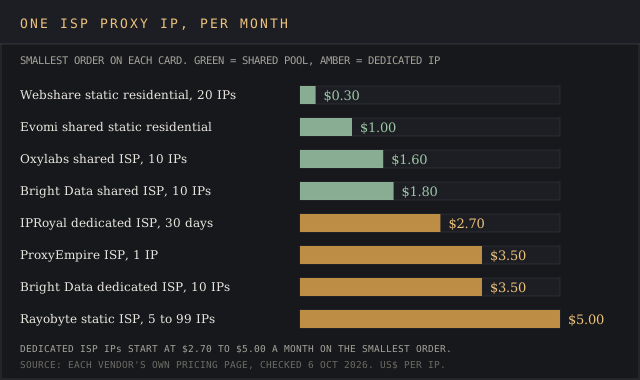
Low per-IP prices can come with IPs that fail on protected targets, and a Webshare reviewer on Trustpilot summed up that trade on 11 September 2026 as "Good price but their IP doesn't work with highly protected site."
Shared pools cost about half of dedicated on the large cards. ISP proxies from Bright Data cost $1.80 per shared IP at 10 IPs against $3.50 per dedicated IP, falling to $1.30 and $2.50 at 1,000 IPs, drawn from a pool of 1.3M+ ISP IPs. Oxylabs charges $1.60 per shared IP at 10 and $1.20 at 500, with dedicated ISP proxies from $2.50.
Smaller ISP proxies providers price a single IP higher. IPRoyal sells ISP proxies in 31+ countries from a pool of 500K+ IPs, at $2.70 for 30 days. ProxyEmpire lists $3.50 for one IP a month falling to $2.00 at volume, across 19 countries. Rayobyte charges $5.00 per IP below 100 IPs. Webshare undercuts all of them at $0.30 per IP for 20 IPs and $0.225 at 10,000, with unlimited bandwidth on the top plans, and Evomi charges $1.00 for a shared IP.
Mobile proxy pricing, from parity with residential to double
Mobile proxies exit through cellular carrier networks and are billed per GB like residential traffic, or per port. On Infatica's and Oxylabs' entry plans they're the most expensive proxy type per GB, and the premium over residential runs from zero to double across the cards checked.
- Infatica charges $8 per GB for mobile pay as you go, twice its $4 residential rate.
- Oxylabs runs mobile from $7.50 per GB on a $30 plan to $3.50 per GB on 715 GB for $2,500, against $6.00 to $2.50 for residential, from a pool of 20M+ mobile IPs in 140+ countries.
- Mobile traffic needn't cost an arm and a leg. Evomi prices mobile and premium residential identically at $3.98 per GB pay as you go, and SOAX applies one rate card to residential and mobile.
- Monthly mobile plans start at $10 per IP or port on Proxy-Seller and $117 a month on IPRoyal.
What moves the proxy cost beyond the proxy type
Five levers change a residential bill after the vendor is picked, and the last one decides who can buy at all.
- Country. SOAX prices by the egress IP's country, so on its $200 Builder plan Tier 1 traffic costs $3.00 per GB, Tier 2 $2.25 and Tier 3 $1.20. Massive's pricing guide describes uniform pricing across all locations, and Bright Data lists country, state, city and zip code targeting as free.
- Targeting depth and session length. Rayobyte includes country, city, ZIP code and ASN targeting plus sticky sessions on every Premium Residential tier. IPRoyal holds a sticky IP for up to 7 days and Oxylabs mobile for up to 24 hours, and neither card adds a surcharge for rotation frequency or session length.
- Protocol extras. Evomi's UDP support over SOCKS5 is "an enterprise-exclusive extra feature" that needs manual activation by its support team, and its docs warn it "will incur additional bandwidth consumption".
- Commitment tier and account management. Oxylabs bundles a dedicated account manager and 24/7 support into every residential plan from $30, and Bright Data reserves unlimited seats and a custom price per GB for Enterprise clients who contact sales.
- KYC. Bright Data requires a compliance review before anyone uses its residential or mobile network, which can include a video call, and a company that wants those IPs has to bite the bullet.
The KYC rule tightened this year. For any new residential zone you create in the dashboard after 7 July 2026, Bright Data grants residential access "only to registered companies" with a verified corporate email domain, and a Gmail or Outlook account isn't eligible. Older zones keep working, and customers already verified keep access. Approval "is never automatic, instant or self-serve."
Requests outside the approved use case are blocked with an "Access denied" error. ISP, datacenter and Web Unlocker access need no KYC, so a solo developer there buys those or goes elsewhere.
Hidden costs in proxy billing
The devil's in the details of the billing FAQ. A per GB rate assumes every byte billed was a byte you wanted. Bright Data's FAQ counts "request headers+request data (POST)+response headers+response data" toward billed bandwidth, so headers and uploads bill at the same rate as page content.
Skyvern, a browser-automation company, burned 200GB of proxy bandwidth, about $500, in six hours in September 2024. Chrome re-downloaded a roughly 70MB machine-learning model from a Google domain on every fresh session. On the Hacker News thread about it, user ronsor wrote on 19 September 2024:
"Residential rotating proxy providers charge very high rates for data, on the order of $1 - $10 per GB."
ronsor, Hacker News, 19 September 2024
The rest of the hidden costs sit in billing rules, and every one below is on the vendor's own page.
- Unused commitment. Bright Data doesn't roll it over, and an account that joins mid-month pays the first commitment on the day it signs up, per its billing docs.
- Suspension. A suspended account there doesn't keep its allocated IPs, and an account that uses 100% of its balance is suspended.
- Auto recharge. Bright Data's auto recharge triggers when the available balance drops below 85% of the account balance. A per-zone usage spend limit in the dashboard caps daily spend by bandwidth or dollars, and the open-source Bright Data Proxy Manager (on GitHub) adds rotation and load balancing features on your own server.
- Payment fees. Bright Data, IPRoyal and Decodo accept PayPal, and Webshare's payment list names Google Pay, Apple Pay and cards with no PayPal option. One IPRoyal customer on Trustpilot complained on 5 September 2026 that "the transaction fee is quite a lot" on each payment.
- Trials that convert into charges show up as a red flag in reviews. Decodo offers a 3-day free trial with 100MB and a 14-day money-back guarantee that excludes trial users. A US reviewer on Trustpilot wrote on 20 September 2026: "They charged me after I cancelled the trial because their IP addresses are a waste".
IP quality and reliability never appear on a card. A Webshare customer on Trustpilot wrote on 4 September 2026:
"IPs have pretty good reputation (60 of 100 passes cloudflare-protected endpoints) but the pricing for data (GB) is expensive."
Webshare customer, Trustpilot, 4 September 2026
Past that point a per-request API can undercut raw bandwidth. User ghxst wrote on Hacker News on 6 February 2025:
"a good quality residential proxy where you pay per GB quickly becomes a lot more expensive than a captcha solver service or the compute for a POW challenge."
ghxst, Hacker News, 6 February 2025
For web scraping at volume, Bright Data's Web Unlocker bills per successful request and handles blocked pages for you, and the web scraping tools ranking compares the APIs that bundle proxies, rendering and retries into one price. Agent builders reach the same network through the Bright Data MCP server, one of the servers on the MCP tools list, or through a web agent API such as TinyFish.
Where residential IPs come from, and what the supply costs
A residential proxy network rents bandwidth from home connections, which raises a user security question for every household whose connection carries strangers' traffic. One provider publishes the money split. PacketStream charges $1.00 per GB and pays the household running its desktop app $0.10 per GB before cashout fees.
Most supply arrives under the radar, through SDKs bundled into free apps. On 22 June 2026 Spur reported that 2,058 of 6,038 LG and Samsung smart TV apps it scanned carried residential proxy SDKs. Bright Data entities published 367 of them, Honeygain UAB, which Spur lists as an Oxylabs subsidiary, published 16, and Spur named Massive as a third major SDK vendor. Krebs reported that the same company accounted for the lion's share of proxy SDKs across both TV platforms.
LG responded within a month. On 21 July 2026 LG senior vice president John Taylor told KrebsOnSecurity that apps keeping the SDK "will be suspended." The company told Krebs that "every peer opts in through a dedicated screen and receives value in return" and that its practices "have now undergone a second independent audit by PwC."
Two networks lost their supply this year. Google's Threat Intelligence Group degraded the IPIDEA network in January 2026, cutting its device pool by millions after counting more than 550 threat groups using its exit nodes in seven days.
On 2 July 2026 the FBI seized hundreds of domains tied to NetNut, which KrebsOnSecurity linked to a botnet of at least 2 million compromised devices. Its operator, Alarum Technologies, fell about 67% in a week to $2.62 a share, and customers who put all their eggs in one basket with NetNut were left with a seized provider.
Bright Data carries its own history. In May 2015 TorrentFreak reported that the free Hola VPN sold its users' bandwidth through its Luminati brand, and Luminati rebranded as Bright Data in March 2021. Two platforms sued it over scraping and lost. Judge Edward Chen ruled against Meta in January 2024 (Courthouse News), and Judge William Alsup dismissed X Corp's suit in May 2024 (CNBC). The Bright Data review covers both cases and the SDK reporting in full.
What a proxy budget looks like at three sizes
Three monthly volumes cover most customers, priced from the tables above at list rates.
- Testing, 10 GB of residential traffic: $27.50 on Webshare, $35 on Decodo, $52.50 on IPRoyal's subscription, and $80 on Massive or on Bright Data pay as you go ($40 during the promo).
- Production, about 100 GB: $49 on Evomi Core, $225 on Webshare, $275 on Decodo, $360 on Infatica, $490 on Massive, $500 on Oxylabs for 125 GB, and $499 on Bright Data for 141 GB while the promo runs.
- Enterprise, 1 TB and up: $1,500 a month on Webshare, $2,000 on Decodo and $2,500 on Oxylabs. Bright Data asks buyers above 1 TB to contact sales, and Vendr tracks a $27,000 median annual contract.
A datacenter budget is a drop in the bucket next to those figures. 100 datacenter IPs cost $2.99 a month on Webshare, $100 on Bright Data's shared plan and $120 on Oxylabs. The Bright Data vs Oxylabs comparison sets the two largest cards side by side.
The use case decides the line item. Price monitoring for pricing intelligence tools and the datasets sold by alternative data providers lean on residential IPs, while SERP collection is usually bought per task, as the DataForSEO pricing and rank tracker pricing reports show.
Frequently asked questions
How much does a proxy cost?
At the smallest order, a datacenter proxy costs $0.02 to $2.25 per IP a month, ISP proxies $0.30 to $5.00 per IP, and rotating residential traffic $0.49 to $8.00 per GB on the standard plans checked on 6 October 2026.
Can you get a proxy for free?
Free proxy access comes in small amounts. Webshare's free plan includes 10 datacenter proxies, Decodo's 3-day trial includes 100MB of residential traffic, and SOAX's Sandbox has no subscription fee.
How much does a US proxy cost?
US residential traffic falls in SOAX's Tier 1, at $3.00 per GB on the Builder plan. Bright Data lists country targeting as free, so a US GB costs its standard $8.00 list rate pay as you go.
What is the cheapest proxy?
By IP, Proxy-Seller's IPv6 proxies from $0.02 and Webshare's datacenter proxies at $0.0299. By GB, Evomi's Core residential plan at $0.49 and Rayobyte Premium at $0.70 from 1,000 GB, before any test on hard targets.
What does proxy pricing mean?
Proxy pricing is the unit a provider's website bills on, per GB of traffic, per IP per month, a flat fee for unlimited bandwidth on a fixed IP count, or prepaid credits, plus the volume discounts and commitments that change it.
Is proxy legal or illegal?
Buying a proxy is legal, and the safety question sits with how the provider sources its IPs. Courts dismissed Meta's and X Corp's scraping suits against Bright Data in 2024, and the FBI's July 2026 NetNut seizure targeted a network KrebsOnSecurity tied to compromised devices enrolled with minimal user consent.
How much does a proxy server cost?
A dedicated proxy server IP costs $1.30 to $5.00 a month across the proxy services above, and a full enterprise contract with Bright Data has a $27,000 median a year on Vendr.
Bottom line
Buy proxies by the unit your traffic uses, and note that proxy pricing rewards volume more than vendor choice. Residential and mobile traffic bills per GB, and the gap between the cheapest and dearest standard plan is 16-fold. Datacenter and ISP proxies bill per IP, where the same static residential IP ranges from $0.30 to $5.00 a month.
The rate card is the start of the bill. Bandwidth counted in both directions, commitments that expire, promos that end in month four, payment fees and KYC that excludes personal accounts all sit outside the headline number. Choosing a provider means weighing cost against performance on your own targets and the security of the IP source, and that last question shut down two networks in 2026.
Where each proxy rate was read, and which volumes stay behind a sales call
Every price on this page links to its origin on first use, and all of them were read on 6 October 2026.
Rate cards come from brightdata.com and docs.brightdata.com, oxylabs.io, decodo.com, iproyal.com, webshare.io, infatica.io, joinmassive.com, soax.com, rayobyte.com, packetstream.io, evomi.com and docs.evomi.com, proxy-seller.com and proxyempire.io. The Bright Data contract median is Vendr's header figure at vendr.com, the supply-cost explainer is Proxy-Cheap's guide at proxy-cheap.com, and the Proxy Manager repository sits on github.com.
The SDK count is Spur's 22 June 2026 report at spur.us. The LG and NetNut reporting is from krebsonsecurity.com in July 2026, the IPIDEA takedown from theregister.com on 29 January 2026, the Hola report from torrentfreak.com in May 2015, the rebrand from proxyway.com, and the Meta and X Corp rulings from courthousenews.com and cnbc.com in 2024. Buyer quotes come from news.ycombinator.com, trustpilot.com and skyvern.com.
No provider here publishes a success rate on protected targets, and Bright Data prints no rate above 1 TB a month, asking those buyers to contact sales.