AccuRanker review: fast daily rank tracking, a 30-position crawl and a $224 entry price
 By Jan Suski. I go deep on every review, checking every number against its source and digging up details other coverage misses, a habit from six years of SEO and link building for tech companies. Bylines at Brand24 and Senuto. How the scoring works.
Best for
SEO agencies and in-house teams tracking 2,000 to 25,000 keywords across multiple clients or markets, who want unlimited users, tagging and daily ranking data with on-demand refreshes.
Not for
Local businesses or freelancers tracking a few hundred terms. The smallest plan covers 2,000 keywords at $224 a month on annual billing, and AccuRanker has no site audit or backlink index.
What it costs
$224 to $1,412 a month on annual billing ($249 to $1,569 month to month), custom pricing above 25,000 keywords, and a separate AccuLLM subscription from $206 a month for AI search visibility.
- Professional
- $224/mo annual, $249 monthly, 2,000 keywords
- Expert
- $764/mo annual, $849 monthly, 10,000 keywords
- Enterprise
- Custom pricing above 25,000 keywords
- Annual discount
- 10%
- Free trial
- None on the pricing page; 14-day refund on first purchase
- Cancellation
- 14 days' notice before the period ends
- Overage
- Billed per day on keywords over plan
- Contract law
- Danish, AccuRanker ApS
- Daily depth
- Top 30 results
- Full Top 100
- Every second week
- On-demand refresh
- Single keyword or whole domain, every two hours
- Location
- Country down to street address
- Devices
- Desktop and mobile, each counted as a keyword
- Engines
- ChatGPT, Perplexity, AI Overviews, AI Mode
- LLM Lite
- $206/mo annual, 100 prompts, 1 brand
- LLM Pro
- $521/mo annual, 300 prompts, 5 brands
- Sentiment
- Scored 1 to 100
- G2
- 4.8 from 233 reviews
- Capterra
- 4.9 from 330 reviews
- Trustpilot
- 2.7 from 110 reviews
- Founded
- March 2013, Aarhus, Denmark
Advanced Web Ranking
Not forA team that needs all 2,000 keywords checked daily; AWR Pro's 7,000 units cover 1,000.
Semrush
Not forA tracker-only buyer: 1,500 daily keywords cost $299, against $249 for 2,000 here.
Pairs well with AccuRanker
Sources for the facts above
Prices, plan limits, the refund window and the AccuLLM tiers come from AccuRanker's pricing page, read 16 October 2026. Tracking depth comes from its num=100 update post, refresh and overage rules from the dynamic keyword usage page, and contract terms from the terms. Ratings are as listed on G2, Capterra and Trustpilot in October 2026.
AccuRanker is a Danish rank tracker, launched in March 2013 and run from Aarhus, that does one job: it tracks keyword rankings on Google and a handful of other search engines, every day, for agencies and in-house teams. It's a rank tracker first and last, the opposite of a jack of all trades, with an AI visibility module, AccuLLM, sold on the side, and that's the frame for this AccuRanker review.
This review covers what the rank tracking delivers after Google's September 2025 change to 100-result pages, what the published rate card costs at each keyword tier, how AccuLLM tracks AI search visibility, what 330 Capterra reviewers and 110 Trustpilot reviewers say, and where an AccuRanker alternative fits better.
It's written for SEO professionals choosing a dedicated rank tracker over the trackers built into SEO tools, agency owners comparing seat and client costs, and anyone on the fence about an AccuRanker renewal. The timing matters: the tracker's crawl depth changed in late 2025, and a renewal now buys a different crawl from the one sold before September 2025.
What AccuRanker does for SEO agencies and digital marketing teams
The core is keyword rank tracking. You add a domain, load keyword lists or pull them from Google Search Console, pick locations and devices, and track keywords daily from there. The keyword rank tracker page says rankings "automatically update every 24 hours", with manual refreshes on top, and its competitor tracking lets you pick up to ten competitors to compare against.
Around that sits a set of modules listed in the site's own navigation:
- Rank tracking with pixel position, SERP features and CTR per keyword.
- Keyword research through a keyword research database for keyword ideas and search volume.
- Tagging, dynamic tagging and a Tag Cloud for keyword organization.
- Reporting, with scheduled and white-label reports.
- Share of voice and forecasting.
- AccuLLM, a separate subscription for AI search visibility.
- Organic Site Explorer, SERP analysis and an AccuRanker MCP connector.
Most SEO tools treat rank tracking as one tab among many. AccuRanker tracks rankings as the main product, so keyword performance, ranking data history and keyword rank tracking settings get the whole interface. Its free Live SERP Checker works as a quick SERP checker for one-off Google search results.
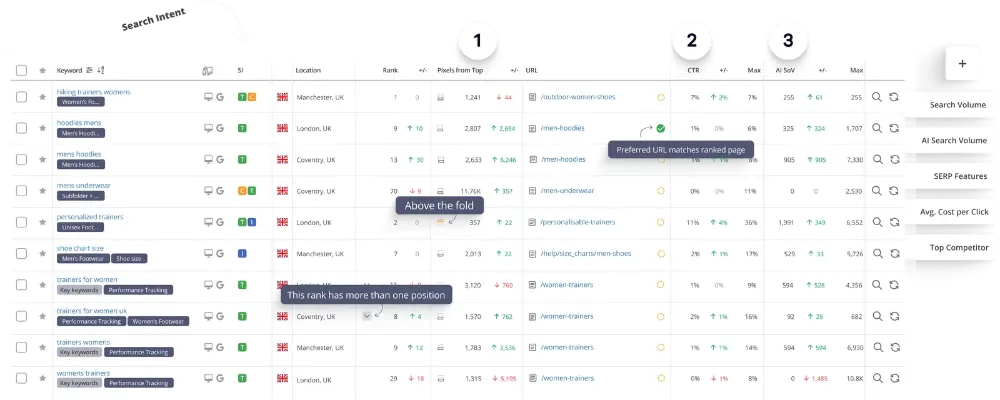
The buyers are SEO agencies and in-house SEO teams. The pricing page labels Professional "ideal for freelancers, consultants, and small agencies" and Expert for "growing agencies and mid-sized in-house teams". A Capterra reviewer, a digital marketing consultant writing in February 2024, put the speed case plainly: "It is the fastest rank tracker I've tried. When you add a new project or keywords, it pulls in the rankings within minutes." (Capterra)
Setup is short when Search Console is connected. A Capterra reviewer, a founder in IT services, wrote in August 2023 that "a simple connection with Webmaster Console is enough to gain access to the already working keywords" (Capterra). That import is the Google Search Console integration getting the ball rolling on day one, pulling in keyword data you already rank for.
How deep the ranking data goes after Google's num=100 change
This is the biggest product change of the last 12 months. On 11 September 2025 Google disabled the &num=100 parameter that let third-party SEO tools fetch 100 search results in one request, as SE Ranking's write-up records. Every rank tracker had to pay for ten page loads where it used to pay for one.
AccuRanker's answer is documented on its own num=100 update post:
- 19 September 2025: Top 30 tracked daily, Top 100 "tracked twice a month", positions 31 to 100 filled from the latest Top 100 update, with current pricing kept "for all existing customers".
- 25 September 2025: the split went live as "the Top 30 daily and the Top 100 every second week", with history backfilled from 13 September 2025.
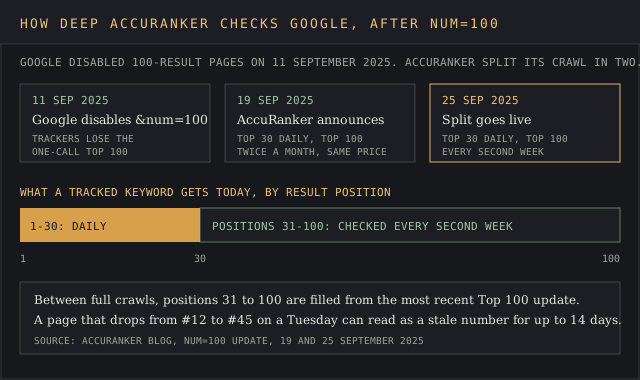
The devil's in the details of that split. AccuRanker tracks the top 100 results every two weeks, and daily tracking now covers positions 1 to 30. For a page sitting at position 12, nothing changes. For a page sliding from position 28 to 45 in the search results, the daily graph shows a stale number for up to 14 days.
That's a red flag for anyone tracking long-tail keyword positions on a new site that ranks below position 30. It's par for the course for page-one work, which is where agency reporting lives anyway. Price held steady through the change, so existing customers lost depth on positions 31 to 100 and paid the same.
Accuracy inside the top 30 gets mixed reviews. AccuRanker's pricing FAQ claims "99.9% accurate data globally and locally" from servers "in every country that we support" (pricing page). An SEO director at a small agency wrote on Capterra in November 2022:
"Sometimes the SERP tracking data of AccuRanker doesn't meet with the results of Google SERP. But as Google also keeps changing its SERP results, the tool not giving the 100% accurate results are expected."
Capterra review, SEO director, marketing and advertising, November 2022. Source
On the other side, a Trustpilot reviewer in April 2023 wrote that "We checked all our rankings in Google, and they were correct. The feature we love most is the on-demand refresh option." (Trustpilot)
Update frequency and on-demand refreshes
Daily tracking runs every 24 hours, and the rank tracking feature page lets you "refresh a single keyword or update your entire domain every two hours". That's as close to real time rank tracking as AccuRanker gets, and on-demand refreshes don't count toward your keyword limits, per the dynamic keyword usage help page.
A Capterra reviewer in December 2024 named daily updates as the reason to buy: "It checks my keyword rankings daily, unlike other tools that can take up to a week between updates." (Capterra)
Search engines, devices and tracking for local businesses
Of the search engines it covers, Google is the main one. AccuRanker added YouTube, Baidu and Yandex in a January 2020 post, and a Capterra reviewer in April 2020 listed Bing alongside them, which makes five search engines in total.
The num=100 post covers Google only. Local rank tracking lets you track keywords at "the country, state, city, postal code or exact street address", per the local rank tracker page, with Local Pack positions tracked separately from organic search results.
Desktop and mobile are tracked per keyword, and each counts against the plan. A Capterra reviewer in online media wrote in January 2025 that the one thing they'd change is "the fact that each keyword for mobile and desktop search counts as 1 keyword each" (Capterra). Tracking the same keyword on both devices in five cities uses ten keywords of a 2,000-keyword plan, a drop in the bucket for one term and 3,000 keywords across 300 terms.
When multiple URLs on one domain compete for a keyword, the preferred URL setting shows which landing page search engines picked, per the getting started guide.
SERP features, CTR and share of voice
Each tracked keyword shows SERP features, pixel position, which shows if the result sits above the fold, current CTR, max CTR and CTR by position. SERP feature tracking is included on Professional. AI CTR and AI search volume sit on Expert and up, per the pricing page.
The AI models page describes the two:
- AI CTR "accounts for more than 120 parameters, such as pixel position and SERP features".
- AI Search Volume "combines insights from Google Keyword Planner, Google Search Console, and Google Trends".
Share of voice is the metric agencies put in client decks. The share of voice help article uses keywords ranking 1 to 20, where "the average CTR for the position is multiplied by the search volume of each keyword", which estimates the organic traffic each ranking earns, and lets you exclude brand terms that would skew it. Our SEO visibility score report covers how vendors build these visibility metrics differently.
Users don't see eye to eye on it. A founder at a small agency wrote on Capterra in April 2023 that "There are some metrics which are not super helpful like share of voice, as they are set by the team behind and doesn't represen[t] actual data." A founder in sports, writing in February 2023, called the Share of Voice metric "an excellent way to show clients how their website compares" with competitors (Capterra). Both are describing the same modelled number.
Keyword research, keyword ideas and tags
Professional includes keyword research, search intent, tagging and advanced filtering. The keyword research database surfaces keyword ideas and keyword opportunities with search volume, and Professional labels search intent on each keyword. It's a lighter tool for keyword analysis than a full suite.
Keyword organization is the stronger half. Tags, dynamic tags, filters and a Tag Cloud that sums keyword performance per tag let a team organize large keyword lists by client, product line or funnel stage. A Capterra reviewer in management consulting wrote in December 2023 that the tool is "A bit cumbersome to use when exporting or editing many keywords at once" (Capterra), so bulk editing individual keywords is where it drops the ball.
A TrustRadius reviewer, an owner in sales, compared it with Search Console in January 2023: "in GSC I can see only a flat list, and it is hard to analyze it." (TrustRadius) That's the case for grouping keyword data by tag, and for finding valuable keywords that a flat Search Console export buries.
AccuLLM: AI visibility in ChatGPT and Google AI Overviews
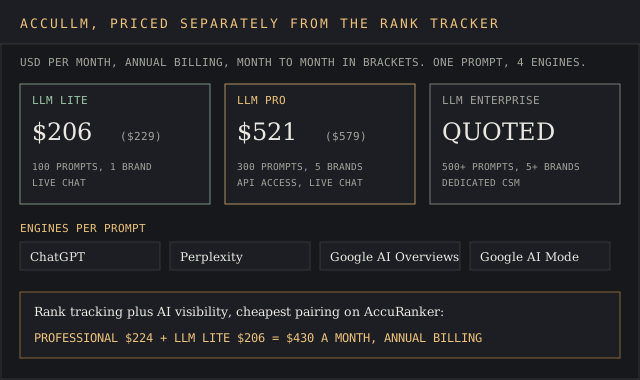
AccuLLM is AccuRanker's answer to AI search, measuring search visibility inside chatbot answers. Per the AccuLLM feature page, one tracked prompt runs across ChatGPT, Perplexity, Google AI Overviews and AI Mode, and the module reports:
- Brand visibility, average rank and share of brand mentions across your prompts.
- Competitor visibility in AI search, side by side on visibility, rank and sentiment.
- Sentiment, scored "from 1 to 100".
- Which domains and landing pages the LLMs cite most often.
- How often the LLMs search the web for a prompt.
Prompts update daily on every AccuLLM tier, per the pricing page. AccuLLM sits on its own price list:
- LLM Lite: $206 a month on annual billing ($229 monthly), 100 prompts, 1 brand.
- LLM Pro: $521 a month annual ($579 monthly), 300 prompts, 5 brands, API access.
- LLM Enterprise: 500+ prompts, quoted, with a dedicated CSM.
A Capterra reviewer, an SEO manager in sporting goods, wrote in November 2025 that "Unlike other tools we looked at it includes multiple LLMs as standard", and that seeing cited publications showed "which publications we should be targeting from a PR point of view". The same review added: "The only downside is the price - the tool isn't cheap but it works well" (Capterra).
Cost is the elephant in the room. AccuLLM isn't included in the rank tracker plans, so a Professional customer adding LLM Lite pays $430 a month on annual billing. SE Ranking's Core plan includes AI search tracking for 100 prompts at $129 a month, so buyers who want rank tracking, AI visibility and brand visibility reports under one bill should run that math first. Our competitive intelligence SEO tools ranking covers more AI visibility trackers.
Google Search Console, Google Analytics and API access
The API and integrations page lists Google Search Console, Google Analytics, Google Data Studio (Looker Studio), BigQuery, Google Sheets, Databox and Swydo. Professional includes the GSC and GA connections. Keywords and history import from other tools or a CSV file, per the getting started guide. Looker Studio arrives on Expert, and BigQuery, for teams that warehouse SEO data, on Enterprise.
API access is where the vendor's two pages disagree. The integrations page offers "Full API access at no additional cost, no matter how many requests you process." The pricing page lists unlimited read API access from Expert at $764 a month and the unlimited write API on Enterprise, with no API row on Professional. Get the answer for your plan straight from the horse's mouth, in writing, before you build a reporting pipeline on it.
Third-party reporting stops at that list. A Capterra reviewer, a founder in marketing and advertising, wrote in January 2023: "I would like more integrations with 3rd-party reporting tools like Oviond." Agencies on AgencyAnalytics should check the connector list in our AgencyAnalytics review before assuming the data flows across.
AccuRanker pricing in 2026
The pricing page publishes every rank tracker tier in USD, with the same figures in euros for EU visitors and in Danish kroner for Denmark. Prices below are per month on annual billing, with month-to-month in brackets:
- Professional plan: $224 for 2,000 keywords ($249), $332 for 3,000 ($369), $548 for 5,000 ($609).
- Expert: $764 for 10,000 ($849), $980 for 15,000 ($1,089), $1,196 for 20,000 ($1,329), $1,412 for 25,000 ($1,569).
- Enterprise plan: above 25,000 keywords, contact sales; adds BigQuery, raw SERP HTML, "enhanced speed", unlimited users and domains and a dedicated customer success manager.
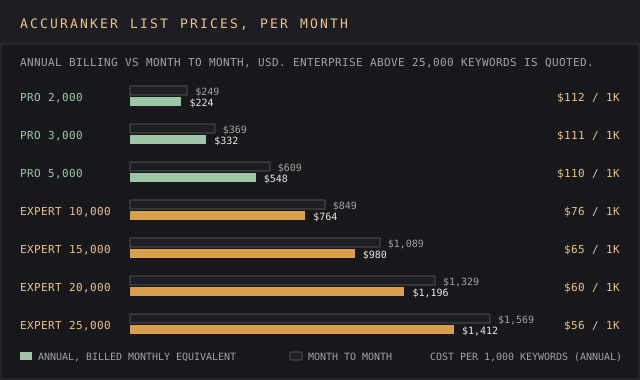
Expert targets teams tracking tens of thousands of keywords, and two things stand out. Cost per 1,000 keywords drops from $112 on Professional to $76 on Expert, so a team at 5,000 keywords pays $548 for half the capacity of the $764 Expert tier. And unlimited users come on every plan: the pricing FAQ says "all current AccuRanker plans include unlimited users", which is the agency selling point.
The full tier-by-tier breakdown, AccuLLM bundles and renewal maths sit in our AccuRanker pricing report, and the cross-vendor numbers in our rank tracker pricing report.
Free trial
AccuRanker's pricing page offers no free trial: every plan button reads "Buy now" or "Contact sales". An older trial help article, last updated November 2023, still describes a 14-day trial on a 1,000-keyword subscription with no credit card required, and Keyword.com's August 2026 review lists the trial as "None".
A working substitute sits in the pricing FAQ: "a 14-day refund policy from the initial purchase". A first-time buyer can load real keywords on a paid plan and still ask for the money back inside those 14 days. The window applies to the first purchase only, so it does nothing for a renewal.
Hidden costs: daily overage
Go past your keyword limit and AccuRanker bills the difference, and the meter runs under the radar. The dynamic keyword usage page counts tracked keywords daily: a 5,000 plan tracking 5,500 on one day pays for 500 that day, summed across the billing period as an extra invoice line. The page names no per-keyword overage rate and no off switch.
A Trustpilot reviewer in Australia wrote in December 2023 that "If you make a mistake and accidentally upgrade (WHICH IS AUTOMATIC) you cant turn this off yourself." (Trustpilot)
Contract, renewal and cancellation
The terms, governed by Danish law and signed with AccuRanker ApS, set four rules a buyer should read before paying:
- Subscriptions renew automatically for another period.
- Cancellation needs "at least 14 days' notice to the end of the subscription period", on the account page or by email to hello@accuranker.com.
- "All prepaid fees under this agreement are non-refundable", and AccuRanker "reserves the right to adjust all prices annually".
- Data isn't kept "beyond 30 days" after the subscription ends.
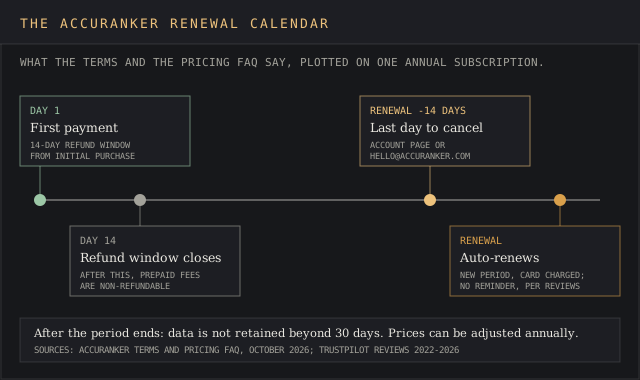
AccuRanker's pricing FAQ adds a 14-day refund window "from the initial purchase", and the changing subscriptions page says downgrades run through Account, Subscription, Change plan and take effect "until the next payment".
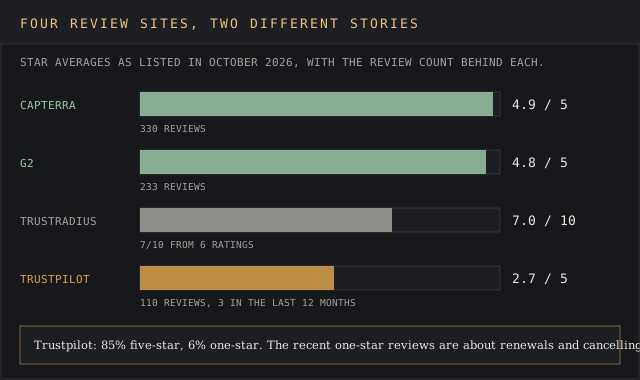
Most complaints behind AccuRanker's Trustpilot score of 2.7 target that renewal window. A Norwegian customer wrote in September 2025:
"Prior to renewal, there is no email notification, or in-dashboard notification. [...] Within 11 hours of the annual renewal, I contacted customer support to be downgraded to a lower account level, and be refunded the difference. This was refused in an arrogant manner."
Trustpilot review, Edle T, Norway, September 2025. Source
The most recent one, from October 2026, reads: "You have to cancel 14 days before next renewal and manually email Support just to be rid of this atrociously inaccurate service." (Trustpilot) Set a calendar reminder 21 days before renewal; a stitch in time saves nine on an annual Expert plan worth $9,168.
What users praise and what they complain about
Read between the lines and the rating sites tell two stories. G2 lists 4.8 from 233 reviews and Capterra 4.9 from 330, with ease of use and customer service both at 4.8. Trustpilot shows 2.7 from 110 reviews, 85% of them five-star and 6% one-star, with only 3 reviews in the last 12 months. TrustRadius shows 7 out of 10 from 6 ratings.
Praise centres on speed, the clean interface and price for value against a full suite. A Capterra CEO in marketing who had used it for over two years and switched from Serpstat, with SE Ranking on the shortlist, gave the reason in July 2023: "Using AccuRanker was a better financial decision from the beginning." (Capterra)
Complaints fall into four buckets, each traced above:
- Price for small users, with the 2,000-keyword floor.
- Renewal and cancellation terms, on Trustpilot.
- Ranking data that doesn't match a manual Google check now and then.
- Reporting limits for agencies: a Capterra writer in May 2025 said "It misses some advanced report customisation so you dont get to white label dashboards fully for clients."
Support response times aren't published. The LLM pricing cards list live chat support on Lite and Pro, and a dedicated customer success manager on Enterprise only.
Where a complete SEO tool with competitor analysis beats AccuRanker
AccuRanker covers rank tracking and leaves technical SEO, on page SEO audits, off page SEO and backlink analysis to other tools. A Capterra CEO in marketing wrote in December 2022 that "AccuRanker is not a complete SEO tool kit." A CEO who weighed it against Ahrefs and Semrush wrote in March 2024 that "Accuranker is focused on ranktracking, while the other products are focused on a lot of other things." (Capterra)
Bundled SEO tools such as Semrush and Ahrefs kill two birds with one stone for buyers who want one powerful SEO tool for audits, backlinks and tracking. If you need just a rank tracker, that focus is the product.
If your SEO strategy needs a site audit, backlink data, keyword difficulty and competitor analysis in one login, combining keyword tracking with those in one of the bundled SEO tools can cost less: SE Ranking's Core plan lists a site audit, backlink research and 2,000 daily keywords for $129, against $224 for AccuRanker's tracker alone. A team running Semrush for audits already gets 1,500 daily keywords on Pro+, per our Semrush pricing report.
AccuRanker alternatives: five rank trackers compared
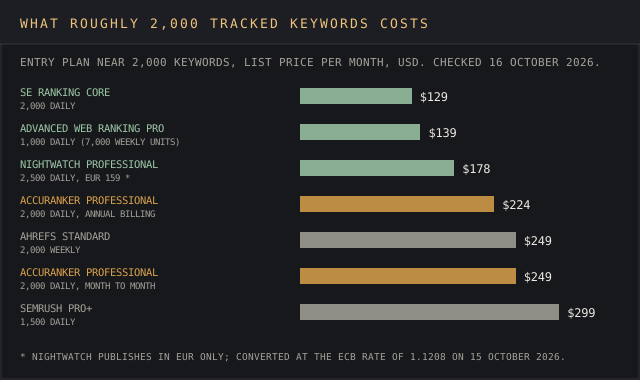
Every AccuRanker alternative below is priced from its own pricing page on 16 October 2026. Three are full SEO tools and two are dedicated trackers, and the useful question is which buying situation each one wins. Our SEO tools pricing report covers 16 vendors. The chart lines up entry plans near 2,000 tracked keywords.
SE Ranking: the cheaper all-in-one with AI tracking included
SE Ranking's Core plan costs $129 a month ($103.20 on annual billing) for 2,000 keywords tracked daily plus 100 daily AI prompts, with a 14-day free trial. That's the same 2,000 keywords AccuRanker sells for $224, with an audit and backlink research thrown in. SE Ranking also publishes a blog post titled around AccuRanker alternatives "committed to tracking the top 100 results", aimed squarely at the num=100 gap.
SE Ranking lets teams track keywords daily with "Google Top 100 tracking" listed on Core, and the plan adds a website audit at 250,000 pages a month plus backlink research.
Where it wins: a small agency or in-house team that wants daily keyword tracking, AI visibility and an audit tool under one bill. Where it loses: a team past 5,000 keywords. SE Ranking's Growth plan tops out at 5,000 for $279 monthly and everything above is a custom Enterprise quote, while AccuRanker publishes prices up to 25,000.
Semrush: position tracking inside a full suite
Semrush's SEO plans track 500 daily keywords on the $139 SEO plan and 1,500 on Pro+ at $299 a month. It wins for a team that needs keyword research, competitor analysis, audits and position tracking in one place. It loses on rank tracking cost: 1,500 keywords for $299 against 2,000 for $249 month to month at AccuRanker. Our Semrush review and the Positive Surfer vs Semrush comparison cover the suite.
Ahrefs Rank Tracker: weekly data inside a backlink suite
Ahrefs' Standard plan is $249 a month with 2,000 tracked keywords, with weekly updates on every plan, so Ahrefs tracks rankings once a week. The Rank Tracker page claims 190+ locations from country to ZIP code on desktop and mobile. It wins for link-building and content teams who live in Ahrefs' backlink index. It loses for anyone reporting daily movement to clients. Our Ahrefs pricing report breaks down the add-ons.
Nightwatch: the closest like-for-like tracker
Nightwatch's Professional plan costs €159* a month for 2,500 keywords tracked daily, plus 150 AI prompts across six AI platforms, Gemini and Claude among them. Nightwatch lets you track keywords daily on every plan, and the plan comes with a 14-day trial and no card. That's 500 more keywords than AccuRanker Professional, with AI tracking included, for about $71 less than AccuRanker's $249 month-to-month price.
* Nightwatch lists prices in euros, quoted as published. At the European Central Bank reference rate of 1 EUR = 1.1193 USD, published 9 November 2026 and refreshed weekly, EUR 159 is about $178. Every other price on this page is the vendor's own US-dollar list price.
Where it loses: Nightwatch's Enterprise tier starts at 20,000 keywords on custom terms, so large accounts end up quoted either way.
Advanced Web Ranking: flexible schedules and units
Advanced Web Ranking's Pro plan is $139 a month for 7,000 keyword units, where a weekly update costs one unit and a daily update seven, so it covers 1,000 keywords daily. You can track keywords on daily, weekly, bi-weekly or monthly schedules.
Unlimited seats and projects come on every plan, as at AccuRanker. It wins for rank tracking teams that can run most keywords weekly and a priority set daily. It loses on pure daily volume. Our Advanced Web Ranking review has the full unit math.
Two more worth a look
Pro Rank Tracker's Starter is $99 a month for 1,000 terms tracked daily, and Pro is $149 for 2,000, both listing Google AI Overviews and AI Mode tracking. The page names Google and YouTube among its search engines and says free trials are temporarily closed to new sign-ups. SpyFu fits buyers who want competitor ad history, with 10+ years of historical data on paid plans per our SpyFu review.
| Tool | Plan near 2,000 keywords | Update | Monthly price | AI tracking included |
|---|---|---|---|---|
| AccuRanker | Professional, 2,000 | Top 30 daily | $224 annual, $249 monthly | Separate, from $206 |
| SE Ranking | Core, 2,000 | Daily | $129 | 100 prompts |
| Nightwatch | Professional, 2,500 | Daily | €159* | 150 prompts |
| Advanced Web Ranking | Pro, 1,000 daily | Daily to monthly | $139 | See review |
| Ahrefs | Standard, 2,000 | Weekly | $249 | Separate |
| Semrush | Pro+, 1,500 | Daily | $299 | Separate toolkit |
Prices are each vendor's published monthly list price in USD, read 16 October 2026, except Nightwatch's euro price, converted in the note above.
To cut to the chase, which is better than AccuRanker depends on volume. For smaller teams doing basic rank tracking under 2,000 keywords, SE Ranking, Nightwatch and Pro Rank Tracker all cost less. For larger teams past 10,000, the gap narrows: AccuRanker Expert is $764 for 10,000, Pro Rank Tracker's Agency tier lists $549 for 10,000 month to month, and SE Ranking and Nightwatch move to custom quotes above 5,000 and 20,000 keywords.
Verdict
AccuRanker is for SEO agencies managing multiple clients and in-house teams that track keywords by the thousand, 2,000 to 25,000 of them, and want rank tracking that reports daily keyword rankings on page one. Unlimited users, tags, share of voice and two-hourly refreshes make it fast to run, and Capterra users rate it 4.9 from 330 reviews. Expert's price falls from $76 per 1,000 keywords at 10,000 to $56 at 25,000, all published without a sales call.
It isn't for local businesses, freelancers or small sites new to the SEO game and tracking a few hundred terms. The $224 floor buys 2,000 keywords, there's no technical SEO or on page SEO audit and no backlink data, and AI search tracking costs another $206 a month at minimum. SE Ranking's $129 Core plan adds a site audit, backlink research and 100 AI prompts for less.
It might suit new sites and long-tail programmes, with two caveats. Positions 31 to 100 refresh every second week since September 2025, so daily graphs below position 30 lag by up to 14 days. And keep an eye on the renewal terms: 14 days' notice, prepaid fees non-refundable, and a Trustpilot score of 2.7 built largely on renewal complaints. Put the cancellation date in the calendar on day one and AccuRanker does the job it's priced for.