Clay MCP review: Functions, rep credit budgets, and a connector that runs only what Ops builds
 By Jan Suski. I go deep on every review, checking every number against its source and digging up details other coverage misses, a habit from six years of SEO and link building for tech companies. Bylines at Brand24 and Senuto. How the scoring works.
Best for
A sales team on Clay Launch, Growth or Enterprise where one Ops person already builds tables, and reps want that work inside Claude, ChatGPT, Codex or Microsoft 365 Copilot with a monthly credit cap on each of them.
Not for
A solo founder with nobody to build Functions, a team still on a legacy Starter, Explorer or Pro plan, or anyone who needs a published tool list before an admin approves the connector.
What it costs
No MCP surcharge. Launch is $185 a month or $167 billed annually for 15,000 actions and 3,000 Data Credits, Growth is $495 or $446, and a Function costs the same credits in chat as in a table.
- Hosted connector
- Built by Clay, OAuth sign-in, "MCP for reps"
- Documented AI clients
- Claude, ChatGPT, Codex, Microsoft 365 Copilot, Glean
- Developer route
- Clay mcp from the Clay CLI, local stdio, for Claude Code, Cursor and Claude Desktop
- Timeline
- Claude 26 January 2026, Functions and budgets 22 April, Codex 2 June, Copilot 16 July
- Tool count
- 17 per Composio and Scalekit, none listed in Clay's own docs
- Namesake
- Mcp.clay.earth, a personal contact CRM unrelated to clay.com
- Free
- $0, 500 actions and 100 Data Credits a month, lookups only through MCP
- Launch
- $185 a month, $167 annual, 15,000 actions, 3,000 Data Credits
- Growth
- $495 a month, $446 annual, 40,000 actions, 6,000 Data Credits
- Enterprise
- Custom, 200,000+ actions, 100,000+ Data Credits, Audiences in chat
- Legacy self-serve plans
- Not named in the Functions rollout
- Seats
- Unlimited on every plan, Sales Rep seats included
- Ratings
- G2 4.6 across 234 reviews
- Provider count
- 150+ in Clay's MCP guide, 200+ on its MCP page
- Mobile match rate
- 30 to 35%, measured by one G2 reviewer
- Company scale
- $100M ARR in December 2025, $115M Series D at $7.1B
- MCP surcharge
- None: a 12-credit Function costs 12 credits from Claude
- Budget reset
- 1st of each month, midnight UTC
- Limit of 0
- Hard-blocks actions, rep stays in the workspace
- Token revocation
- Not possible from the MCP page
- People Search cap
- Up to 1,000 results per search
- Data Credit top-ups
- 30% premium on Launch and Growth, down from 50%
Lusha MCP
Not forTeams that want reps running Ops-built, multi-step workflows.
Amplemarket MCP
Not forTeams under $7,200 a year in tooling budget.
Clay MCP is the connector that puts Clay, the data enrichment platform, inside AI assistants such as Claude and ChatGPT. It runs on the Model Context Protocol, the open standard AI agents use to call outside software. A rep types a request in natural language, the assistant calls Clay's tools, and contacts, research notes and draft emails come back in the chat. Clay shipped the Claude connector on 26 January 2026, with 500 free Clay credits for anyone who connected.
So what does Clay AI do once it's in a chat window? The MCP page lists three jobs: search Clay's company data and people database, enrich leads through a waterfall across "200+ data vendors," and push validated prospects into a sequencer or CRM. The Clay AI tool most buyers know, the spreadsheet interface with a column per integration, stays behind the scenes, and Ops decides what reps can call from it.
This review covers both official servers, the community wrappers, setup, plan gating, the credit system, and what the connector carries over from the platform underneath. I didn't connect a paid workspace for it, so every behaviour below comes straight from the horse's mouth in Clay's documentation, or from named users, each linked. The full Clay review covers the enrichment platform in depth, and this page stays on the MCP connector.
It's written for sales teams, growth teams and other go-to-market teams who already pay for Clay and want reps working from Claude or ChatGPT, and for buyers comparing AI powered sales intelligence vendors on MCP support.
The timing matters because Clay added Functions, permissions and per-rep budgets on 22 April 2026, which changed the connector from a lookup tool into a way to hand Ops-built custom workflows to people who never open a table. It matters because reps already research accounts and draft emails in ChatGPT and Claude, and Clay's launch page promises them go-to-market data there with "No Clay login required."
↑ FACT SHEETWhat exists: two Clay MCP servers, community wrappers, and a namesake
Clay runs two official routes. The hosted one, branded "MCP for reps," connects over OAuth from Claude, ChatGPT, Codex, Microsoft 365 Copilot and Glean, per Clay University's MCP settings page. It's the one in the Claude connectors directory, listed as made by Clay, with the tagline "Find prospects. Research accounts. Personalize outreach."
The second route is for developers. The Clay developer docs describe a local server started with the clay mcp command from the Clay CLI, running over stdio for hosts such as Claude Code, Cursor and Claude Desktop, and the agent workflows page adds Codex. It signs in with the CLI session or a CLAY_API_KEY environment variable, and stays pinned to one workspace until the host restarts it.
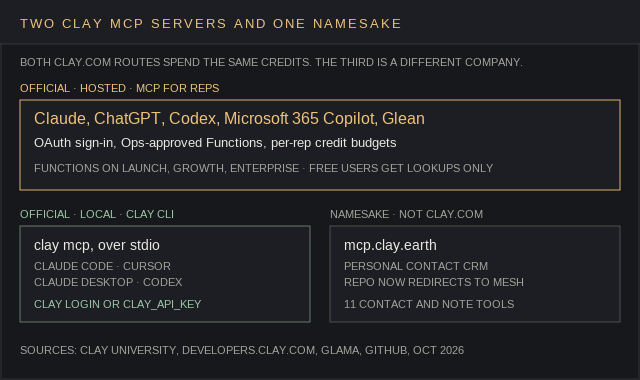
Clay's docs publish no list of tool names for either route. Third parties fill that gap. Composio's Clay MCP toolkit counts 17 tools, from Find-and-enrich-contacts-at-company and Run subroutine to Get-credits-available, with managed OAuth. Scalekit's connector also counts 17 and names 8, including claymcp_ask_question_about_accounts for Audiences. Neither says if it wraps Clay's hosted server or hosts its own.
Search for "clay mcp" on GitHub and you'll bark up the wrong tree. The clay-inc/clay-mcp listing on Glama points at mcp.clay.earth, a personal contact manager with 11 contact, note and group tools, and the GitHub repo now redirects to mesh/mesh-mcp. It has nothing to do with clay.com's go-to-market data. Check the endpoint before connecting anything.
↑ FACT SHEETHow to connect Clay to Claude, ChatGPT, Codex and Copilot
Clay's ChatGPT guide and MCP guide give the rep-side steps, and they're short:
- In ChatGPT, type @Clay in the browser or /Clay in the desktop app. In Claude, add Clay from the Connectors page.
- Sign in through app.clay.com/oauth, or create a Clay account on the spot.
- On Claude Enterprise, ask an admin to enable the connector first.
- Run the entire process once: find a contact, verify the email, research the account, draft outreach.
Codex followed on 2 June 2026, connected from the MCP section of the workspace. Microsoft 365 Copilot arrived with the "Clay for Reps" announcement on 16 July 2026, which promised Glean the following week, and Clay University now links a connection guide for each.
Reps can hit the ground running. The admin side takes longer, and the order matters. Clay University's MCP settings page lists five steps: invite each rep with the Sales Rep permission type, set a default credit limit before anyone connects, enable the Functions reps should use, configure Audiences on Enterprise, then share the connection guide. Skip the second step and reps who connect sit at "No limit," which is a red flag on a team with a shared Data Credit pool.
Clay's guide also tells reps to find, filter and enrich in three separate prompts so they can check results before spending credits, and to search by company domain over company name. Most sales teams will want that written into onboarding. It's sensible advice, and it's also an admission that one loose prompt can spend more than the rep expected.
↑ FACT SHEETFunctions: the AI powered custom workflows Ops builds and reps run
Of the release's key features, Functions are the reason the connector exists for paying teams. Clay's 22 April 2026 launch post, by Matthew Quan, defines them as reusable enrichment workflows built in Clay that take defined inputs, run a sequence of enrichments and return structured data.
It gives two examples: a company enrichment Function that runs a waterfall plus ICP lead scoring, and an outbound generator that looks up the contact in Salesforce and Snowflake, pulls signals and drafts outreach. Each Function can collect data from several providers and hand the rep one row of enriched data.
An admin toggles "MCP for reps" in a Function's settings, names it, and describes it.
The settings page warns against names such as "find contacts" or "enrich company," since the AI tool may call Clay's built-in tool of the same name. It also notes a Function returns a column's output only if it includes an enrichment or output column, so the data transformations and field mapping inside the table decide what the rep sees. Ops can add custom data points as extra output columns, and the MCP page names lead scoring and account prep as typical jobs.
The Sales Rep permission keeps reps out of the build. Per the settings page, those users "won't be able to see the Clay UI, tables, API keys, or workflows," and can run only admin-approved Functions. That answers the oldest complaint about Clay AI, that the team relies on one person with knowledge nobody else has. A TrustRadius reviewer in corporate put it plainly:
"Clay is too open and wide for specific scenarios on different teams, so only marketing operations people are good at using it. I'm thinking about tools like 6sense, Nooks, and Common Room where other teams want to use AI to propel their selling or marketing strategy."
Verified User, Contributor in Corporate, TrustRadius review, 1 October 2025.
For sales teams, Functions put the ball in Ops' court. Someone still has to build the table, test the waterfall and keep the CRM records it writes clean.
Clay sells that as the point. Its MCP page quotes a Saviynt marketing ops director saying reps "move faster without Ops losing control," a vendor-picked line. The MCP guide also cites results from SaaS companies, such as Anthropic's "4 hrs/week saved per person," without tying any of them to MCP use. Read between the lines: those are platform figures.
Clay's community material helps the people who do build. Christopher L., an account development rep at an enterprise firm, wrote on G2 on 28 April 2026: "It democratizes knowledge, use cases, best practices, all without having to engage with Clay staff."
↑ FACT SHEETWhat a rep gets from Clay AI in chat: data enrichment, research and drafts
Without any Function, a rep on a paid plan gets a default set of enrichments. The launch post lists headcount growth, recent news, investors, competitors, customers, tech stack, website traffic, open jobs, revenue model, annual revenue, latest funding, email, a work history summary and thought leadership, "to name a few."
The MCP page adds that a search can "return up to 1,000 People Search results" from Clay's database, filtered by job title, company size and location. Clay's January post adds org charts, job changes, funding history and tech stack signals.
Clay's own guides are honest about how much data enrichment belongs in chat. Both say chat suits about 1 to 20 contacts, exploratory research and single emails, while 20+ contacts, complex workflow automation and CRM syncs belong in the platform.
Where Clay helps most is the manual research a rep does before a call: the pre call prep tab in LinkedIn Sales Navigator, the Google Sheets list a rep builds by hand, and the habit of switching between multiple tools. A table that enriches 5,000 rows overnight stays in the platform, and so does bulk list building.
The draft step has a guardrail. The ChatGPT guide says the "Draft email" action, for a first email or a follow up, appears only after a verified address exists, and recommends confirming business context in workspace settings so drafts reflect your company. Validated contacts can then go to the sequencer, the CRM or other outreach tools under Ops-defined write rules.
The research behind it comes from Claygent, Clay's AI research agent, which the pricing page includes even on the free plan. G2 reviewers single it out. Manzar I., a sales manager at an enterprise marketing firm, wrote on G2 on 1 April 2026: "I also love Claygent, the AI agent, because it can visit company websites." Mounib S., a partner engagement manager, said it "saves us a lot of time and money by automating the manual work behind prospecting" (G2, 7 May 2026).
Bilal S., a digital marketing executive at a small business, wrote that "It's solved the 'personalization at scale' problem" (G2, 27 August 2026).
Those reviews describe the platform. The connector hands the same research agents to reps, and each answer still depends on the data sources behind the waterfall. Vikash Kumar D., an associate consultant, wrote that "Some niche markets and smaller regional companies occasionally required additional verification" (G2, 18 September 2026), so lists of local businesses deserve a second check.
↑ FACT SHEETClay's pricing and which Clay AI plans include MCP
Clay's pricing changed on 11 March 2026. Varun Anand and Karan Parekh wrote in the pricing announcement that Clay folded three self-serve plans into Launch and Growth, with Enterprise above them. Legacy Pro had been $800 a month and Growth starts $305 lower at $495. The pricing toggle reads "Save 10%" on annual billing, and 10% off $800 is $720, the Pro figure AI answers still quote.
Marketplace data now costs "50–90% fewer credits" on the most-used enrichments, and the top-up premium fell from 50% to 30%. The same post warned that customers who mainly use their own API keys may see a price increase.
The pricing page sets the current ladder. Free is $0 for 500 actions and 100 Data Credits a month, which AI answers often describe as 100 searches, plus a 200-row cap per table and no phone enrichment. Launch is $185 a month or $167 with annual billing, for 15,000 actions and 3,000 Data Credits.
Growth is $495 or $446, for 40,000 actions and 6,000 Data Credits, and adds CRM integrations, HTTP API calls, webhooks and web intent signals.
Clay's integrations directory lists HubSpot and Salesforce, and its ads feature syncs audiences to LinkedIn, Meta and Google. Launch already carries phone enrichment and signals such as job changes, and the web intent signals on Growth are the closest thing to real-time intent data on the rate card. Enterprise carries custom pricing for teams past 100,000 Data Credits a month, with the FAQ pointing at 200,000+ actions.
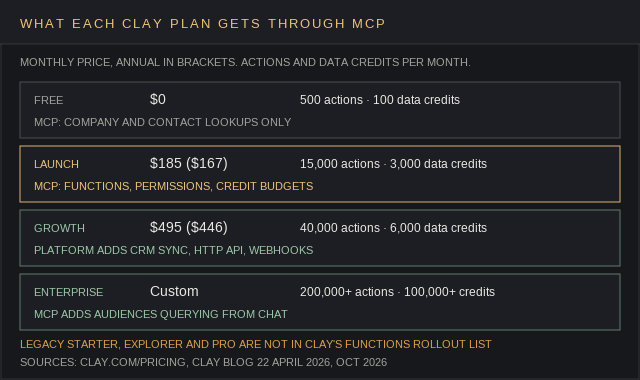
MCP gating follows the plan. Per the April post, "MCP with Functions, MCP permissioning, and credit budgets is available now on all modern self-serve (Launch, Growth), and both modern and legacy Enterprise plans," while "company and contact lookups are still available for free and trial users." Legacy Starter, Explorer and Pro aren't on that list, and the pricing post already warned that major new releases would reach modern plans only.
Enterprise adds one more layer. Teams that sync their own first-party data, such as Salesforce accounts, into Audiences, which Clay still labels beta, can let reps query it from ChatGPT and Claude, and the settings page can restrict that querying by Salesforce owner.
That matters for the AI Search answers on this topic, which still quote a Starter plan near $134 and an Explorer plan near $314. Those tiers are retired for new buyers. G2's Clay listing still shows Starter at $143 a month and Explorer at $314 as of 15 October 2026, which is how stale figures keep circulating.
A team still on one of those plans gets lookups through MCP, and needs Launch or above for Functions.
The credit based pricing splits into two currencies. Actions measure "the orchestration you do on Clay" and reset every billing cycle. Data Credits pay for marketplace data from Clay's data providers, such as an email enrichment, and skip entirely when you bring your own API keys, a route the pricing FAQ spells out.
Seats are unlimited on every plan, so adding 30 Sales Rep users costs nothing until they spend. The Clay pricing report runs every tier and the Enterprise contract data in full.
↑ FACT SHEETThe credit system behind every prompt: budgets, limits and gaps
Clay's credit-based system charges the same rates in chat as in a table. Clay University's example: a Function that "costs 12 credits" in a table "costs 12 credits when a rep triggers it from Claude or ChatGPT."
There's no MCP surcharge, and Clay doesn't publish a per-Function credit cost either, because each Function's cost depends on the providers in its waterfall. Credit usage for a given prompt will vary depending on which data sources answer first, and the devil's in the details of each waterfall.
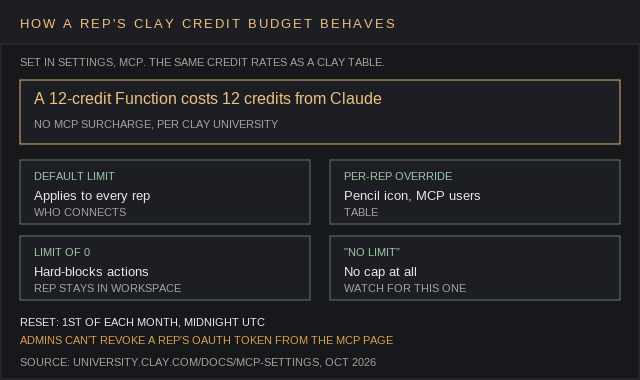
The budget controls are the strongest part of the release. An admin sets a default limit that applies to every rep who connects, overrides it per user from the MCP users table, and can keep an eye on spend data under Settings, Credit Usage.
Spend resets on the 1st of each month at midnight UTC. A limit of 0 "hard-blocks further actions without removing them from the workspace," and once a rep hits the cap, Functions and enrichments stop until the reset or until an admin raises it.
There are two gaps. "Admins can't revoke OAuth tokens from the MCP page," so cutting off a departing rep means removing them from the workspace or setting their limit to 0. And reps showing "No limit" have no cap at all, which is the state anyone sits in if the admin skipped the default. A stitch in time saves nine here: set the default before sending the invite.
Users have asked for exactly this kind of guardrail for years. A G2 reviewer on the small-business tier wrote in December 2023:
"I think it would be that it can in some cases be quite easy to burn a lot of credits quickly without realizing it. Especially if you're pulling in a ton of different data sources. With that in mind, it could be helpful to have 'credit estimates' or 'maximum credit usage' for a given run to help mitigate that."
Max T., Small-Business, G2 review, December 2023.
Budgets answer that complaint at the rep level, and the platform underneath still bites. Koedun P., a senior campaign analytics manager, wrote on G2 on 8 June 2026: "It is an expensive tool and you can quickly burn through credits." A mid-market software reviewer gave Clay one star on 11 September 2026 after "changing a dedupe setting re-ran the entire workbook and blew through our entire month's credits," and wrote that the refund covered a fraction of the loss.
A founder at a small agency described the same unpredictability from the buyer's side:
"pricing is too high for me and there credit system is somewhat messy like its unpredicatble to get how I much credit will be used for the enrichment...Clay is well suited if you need to do filtering and enrichment in volume like alteast 2k leads."
Jitendra Dhage, Founder, Prospectvista (1-10 employees), TrustRadius review, 2 January 2026.
The pricing page also contradicts itself. Its FAQ says unused Data Credits on Launch and Growth "can accumulate up to 2x your monthly credit amount," while the comparison table lists rollover as "Up to 1 month's credits." The Launch data-credit figure no longer splits: rendered in a browser on 7 November 2026 with monthly billing selected, the plan card reads 2.5K a month, matching the tier list and Clay's plans-and-billing doc. Read the invoice, then the page.
↑ FACT SHEETWhat Clay MCP inherits: enriched data, accuracy and a steep learning curve
The connector answers from the same enrichment platform, so its answers are only as good as the data providers behind the waterfall. Clay AI can't agree on how many there are. The MCP guide dated 14 June 2026 pitches "150+ data providers" and AI research agents to GTM teams, and the MCP page says "200+ providers."
Either way, a waterfall across multiple data providers, pulling from multiple sources in order, stops at the first match, which keeps the cost of finding data down and the coverage up. Both counts clear 100 data sources for enrichment.
Coverage is uneven by field. Chris J., a product marketing manager in the mid-market tier, measured mobile numbers:
"The UI looks like a friendly spreadsheet, but when you need conditional logic and formula chains, it's basically programming. The phone number coverage is really weak, with mobile matches only around 30-35%."
Chris J., PMM, Mid-Market, G2 review, 4 May 2026.
The same reviews describe a steep learning curve for non-technical users, the one MCP is meant to hide, and complaints about the table-based workflow builder are par for the course. Brauny N., a site reliability analyst, wrote on G2 on 26 August 2026 that "The learning curve is steeper than the marketing suggests," in a five-star review. Leon W., a revenue operations specialist, said "it took me weeks to understand what's what" (G2, December 2023).
Clay looks like Google Sheets and behaves like code, which is why the Function model is a big difference for most teams. The technical thinking stays with one builder, and the 10 reps using the connector never touch a formula. Justin Ashby, VP of Marketing at Glyphic, summed up why builders like it: "It's a spreadsheet with every column is an integration, so whatever you want to do... it's just so easy" (TrustRadius, 26 September 2025).
Aaron Leeder, a partnerships VP at Pavilion, wrote that "Clay is revolutionizing how we approach much of the manual work that is executed by the Pavilion operations team" (TrustRadius, 17 October 2025). The ratings sit at 4.6 across 234 reviews on G2, and this site's report on how far to trust Capterra and G2 scores covers how those reviews get collected.
Company stability looks solid. Kareem Amin, Clay's CEO, wrote that Clay crossed $100M ARR in December 2025, two years after $1M, and Clay later announced a $115M Series D at a $7.1B valuation. The open questions sit in the documentation, the credit math and the plan gating covered above.
Clay also ranks in this site's data enrichment tools ranking, its go-to-market tools ranking, and the lead intelligence software ranking, and the MCP tools list places it eighth among confirmed servers.
↑ FACT SHEETClay MCP against Lusha MCP, Amplemarket MCP and Seamless MCP
Lusha's hosted server, covered in the Lusha MCP review, exposes 22 tools and works on Lusha's free plan, which Clay's Function layer doesn't. It caps each call at 25 companies or 50 contacts.
Lusha sells its own database, while Clay routes each lookup through third-party data providers. The Lusha pricing report puts Pro at $69.90 a month, with an email reveal at 1 credit and a phone number at 5. Lusha suits sales teams that want quick contact lookups, basic data enrichment and light list building at a low entry price. Clay pulls ahead once an Ops team wants to hand reps a scored, multi-step workflow.
Amplemarket goes further into outbound. The Amplemarket MCP review counts 63 named tools across 16 categories, including full sequence management, with enrichment at 0.5 credits per request.
The entry price can cost an arm and a leg for a small team: Startup runs $600 a month billed annually per the Amplemarket pricing report, against $167 for Clay Launch. Amplemarket suits outbound teams that want to send from chat. Clay fits teams that build their own enrichment logic first.
Seamless.AI's server, in the Seamless MCP review, lists 54 tools across 11 domains and nine named clients, the broadest client support of the group. It's sales-led above Free, with Pro and Enterprise both reading "contact sales," and one Capterra reviewer measured 70% deliverability against Seamless's "verified" label. Clay AI's public rate card and waterfall give it the edge on accurate data and price transparency among the sales tools compared here.
For a wider view, the ZoomInfo alternatives comparison scores Clay against ZoomInfo's full go-to-market bundle, and the ICP tools ranking covers it as a scoring tool for target accounts.
↑ FACT SHEETFAQ
What is MCP in Clay?
MCP stands for Model Context Protocol, the open standard AI assistants use to call outside tools. In Clay it's the connector that lets Claude, ChatGPT, Codex, Microsoft 365 Copilot and Glean find companies, search Clay's database, enrich leads and run Functions an admin has approved.
Does Clay have an MCP?
Yes. Clay runs a hosted connector with OAuth sign-in for AI assistants and a local clay mcp server in its CLI for coding agents. The clay-inc/clay-mcp repo on GitHub belongs to an unrelated contact manager and now redirects to Mesh.
What is ChatGPT Clay?
It's the Clay app inside ChatGPT. You type @Clay in the browser or /Clay on desktop, sign in, and ask for contacts by job title, account research or a draft email. Clay recommends it for 1 to 20 contacts at a time.
Who is the CEO of Clay AI?
Kareem Amin, who co-wrote Clay's December 2025 post announcing $100M in annual recurring revenue.
Is Clay AI legit?
Clay AI is a real, venture-funded company with a $7.1B valuation at its Series D and a 4.6 rating across 234 G2 reviews. The complaints on record concern credit burn and the learning curve, both covered above.
Is Clay worth it for a team that wants only the MCP connector?
It's worth it when someone on the team will build Functions and own the data enrichment logic behind them. Free users get lookups through MCP, the 500 free credits on first connect are a drop in the bucket next to a working Function, and the real value sits in Ops-built workflows on Launch at $167 a month annual or above.
↑ FACT SHEETVerdict
Clay MCP is for sales teams already on Launch, Growth or Enterprise where one person builds tables and everyone else should never have to. Reps get Functions in Claude, ChatGPT, Codex or Copilot, admins get per-rep budgets that hard-block at 0, and a Function costs the same credits in chat as in a table under one credit model.
The 80 on time to first output, the 76 on admin controls and the 72 for reps with no Clay training come from those facts, since reps never see a table.
It isn't for a solo founder with no Ops builder, which is why that fit scores 40, or for a team on a legacy Starter, Explorer or Pro plan that Clay left out of the Functions rollout. The 34 on documentation consistency reflects a provider count that reads 150+ in one place and 200+ in another, a pricing page with two rollover rules, and a tool list you have to get from Composio.
The middle case is a team with a builder and a tight budget. Set the default credit limit before inviting a single rep from the go-to-market team, since "No limit" means no cap, and remove departing reps from the workspace, since admins can't revoke their tokens. Price transparency scores 58 because per-Function costs stay unpublished, and the jury's still out on how those Functions behave across a full quarter of rep use.