Medical device market intelligence
Medical device market intelligence is the systematic collection and analysis of regulatory filings, procedure volumes, reimbursement data, and competitor activity. It helps device makers, hospital purchasing teams, and investors understand where a device category is headed before a rival's launch or an FDA decision reshapes it.
Where pharma market intelligence tracks a drug through trials and patent cliffs, this discipline tracks a device through a shorter, faster product cycle: iterative hardware and software updates, a different clearance pathway, and competitive dynamics that shift within a single fiscal year rather than over a decade.
Market-size estimates for this industry rarely agree, and the gap says more about category boundaries than disagreement over growth. Fortune Business Insights sizes the global medical devices market at $604.99 billion in 2026, growing to $1,032.66 billion by 2034. Precedence Research puts 2026 at $719.61 billion, reaching $1,209.42 billion by 2035, while Statista's more conservative estimate puts 2026 revenue at $571.72 billion. In-vitro diagnostics, wearables, and software-as-a-device get counted inconsistently across reports, which is why three reputable firms land in three different places for the same year.
Best medical device market intelligence tools
| Rank | Tool | Best fit | Signals | Watch-outs | Review |
|---|---|---|---|---|---|
| 1 | GlobalData | Device pipeline and company-level competitive tracking | Device forecasts, company financials, clinical trial analytics, epidemiology | Breadth over depth in narrow device subcategories | GlobalData review |
| 2 | Evaluate | Consensus forecasts and MedTech competitive benchmarking | Market sizing, consensus forecasts, company and therapy-area comparisons | Specialist scope; pair with a document-research tool for filings | Evaluate review |
| 3 | IQVIA | Procedure volume and real-world evidence at scale | Claims data, procedure counts, real-world outcomes, patient registries | Enterprise contracts; heavy data governance workload | IQVIA review |
Tool profiles
GlobalData
Best for: teams tracking device pipelines and company financials across a broad medtech portfolio. Why it fits: its device forecasts and epidemiology data pair company-level detail with category-wide market sizing in one platform. Buyer check: sample coverage depth in your specific device subcategory before committing budget, since breadth can trade off against granularity.
Evaluate
Best for: consensus forecasts and competitive benchmarking through Evaluate MedTech. Why it fits: strategy teams comparing a device launch against consensus market sizing get a faster, more defensible number than building one from scratch. Buyer check: confirm forecast granularity for your device category and geography.
IQVIA
Best for: teams that need procedure volumes, claims, and real-world evidence at national scale. Why it fits: reimbursement and market access decisions depend on actual procedure counts and patient outcomes, not just forecasted demand. Buyer check: confirm data governance and country-level access before signing.
How medtech teams should choose
Choose GlobalData for pipeline and company-level breadth, Evaluate for consensus market sizing and competitive benchmarking, and IQVIA for procedure-level and real-world evidence depth. Most enterprise medtech strategy teams end up running at least two of the three, since forecasting, competitive tracking, and procedure-volume data rarely live in a single platform well.
Category names, not vendor names
iData Research, headquartered in Burnaby, British Columbia, has specialized in medical device market intelligence since 2005 without a review on this site yet. Its flagship offerings are 10-year market forecasts, competitive analysis, and procedure volumes across more than 70 countries, spanning device categories from orthopedics and dental to cardiovascular and diagnostic imaging.
For MedTech product and commercial teams who need device- and procedure-level granularity specifically, it is worth shortlisting alongside the reviewed tools above.
Diagnostic imaging, advanced technologies, and where data density varies
Data quality is not uniform across device categories, and a program that assumes otherwise will overinvest in the wrong places.
Orthopedics and cardiovascular devices carry decades of registry data, national joint registries and cardiac device registries in particular, so competitive and outcomes data runs deep. Diagnostic imaging sits closer to the software side of the industry now, with AI-enabled reading tools clearing at a pace hardware-only devices never matched.
In-vitro diagnostics (IVD) carries its own separate regulatory track in most major markets, run in parallel to the device pathways covered here rather than folded into them.
A single intelligence program covering every category well is rare. Most teams scope by category first, orthopedics, cardiovascular, diagnostic imaging, IVD, and only build cross-category coverage once the highest-priority category's monitoring is working reliably.
Market insights: what medical device market intelligence covers
The discipline pulls from sources that don't exist in most other industries: FDA clearance and approval databases, device-specific adverse event reports, hospital purchasing and procedure data, and reimbursement coding systems that determine whether a hospital gets paid for using a device at all.
Data sources for medical devices include regulatory filings, clinical trial registries, hospital procurement data, and payer coverage policies, combined into a picture that spans the entire path from FDA submission to operating-room adoption.
What ties the sources together is timing. A competitor's 510(k) clearance, a CMS coverage decision, or a device recall each move the competitive picture within weeks, not the years a pharma pipeline signal usually takes to play out.
Teams that treat medical device market intelligence as a quarterly report rather than a continuous feed miss the window where the information is actually actionable. A 510(k) clearance moves the competitive picture within weeks, not the years a pharma pipeline signal usually takes.
The Regulatory Backbone: FDA Clearance and Approval Pathways
Almost every device that reaches the U.S. market goes through one of two very different FDA pathways, and market intelligence has to track both because they move at different speeds and signal different things about a competitor's strategy.
The 510(k) premarket notification pathway covers moderate-risk devices and clears roughly 3,100 to 3,300 devices a year: 3,326 in fiscal year 2023, 3,107 in fiscal year 2024, and 3,238 in fiscal year 2025.
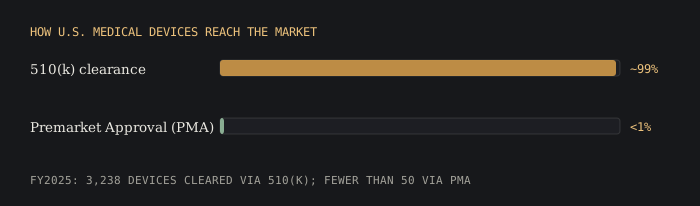
Nearly 99% of devices that reach the market do so through 510(k) clearance rather than the more demanding Premarket Approval (PMA) pathway, and more than 82% of Class II devices specifically clear through 510(k).
Why PMA is a different order of scrutiny
PMA is the other pathway, reserved for high-risk devices, and it is a different order of scrutiny entirely: PMA requires clinical trial data, a full description of the design and manufacturing process, and a summary of safety and effectiveness, while 510(k) relies mainly on benchtop and descriptive data showing substantial equivalence to an already-cleared device.
The FDA receives more than 4,000 510(k) submissions a year against fewer than 50 PMA submissions, a ratio that itself tells a competitive intelligence story: a company filing a PMA is signaling a genuinely novel, higher-risk device, while a 510(k) filing usually means an iteration on an existing category.
Tracking which pathway a competitor files under, and how long clearance takes, is one of the more reliable early signals in this industry.
The EU MDR Bottleneck
Outside the U.S., the European Union's Medical Device Regulation (MDR) has created its own competitive intelligence signal, one built from delay rather than approval speed.
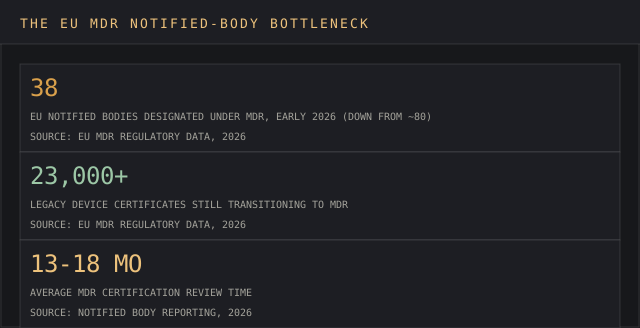
Just 38 notified bodies were designated under the MDR as of early 2026, down from roughly 80 that operated under the prior framework, and more than 23,000 legacy device certificates still need to transition from the old directive to the MDR. Notified bodies now report average certification reviews of 13 to 18 months, with 12- to 18-month backlogs on technical file reviews for complex devices.
Deadlines that compound the pressure
Class I manufacturers and other economic operators must complete EUDAMED registration by May 28, 2026, or face immediate market suspension; the extended transition for Class III custom-made implantable devices ends May 26, 2026; higher-risk Class III and certain Class IIb implantable devices face a December 31, 2027 deadline; and medium- and lower-risk devices have until December 31, 2028.
A competitor's notified body assignment and MDR certification status are now as relevant as its FDA clearance history. A bottlenecked recertification can pull an established device off EU shelves entirely while a rival with an earlier-filed dossier keeps selling.
Adverse Events, Recalls, and the Move to AEMS
Once a device is on the market, the FDA's adverse event reporting system is the primary public record of what goes wrong with it.
The Manufacturer and User Facility Device Experience database, MAUDE, held more than 24 million device-related adverse event reports covering the trailing ten years of mandatory and voluntary reports from manufacturers, importers, device user facilities, clinicians, and patients. In March 2026 the FDA began replacing MAUDE, along with six other legacy databases, with a unified Adverse Event Monitoring System (AEMS), with the transition scheduled to complete by the end of May 2026.
Newer adverse event reports increasingly carry a Unique Device Identifier (UDI-DI) that links a report to a specific model, version, and packaging lot inside the FDA's Global Unique Device Identification Database (GUDID).
For competitive intelligence, UDI-DI traceability is the difference between knowing a category has a problem and knowing which competitor's specific device generation is driving it, a level of resolution most other industries' complaint data doesn't offer.
How Often Devices Get Recalled
Recalls are the other side of the adverse-event ledger, and the trend line matters as much as the count.
Medical device recalls climbed to 1,059 events in 2024, the highest total in four years, and Class I recalls, the most serious tier, reached their highest level in 15 years. Class I recalls alone rose 232% between 2020 and 2025, with 35 of the 44 reported cases since 2020 landing in 2025 specifically. The FDA's device recalls and early-alerts page logged 111 recalls and early alerts in 2025.
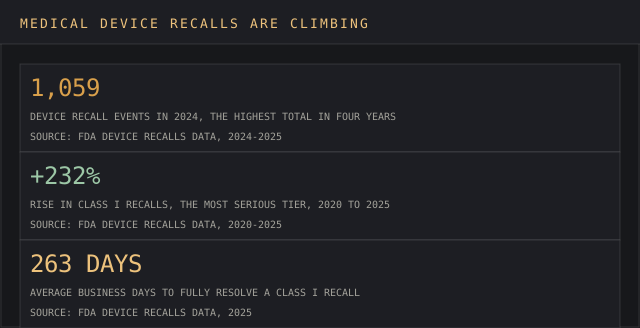
Severity is not evenly distributed. Roughly 88% of classified device recalls are Class II, the moderate-risk tier; about 9% reach Class I; and around 3% are Class III.
Processing takes time regardless of tier: Class I recalls averaged 263 business days from completion to termination, against 269 days for Class II and 248 for Class III. A competitor's recall rarely resolves quickly enough to disappear from a well-run intelligence feed before it has already shaped a purchasing decision.
Reimbursement and Procedure-Level Data
A device can clear FDA review and still fail commercially if it doesn't have a reimbursement pathway a hospital can bill against.
Reimbursement intelligence tracks CPT and HCPCS coding decisions, CMS coverage determinations, and payer policy alongside the clinical and regulatory signals, since a coding delay can stall adoption of an otherwise well-cleared device for a full budget cycle.
Procedure volume data, tracked at the hospital or ambulatory-surgery-center level, shows whether adoption is actually happening once reimbursement clears, rather than relying on a manufacturer's own shipment numbers as a proxy for real-world use.
Procedure counts drawn from actual claims data catch an adoption curve months before a company's own sales figures would reflect it, since claims lag surgery by weeks rather than a full reporting quarter. This is where IQVIA-class claims and real-world-evidence data earns its place in a medtech intelligence stack.
Competitive Intelligence in a Fast Iteration Cycle
Device competitive cycles move faster than drug competitive cycles because the underlying technology, materials science, software, sensor hardware, iterates faster than a drug's chemistry does once a molecule is locked.
A competitor's next-generation device often reaches the market as a 510(k) modification to its own prior clearance rather than as a wholly new submission, which means tracking a competitor's clearance history over time reveals a product roadmap that a press release alone would not.
Patent and licensing activity adds another layer specific to devices: unlike pharma, where a single patent cliff can define a company's fate, medtech IP tends to be more fragmented across components, materials, sensors, connectivity, software, so competitive teams track a portfolio of smaller patent events rather than watching one expiration date.
AI-assisted monitoring increasingly automates this kind of fragmented tracking, flagging a competitor's new 510(k) filing, patent grant, or CMS coding change the same week it posts rather than in a quarterly literature review.
AI-Enabled Devices and the New SaMD Category
Software as a medical device, SaMD, has become a competitive category of its own, and the FDA had authorized more than 1,350 AI-enabled devices by early 2026, roughly double the count from 2022.
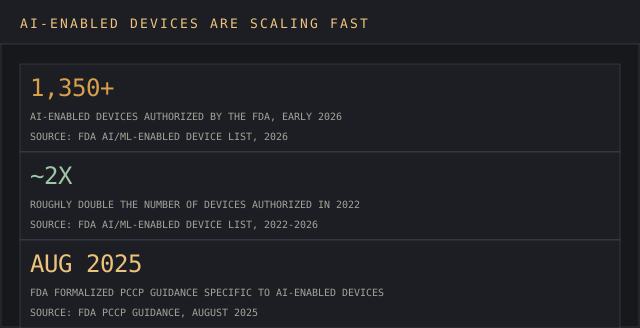
Cleared use cases already span autonomous diabetic retinopathy screening, fracture detection in radiographs, smartphone ECG interpretation, and large-scale data triage. The pace of clearance means a competitor's AI feature can go from filing to market inside a single product cycle.
Why these devices need a different oversight model
The regulatory framework built around these devices reflects that AI models keep learning after clearance, which a static hardware device never did.
The FDA's predetermined change control plan, PCCP, first proposed for AI/ML-based SaMD in 2019 and formalized in August 2025 guidance specifically for AI-enabled devices, lets a manufacturer pre-specify how a model is allowed to change after clearance instead of refiling for every update.
That sits inside a broader total-product-lifecycle, TPLC, oversight model the FDA has committed to for AI/ML SaMD: continuous real-world monitoring and planned updates instead of a single one-time approval event.
A competitor's PCCP filing is itself a signal worth tracking, since it previews how and how often that competitor's device is allowed to change without a fresh submission.
Market dynamics: the global market, aging population, and digital health
The medical devices market's growth is driven by demographic and disease trends more than by any single regulatory event, and these market dynamics matter for revenue forecasting as much as any single clearance count.
People aged 60 or older worldwide by 2050. That aging population is driving demand for cardiovascular and diabetes-care devices, alongside a chronic disease burden that keeps expanding as populations age and healthcare costs rise accordingly.
North America holds 38% of the global market for medical devices, the largest share of any region, while Asia-Pacific is the fastest-growing medical devices market at an 8.7% compound annual growth rate.
Healthcare delivery itself is shifting toward digital health ecosystems that tie data analytics and device connectivity together, a trend regulators and market reports alike now track as closely as clearance volume. Market growth is not spread evenly across device categories.
What market reports get wrong about industry dynamics
Most market reports on medical devices lead with a single global market size figure, projected to reach $886.80 billion by 2032 on some estimates, and stop there.
The industry dynamics that actually move revenue sit one level down: robotic-assisted surgery, wearable devices, and patient monitoring devices are each growing faster than the market average. The global medical robots market is projected to reach $41.70 billion by 2031, the patient monitoring devices market $76.11 billion by 2031, and the surgical devices market $296.76 billion by 2031, according to MarketsandMarkets.
Wearable medical devices are reshaping remote patient monitoring, extending it from hospitals into home healthcare devices, a shift that market reports focused only on hospital procurement volume tend to miss.
Supply chain resilience has also become a competitive advantage in its own right: companies are diversifying their supplier base and increasing regional manufacturing specifically to protect against the disruption a concentrated supply chain creates.
How commercial dynamics vary by device category
Device categories vary widely in commercial dynamics. Diabetes management devices, blood pressure monitors, and other monitoring devices serve an increasing patient population managing chronic disease day to day, and technological advancements in this category increasingly mean software rather than new hardware.
Robotic surgical systems and other surgical instruments used in minimally invasive surgery are transforming surgical procedures that once required open surgery, improving patient outcomes and shortening recovery, while connected devices and therapeutic devices extend monitoring and care outside the hospital and into home healthcare devices used for early disease detection.
Cardiovascular disease and respiratory care devices remain two of the largest categories by procedure volume, and orthopedic devices continue to benefit from a growing elderly population and rising demand for joint replacement.
Emerging technologies from technology companies entering medtech from outside the traditional industry, and innovative solutions built around artificial intelligence, are reshaping what counts as a medical device at all. Leading market players such as Philips Healthcare and GE Healthcare compete alongside smaller technology companies on laboratory diagnostics and diagnostic devices.
Healthcare modernization initiatives, often backed by government initiatives in emerging economies and emerging markets, are extending healthcare infrastructure and healthcare facilities to regions with previously limited healthcare services. Regulatory compliance, patient care standards, and healthcare delivery models differ by country, but the direction is consistent: healthcare professionals and healthcare providers increasingly rely on connected, data-generating equipment rather than standalone medical equipment.
That shift helps enhance patient care while creating significant investments and significant growth opportunities for medtech intelligence teams tracking the healthcare sector, healthcare industry, and broader healthcare services growth alongside the core regulatory and reimbursement data this report already covers.
Sizing the market against the competitive landscape
Market intelligence is essential for navigating regulatory approvals in the medical device sector, and market intelligence services help identify high-growth regions and aid R&D investment decisions across the medical device market.
The medical device market was worth $518.46 billion in 2023 on some estimates, with North America accounting for $197.83 billion of that total, and the competitive landscape across the medical devices market keeps shifting as robotic-assisted surgeries improve healthcare services and remote patient monitoring expands beyond hospitals into home settings.
Wearable devices are revolutionizing health monitoring and patient care broadly, and Medtronic and Abbott Laboratories remain among the key players competing across the medical device market's largest device market segments.
Building the Capability: A Practical Path
A workable medical device intelligence program starts narrower than most teams expect and grows from there.
- Anchor on the device category, not the company. Track FDA clearances, PMA filings, and recalls within a specific device category first, since that is where the regulatory signal density is highest and where a competitor's next move is most visible early.
- Layer in reimbursement tracking. Add CPT/HCPCS coding and CMS coverage monitoring once regulatory tracking is running, since a device that clears FDA review with no reimbursement pathway is not yet a commercial threat.
- Add procedure-level data last. Claims-based procedure volume data is the most expensive layer and the one that confirms whether adoption is real; add it once regulatory and reimbursement tracking justify the investment.
- Watch adverse events continuously. A rising adverse event pattern in AEMS, or its MAUDE predecessor, on a competitor's device is both a competitive signal and, if it's your own device, an early warning worth acting on before a formal recall.
- Brief in device-cycle time, not pharma-cycle time. A monthly brief is often too slow for a category where a competitor's next 510(k) modification can ship within a single quarter; weekly monitoring on the highest-priority categories keeps the intelligence function useful rather than reactive.
How This Differs From Pharma and Healthcare Intelligence
Medical device intelligence sits between two adjacent disciplines this site covers separately.
Pharma market intelligence tracks a drug through clinical trials and a single, high-stakes approval event; device intelligence tracks continuous, incremental clearances against a much larger volume of submissions.
Healthcare market intelligence, meanwhile, covers the provider and payer side, hospital demand, referral patterns, service-line planning. It intersects with device intelligence at the point of procedure volume and reimbursement, but starts from the hospital's demand picture rather than the manufacturer's regulatory and competitive picture.
A device company's own intelligence function typically needs a slice of all three: market intelligence fundamentals for the core discipline, procedure and claims data that overlaps with healthcare market intelligence, and enough of the pharma playbook to track combination products and drug-device pairings that increasingly blur the line between the two categories.
Investor and Licensing Activity
Deal activity is its own intelligence stream, distinct from regulatory and procedure data, and it moves on a different clock: a licensing deal or acquisition can be announced the same quarter a device clears 510(k) review, well before procedure volume or reimbursement data would show real-world traction.
Evaluate and GlobalData both track company financials and deal comparables alongside their forecasting data, which is why strategy and corporate-development teams tend to lean on the same two platforms for M&A screening that clinical and regulatory teams use for pipeline tracking.
Private-equity and strategic-acquirer interest in medtech tends to concentrate wherever procedure volume is both large and growing. Orthopedics and cardiovascular devices historically draw the deepest pool of acquirers, which is also why those categories carry the richest third-party registry and forecast data described above.
A device company evaluating a partnership or exit benefits from the same regulatory and procedure-level intelligence used for competitive tracking, since an acquirer will ask the identical questions about clearance pathway, recall history, and reimbursement status during diligence.
FAQ
What is medical device market intelligence?
The systematic collection and analysis of FDA regulatory filings, procedure volumes, reimbursement data, adverse events, and competitor activity, used by device makers, hospital purchasing teams, and investors to track a device category that moves faster than most other regulated industries.
What is the difference between 510(k) and PMA?
510(k) clearance covers moderate-risk devices shown to be substantially equivalent to an already-cleared device, relying on benchtop and descriptive data; PMA approval covers high-risk devices and requires clinical trial data plus a full safety and effectiveness review. Roughly 99% of devices reach the market through 510(k) rather than PMA.
How many medical devices does the FDA clear each year?
Around 3,100 to 3,300 devices a year through the 510(k) pathway in recent fiscal years (3,326 in FY2023, 3,107 in FY2024, 3,238 in FY2025), against fewer than 50 PMA approvals over the same period.
What replaced the FDA's MAUDE database?
The FDA began replacing MAUDE, which held more than 24 million adverse event reports, with a unified Adverse Event Monitoring System (AEMS) in March 2026, with the transition scheduled to complete by the end of May 2026.
How big is the global medical device market?
Estimates vary by how each research firm draws category boundaries. Fortune Business Insights puts 2026 revenue at $604.99 billion, Precedence Research at $719.61 billion, and Statista at $571.72 billion, with most forecasts showing continued growth through the early 2030s.
How many medical device recalls happen each year?
Recalls climbed to 1,059 events in 2024, the highest in four years, with Class I recalls at their highest level in 15 years. About 88% of classified recalls are Class II, 9% Class I, and 3% Class III, and even a Class I recall takes an average of 263 business days to fully resolve.
How many AI-enabled medical devices has the FDA authorized?
More than 1,350 by early 2026, roughly double the number authorized in 2022, covering uses from autonomous diabetic retinopathy screening to smartphone ECG interpretation. The FDA's predetermined change control plan, formalized in guidance in August 2025, lets manufacturers pre-specify how these devices are allowed to change after clearance.
Why is EU MDR recertification taking so long?
Only 38 notified bodies are designated under the MDR, down from about 80 under the prior directive, while more than 23,000 legacy device certificates need to transition. That capacity gap has pushed average certification reviews to 13 to 18 months, with similar-length backlogs for complex technical file reviews.
Bottom Line
Medical device market intelligence turns a regulatory system built for speed, 510(k) clearances measured in months, not years, into a competitive advantage for the teams that track it continuously. The disciplines are stable even as the underlying databases change: regulatory tracking across 510(k) and PMA filings, adverse event monitoring through AEMS, reimbursement tracking through CPT/HCPCS and CMS coverage, and procedure-level data to confirm real adoption. Companies that run this stack well see a competitor's next move in a clearance filing months before it shows up in a press release.