Crayon vs Klue in One Read
Crayon vs Klue is the comparison most product marketing owners run first when they decide to formalize competitive intelligence, and the short version is that both are strong competitive intelligence platforms built for market intelligence teams solving slightly different jobs. Crayon leans toward wide-lens coverage, an automated web crawler that tracks over 300 million web pages for competitor changes across pricing pages, job postings, press releases, and website changes. Klue leans toward sales enablement, with battlecards and Klue's Compete Agent built to put competitive insights directly into a sales conversation at the moment a rep needs them.
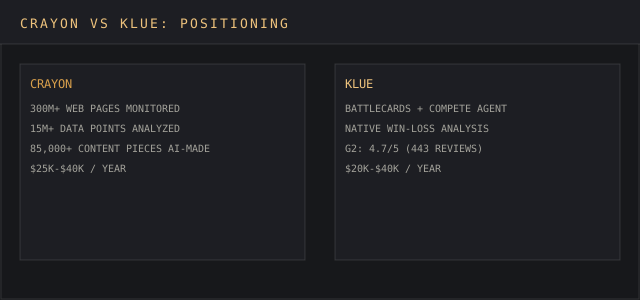
Neither Crayon nor Klue publishes pricing publicly, and both fall into the same tier-3 competitive intelligence tool pricing band once quotes come back, so the real decision between klue and crayon rarely comes down to price alone. It comes down to whether a team needs unlimited competitors tracked with wide coverage, or a smaller set of competitors tracked with deeper sales enablement content behind each one.
What Crayon and Klue Actually Do
Both platforms exist to turn scattered competitor signals, pricing changes, product launches, job postings, review sites commentary, and press releases, into a competitive intelligence program a sales team and a marketing team can both use. Crayon's automated web crawler pulls from data sources across the open web and classifies incoming signals with artificial intelligence, then suggests relevant competitive content to the teams that need it. Crayon's AI has analyzed over 15 million data points and generated over 85,000 pieces of competitive content for customers running a competitive intelligence program at scale.
Klue takes a narrower data-sources net and a deeper delivery layer: Klue integrates with Salesforce for deal-specific insights, and Klue's AI speeds up battlecard content creation while improving content discoverability for sales reps searching mid-call. Klue's Compete Agent, a generative AI assistant, lets a rep ask a plain-language question about a specific competitor and get an answer sourced from the platform's own insights instead of digging through a battlecard by hand. Both platforms use AI assistively, not autonomously, a distinction every vendor in this competitive intelligence tool category is careful to make.
Monitoring Breadth: Where Crayon Pulls Ahead
Crayon's monitoring breadth is its key strength for CI teams that need broad monitoring across many competitors and many data sources at once. Crayon provides broader competitive intelligence across more competitors than Klue typically covers in a single deployment, and Crayon is better for tracking many competitors across various dimensions, pricing pages, hiring signals, and competitors' digital footprints, rather than a curated shortlist. For a dedicated CI analyst running a formal competitive program across an entire market rather than three or four named rivals, that monitoring breadth is usually the deciding factor.
Crayon's real time insights arrive as automated alerts the moment a competitor changes a pricing page or ships a product update, giving a competitive intelligence team broader context before the news reaches a sales conversation. The tradeoff is volume: extensive coverage across 300 million web pages can produce too much noise for a small team without a dedicated owner filtering it, which is why Crayon deployments benefit most from having someone own the feed full time.
Sales Enablement: Where Klue Pulls Ahead
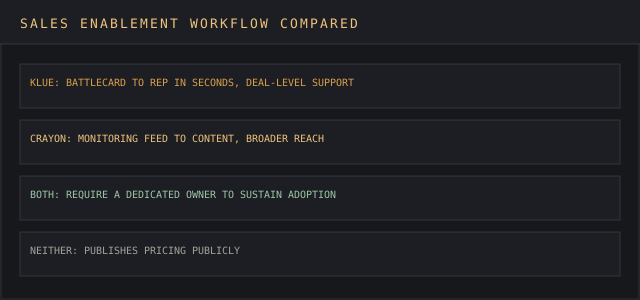
Klue's battlecard workflow is category-leading for sales enablement, and Klue emphasizes high-impact battlecards and deal-level support over raw monitoring volume. Klue prioritizes user adoption through easy-to-consume battlecards a sales rep can scan in the thirty seconds before a call, which is the reason product marketers and sales enablement teams gravitate to Klue when the primary use case is arming reps rather than tracking a market.
Klue's win-loss analysis is built directly into the platform, so win-loss data collected from closed deals feeds straight back into the same battlecards reps already use, closing a loop that a bolt-on tool cannot match. That built-in depth is one of Klue's clearest differentiators against Crayon, which tracks competitors well but was not built around the win-loss workflow specifically. Klue has a G2 rating of 4.7 out of 5 based on 443 reviews, with a separate source citing Klue at 4.8 out of 5 for sales enablement specifically, both figures well ahead of category averages.
AI Features Compared
Crayon's AI classifies incoming signals across every monitored competitor and suggests relevant competitive content automatically, a workflow built for scale across unlimited competitors rather than depth on any single one. Klue's AI features work the other direction: Klue's AI speeds up battlecard content creation and Klue's Compete Agent answers rival-specific questions in plain language, ai tools built to compress the time between a rep's question and a usable answer rather than to widen monitoring coverage.
Neither vendor's AI features replace human analysts; both platforms use AI assistively, not autonomously, flagging signals and drafting content for a human to approve rather than publishing unsupervised competitive analysis. Teams evaluating ai features in this competitive intelligence tool category should ask each vendor the same question: does the AI reduce human effort on collection, Crayon's strength, or on delivery to sales reps, Klue's strength.
Win-Loss Analysis and Deal Support
Win loss analysis is the single feature buyers ask about most once they get past monitoring breadth, and it is where the two platforms diverge most clearly. Klue's native win loss analysis ties win loss data directly to the battlecards influencing revenue in real deals, letting a product marketing owner see which competitive content actually moved a competitive deal rather than guessing. Crayon supports win-loss workflows through integration rather than a fully built-in module for the same workflow, which is a meaningful gap for a sales team that wants win-loss feedback baked into the same screen reps already use daily.
For teams whose primary goal is winning more competitive deals against two or three named rivals, Klue's win-loss depth usually outweighs Crayon's broader monitoring. For teams fighting a shifting field of competitors where the next threat is unknown, Crayon's monitoring breadth catches new entrants a narrower Klue deployment might miss until a deal is already at risk.
Crayon Answers and the Compete Agent
Both vendors have invested heavily in their own generative AI assistant, and the two products mirror each other closely. Crayon Answers is Crayon's own Gen AI compete assistant: a sales team member can ask it a plain-language question, "why do we beat this specific competitor on pricing," and get key insights pulled straight from the hundreds of millions of web pages Crayon monitors, without opening a single battlecard. Compete Agent works the same way from the opposite side of the data set, drawing its answers from Klue's curated battlecards and win-loss data rather than open-web monitoring.
The practical difference shows up in the kind of question each assistant answers well. Crayon Answers is stronger on broad, research-style questions about market intelligence trends, hiring, and funding news, because it draws on wide-lens web coverage rather than a single team's manually curated notes. Klue's Compete Agent is stronger on deal-specific competitive guidance, since its answers are grounded in the same competitive content and win-loss data a rep would otherwise dig for manually before a call. Neither assistant replaces a dedicated owner's judgment, but both cut the time between a question and an answer a rep can actually use, whether the venue is a live sales call or a written deal update.
Building a Formal CI Program from Scratch
Companies without an existing ci program tend to underestimate two things: how much manual effort collection takes before a platform is in place, and how much a pricing model built around competitors tracked can shift as the program matures. A ci program that starts with three named rivals and grows to fifteen within a year will outgrow an entry-level pricing model fast, regardless of which vendor sold it. Research reports from both companies' own marketing lean toward showing fast time-to-value, but buyers who have run a ci program before know the real ramp is measured in months, not the first demo week.
Marketing teams are often the first internal group to ask for a formal ci program, usually after a lost deal where competitive guidance arrived too late to matter, or after a product launch where a rival moved first without anyone noticing the signal in advance. That first request is worth capturing before selecting a vendor: whether the initial ask is for broader market research and competitive content for the marketing teams, or for tighter sales enablement material a sales team can use on the next sales call, points toward Crayon or Klue respectively before a single demo is booked.
Data Sources and Monitoring Depth
Both platforms pull from overlapping data sources, competitor websites, pricing pages, job postings, press releases, review sites, and social channels, but weight them differently. Crayon's data sources skew toward automated, high-volume page coverage; Klue's data sources skew toward curated inputs a dedicated owner or product marketing owner has manually flagged as worth watching closely. Neither approach is strictly better, and several teams running a mature competitive intelligence program eventually license both to cover monitoring competitors broadly while keeping a curated layer for the handful of rivals that matter most to the sales team.
Pricing: What Crayon and Klue Actually Cost
Crayon's pricing typically ranges from $25,000 to $40,000 annually, and Klue's pricing also ranges from $20,000 to $40,000 annually, per buyer-reported figures; neither Crayon nor Klue publishes pricing publicly, so every quote starts as a negotiation shaped by competitors tracked, data sources licensed, and seat count. There is no meaningful free plan at either vendor for a serious competitive intelligence program, though limited trial access is sometimes easily accessible for evaluation before a full enterprise deployment.
Both platforms require a dedicated owner for effective use, and total cost of ownership includes that owner's salary, which often exceeds the software cost itself once a company factors in the product marketing owner or CI owner role neither tool eliminates. Buyers comparing a crayon alternative or any other CI tool should price the person alongside the platform, not the platform alone, since a formal competitive program with every competitor tracked and no owner behind it produces manual effort and human error instead of the automated alerts either vendor advertises.
Enterprise Deployments and Scaling
At enterprise deployments scale, the tradeoffs sharpen. Large sales teams running dozens of competitive intelligence tool integrations into their tech stack, CRM, Slack, and sales tools alike, tend to standardize on Klue for the delivery layer regardless of which monitoring vendor feeds it, since reps interact with battlecards far more often than with raw monitoring data. Enterprise deployments of Crayon, by contrast, often sit upstream of several delivery tools no rep sees directly, feeding market research and analysis to marketing teams as much as to the sales team.
Enterprise buyers evaluating either platform should ask about competitors tracked limits, since some contracts cap the number before requiring an upgrade, and about how each platform's published pricing tiers handle mid-year headcount growth, a detail that shapes year-two cost more than the initial quote does.
Steep Learning Curve and Adoption
Klue's steep learning curve can hinder new user adoption, particularly for sales reps who only open the tool a few times a month, forget the workflow between uses, and end up relearning the same navigation before every quarterly business review; Klue prioritizes user adoption through easy-to-consume battlecards specifically to counter that risk, and most complaints on review sites concern initial setup rather than ongoing use. Crayon carries its own adoption tax: wide coverage across hundreds of data sources means a new user faces a firehose of alerts before a dedicated owner tunes the feed to what actually matters for their sales cycle.
Product marketers report that either platform stays ahead of adoption problems only when a single owner is accountable for the feed and the battlecards, echoing the dedicated-owner requirement that shows up in every serious comparison of klue and crayon. That requirement is not vendor-specific; it shows up in comparisons of Crayon against Kompyte and Klue against Kompyte just as often, which suggests the steep learning curve issue belongs to the competitive intelligence tool category generally, not to either company's product decisions in isolation.
Competitive Enablement: Turning Intelligence into Sales Motion
Competitive enablement is the layer where raw market intelligence stops being a research artifact and starts changing what a rep says on a sales call. Klue's approach to competitive enablement runs through the battlecard and Compete Agent, delivering actionable insights at the exact moment a rep needs them; Crayon's approach to competitive enablement runs more indirectly, through competitive content pushed to a sales team from the broader monitoring layer rather than a purpose-built enablement surface. Both count as competitive enablement in the category's own marketing language, but buyers should test each vendor's competitive enablement claim against an actual sales call transcript before assuming either delivers it equally well.
A competitive intelligence platform earns its budget when it demonstrably influenced revenue, not when it produced more content. Product marketing owners who track win rates on competitive deals before and after adopting a competitive intelligence platform get a real answer to whether competitive enablement influenced revenue at all; those relying on usage dashboards alone often cannot tell the difference between a platform that helped and one that simply generated key insights nobody acted on. Published pricing would make this comparison easier, but since neither vendor offers published pricing, buyers are left running their own before-and-after analysis on competitive deals to justify the renewal.
Klue and Crayon Side by Side
Put klue and crayon next to each other on a single sheet and the split is consistent across every dimension covered in this report: Crayon wins on breadth, competitor monitoring across unlimited rivals, product launches tracked across an entire market, and raw data sources at scale; Klue wins on depth, sales enablement content, native win-loss analysis, and a dedicated CI workflow built around a smaller set of named rivals. Teams that have evaluated klue and crayon side by side consistently report the same tradeoff, which is why so many comparisons of klue and crayon land on "it depends on team size and rival count" rather than a single winner.
For related reading beyond this comparison, teams evaluating a dedicated CI hire alongside either platform should look at how a dedicated CI role is scoped at peer companies before writing the job description, since the tooling choice and the headcount decision are made together in practice far more often than the vendor pitch decks suggest.
Which Tool Fits Which Team
Choose Crayon when the primary need is extensive coverage across many competitors, a market with more than four or five real rivals, frequent new entrants, and a marketing team that wants market research and competitive analysis feeding multiple downstream teams, not just sales. Choose Klue when the primary need is sales enablement against a known, stable set of two to four competitors, win-loss data tied natively to real deals, and battlecards a rep will actually open before a sales call. Some enterprise deployments run both, Crayon upstream for monitoring, Klue downstream for enablement, though that doubles the dedicated-owner requirement rather than eliminating it. A smaller company evaluating market intelligence tooling for the first time should resist buying both at once; start with whichever gap, monitoring or enablement, is costing the sales team deals right now, and add the second competitive intelligence tool only once the first one has a real owner and a measurable habit behind it.
Teams still building a formal CI program from scratch, without a dedicated analyst yet in place, may be better served starting with a lighter-weight tool and our market intelligence platform pricing report before committing to either vendor's enterprise deployment tier. A competitor battlecard template and a win-loss analysis template are useful ways to prove out the workflow manually before paying for either platform's automation.
Evaluating Either Platform Before You Buy
Before signing a contract with either vendor, run the same evaluation a mature competitive intelligence buyer runs: pull three recent lost deals, listen back to the sales calls if recordings exist, and check whether the rep had the competitive information they needed at the moment the prospect raised a rival's name. If the gap was information the rep never had, Klue's battlecard and Compete Agent workflow is the more direct fix. If the gap was a competitor move nobody on the team saw coming until it showed up in a lost deal, Crayon's monitoring breadth is the more direct fix. Most teams asking "which competitive intelligence tool should we buy" are really asking which of those two failure modes happened most recently, and the honest answer to that question is a better guide than any vendor's own comparison page.
Whichever platform a team chooses, competitive intelligence only compounds in value when someone owns it past the first ninety days. Renewal conversations are where the dedicated-owner requirement gets tested for real: a program with an engaged owner tends to expand seats and data sources at renewal, while a program nobody owns tends to get quietly cut regardless of how strong the underlying competitive intelligence platform was on day one.
FAQ
Is Crayon or Klue better for sales enablement?
Klue. Klue's battlecard workflow and native win loss analysis are built specifically for sales enablement, and Klue's Compete Agent puts competitive insights in front of sales reps mid-conversation. Crayon supports sales enablement but its core strength is broad monitoring across competitors, not battlecard depth.
How much do Crayon and Klue cost?
Crayon's pricing typically runs $25,000 to $40,000 annually; Klue's pricing runs $20,000 to $40,000 annually, per buyer-reported figures. Neither publishes pricing, and both require a dedicated owner whose salary often exceeds the software cost, so budget for the person as much as the platform.
What is the difference between Crayon and Kompyte?
Kompyte, like Crayon, focuses on automated competitor monitoring, but buyer comparisons generally place Crayon ahead on monitoring breadth and AI-generated competitive content, while Kompyte is often evaluated as a lower-cost alternative for smaller sales enablement teams.
Do Crayon and Klue offer a free plan?
No meaningful free plan exists for a serious competitive intelligence program at either vendor. Limited trial access is sometimes easily accessible for evaluation, but full enterprise deployments are quoted individually.
Sources: Klue vs Crayon comparisons via Parano.ai, AlphaSense, ZoomInfo Pipeline, and PlayWiseHQ; G2 review data; Crayon and Klue vendor documentation, 2025 to 2026.