Hotjar vs Mixpanel
 By Jan Suski, six years working in digital. How the scoring works.
| WHAT EACH ONE DOES | HOTJAR | MIXPANEL |
|---|---|---|
| Core job | Diagnose one page | Measure a product |
| Data model | Session recordings | Typed event stream |
| Session Replay | All tiers, unmetered | 10K→500K/mo by tier |
| Heatmaps | Every tier | Bundled with replay |
| Cohort analysis | No equivalent | Native, all paid tiers |
| Feature flags, tests | No feature | Up to 50 flags, Growth |
| Mobile apps | Web only | iOS, Android, Flutter |
| Surveys, feedback | Native, all tiers | No native survey |
| Skip it if | You need event data | No engineer to set up |
| WHAT YOU GET | HOTJAR | MIXPANEL |
|---|---|---|
| Free tier limit | 200K sessions/mo | 1M events/mo |
| Growth entry price | $49/mo, 7K sessions | $20/mo, 10K MTU |
| Unit metered | Sessions | Monthly Tracked Users |
| Seats | Unmetered, every tier | Unlimited, every tier |
| Data residency | Not self-serve | US/EU/India, free |
| Compliance certs | 7 certs, widest set | 3 certs |
| G2 score | 4.3 from 345 | 4.5 from 1,372 |
| Reliability, 90d | 100% uptime | 99.65% uptime |
| Owner | Contentsquare, private | Independent, VC-backed |
StrongerWeakerNo edge
Thirty-six further documented limits sit behind the button below: API rate limits, compliance certificates, replay quotas and what each plan gates. Hotjar's free tier already covers this page's 200,000-session anchor at no cost; Mixpanel's $20 entry price is its own quoted example at 10,000 Monthly Tracked Users, not a converted equivalent, since the two vendors don't meter the same unit.
Prices come from each vendor's own pricing page, read 27 August 2026. Every figure is sourced from its row's linked section.
| Hotjar | WHAT IT DOCUMENTS |
|---|---|
| Free plan sessions | 200,000 a month, one project |
| Growth entry | $49/month, 7,000 sessions, billed annually (was $39 on 8 Aug 2026) |
| Free trial | 15 days of Growth, no card required |
| Data retention (stated way #1) | 365 days from capture, "all accounts and plans" |
| Data retention (stated way #2) | Basic 1 month, Plus 6 months, Business 12 months, same article |
| SSO | Google OAuth on Free/Growth, SAML on Pro |
| API access | Scale plans only |
| Compliance certs | ISO 9001:2015, ISO/IEC 27001 (+SoA), 27017, 27018, 27701, SOC 2 Type II |
| PCI-DSS | SAQ-A self-assessment on file, no cardholder data touches infrastructure |
| GDPR | DPO appointed, DPA available, 10-day sub-processor notice |
| Mixpanel integration name | "Mixpanel Growth" |
| Mixpanel integration scope | Client-side only, event name only, excludes Surveys filtering |
| Ownership | Acquired by Contentsquare 2021; Hotjar Ltd merged 1 Jul 2025 |
| Contentsquare funding | $1.4bn+ raised total; Paris, founded 2012 |
| Reliability, trailing 90d | 100% uptime |
| Incident, broadest in 12mo | 30 Jul 2026, "potentially all Hotjar accounts," resolved same window |
| Incident, billing | 13 Aug 2026, Growth customers not renewed for one day |
| G2 score | 4.3 from 345 reviews |
| Mixpanel | WHAT IT DOCUMENTS |
|---|---|
| Free plan events | 1,000,000 a month, unlimited seats, no card |
| Growth entry (calculator) | $20/month for up to 10,000 Monthly Tracked Users, billed annually |
| Growth event cap (plan card)* | "Up to 20 million events a month," first 1M free |
| Session Replay quota* | 10,000/mo Free, 500,000/mo Growth |
| Session Replay retention† | Customizable 7 to 365 days |
| Ingestion API limit | 2GB uncompressed JSON/minute, about 30,000 events/second |
| Query API limit | 5 concurrent queries, 60 queries/hour |
| Raw Data Export API limit | 100 concurrent, 60/hour, 3/second |
| Lexicon Schemas API limit | 5 requests/minute, under 4,000 updates/minute |
| Feature flags | Up to 10 active (Free), up to 50 (Growth) |
| Experiments | Up to 1,000 MEU/mo (Free), up to 100,000 MEU (Growth) |
| Saved reports | 5 per seat (Free), unlimited (Growth, Enterprise) |
| Data residency | US default, EU or India, free on every plan |
| Compliance certs | Native SOC 2 Type II, ISO 27001, ISO 27701 |
| HIPAA | BAA available, Enterprise plan only |
| Reliability, trailing 90d | 99.65% application uptime (99.06% US, 99.94% EU/India) |
| Recent shipped feature | Mobile Autocapture for screen views, 7 Aug 2026 |
| G2 score | 4.5 from 1,372 reviews |
*Mixpanel states this two ways on its own pricing page. The Growth plan card advertises "up to 20 million events a month" while the Growth calculator on the same page prices the plan by Monthly Tracked Users instead. The plan card separately shows a 20,000/month Session Replay quota where the plan-card summary shows 500,000. This page publishes the calculator figure and the plan-card replay figure, since those are what a buyer purchases.
†Mixpanel's Session Replay product page states retention as customizable from 7 days to 1 year on any tier; its pricing page separately shows 30 days on Free and Growth, with the 7-to-365-day range reserved for Enterprise. This page publishes the tier-gated pricing-page split, since it's the one that applies at signup.
Hotjar's own data retention article ships an unresolved A/B test. The same page states "365 days from the date of capture" applies to "all accounts and plans," directly above a table splitting retention as Basic 1 month, Plus 6 months, Business 12 months. Both rows above are published side by side instead of picking one, since neither resolves the other.
Sources, and what neither vendor publishes
Every row comes from a vendor property, read 27 August 2026.
- Hotjar and Contentsquare: contentsquare.com/pricing, contentsquare.com/comparison/mixpanel, trust.contentsquare.com, help.hotjar.com, status.hotjar.com.
- Mixpanel: mixpanel.com/pricing, mixpanel.com/platform/session-replay, mixpanel.com/security-privacy, mixpanel.com/legal, docs.mixpanel.com, status.mixpanel.com.
Neither vendor publishes a session-to-event conversion rate, so no single blended cost exists across both platforms. Each is priced against its own confirmed anchor instead. Neither vendor's own domain documents the November 2025 Mixpanel security incident covered further down this page; that came from the customers Mixpanel notified, not from mixpanel.com.
Hotjar and Mixpanel split cleanly for years: Hotjar recorded what one visitor did on one page, and Mixpanel counted what many users did across a product. That split narrowed in 2026. Mixpanel bundled Session Replay and heatmaps into every paid plan instead of selling them as a separate add-on, so the two tools now overlap where they never used to.
This page prices both tools against real scenarios, walks through where they overlap today, and names who should buy which. It's built for product teams and marketing teams holding a quote from one platform and weighing if the other belongs in the stack too.
Mixpanel vs Hotjar used to be an easy split between event data and session data. The honest answer now turns on what a buyer needs first: event tracking, page diagnostics, or increasingly both from one login, because Mixpanel started shipping the second half itself.
Every price below comes from each vendor's own pricing page, read 27 August 2026. Every feature claim traces to a vendor domain, and G2's numbers are cited as G2's own figures, not as fact about the product.
↑ COMPARISONHotjar and Mixpanel now overlap where they didn't before
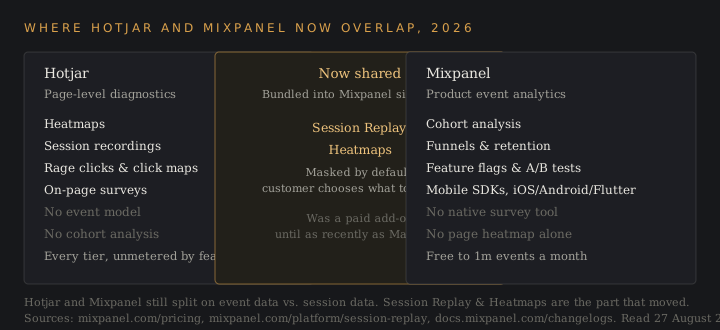
Mixpanel's pricing page frames Session Replay & heatmaps as built into the product, not a bolt-on: every paid plan includes a replay quota, from 10,000 recordings a month on Free to 500,000 on Growth. Session data is masked by default, and a customer chooses what to unmask.
That's new. Mixpanel's own changelog still described Session Replay as a paid add-on as recently as May 2026, before folding it into the plan quotas shown today. Hotjar has recorded sessions since it launched; Mixpanel has done it as a bundled feature for months, not years.
Hotjar's recordings remain the deeper tool for page-level diagnostics. Interactive heatmaps, rage clicks and click maps ship on every tier, built to answer one question: why a visitor left mid-task, with every session stringing individual user actions together into one replayable timeline. Mixpanel's replay sits beside its event data instead, watched from the same dashboard that runs funnels and cohort analysis.
Both vendors now sell the same basic vocabulary for this category: user behavior, user interactions and a full user flow mapped end to end. What separates them is which of those a team can act on without hiring a data analyst first, and that's the split that survived Mixpanel's replay launch.
What each vendor's own marketing promises
Mixpanel's site sells a specific pitch: spot trends at scale, then zoom into individual session replays without switching tools, from one user friendly interface. It calls that combination unified analytics, built to analyze user behavior at the pattern level and the single-session level in the same dashboard, so a team can track user interactions from a cohort chart down to one recording.
Contentsquare markets Hotjar around a narrower promise: visualizing user behavior on one page, fast, with no engineer required. Heatmaps show where users click, recordings show how users move through a page, and surveys show how users engage with one specific prompt. All three exist to produce insights a bar chart alone can't.
Vendors in this category compete on adjectives as much as mechanics. Mixpanel promises granular insights and deep insights from event data; Hotjar promises detailed insights and precise insights from recordings; both claim their reports produce valuable insights fast enough to justify the price. None of those adjectives is measurable, which is why this page prices plans and counts quotas instead of repeating them.
Both vendors chase the same buyer: product managers and marketing teams who want data driven decisions built from real insights, not raw exports. Mixpanel frames that as actionable insights pulled from real time data as events arrive; Hotjar frames it as direct feedback and visual insights from real people, replayed as real time data the moment a session ends.
Neither product is a web analytics tool in the Google Analytics sense. Neither attributes a session to a marketing channel, neither reports conversion rates by traffic source, and neither runs the console errors a debugging tool would surface. Google Analytics still owns acquisition in most stacks that run one of these two products alongside it, and a specific business rarely drops it once one of these tools is added.
Every metric on this page reduces to how many users did something. Hotjar counts users by session: one visit, one record, no matter how many pages those users touch before leaving.
Mixpanel counts users by event instead. Users who fired ten events this month and users who fired one both count as a single Monthly Tracked User, so the price doesn't change with how active individual users get.
Neither vendor prices per named user account; both price per group of users engaging with the product in a given month, which is why seats stay unlimited on both sides while the users themselves are what gets billed.
↑ COMPARISONPricing plans: sessions against Monthly Tracked Users
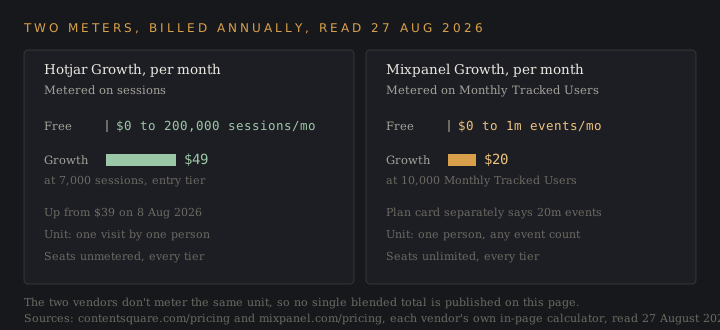
Hotjar's free plan covers 200,000 monthly sessions at no cost, and its Growth tier starts at $49 a month for 7,000 sessions, billed annually, up from $39 earlier this month. Mixpanel's free plan covers 1 million events a month, and its Growth tier prices differently: $20 a month for up to 10,000 Monthly Tracked Users, billed annually, not by raw event count.
The Mixpanel vs Hotjar decision is two decisions stacked together: which unit fits the budget, sessions or tracked users, and which report a team reads every week. Buying analytics software by feature count alone misses the pricing story above; the unit each vendor meters decides the bill, and no single feature swings it as much.
The two vendors don't meter the same unit. Hotjar counts a session, one visit by one person; Mixpanel's Growth calculator counts a tracked user, one person, no matter how many events that person generates in a month.
| Plan detail | Hotjar | Mixpanel |
|---|---|---|
| Free plan limit | 200,000 sessions/month | 1 million events/month |
| Growth entry price | $49/month, 7,000 sessions | $20/month, 10,000 MTU |
| Unit metered | Sessions | Monthly Tracked Users |
| Seats | Unmetered, every tier | Unlimited, every tier |
Mixpanel's own pricing page states its metering two different ways in the same breath. The Growth plan card advertises "up to 20 million events a month," while the calculator on that same page prices Growth by Monthly Tracked Users instead. A team sizing Growth off event volume alone can land on the wrong quote, since the calculator is what generates the number a buyer pays.
Mixpanel's Free tier caps at 1 million events, not the 20 million a month some third-party roundups repeat. That higher figure belongs to Growth, where the first million events stay free before metering starts. A higher Growth price doesn't cost Hotjar more customers by itself, since its free tier already satisfies most teams under 200,000 monthly sessions.
↑ COMPARISONData management, compliance and the incident Mixpanel didn't put on its status page
Mixpanel holds a native SOC 2 Type II attestation plus ISO 27001 and ISO 27701 certification, and it stores data in the US, the EU or India at no extra charge on every plan. Hotjar's parent, Contentsquare, carries a wider certification set: ISO 9001, 27001, 27017, 27018 and 27701, plus SOC 2 Type II and a PCI-DSS SAQ-A self-assessment.
Both handle sensitive data under GDPR and CCPA. Mixpanel adds India's DPDP Act and Brazil's LGPD by name, and Contentsquare publishes its own LGPD and GDPR commitment pages. HIPAA support exists on both sides: Mixpanel gates it to the Enterprise plan, and Contentsquare requires a signed business associate agreement either way.

Neither vendor publishes real time alerts as a base-plan feature. Mixpanel's Enterprise tier adds anomaly detection on top of the five alerts Growth includes; Hotjar has no alerting layer of its own at any tier, paid plans included.
Mixpanel disclosed a security incident in November and December 2025. Customers including OpenAI and CoinTracker notified their own users that unauthorized access to Mixpanel's backend, reached through SMS-based social engineering, had exposed names, emails and account metadata tied to API accounts. No passwords, API keys or payment data were affected, per those notices.
That incident doesn't appear on Mixpanel's own status page or trust center in any form we could read. The disclosure came from the customers Mixpanel notified, not from Mixpanel's public record. Hotjar's status page lists its own incidents directly, including a July 2026 event that degraded service for "potentially all Hotjar accounts," resolved the same window.
↑ COMPARISONCohort analysis, event tracking and the data Hotjar has no equivalent for
Mixpanel runs on event tracking: every user action becomes a named event, and funnels, cohort analysis and retention reporting all build from that same event stream. Session recordings are the rawest form of user interactions, unfiltered by any taxonomy. Mixpanel's event model turns those same user interactions into named, queryable rows instead, and recordings show exactly how users interact with a single page, click by click.
Hotjar has no comparable model: it records sessions instead of typed events, so a Hotjar recording can show a rage click but can't tell an analyst how many users hit that click in the last 90 days.
Mixpanel excels at granular event tracking specifically, and Mixpanel offers that reporting across every tier, free included; Mixpanel offers no equivalent for session-level video playback below Free's 10,000-replay allowance. Cohorts, feature flags (up to 50 active on Growth) and A/B experiments (up to 100,000 Monthly Experiment Users on Growth) all run off the same instrumentation a team sets up once.
That setup is the trade: Mixpanel requires thoughtful event instrumentation before any of those reports produce anything useful. Mapping a full user flow through the product takes real planning time up front. Mixpanel's dashboards are built for detailed analytics work, not a five-minute glance, and that learning curve runs in the opposite direction from Hotjar's near-zero one.
Mixpanel is the more mature event based analytics platform of the two by a wide margin, and its cohort reports turn raw events into insights a product manager can act on within the day. Neither platform sells insights it can't trace back to a logged event or a recorded session.
Hotjar needs none of that planning. One script starts recording user sessions the same day, with no taxonomy to define and no engineer required to maintain it.
The trade runs the other way: Hotjar's session data suits individual page problems and stays separate from the account-level retention or lifetime-value metrics Mixpanel's event model produces natively. A team with no time to analyze data by hand still gets a heatmap summary automatically, the moment a session ends.
Hotjar's heatmaps aggregate user behavior patterns across thousands of sessions into one image, which is a valuable tool for a team that needs a single chart to make the case for a redesign.
Contentsquare's own Mixpanel alternative isn't Hotjar
Contentsquare owns three analytics products now: Hotjar, the Product Analytics module built from its 2023 Heap acquisition, and its own core experience-analytics platform. When Contentsquare positions itself against Mixpanel, it's the Heap-descended Product Analytics module doing the comparing, not Hotjar.
Contentsquare's own comparison page rates its Product Analytics "Very Strong" against Mixpanel's "Medium" on autocapture and AI-driven analysis. Its blog states outright that Product Analytics "replaces Mixpanel's core features," and Hotjar gets a different role in the same piece: a companion tool, recommended alongside Mixpanel instead of standing among the other tools built to unseat it.
The integration between the two runs one way. Hotjar's Mixpanel connector, internally named Mixpanel Growth, pulls client-side Mixpanel events into Hotjar to filter heatmaps, recordings and funnels. It ignores server-side events and event properties, and it sends nothing back into Mixpanel.
Contentsquare markets its whole portfolio, Hotjar included, as enabling businesses to fix a page before losing the visitor for good, and its own copy leans on the Mixpanel vs Hotjar framing to sell the bundle. Mixpanel ships SDKs for mobile apps on iOS, Android and Flutter, so a product spanning web and mobile still reports through one event model; Hotjar's tracking script covers web pages only, and its brand doesn't extend to native apps.
↑ COMPARISONReading the review scores, and who each analytics software serves
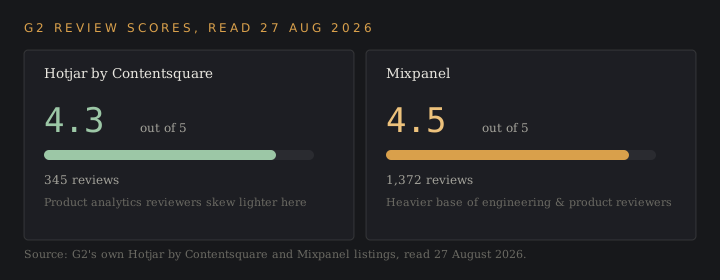
G2 lists 1,372 reviews for Mixpanel at 4.5 out of 5, and 345 reviews for Hotjar by Contentsquare at 4.3. The gap in review volume says as much as the score: Mixpanel draws a heavier base of engineering and product reviewers, the exact audience event based analytics is built for.
Mixpanel's existing customers write the loudest reviews about setup cost, and OpenAI and CoinTracker, two of Mixpanel's own customers, are the ones who had to notify their own users about the November 2025 incident. Paying customers on either platform can request a full data export at any time.
Existing customers on Hotjar's older Basic-era plans still see legacy tier names in some help-centre articles, a smaller but real sign of the same rebrand lag that hit the retention page. Surveys are Hotjar's clearest channel for direct user feedback; Mixpanel has no comparable survey feature built into the core product, so teams pair it with a separate feedback tool when they need one.
Mixpanel's own reviewers cluster around one complaint: a steep learning curve, named in 37 reviews. A separate cluster calls event tracking clunky in 23 more reviews, and several note the reports don't turn into insights until someone finishes that setup work. Cost comes up too, with 22 reviews flagging A/B testing as expensive to run well without real planning behind it.
Reliability reads close on paper. Mixpanel's status page shows 99.65% application uptime over the trailing 90 days, with two brief incidents in August 2026. Hotjar's status page shows 100% over the same window, though its 12-month history includes a broader July 2026 disruption Mixpanel's shorter public record has no matching entry for.
↑ COMPARISONWhich tool fits which team
Pick Mixpanel when the question is about a product: activation, retention, feature adoption, anything a product manager needs traced through a conversion funnel. Its event model scales with product teams that already instrument releases and want cohort analysis layered on top of that data, and it rewards a specific business decision to invest in tracking early. Growth pricing assumes more customers arrive each month, which is part of why neither vendor caps seats.
Pick Hotjar when the question is about a page. A conversion funnel leaks, a form loses people at one field, and marketing teams or ux teams need a user friendly interface that shows visual proof in an afternoon, not a data pipeline.
Session recordings and heatmaps answer that without touching a line of tracking code, and they surface pain points, frustration signals and other insights a dashboard alone won't show. Teams building marketing strategies around one landing page lean on Hotjar; teams building marketing strategies around a full product funnel lean on Mixpanel.
Run both on a product with real revenue and a measurable conversion goal. Mixpanel's event stream can report that more customers converted this month, and a funnel chart can show where more customers dropped off before checkout, but neither line says why. Hotjar's recordings show the six sessions where a checkout broke and why. Neither view replaces the other for data driven decisions, and both support informed decisions only once someone reads past the summary number.
A cohort report explains user behavior in aggregate; a recording explains it one person at a time. Together, the two explain what neither view reaches alone. Both categories exist because user experience problems don't always show up in a funnel report, and a funnel report doesn't always explain a user experience complaint on its own.
UX research and user experience work are Hotjar's home turf; Mixpanel's product team reads event data as a proxy for user experience, not a direct measure of it. This comparison doesn't dive deep into every settings screen on either platform; it prices the plans and counts the quotas that decide a purchase, and it leaves the key features that don't move that decision out entirely.
Diagnosing a website's performance problem and diagnosing a product's business goals are two different jobs, and buying one tool to do both usually means buying two. Compare Hotjar against Amplitude for the same split against a public-company event platform instead of a private one.
Common Hotjar and Mixpanel questions
Is Hotjar better than Mixpanel?
For page-level diagnostics, yes. For product analytics, no. Hotjar vs Mixpanel isn't a single-winner question; it turns on what the team needs first, session evidence or event data.
Who are Mixpanel's competitors?
Amplitude and PostHog on event analytics, plus Contentsquare's own Heap-descended Product Analytics module, which Contentsquare positions directly against Mixpanel.
Who are Hotjar's competitors?
Microsoft Clarity, Crazy Egg, FullStory, Smartlook and Lucky Orange on session recording and heatmaps. Clarity is free at any volume, which reshapes the shortlist for budget-led teams.
Is Mixpanel worth it?
For a team already instrumenting events, yes: cohort analysis, feature flags and experiments run off the same setup, and the payoff shows up as more customers retained once a team acts on what the funnels reveal. For a team with no engineer to maintain that taxonomy, the free plan's 1 million events run out fast, and Growth's $20 entry price is the smaller cost next to the setup time behind it.
Does Hotjar still exist?
Yes. Contentsquare acquired Hotjar in 2021, and Hotjar Ltd merged into the Contentsquare Group on 1 July 2025. The brand, the login and the product stayed; pricing and signup moved to contentsquare.com.
What is Hotjar used for?
UX research and website optimization: heatmaps show where visitors click and scroll, session recordings show individual visits end to end, and on-page surveys collect direct user feedback at the moment someone struggles.
Can Hotjar replace Mixpanel?
No. Hotjar has no event model, no cohort analysis and no retention reporting, so nothing in it reproduces what Mixpanel's product analytics stands on.
Figures worth re-checking before you sign
Hotjar's Growth price moved from $39 to $49 a month between 8 August and 27 August 2026, so the ladder above can shift again with no announcement. Mixpanel's Session Replay quota also changed shape this year, from a paid add-on in May to a bundled allowance by August, the kind of change an older comparison won't show.
Sources for Mixpanel: mixpanel.com/pricing and its plan cards; mixpanel.com/platform/session-replay; mixpanel.com/legal/security-overview and mixpanel.com/legal/mixpanel-hipaa; docs.mixpanel.com/reference/rate-limits and docs.mixpanel.com/changelogs; status.mixpanel.com; G2's Mixpanel listing.
Sources for Hotjar and Contentsquare: contentsquare.com/pricing, contentsquare.com/comparison/mixpanel and trust.contentsquare.com; help.hotjar.com on data retention, compliance and the Mixpanel integration; status.hotjar.com; G2's Hotjar by Contentsquare listing. Accessed 27 August 2026.