Consensus review: the AI research search engine, its Consensus Meter, and the billing complaints
 By Jan Suski. I go deep on every review, checking every number against its source and digging up details other coverage misses, a habit from six years of SEO and link building for tech companies. Bylines at Brand24 and Senuto. How the scoring works.
Best for
A graduate student, clinician or analyst who wants peer-reviewed literature on a yes-or-no research question within minutes and will open the cited studies before quoting them.
Not for
A team running a formal systematic review that has to be reproducible, or a humanities scholar whose journals sit behind paywalls Consensus reads as abstracts only.
What it costs
Free with 10 Pro messages and 3 Deep reviews a month; Pro at $20 a month or $144 a year; Deep at $65 a month or $540 a year; Teams at $30 per seat per month.
- Free
- 10 Pro messages and 3 Deep reviews a month
- Pro
- $20 a month or $144 a year
- Deep
- $65 a month or $540 a year
- Teams
- $30 per seat per month, up to 200 seats
- Discount
- Up to 40% for students, faculty and US clinicians
- API and MCP
- 500 calls on Pro, 2,000 on Deep, $0.05 per extra call
- Corpus
- 220 million+ papers, updated weekly
- Medical Mode
- About 8 million papers and 50,000 clinical guidelines
- Deep review
- Up to 20 searches, 1,000+ papers screened
- Consensus Meter
- 5 to 20 papers per answer
- Refund window
- 72 hours monthly, 120 hours annual, 14 days in the EU
- Disputes
- Binding JAMS arbitration
- Trustpilot
- 2.4 from 6 reviews
Reach
- Users
- 10 million+ on the About page, 5 million+ on the pricing page
Company
- Founded
- 2021, San Francisco
- Funding
- $45 million, including $30 million announced 11 May 2026
Elicit
Not forA student who wants a quick read on a yes-or-no question for a quarter of the price.
Scite
Not forA reader who wants a fast first answer across a new research area.
Pairs well with Consensus
Consensus is an AI-powered academic search engine that answers a research question with peer-reviewed papers, cited summaries and, for yes-or-no questions, a Consensus Meter showing which way the studies lean. Eric Olson and Christian Salem founded Consensus NLP, Inc. in 2021, per its About page.
This review tests retrieval, the Meter, Deep search, pricing, billing and accuracy, then compares three rivals. It matters now: Consensus announced a $30 million round on 11 May 2026 and shipped a Claude connector, a ChatGPT app and an API by August, per its changelog, so Consensus AI guides from 2024 are out of date.
Consensus belongs in the search-and-summarization group our guide to AI market research tools describes, built for academic research users who want to cut to the chase.
↑ FACT SHEETHow Consensus works, from question to ranked papers
Consensus draws on Semantic Scholar, OpenAlex and its own crawl for more than 220 million peer-reviewed papers, updated weekly, per its database page. Full text comes from open access PDFs and publisher deals; the rest of the research literature, including most paywalled articles, is read from abstracts.
Retrieval runs in three passes, per the how it works page. Embedding search and BM25 keyword matching pull candidates. A quality pass ranks them by recency, citation counts and journal reputation. Then larger AI models re-score the top 20 papers, so Consensus results lean toward well-cited open access articles.
Consensus offers three search modes, and the search modes map to the tiers:
- Paper Search: results matched on the paper title, abstract and any full text, with no AI analysis.
- Pro: the default, a cited answer over the top-ranked articles.
- Deep: a literature review agent that runs up to 20 searches and analyzes up to 100 papers.
What sets Consensus apart from Google Scholar is ranking plus filters: journal rank, sample size, a research field filter covering 23 disciplines and 19 study designs. Natural language questions work best when each research question is narrow. Students can use Consensus for the secondary research step in our market research methods guide.
↑ FACT SHEETThe Consensus Meter and the study snapshot
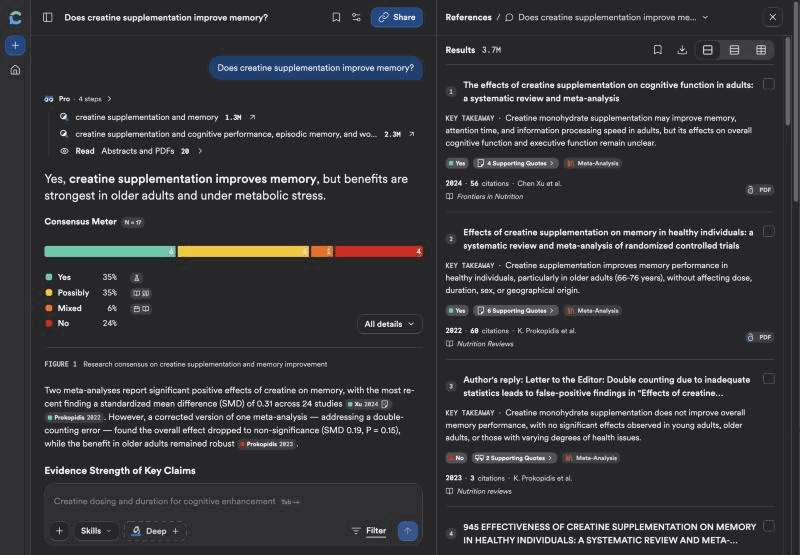
The Consensus Meter labels each of the 5 to 20 most relevant papers Yes, No, Possibly or Mixed and draws the split as a bar, per its help article. Badges add average publish date, the count of RCT, systematic review and meta-analysis designs, average SJR journal rank and total citations.
Each paper also gets a study snapshot of seven attributes: population, sample size, duration, location, methods, outcomes and results, per the snapshot guide. Students quickly understand 20 papers without opening 20 PDFs; clinicians quickly understand trial sizes.
I absolutely do use AI tools like Consensus.app, which aggregates and summarizes peer-reviewed publications so I can ask things like "Is berberine beneficial for lowering cholesterol?"
vunderba on Hacker News, August 2026
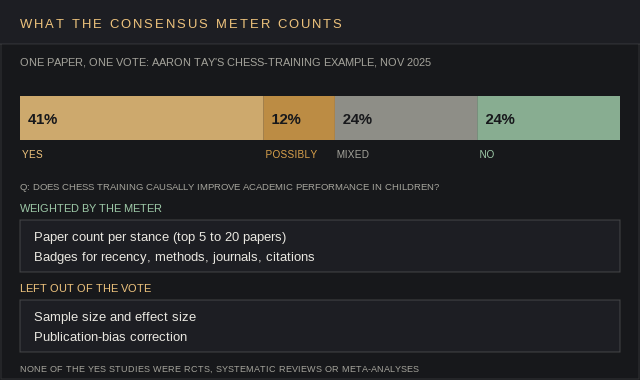
Aaron Tay, who evaluated Consensus for Singapore Management University Libraries, wrote in a November 2025 deep dive that the Meter "is essentially a form of vote counting," a method evidence-synthesis specialists have warned against for decades.
His chess-training example split 41% Yes, 12% Possibly, 24% Mixed and 24% No, and none of the Yes studies were RCTs, systematic reviews or meta-analyses. Read between the lines of the badges; the percentage alone is a headcount, far from scientific consensus. Consensus concedes the classifier "will occasionally incorrectly classify results."
↑ FACT SHEETDeep search mode on a real literature review
Deep, the mode to use Consensus for a literature review, splits a question into sub-questions, runs up to 20 searches, screens 1,000+ papers and writes a detailed summary of usually 50, per the Deep review guide.
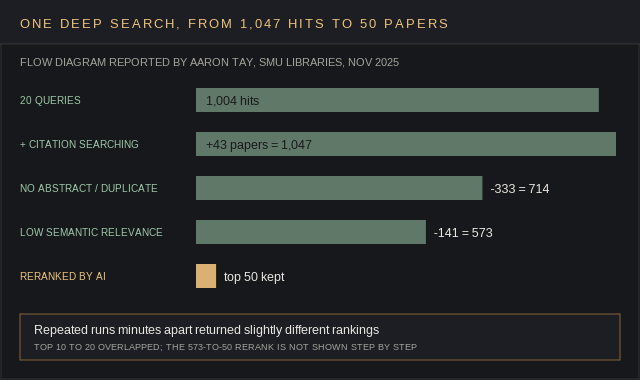
Tay's documented Deep Search run: 20 queries returned 1,004 hits, citation searching added 43, duplicates and missing abstracts removed 333, low relevance removed 141, and a rerank kept 50 of 573. The 573-to-50 rerank runs out of sight.
In my informal tests, repeated Deep Search runs on the same question minutes apart gave slightly different rankings, though the top 10–20 papers tended to overlap strongly.
Aaron Tay, academic librarian, Musings about Librarianship, November 2025
Drift is par for the course for agents built on large language models and rules Deep out for a Cochrane-style review. For in depth research before a thesis, Pro's 15 Deep reviews go far; most researchers won't need the 200 more searches Deep sells.
↑ FACT SHEETMy Library, Zotero import and the citation graph
Consensus can import a Zotero library for searching, live since February 2026, but the import is one-way and manual, per the import guide: pulling new papers means re-importing, and only PDFs of articles stored in Zotero come across.
Only journal articles feed search. Books, theses and reports land in the Library but stay out of it, so a historian's book chapters sit where the AI never reads them. Imported articles can be searched semantically, compared across multiple papers in a Collection and scanned for research gaps against the existing literature in your own research.
The citation graph visualizes citation connections, plotting 20, 40 or 60 papers around up to 5 seeds using direct citation, co-citation and bibliographic coupling, per the citation graph page; it's beta and graphs aren't saved. An export arrow in the upper right corner of the results writes RIS or CSV files for EndNote, Zotero or Paperpile, keeping the research workflow in your reference manager.
↑ FACT SHEETConsensus pricing and the limit each tier sets
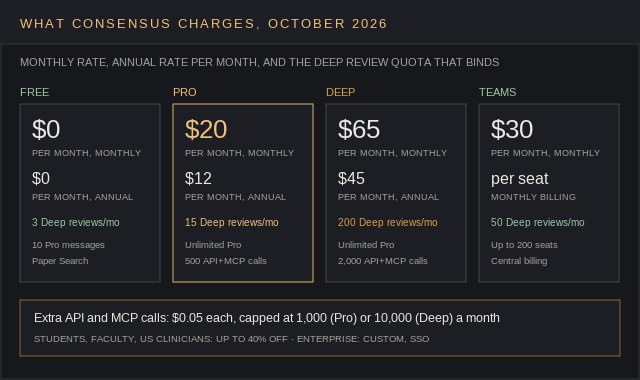
The pricing page and its team tab list Free, a Pro plan, a Deep plan and Teams, and the devil's in the details: the Deep review quota binds at 3 a month on Free, 15 on Pro, 50 on Teams and 200 on Deep. Enterprise is custom, with SAML single sign-on.
Is Consensus AI free? For Paper Search, yes. Older guides quote unlimited Quick Searches over 10 sources and 15 Pro searches a month, and some call the paid tier unlimited Pro searches; Quick Search became Paper Search in April 2026.
Students, faculty and US clinicians get up to 40% off. An Effortless Academic affiliate code offers 25% off a year of Pro.
API and MCP calls share one pool across ChatGPT, Claude and direct use, per the API page. Each call covers up to 100 papers; the full Pro overage of 500 calls costs $25, a drop in the bucket.

1 week free
Try Consensus Pro
A 1-week free trial of Consensus Pro, to run your own research questions through the Meter and Deep reviews. Note the date the week ends; the billing section below covers what follows.
Start the free week →
May earn a commission if you sign up through this link, at no extra cost to you. Full affiliate disclosure.
↑ FACT SHEETBilling, refunds and the Trustpilot complaints
The Trustpilot profile is unclaimed and sits at 2.4 from 6 reviews, 5 of them one-star; four describe a charge after a trial or annual renewal. Six reviews is thin evidence.
Around a year later, I was charged $107.88 with no warning or reminder that I was on an annual subscription or that it would renew.
Robert, Trustpilot review, United Kingdom, February 2026
The refund policy explains why such requests stall: 72 hours on monthly plans, 5 days on annual plans, 14 days in the EU. Cancelling keeps premium access to the period's end, so a renewal noticed on day six misses the boat.
I was charged €104 after signing up for a free trial with Consensus, without receiving any clear notification that the trial was ending or that I would be billed.
El Yazid Sajid, Trustpilot review, France, May 2026
Limits can move mid-contract. The Terms of Service, updated 25 June 2025, let the company modify terms at any time and send disputes to binding JAMS arbitration. A UK annual subscriber found out:
One month later the total look ups for the rest of the year has reduced from 1000 per month to 250 per month, a 75% drop.
Justin Johnson, Trustpilot review, United Kingdom, June 2026
Today's rate card offers 500 or 2,000 calls, never his 1,000. Keep an eye on the renewal date; the missing reminder is the red flag in four of six reviews.
↑ FACT SHEETAccuracy limits Consensus publishes about itself
Is Consensus AI reliable? Its Responsible AI page guarantees every cited paper is real and says the one possible hallucination is misreading a source; the tool is "built to enhance, not replace, the research process." Papers under a relevance threshold drop out, which can cost relevant references.
Tay ran a negative-rejection test, a question with no scientific literature behind it, and Consensus refused to answer. "Consensus is in my view, likely one of the top tools in its class," he concluded.
Misreads still surface. A US reviewer in July 2026:
this supposedly research AI claimed verified studies I had in my dissertation didn't exist because their AI wasn't able to find them.
OLB BPA, Trustpilot review, United States, July 2026
Paywalls are the structural limit. Tay found that "For most paywalled content, it is working from titles and abstracts only," which hits the humanities and social sciences hardest. Medical research is where this AI tool leans, with Medical Mode restricted to the top 1,000 medical journals, and full access to paywalled articles depends on your library.
Academic literature on the tool is thin: a Cureus rapid review from July 2025 found 10 papers on it across 210 databases. The manual-review point in our AI quality checks guide applies: a person reads the source first, since no search engine can replace thinking.
↑ FACT SHEETConsensus AI against ChatGPT and other AI tools
Consensus searches academic research; ChatGPT searches the open web and reaches 1 billion weekly users, per our AI statistics. Consensus AI gives evidence based answers from journal articles, and both tools run on similar AI models, so evidence based research still means reading the papers.
ChatGPT Search provides this, by the way, though it relies a lot on the quality of Bing search results. Consensus.app does this but for research papers, and has been very useful to me.
CaptainFever on Hacker News, November 2024
The two now overlap. A Consensus app replaced the Consensus GPT inside ChatGPT on 6 May 2026 and a Claude connector shipped 24 March 2026, per the ChatGPT guide. You can use Consensus inside ChatGPT's Deep Research, which fits our guide to using ChatGPT for market research.
But with Consensus plugged in, you can get a list of only valid answers, including clickable links to the actual studies.
Chris Guest, Topology, Product Hunt review, September 2023
Grounding cuts fabricated citations, and the synthesis tradeoffs in our piece on generative AI in market research still apply.
↑ FACT SHEETConsensus as a research method: how expert panels agree
Outside the app, a consensus exercise is a structured evaluation in which an expert panel weighs evidence alongside professional judgment to reach collective agreement. Panels form where "research evidence is limited, inconsistent, or absent," per the ACCORD explanation paper, pooling diverse expertise to set clinical guidelines, position statements or recommendations.
The ACCORD guideline covers structured methods that curb groupthink: the Delphi method, an anonymous survey over several rounds, and the nominal group technique, a structured meeting that generates and ranks ideas. Thresholds are fixed in advance: ACCORD's own Delphi needed 80% of at least 20 respondents across three rounds.
Expert selection and evidence framing are where bias enters, agreement can stop short of unanimity, and the Consensus Meter skips all of that academic work.
↑ FACT SHEETConsensus against Elicit, SciSpace and Scite
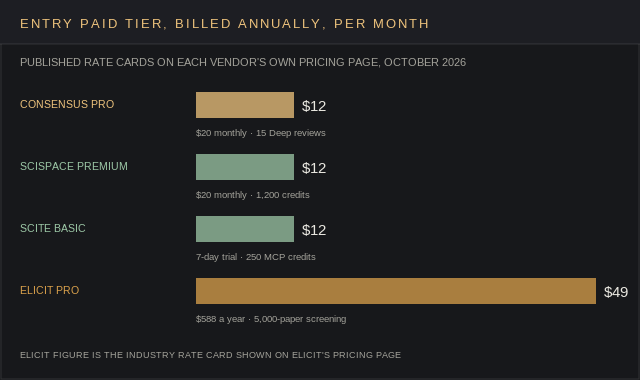
Three AI tools compete with this AI tool; commercial questions belong in our market research tools ranking of other tools.
Elicit
Elicit Pro costs $49 per user per month billed yearly on its pricing page. It wins on extraction tables for a systematic literature review and loses on price: what makes Consensus cheaper is a $12 annual Pro rate, a quarter of Elicit's. A Cochrane Evidence Synthesis and Methods study found Elicit's sensitivity averaged 39.5% against 94.5% for the original searches.
SciSpace
SciSpace Premium runs $20 a month or $12 billed annually with 1,200 monthly credits, and its pricing page offers a 24-hour money-back guarantee. It wins for chatting with PDFs and loses on the Meter and snapshot.
Scite
Scite Basic is $12 a month billed yearly after a 7-day trial, per its pricing page. Its 1.6 billion+ classified citations show if later articles support or contrast a claim. For a first scan of a new research area, Consensus answers faster. Semantic Scholar, a free research tool, suits anyone who only needs to find research papers, open access articles and abstracts.
↑ FACT SHEETVerdict
Use Consensus if you're a graduate student, clinician or analyst who needs evidence based research on a yes-or-no research question fast and will read what it cites. Annual Pro at $12 a month buys 15 Deep reviews, and Tay ranks Consensus AI among the top tools in its class for academic research.
Don't rely on this research tool as the search of record for a formal literature review: Deep's rankings drift and the Meter counts one vote per paper. Humanities and social sciences scholars working behind paywalls get abstract-level answers.
Use Consensus AI with caveats if you're paying annually or for MCP volume: refunds close at 120 hours, four of six Trustpilot reviewers describe unexpected charges, and one buyer's allowance fell 75%.
1 week free
Test Consensus Pro on your own question
A 1-week free trial of Consensus Pro is long enough to check its answers against papers you already know.
Try Consensus Pro free →
May earn a commission if you sign up through this link, at no extra cost to you. Full affiliate disclosure.