Market Intelligence Report Template
 By Jan Suski. I go deep on every review, checking every number against its source and digging up details other coverage misses, a habit from six years of SEO and link building for tech companies. Bylines at Surfer, Brand24, and Senuto. How the scoring works.
· Prefer this source on Google
This market intelligence report template turns a recurring intelligence cycle, market trends, competitive moves, and customer signals, into one document a team rereads next quarter, ending the habit of filing it away and forgetting it.
The nine sections repeat every cycle: same structure, new findings, so the file becomes a habit: reread and updated every cycle, no longer a one-off deck. Nobody has to start from scratch each quarter. It's free, one of several report-cycle documents in the templates set, and your team can call it a market intelligence report or a marketing intelligence report since the same nine sections cover both.
The case for a template is adoption ahead of neatness: 90% of Fortune 500 companies use competitive intelligence to compete, yet only about 11.4% of companies have a dedicated competitive intelligence team, and 78.6% instead spread the work across generalists like product marketers.
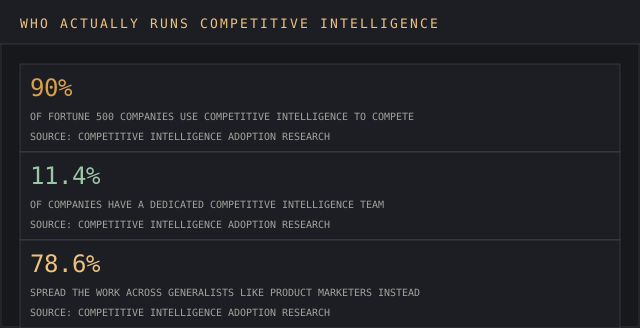
A fixed template is what keeps that generalist-run process consistent from one report to the next, even when the person filling it in changes every few quarters.
Download the Market Intelligence Report Template
Download the market intelligence report template (DOCX)Report overview, executive summary, market trends, competitive landscape, customer intelligence, opportunities and risks, recommendations, metrics to track, and data sources and methodology.
The file carries no branding beyond a title page and opens cleanly in Word or Google Docs. Every section ships with an italic prompt line describing what belongs there, so a first-time user fills in findings right away.
How to develop market intelligence and gather market intelligence data
A market intelligence report is a structured document that synthesizes market trends, competitor activity, and customer signals into findings a business can act on, distinct from a one-time market research report because it repeats on a cycle, monthly or quarterly.
The report's job is synthesis. Collection happens upstream of it. Raw data, win-loss notes, pricing pages, review sites, sales call transcripts, means little until it is compared against the last cycle's findings and turned into a small number of recommendations someone owns.
Why a Template Beats Starting Blank
A fixed structure is what makes report five comparable to report one.
Nearly half of companies plan to increase their use of competitive intelligence technology, and 42% plan to add competitive intelligence headcount, according to Crayon's State of Competitive Intelligence research, growth that a consistent report format has to absorb without breaking the ability to compare periods. That's the kind of investment that keeps a team ahead of the curve while competitors are still scrambling to catch up.
Structure also protects the report from becoming a data dump. Customer experience strategy is the application area 43% of insights, strategy, and marketing leaders name most for competitive intelligence research.
That is exactly the kind of finding a rigid nine-section template surfaces reliably and a blank document lets slip past unnoticed.
What Goes in Each Section
The template's nine sections follow the order a reader needs, top-line findings first, supporting detail after.
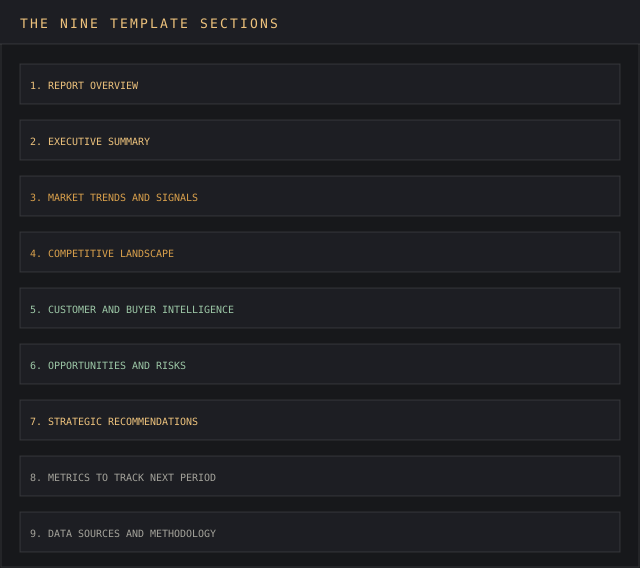
1. Report overview
Scope, reporting period, and primary audience in three lines, so a reader six months from now knows immediately what this document does and does not cover.
2. Executive summary
Three to five sentences: the single biggest change since the last report, the most urgent competitive move to watch, and the top recommendation. Busy executives read this section and nothing else, so it has to stand alone.
3. Market trends and signals
A table of named trends, each with its evidence source, why it matters, and a confidence rating, so a reader can tell a well-supported call from a hunch at a glance.
4. Competitive landscape
The same fields tracked for every named competitor every period, recent move, pricing or positioning change, and the team's response, so a rival's pattern over four quarters becomes visible in one place, no longer buried across four separate documents. What used to be a needle in a haystack turns into a pattern anyone on the team can spot in seconds.
5. Customer feedback and buyer intelligence
Win themes, loss themes, and recurring complaints, each tied to a source, support tickets, review sites, sales call notes.
6. Opportunities and risks
A short, period-specific read. Copying a SWOT forward unchanged every quarter is the single most common way a SWOT section stops getting read.
7. Strategic recommendations
Every recommendation ties back to a numbered finding above it, with an owner and a timeframe, the same discipline that turns a report into a set of decisions.
8. Metrics to track next period
The specific numbers that will confirm or contradict this report's conclusions, set before the next cycle starts so the team isn't picking metrics that flatter whatever happened.
9. Data sources and methodology
Every source named, primary research, secondary research, internal data, and tools used, so a colleague could rebuild or challenge the findings without asking the original author.
How Often to Publish
Monthly suits fast-moving categories where a competitor's pricing or product page changes inside a quarter; quarterly suits most B2B categories where the underlying market moves slower than a monthly cycle can meaningfully measure. The template's structure works at either cadence unchanged; what changes is how much evidence accumulates in the market trends and competitive landscape tables between reports.
Whatever the cadence, the report earns its place on a calendar. A market intelligence program that skips a cycle when things get busy loses exactly the quarter-over-quarter comparison that makes the template valuable in the first place.
AI and Market Intelligence Reporting
Compete teams have adopted AI into this workflow fast: AI adoption among these teams grew 76% year over year, and 60% now use AI daily, up 25 percentage points from the year before. Teams that picked up the tools early hit the ground running while others are still deciding if it's worth the effort.
In practice that means AI increasingly drafts the first pass of the market trends and competitive landscape tables, summarizing filings, pricing pages, and review volume, while a person still owns the executive summary and the recommendations, the sections where judgment about what matters cannot be automated away.
Tools That Feed the Report
The template holds the structure; the tools underneath it supply the evidence each section needs. Market trends and digital visibility data typically come from platforms like Similarweb or Semrush, which track traffic and search visibility shifts a purely internal data set would miss. Customer and buyer intelligence draws on review platforms; our G2 review covers how to pull satisfaction and adoption data by category for the customer intelligence section.
Competitive landscape work on funding, hiring, and company-level moves often runs through Crunchbase, which fills in the private-company detail a public filing search alone would not surface.
None of this replaces the analyst filling in the template. A tool surfaces the raw signal, a competitor's traffic dipped, a review theme shifted, a company raised a round, but deciding which of those signals belongs in the executive summary and which stays a footnote in the trends table is still a judgment call the report has to make explicit.
Common mistakes in a competitive intelligence report
The most common failure is a report that lists activity without a recommendation attached, competitor A did X, competitor B did Y, with no next section connecting either move to an action. That's the report dropping the ball right when it mattered most. A close second is the copy-forward SWOT: opportunities and risks that read identically to last quarter's because nobody deleted the old text before adding new findings.
Unsourced claims are the third failure, and the most damaging one, since a reader who catches one unsupported number in the report stops trusting every other number in it. The data sources section exists specifically so that never happens by accident.
Competitive intelligence, brand positioning, and competitor analysis
Competitive intelligence is not a synonym for market intelligence, it is one section inside it: competitor analysis identifies the strengths and weaknesses of named rivals, while brand positioning statements describe how a company reaches its target market relative to those same rivals.
74% of tech providers say they prioritize competitive and market intelligence, and market intelligence more broadly helps a company create a distinctive brand identity, since competitor analysis directly informs brand positioning strategy.
Effective brand positioning differentiates a company from its competitors on terms customers notice, price, service, or product depth.
Building competitive advantage through a competitor intelligence report
A competitor intelligence report connects data across multiple sources, and it combines quantitative and qualitative insights, financial filings alongside win-loss interview notes, to build a genuine competitive advantage.
Some standalone competitive intelligence reports run 20 to 30 pages when they exist as a one-time deep dive. The recurring market intelligence report this template is built for stays leaner, two to six pages, because it repeats every cycle. Cutting to the chase is the whole design philosophy: fewer pages, same discipline.
Critical insights from competitor intelligence
The critical insights a competitor intelligence report has to surface are the ones that change a decision: a competitor's new pricing tier, a leadership departure, a product cut. Anything that only describes the competitor's existing position belongs in an appendix. Competitive intelligence informs long-term strategic planning specifically because these critical insights compound over several report cycles into a pattern a single snapshot would never reveal.
Using the template for new market entry and competitive positioning
A team evaluating new market entry uses the same nine sections, but the competitive landscape section carries more weight than it does in a mature, existing market: market share is unknown, new market entrants haven't settled into fixed positions, and market entry decisions hinge on investment risk and capital requirements more than on quarter-over-quarter tracking.
The market trends section should target specific customer segments the entry is built for, since a report that tries to target every segment gives strategic insights to none of them.
Former employees and industry experts are two of the more overlooked sources for this kind of market intelligence report: most companies interview neither, yet both routinely explain why a competitor lost a deal or gained the biggest market share in a category, straight from the horse's mouth.
Financial reports fill in the numbers a former employee's account can't confirm, and the two sources together give a market understanding that pricing pages alone don't provide. Product intelligence, what an existing competitor's product's quality is running on, and how their product differentiators hold up against a new entrant, belongs in the same section.
Customer behavior, consumer feedback, and turning data into informed decisions
Consumer behavior and consumer preferences change faster than most nine-section reports get filled in, so the customer feedback section works best when it pulls consumer feedback from more than one channel, support tickets, social listening, and sales call notes.
Customer behavior data on its own is a market signal and stops there; gaining actionable insights from it means comparing this cycle's pain points against last cycle's and writing down what changed for the customers who noticed.
External data, review platforms, social listening tools, and win-loss interviews, and internal data, CRM exports, support tickets, need the same treatment: automatic data analytics can flag that something moved, but a person still decides if it's relevant content for the executive summary or a footnote in the trends table.
That distinction turns key insights into informed decisions. The goal isn't more data analytics dashboards; it's fewer, better-labeled numbers that support informed decision making and the strategic decisions a business can act on.
A worked example: filling in the competitive landscape section
Take an example: a mid-market SaaS business tracking three named competitors. Each competitor's row logs one pricing change, one new feature, and one hire from a named public source, LinkedIn, a press release, a G2 review, so the research behind the report template stays checkable months later. Marketing tactics belong in the same row as the pricing move that triggered them, because the two rarely change independently.
Sales and customer-success notes are a second example worth logging every cycle: a win against a specific competitor and a loss to the same one, both with a one-line reason, turn into a pattern after three or four reports that no single deal review would show. That pattern, and no individual data point, lets a team stay ahead of competitors, anticipating the next move before it happens.
The right tools, often a spreadsheet is enough at this stage, matter less than filling in the same fields every period regardless of which tool holds the data. The habit of leaving no stone unturned each cycle counts for more than the toolkit doing the logging.
Why the report template beats ad hoc research for most companies
Most companies already run some market research, a competitor analysis before a launch, a customer survey after a complaint spike, but ad hoc research disappears into a deck nobody reopens.
A market intelligence report template turns that same research into a habit for the business: the same sections, the same named competitors, the same customer segments, reviewed on a fixed cadence, set by the calendar and not by competitive panic.
Services businesses and product businesses fill in the report template differently.
A services business's competitive landscape section tracks proposals lost and win rates by deal size, while a product business's tracks feature parity against competitors, but both rely on the identical market intelligence report template because the discipline behind a recurring market intelligence report is the same regardless of category, keeping services and product teams on the same page even when their day-to-day metrics look nothing alike.
Every addition above still funnels back into one market intelligence report template: nine sections, filled in the same way when this cycle's focus is customers, competitors, or a new market.
Teams that keep the report template narrow in focus, one business, its named competitors, and the customers who chose between them, get more usable research out of it than teams that widen scope every cycle. The market intelligence report template only works as a recurring instrument if the data feeding it, and the insights pulled from that data, stay comparable report over report.
Market intelligence research and staying close to the target market
Market intelligence research works best when it treats customers as the anchor over the competitors: the same fixed panel of customers surveyed each cycle explains market signals a one-time customer survey misses.
Comparing what customers say about existing products against what customers do gives a business a competitive edge no report on competitors alone can supply.
A target market that shifts its preferences without the report noticing is the widest kind of market intelligence data gap; it is the gap a nine-section market intelligence report template exists to close. Keeping an eye on that target market is the one job the report can't afford to skip.
Customers rarely volunteer why they chose a rival. It takes a direct question, asked the same way every cycle, to gain insights from them, and market research that treats customers as a moving target.
Market research run once a year misses the same target market shift that market research run every quarter catches early. A competitive intelligence report earns its place on a recurring calendar exactly because customers, and the market they buy in, don't hold still between reports, and making informed decisions about existing products depends on catching that movement before a competitor does.
FAQ
What is a market intelligence report template?
A pre-built document structure, executive summary, market trends, competitive landscape, customer intelligence, recommendations, and data sources, that a team fills in on a recurring cycle.
How is this different from a competitive analysis template?
A competitive analysis template is a single-point-in-time grid comparing named competitors on set dimensions. This report template covers a wider intelligence cycle, market trends and customer signals alongside competitors, on a recurring reporting schedule.
How long should a market intelligence report be?
Long enough to support every recommendation with a named source and short enough that an executive reads the summary in under a minute. Most functional reports run two to six pages once the nine sections are filled in at a working level of detail. In a nutshell, that's the balance the whole template design works to protect.
Who should own the market intelligence report?
Given that only about 11.4% of companies have a dedicated competitive intelligence team, ownership most often falls to product marketing or a strategy function, which is exactly why a fixed template matters: it keeps the report consistent even as the person filling it in changes.
Bottom Line
Every number in the report needs a source, every trend needs a confidence rating, and every recommendation needs an owner with a deadline attached; skip any of the three and the report gets filed unread. Download the template, fill in one real cycle's worth of findings, and the second report will take a fraction of the time the first one did, since the structure, and never the writing, was always the hard part.