Cash Flow Statement Template
 By Jan Suski. I go deep on every review, checking every number against its source and digging up details other coverage misses, a habit from six years of SEO and link building for tech companies. Bylines at Brand24 and Senuto. How the scoring works.
Get the cash flow statement template
An Excel workbook with a 12-month direct-method statement, a forecast that runs 13 weeks ahead with a worst-case copy, and an indirect-method check that ties net income back to operating cash.
Download XLSXA cash flow statement records the cash that came into and went out of a business over a period, sorted into operating, investing and financing activities, and walks the opening balance to the closing one. The FDIC and SBA's small business finance course, Money Smart for Small Business, calls it a "backward-looking record of cash movements over a specific period."
This cash flow statement template covers both directions in one Excel file. The monthly statement looks back at what happened, and the forecast looks 13 weeks ahead at what's due. This page covers the download, the three sections, the direct and indirect methods, a step-by-step fill-in, a worked example for a nine-person design agency, two forecast scenarios, common mistakes, and the software question.
It's for owners of small businesses who manage cash flow themselves, their bookkeepers, finance leads at agencies and nonprofit organizations, and anyone preparing figures to support a credit line application before they talk to the bank.
Profit and cash part ways more often than owners expect. An income statement can show a profitable quarter while payroll, taxes and other expenses drain the bank account, and the ability to pay bills on time depends on liquidity, the cash in the account. The statement gives the picture of where the money went, and the forecast shows the next squeeze before it happens.
Download the free cash flow statement template
Download the template (XLSX)Five tabs with instructions, a 12-month direct-method cash flow statement, a 13-week forecast with a minimum-balance alert, a worst-case copy of the forecast, and an indirect-method check, pre-filled with the Brightwater Studio worked example.
The free template opens in Excel, Google Sheets and LibreOffice Calc. It runs on SUM, MIN, INDEX/MATCH and one IF per alert, and all three apps support every one of those, so nothing breaks on import. Conditional formatting turns any balance below your buffer red.
What a cash flow statement shows
Every item on the statement falls into one of three categories, and the template keeps them in the same order. IAS 7, the international standard for the statement, uses the same three sections as the SEC's Office of the Advocate for Small Business Capital Formation in its plain-English primer.
| Section | What goes in it | Items in this template |
|---|---|---|
| Operating activities | Cash from running the business day to day | Project receipts, recurring revenue from retainers, and operating expenses: payroll, rent, utilities and software, contractors and materials, marketing, insurance, sales tax, inventory for product businesses |
| Investing activities | Buying or selling long-term assets | Equipment purchases, property, proceeds from selling old assets |
| Financing activities | Money from or to owners and lenders | Loan proceeds, loan payments, owner contributions, draws and dividends |
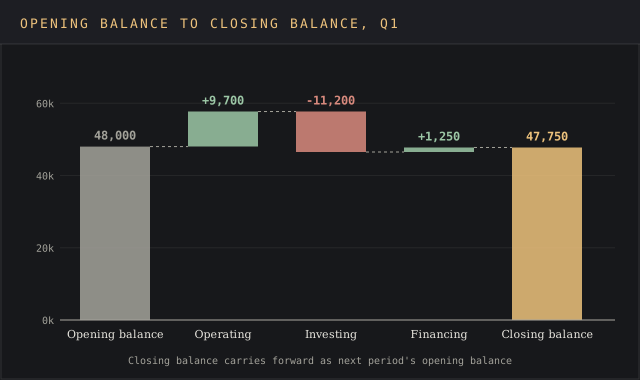
Net cash flow for the period is operating plus investing plus financing. Add it to the opening balance and you get the closing balance, which becomes next month's opening figure.
Direct and indirect method
The direct method lists actual cash receipts and payments. The indirect method starts with net income and adjusts it for non-cash expenses such as depreciation and for changes in receivables, payables and prepaid costs. IAS 7 permits both. The SEC primer notes that most companies keep accrual books, which suit the indirect method, so generally only smaller companies report the direct way.
This template uses the direct method for the main statement, because a small business owner reads it straight off the bank feed. The Indirect Check tab supports those figures by rebuilding operating cash from net income. If the two disagree, a transaction is missing or sits in the wrong section.
What's inside the template
| Tab | What it holds |
|---|---|
| Instructions | The fill-in steps, which items go in which section for your organization, the color key |
| Cash Flow Statement | 12 month columns plus a year total, opening balance, cash receipts and expenses in three sections with subtotals, net change, closing balance, and a months-of-cover row |
| 13-Week Forecast | 13 weeks of columns from a start date you set, the same items, a minimum-balance buffer, and a low-point finder that names the weakest week |
| 13-Week Worst Case | The second of two forecast scenarios, a copy of the forecast with the largest late-quarter project receipt pushed past the window |
| Indirect Check | Net income, depreciation, changes in receivables, prepaid costs and payables, and the difference against the statement's operating cash |
How to fill in the template, step by step
Download the file and work through six steps to manage cash flow month by month. The process runs once a month for the statement and once a week for the forecast.
- Enter the opening balance from your organization's bank statement for the first day of the period. Use the bank's figure, since an accounting balance can include payments that haven't cleared.
- Log cash inflows on the day the money lands. A client invoiced on net-30 terms who pays on day 45 belongs in the week of day 45.
- Schedule every expense on its real date, with payroll on pay dates, rent on the 1st, loan payments on the due date, insurance and taxes in the month they're paid.
- Put one-off items in the right section. A laptop purchase is investing spending. An equipment loan or an owner's top-up is financing and never counts as income.
- Reconcile each month. The closing balance has to match the bank statement to the dollar. Fix any gap before the month closes, because it means a missing entry.
- Set a buffer that fits your organization and roll the forecast. Each week, replace week 1 with actuals and add a new week so the sheet always covers the next 13 weeks.
Worked example: a nine-person design agency, Q1 2026
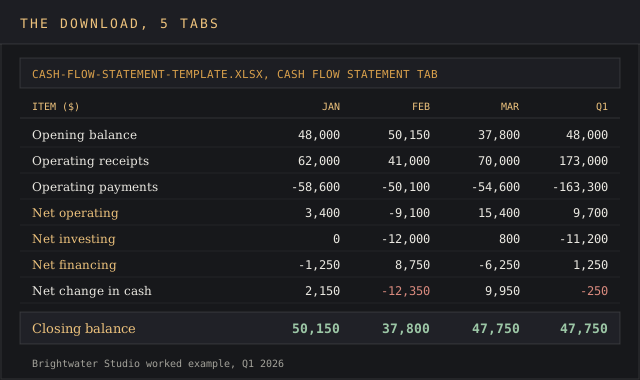
Brightwater Studio is a fictional B2B design agency with nine employees. It earns from project fees and three retainers billed every month, and in February it bought workstations partly funded by a $10,000 loan on a $1,250-a-month schedule. Its first quarter in the template:
| Item | Jan | Feb | Mar | Q1 |
|---|---|---|---|---|
| Opening balance | 48,000 | 50,150 | 37,800 | 48,000 |
| Project receipts | 44,000 | 23,000 | 52,000 | 119,000 |
| Retainer receipts | 18,000 | 18,000 | 18,000 | 54,000 |
| Payroll | −38,500 | −38,500 | −38,500 | −115,500 |
| Rent | −4,200 | −4,200 | −4,200 | −12,600 |
| Utilities and software | −1,900 | −1,900 | −1,900 | −5,700 |
| Contractors and materials | −6,000 | −3,500 | −7,500 | −17,000 |
| Marketing | −2,000 | −2,000 | −2,500 | −6,500 |
| Insurance (annual premium) | −3,600 | 0 | 0 | −3,600 |
| Sales tax remitted | −2,400 | 0 | 0 | −2,400 |
| Net operating | 3,400 | −9,100 | 15,400 | 9,700 |
| Equipment purchase | 0 | −12,000 | 0 | −12,000 |
| Sale of old hardware | 0 | 0 | 800 | 800 |
| Net investing | 0 | −12,000 | 800 | −11,200 |
| Loan proceeds | 0 | 10,000 | 0 | 10,000 |
| Loan payments | −1,250 | −1,250 | −1,250 | −3,750 |
| Owner draw | 0 | 0 | −5,000 | −5,000 |
| Net financing | −1,250 | 8,750 | −6,250 | 1,250 |
| Net change in cash | 2,150 | −12,350 | 9,950 | −250 |
| Closing balance | 50,150 | 37,800 | 47,750 | 47,750 |
February's negative net change of $12,350 looks alarming on its own. Most of it is the $12,000 workstation purchase, $10,000 of which the loan covered, plus a slow month for sales at $23,000 of project receipts. The months-of-cover row puts February's closing balance at 0.75 months of that month's $50,100 in operating expenses.
The template's Indirect Check tab tells the other half. Brightwater's books show Q1 net income of $16,900. Add back $1,000 of depreciation, subtract a $6,500 rise in unpaid invoices and $2,700 of insurance paid in advance, add a $1,000 rise in unpaid supplier bills, and you land on the same $9,700 of operating cash.
A profitable quarter, and the bank balance still fell by $250. The reverse happens too. A business can post positive cash flow in a quarter it loses money, if it collects old invoices or borrows. Income taxes sit outside these three months, since Brightwater settles them in estimated installments from April.
The 13-week cash flow forecast
Thirteen weeks make up one quarter of 91 days. That's short enough to estimate receipts invoice by invoice and long enough to see trouble coming six or seven payroll runs out. Weekly columns matter because payroll, rent and taxes land on specific days, and a monthly total hides the week when they collide.
Brightwater's forecast in the template starts on 6 April 2026, runs 13 weeks from the $47,750 March closing balance, and holds a $25,000 minimum buffer, enough to support one payroll run with room to spare. The agency's payroll schedule is semi-monthly.
The template's low-point finder flags the week of 15 June, the earliest sign of a squeeze: a $19,250 payroll run, a $6,000 quarterly estimated tax payment and a $3,500 contractor bill fall in that week with no incoming payments, and the balance drops to $20,300.
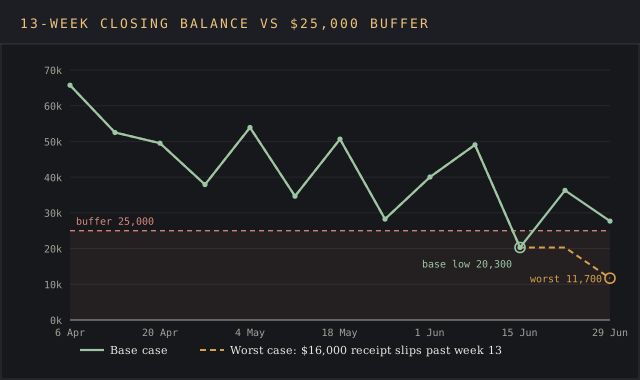
Of the two scenarios, the template's worst case tab tests the agency's ability to cover payroll if one account slips 30 days. It pushes the $16,000 project payment due in the week of 22 June past the 13 weeks, and the low point moves to $11,700 in the final week.
To discover that ten weeks ahead leaves time to fix it, and there are three ideas to try: invoice the July retainer early, save cash by moving the contractor payment and trimming discretionary spending, or draw on a credit line before the bank asks why.
Common mistakes
- Mixing business and personal finances. Owner draws and top-ups go on their own financing rows. Personal spending paid from the business account distorts every figure on the sheet.
- Using invoice dates for receipts. Revenue is booked when you invoice, and cash arrives when customers pay. Only the second belongs here.
- Forgetting lumpy bills. Annual expenses such as insurance, quarterly taxes, sales tax remittances and bulk inventory orders arrive once or four times a year, and a sheet built from a typical month misses them.
- Booking a loan as income. A loan is finance from a lender. The proceeds raise the balance and the repayments lower it. Neither one is income, so the template keeps both on financing rows.
- Skipping the bank reconciliation. A statement that doesn't tie to the bank to the dollar has a missing transaction somewhere. Fix it before the next month starts.
- Reading one month in isolation. A negative month driven by an asset purchase is a different story from three straight weeks of negative operating cash.
Excel, Google Sheets or accounting software
A spreadsheet is enough to manage cash flow for small businesses and any organization with a single bank account. Excel and Google Sheets give you full control of the categories, and this template's formulas work in both. Business accounting software supports a cash flow report straight from the ledger, which saves time once the books are kept there and the data is categorized correctly. Larger companies run the statement from their ledger for that reason.
The forecast is the part accounting packages often leave out. Focus the finance software on the history, and use this template's forecast tab to look ahead week by week.
FAQ
Is there a cash flow template in Excel?
Yes. Microsoft publishes cash flow forecast templates for Excel, and the file on this page is an .xlsx workbook with a monthly statement, a 13-week forecast and an indirect-method check, ready to download.
How do I create a cash flow statement in Excel?
Create one column per month and one row per receipt or expense type, grouped into operating, investing and financing. Sum each section, add the three subtotals for the net change, and set each month's opening balance equal to the previous month's closing balance. The template above has this layout built in.
How do you make a cash flow forecast?
Start from your organization's bank balance today, list every expected receipt on the date clients will likely pay, list all expenses on their due dates, and run a weekly balance for the next 13 weeks. Set a minimum buffer and look for the week the balance comes closest to it.
What are the types of cash flow statements?
By method there are two kinds. The direct method lists receipts and payments, and the indirect method starts from net income. By time there's the historical statement or cash flow report, and the forward-looking forecast or projection.
Can ChatGPT make a cash flow statement?
AI chat tools support drafting the layout and the formulas. The figures still have to come from your organization's bank and ledger data, and every formula needs checking on a month you can reconcile by hand.
How often should I update a cash flow forecast?
Update a 13-week forecast every week. Replace the week that just ended with actuals and add a new week at the end, so the window always covers 13 weeks. A 12-month projection can be refreshed monthly, when the statement for the month closes.
Bottom line
Use this template to manage cash flow in any organization that runs payroll on fixed dates and collects on its clients' schedule. The statement tab says where the money went, the forecast and its two scenarios say when it'll run short, and the indirect check proves the figures match your accountant's books. Bring the forecast into strategic financial planning before you hire for growth, since one more salary changes your ability to make payroll in every forecast week.
For a single runway figure, the burn rate calculator is the quicker tool. For the receivables and payables behind a cash squeeze, the working capital calculator goes a level deeper.