Feasibility Analysis Template
 By Jan Suski. I go deep on every review, checking every number against its source and digging up details other coverage misses, a habit from six years of SEO and link building for tech companies. Bylines at Surfer, Brand24, and Senuto. How the scoring works.
Get the feasibility analysis template
An Excel feasibility study template that scores a proposed project on five feasibility dimensions and runs the NPV, payback and sensitivity math, plus a Word report for presenting the findings.
Download XLSX Report (DOCX)A feasibility analysis template is a structured file that evaluates a proposed project against five questions before anyone signs the budget: will the market buy it, can the team build it, does the money work, can the organization run it, and is it legal. It ends in one of three verdicts: go, conditional go, or no-go.
This page walks through the five dimensions the feasibility study template scores, every tab of the workbook, the nine sections of the companion feasibility study template for the written report, a step-by-step fill-in guide, and a worked example: a $180,000 self-serve launch whose base case clears a 10% hurdle and whose sensitivity tab shows how little room it has.
It's built for project managers, product leads, entrepreneurs testing a business idea, and anyone asked to write the business case for a new project that will tie up significant resources. A feasibility study on paper is cheap. Discovering after launch that the market demand was never there can cost an arm and a leg.
Download the free feasibility analysis template
Download the feasibility analysis template (XLSX)A seven-tab feasibility study template, from the weighted scorecard and NPV model to the risk register, pre-filled with the worked example below.
Download the feasibility study report template (DOCX)A nine-section financial feasibility report in Word, from executive summary to recommendations, with instruction lines and the same worked example in italics.
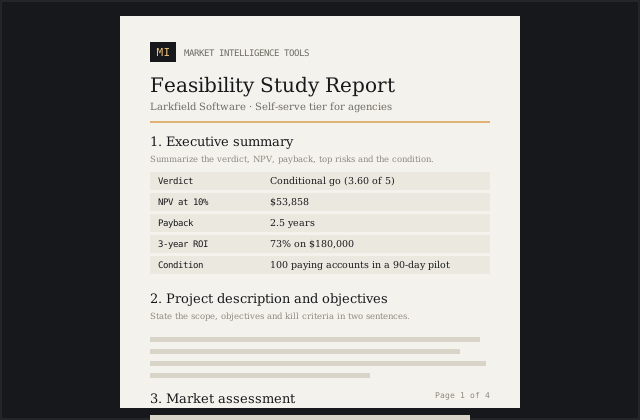
The feasibility study template opens in Excel, Google Sheets or LibreOffice Calc with its formulas intact, and the report, built to present the findings, opens in Word or Google Docs. Both ship with the worked example in italics, so your first real entry copies a pattern; clear those rows when you start your own project.
What a feasibility analysis is, and when to run one
Every feasibility study answers one question: should this project go ahead? A feasibility study is "an assessment of the practicality of a project or system," in the definition Wikipedia's feasibility study article opens with. The feasibility analysis is the evaluation inside that study: the scoring, the financial analysis and the risk log its findings rest on. The feasibility study template holds the analysis, and the report presents it to whoever signs.
Conduct one at project initiation, once someone has a one-paragraph pitch and a rough number, to determine if the idea is worth pursuing before project approval commits resources. Asana's feasibility study guide suggests skipping a fresh study only when the team ran a similar analysis within the past three years.
The trigger is spend you can't take back. A new product line, entry into new markets, a second site, a platform migration, or any business venture where the money is gone if the idea flops all qualify, and so does any new project big enough to need a sign-off. A $3,000 experiment you can switch off next month is cheaper to test than to study; if it fails, it's back to the drawing board for the price of the test.
Before the numbers, a business model canvas template puts the venture's customers, costs and revenue streams on one page, which shows the feasibility study which assumptions it has to test.
Peter Fellows' 1997 FAO guidelines for small-scale processors make the case in one line: a plan lets an entrepreneur make mistakes on paper before making them in a working business. The same guide evaluates each idea from several angles in turn, covering market analysis, technical feasibility and financial feasibility, so the decision rests on evidence and stays clear of gut feel.
The five feasibility dimensions the template scores
Most guides agree on five dimensions, and they are the critical factors every feasibility study weighs. Asana lists technical, financial, market, operational and legal feasibility. The older TELOS acronym, which Wikipedia's article credits to James Hall (2010) and P. M. Heathcote (2005), swaps market for scheduling and calls financial "economic".
This feasibility study template uses Asana's five and folds schedule into technical feasibility, since a build that can't ship on time is a technical problem with a date attached. Each dimension gets the same evaluation: a score from 1 to 5 backed by a sentence of evidence.
| Dimension | Question it answers | Evidence the template asks for | Default weight |
|---|---|---|---|
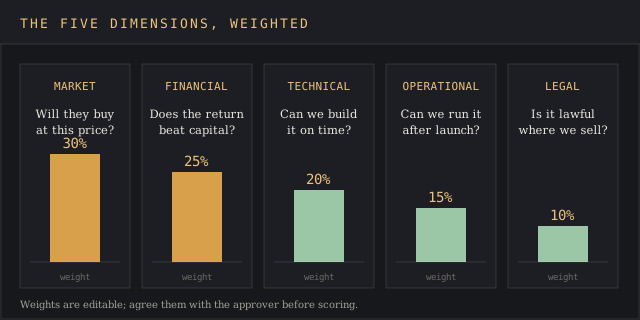
| Market | Is there customer demand at the planned price? | Market analysis: target market size, competitors, pricing, pilot or interview data | 30% |
| Technical | Can the team build it with the resources and time available? | Technical considerations, technology stack, build estimate, skills gap, schedule | 20% |
| Financial | Is the project viable, with a return that beats the cost of capital? | Initial investment, revenue projections, expected costs, cost-benefit analysis, NPV, payback | 25% |
| Operational | Can the organization run it after launch? | Organizational structure, staffing requirements, support load | 15% |
| Legal | Can it run lawfully in every market you plan to sell in? | Licenses, permits, regulations, tax laws, data rules, contracts | 10% |
Weights are a judgment call, and the feasibility study template exposes them as editable cells, so they can follow the project's specific risk profile. A regulated medical product might give legal 25%; a pure software feature might drop it to 5%. Agree the weights with the approver before scoring, so everyone is on the same page before a single score goes in and nobody retunes them later to rescue a favorite idea.
What's inside the feasibility study template
The feasibility study template runs in the order a reviewer reads, the verdict first and the evidence behind it second, so an approver can evaluate the call before the detail. Each tab carries one of the key components of the feasibility study, and together they make up the essential elements a reviewer expects to find. One standardized format also means findings from two projects can be compared side by side.
| Tab | What it holds | Key formula |
|---|---|---|
| Read Me | How to use the file, scoring rules, verdict thresholds | None |
| Project Overview | Project name, sponsor, clear objectives, scope, kill criteria, decision date | None |
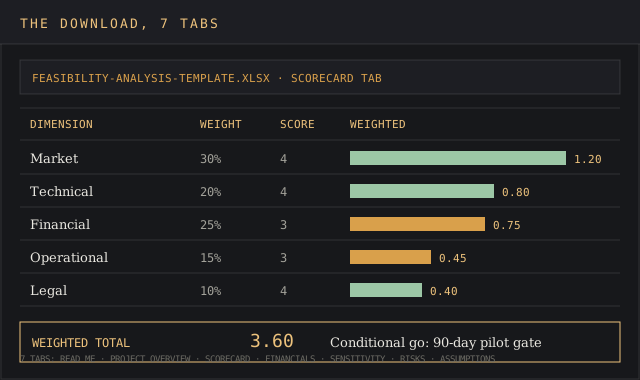
| Scorecard | Five dimensions with weight, 1 to 5 score, rationale and weighted score | =SUMPRODUCT(C6:C10,D6:D10) and an IF() verdict |
| Financials | Year 0 to 3: accounts, price, revenue, variable and fixed costs, net and cumulative cash flow | =NPV(rate,Y1:Y3)+Y0, payback, ROI |
| Sensitivity | Four downside cases next to the base case | NPV and payback per scenario |
| Risks | Risk register with likelihood, impact, mitigation and owner | =likelihood*impact |
| Assumptions | Key assumptions, source, confidence and how to test each | None |
The Word document is the presentation layer. Its sections follow the order ProjectManagementDocs' free feasibility study template uses, executive summary first and findings last, regrouped around the five dimensions:
- Executive summary
- Project description and objectives
- Market assessment, including the marketing strategy and target audience
- Technical feasibility
- Operational feasibility: organizational structure and staffing requirements
- Legal and regulatory feasibility
- Financial feasibility: financial projections, key assumptions and sensitivity analysis
- Risks and mitigation
- Findings and recommendations, with the likelihood of success
Write the executive summary last and present it first. It's the one page most stakeholders read, so it cuts to the chase: the verdict, the NPV, the payback period, the top two risks and the condition attached to a go, with nothing the later sections don't prove. The detailed analysis lives in sections 3 to 8, and detailed project planning, the full schedule and budget, comes after approval.
How to fill in a feasibility analysis template, step by step
Create the project overview in two sentences. Name the proposed project, its scope, the problem it solves, the decision date and who signs. If the project involves developing something new, describe the smallest version that would answer the question.
Set clear objectives and kill criteria. One revenue objective, one adoption objective that defines success, and the number below which the answer is no. Writing the no-go line first keeps the analysis honest.
Run the market assessment. Evaluate market demand first: size the target market, list competitors and their prices, and collect evidence of customer needs from interviews, a landing-page test or a pilot. Fellows' FAO guide warns that newcomers overestimate the market share they can expect, so start from the low estimate; the market sizing template handles the TAM, SAM and SOM math.
Check technical considerations and the schedule. Evaluate what has to be built or bought, the skills and resources the team lacks, and where external consultants come in, then put a date on each milestone.
Map the operational load. Sketch the organizational structure after launch: who supports the product, who sells it, and the hires and resources that follow.
Assess legal requirements. Licenses, permits, data-protection rules, tax registration and contracts in every market you plan to enter. The devil's in the details here: one missed sales-tax registration can erase a quarter's margin.
Build the financial projections, then score. Enter the initial investment, revenue projections and expected costs; read NPV, payback and ROI; run the sensitivity tab; then score all five dimensions from 1 to 5 and let the scorecard determine the verdict.
Every score needs a sentence of evidence in the rationale column. A 4 with no reason attached is an opinion, and the point of a feasibility study is to replace opinions with financial information and market data a skeptic can check. That written trail is what supports informed decision making when the approver asks why.
Worked example: scoring a $180,000 self-serve product line
Larkfield Software is a fictional 45-person company selling a reporting tool to mid-size marketing teams at $299 a month. Its proposed project is a $49-a-month self-serve tier for agencies with fewer than 20 staff, a new product line that needs a self-serve onboarding flow and card billing. Every number below sits in both files of the feasibility study template, and the workbook's formulas reproduce them.
Year 0 carries a $180,000 initial investment: $120,000 for the build, $25,000 for billing, tax and compliance setup, and $35,000 for launch marketing. The plan assumes 250 average paying accounts in year one, 600 in year two and 1,000 in year three, variable costs at 30% of revenue, $150,000 a year in fixed costs, and a 10% discount rate.
| Line | Year 0 | Year 1 | Year 2 | Year 3 |
|---|---|---|---|---|
| Average paying accounts | 250 | 600 | 1,000 | |
| Revenue ($49 × 12 per account) | $147,000 | $352,800 | $588,000 | |
| Variable costs (30%) | $44,100 | $105,840 | $176,400 | |
| Fixed costs | $150,000 | $150,000 | $150,000 | |
| Initial investment | $180,000 | |||
| Net cash flow | -$180,000 | -$47,100 | $96,960 | $261,600 |
| Cumulative cash flow | -$180,000 | -$227,100 | -$130,140 | $131,460 |
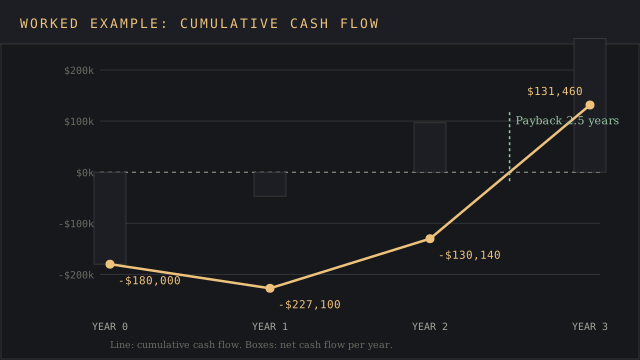
Read off the feasibility study template's Financials tab: NPV at 10% of $53,858, payback at 2.5 years (two full years plus $130,140 of the $261,600 earned in year three), and a three-year cumulative net of $131,460, a 73% return on investment against the expected 10% hurdle. On its own, the base case looks like a green light. The project is technically viable; the money is where it gets thin.
| Dimension | Weight | Score | Weighted | Evidence |
|---|---|---|---|---|
| Market | 30% | 4 | 1.20 | Rivals charge $39 to $79; 14 of 20 agencies interviewed named the reporting pain unprompted |
| Technical | 20% | 4 | 0.80 | Onboarding reuses the existing reporting engine; four-month build |
| Financial | 25% | 3 | 0.75 | NPV of $53,858 turns negative on a 9% demand miss |
| Operational | 15% | 3 | 0.45 | Needs one support hire; no help centre yet |
| Legal | 10% | 4 | 0.40 | Card billing in two countries needs VAT and sales-tax compliance |
| Total | 100% | 3.60 | Conditional go |
The scorecard's thresholds are 3.75 and up for go, 3.00 to 3.74 for conditional go, and under 3.00 for no-go. At 3.60, held back by its financial feasibility score, Larkfield gets a conditional go, and the condition comes from the sensitivity tab: a 90-day pilot must reach 100 paying accounts before the $35,000 of launch funding is released.
Sensitivity analysis: how far the numbers can bend
The feasibility study template's Sensitivity tab reruns the financial projections with one assumption moved at a time, so the reader sees which input project viability hangs on, the part of the financial analysis most reviewers skip. Iseo Blue's financial feasibility guide describes it as the step that shows how resilient a project's financial outcomes are to changes in the underlying assumptions.
| Scenario | Change | NPV at 10% | Payback |
|---|---|---|---|
| Base case | None | $53,858 | 2.5 years |
| Demand -20% | 200 / 480 / 800 accounts | -$67,519 | Beyond year 3 |
| Price -10% | $44 a month | -$8,069 | 2.8 years |
| Fixed costs +15% | $172,500 a year | -$2,096 | 2.7 years |
| Combined downside | Demand -20% and fixed costs +15% | -$123,473 | Beyond year 3 |
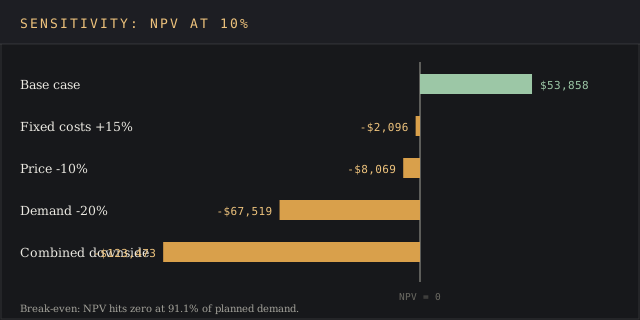
All four downside cases flip NPV negative. The break-even point sits at 91.1% of planned demand, so a shortfall of just under 9% wipes out the return. That's why financial feasibility scores a 3, why demand is one of the critical factors in the findings, and why the pilot gate exists. Booking 1,000 accounts in year three before the first 100 sign up would be counting your chickens before they hatch.
Move one input per row and present the base case next to it. Changing two at once tells you the combined case is bad but hides which assumption broke it, so the combined row exists only as a stress test.
Identifying risks and writing the mitigation
The Risks tab of the feasibility study template helps you identify risks, then scores each threat by likelihood and impact on a 1-to-5 scale and multiplies them, the same grid the risk assessment matrix template uses. Anything scoring 12 or more needs a named plan to mitigate it before project approval. Evaluate each project risk against the sensitivity tab as you go.
| Risk | Dimension | Likelihood | Impact | Score | Mitigation |
|---|---|---|---|---|---|
| Demand below plan in year one | Market | 3 | 4 | 12 | 90-day pilot gate of 100 paying accounts before launch spend |
| Support load outgrows one hire | Operational | 3 | 3 | 9 | Help centre and in-app guides built before launch |
| Cannibalises the $299 tier | Financial | 2 | 4 | 8 | Cap the self-serve tier at three seats |
| VAT and sales tax in two countries | Legal | 2 | 3 | 6 | Bill through a merchant-of-record provider |
| Onboarding build overruns four months | Technical | 3 | 2 | 6 | Fixed-scope first release; cut features before moving dates |
The top risk mirrors the sensitivity tab, and that agreement is the check: when the two tabs disagree about what could sink the project, one of them is wrong. For a fuller weighing of upside against downside, the risk-benefit analysis template takes the same register further.
Common mistakes in a feasibility study
- Starting from the answer. A feasibility study written to justify a decision already made scores every dimension a 4. An honest evaluation writes the kill criteria before anyone gathers all the data.
- Top-down market share. "1% of a $2 billion market" is pie in the sky. Count reachable buyers from the bottom up, check the potential market share against what competitors hold, and test market demand with a pilot.
- Skipping the operational tab. Teams cost the project build and forget the support hire, the billing admin and the on-call rota that come with it.
- Excel's NPV trap. Microsoft's NPV documentation says the function treats its first value as one period out, so a year-0 cost has to be added outside it:
=NPV(10%,Y1:Y3)+Y0. Put the investment inside and every cash flow shifts a year. - One scenario only. A single-point project forecast hides the 9% margin the worked example exposes.
- Letting the scorer set the weights. Fix the weights with the approver first, then score.
Excel, Word, or Google Sheets
The feasibility study template uses plain functions, SUMPRODUCT, NPV, IF and arithmetic, so it imports into Google Sheets with every formula working, and LibreOffice Calc opens it unchanged. Keep the lion's share of the work in the spreadsheet, where a changed assumption recalculates every tab, and paste the final figures into the project's Word report once the numbers stop moving.
Project management software adds approval workflows and portfolio views on top of the same fields, which earns its fee when a PMO runs dozens of studies a year. For one decision, a free feasibility study template and a spreadsheet are enough; create one copy per project, so each feasibility study keeps its own history. For the market evidence itself, these market research methods cover surveys, interviews and concept tests.
Pair the feasibility study template with the files that feed it: a SWOT analysis template or PEST analysis template for the outside view, a competitive analysis template for pricing evidence, and, once the answer is go, a go-to-market plan template to carry the decision into launch.
FAQ
What is the format of a feasibility report?
Nine sections in this order: executive summary, project overview, market assessment, technical, operational, legal and financial feasibility, risks, and findings with recommendations. The DOCX feasibility study template on this page follows that format, so you can create the report by filling in each section.
What are the 5 elements of a feasibility study?
Market, technical, financial, operational and legal feasibility. TELOS, the older project-management version, uses technical, economic, legal, operational and scheduling.
What are the four types of feasibility?
Four-type lists usually keep technical, economic, operational and schedule feasibility and drop legal. This feasibility study template scores five so legal requirements don't get skipped on any project.
Can I do a feasibility study on my own?
Yes. A feasibility study for a small business idea or an internal project is a one-person job. Bring in external consultants when you need evidence you can't produce yourself: engineering estimates, a regulatory opinion, or an independent market assessment a lender will accept.
What are the 7 steps in conducting a feasibility study?
Describe the project, set objectives and kill criteria, run the market assessment, evaluate the build, map operations, assess legal requirements, then build the financials and score. The step-by-step section above covers each one.
How to create a feasibility analysis?
Download the feasibility study template, replace the italic worked-example rows with your project's data, agree the weights, score each dimension with written evidence, and let the scorecard determine the verdict.
Where can I find templates for feasibility studies?
Both files on this page form a free feasibility study template set, with no email gate, ready for your next project. ProjectManagementDocs also publishes a free nine-section Word version, and Asana's guide includes a checklist.
What is a feasibility assessment?
A shorter, earlier pass at the same question: a one-page evaluation of the five dimensions that determines if a full feasibility study is worth the effort and the insights needed to make it one.
Bottom line
Reach for the feasibility analysis template when a decision commits money you can't recover and more than one function has to sign off. Its value is the agreement it forces up front on weights, kill criteria and assumptions, so well informed decisions get made before the financial commitment and the potential success of the idea is argued with numbers.
For a decision driven mainly by downside exposure, the risk-benefit file fits better, and for sizing a market before any project exists, start with the total addressable market template. When the feasibility study template's scorecard says go, move to the product launch checklist; when it says no-go, you get to cut your losses before there are any.