Business report: types, structure, and how to write one
 By Jan Suski. I go deep on every review, checking every number against its source and digging up details other coverage misses, a habit from six years of SEO and link building for tech companies. Bylines at Surfer, Brand24, and Senuto. How the scoring works.
· Prefer this source on Google
The short version 11 points · 40 seconds
- 01A business report exists to settle one decisionTerms of reference name the owner and deadline
- 02Eight report types cover most business reportingFrom periodic sales reports to situational ones
- 03Regulators set the format and deadline for complianceOSHA Form 300A goes up by February 1
- 04A formal report runs in a fixed order of ten partsTen blocks from title page to appendices
- 05Decision makers read the summary and skim the restWeb readers get through 20% to 28% of words
- 06Write the executive summary after the conclusions settleAmazon's six-page memos take a week or more
- 07Write for a named reader before collecting dataBuffett wrote Berkshire's report for his sisters
- 08Plain formal style has a published SEC standardThe 1998 handbook lists 12 techniques
- 09Finish the analysis before drafting the bodyConclusions go down as key points first
- 10A Form 10-K maps onto the formal report structureItem 1 sets context, Item 8 holds the evidence
- 11Market intelligence supplies the outside numbersMarket growth, competitor pricing and share
A business report is a structured written document that gives decision makers the relevant data, the analysis, and a recommendation so they can make informed decisions on one specific call. It can be a two-page weekly sales summary or a Form 10-K filed with the Securities and Exchange Commission.
This guide covers the types of business reports and the question each answers, the compliance reports that carry legal deadlines, and the anatomy of a formal business report. Then comes a step by step guide to writing one, and a 10-K read as a worked example.
It's written for analysts, founders, and managers who hand reports to upper management and want them read past page one.
What a business report is for
Every business report starts with a decision someone has to make. A terms of reference section, usually half a page, states it: who commissioned the report, what it covers, what it leaves out, and when the answer is due. That puts writer and reader on the same page about scope before a single figure is collected.
The working definition, then: a business report is an official document that turns raw data into a recommendation a named person can accept or reject. Business reports serve three jobs. They support informed decision making, they track progress against a plan, and they leave a written record a board, an auditor, or a successor can check a year later. They're also the written input to decision making processes for budgets and hiring.
A progress report documents what was promised, what shipped, and what slipped, so the next budget meeting argues from paper. Over a year, the stack of performance reports gives a view of organizational performance no single meeting holds.
Types of business reports and the question each one answers
The common four-way split of report types is informational, progress, analytical, and compliance. The table breaks those into eight working formats, each business report type tied to the question its reader asked.
| Type | Question it answers | Cadence | Example |
|---|---|---|---|
| Periodic report | How did we do this period? | Weekly, monthly, quarterly | Sales reports, inventory reports, financial reports |
| Progress report | Is the project on plan? | Per milestone | Launch status against dates and budget |
| Analytical or research studies report | What's happening, and why? | One-off | Market analysis reports, trend analysis reports |
| Feasibility report | Should we fund this proposed idea? | Before spending | New-market entry with associated costs and break-even |
| Yardstick report | Which option wins on fixed criteria? | One-off | Three vendors scored on the same criteria |
| Investigative report | What went wrong, and why? | After an incident | Root-cause review of a failed release |
| Compliance report | Did we meet the rule? | Set by the regulator | OSHA Form 300A, EEO-1, Form 10-K |
| Situational report | What's happening right now? | During an event | Daily status during a supply outage |
Periodic performance reports make up the bulk of the volume. Sales reports, inventory reports and financial reports land on a fixed cadence, and their value comes from comparison: this month against last month, against plan. It takes three periods side by side to provide meaningful insights and identify trends in the performance metrics the reader tracks.
Annual reports are the periodic report at full size, summarizing a year of financial performance and risk. Outsiders judge a company's performance by them, and for a U.S. public company the regulated version is the Form 10-K.
Analytical reports carry the detailed analysis and most of the valuable insights. A market analysis sizes demand & competitors; a trend analysis follows statistical trends in pricing or consumer preferences across several years of research data. Both lean on external evidence, the subject of market intelligence analysis.
A yardstick report scores options against criteria fixed before anyone looks at the options, which stops a team from picking a favorite first. The benchmarking report template uses the same logic to examine efficiency against peers.
A feasibility report tests a proposed idea against its costs and expected return before money is committed; the feasibility analysis template lays out its sections. An investigative report works backward from an incident to its cause. A situational report, written against the clock during an outage, covers what happened, what's affected, and what happens next.
Compliance reports and the deadlines regulators set
A compliance report is the one type where the writer doesn't choose the format, the deadline, or the audience. The regulator sets all three, and a miss carries a penalty. Grant agreements work the same way: the recipient files to show it's spending money properly against the approved budget.
OSHA's Form 300A shows how specific the rules get. Under 29 CFR 1904.32, an employer posts the annual injury summary no later than February 1 and keeps it up until April 30. The rule says "a company executive must certify that he or she has examined the OSHA 300 Log." Covered establishments then submit the data through OSHA's Injury Tracking Application by March 2.
Headcount decides who files. OSHA's electronic reporting rule skips establishments that peaked at 19 or fewer employees the previous year. The EEOC requires an EEO-1 Component 1 report from every private employer with 100 or more employees, and from federal contractors with 50 or more that meet its criteria, broken down by job category, sex, and race or ethnicity.
Public companies face the tightest calendar. The SEC's Form 10-K general instructions give large accelerated filers 60 days after fiscal year end, accelerated filers 75, and all other registrants 90. Under Sections 302 and 906 of the Sarbanes-Oxley Act of 2002, the CEO and CFO certify that the 10-K, financial data included, is accurate and complete. Regulatory compliance filings let an outsider check every figure against a written rule.
The structure of a formal business report

A formal business report runs in a fixed order, and the order exists for the reader who stops early. Someone who reads two pages should leave with the answer. Someone who reads the entire report should find every number traced to a source.
- Title page: title, author, recipient, date.
- Terms of reference: who asked, the question, scope, deadline.
- Executive summary: the answer and the recommendation on one page.
- Table of contents: headings and subheadings that preview the report's content.
- Introduction: the business context and why the question came up now.
- Methodology: how the data was gathered and analyzed, with date ranges.
- Findings: the body, with charts and tables.
- Conclusions: what the findings mean, stated as key points.
- Recommendations: each action with an owner, a cost, and a date.
- Bibliography and appendices: every source, plus raw data and statistical data too long for the body.
Short internal reports drop the table of contents. A professional business report going to a board or an outside funder keeps all ten parts. The methodology is where a skeptical reader turns first, and a findings section with no stated date range is a red flag for any reviewer.
The executive summary carries the report
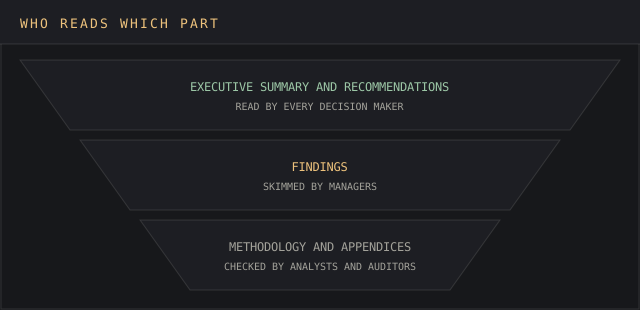
Most readers stop early. Jakob Nielsen's May 2008 study for Nielsen Norman Group found that on an average web page, users have time to read at most 28% of the words, and 20% is more likely. A business report gets the same treatment from upper management: the summary gets read, the headings get skimmed, the body gets opened where a number looks off. A summary that buries the recommendation on page four works against informed decision making.
So the executive summary is where a business report cuts to the chase. Write it last, after the conclusions are settled, and put the recommendation in its first paragraph. A good one is a brief overview of a page or less: the question, the answer, the three findings that support it, and the cost. Every claim in it points to the section of the body that proves it.
Amazon pushes the idea furthest. In his 2017 letter to shareholders, Jeff Bezos wrote that the company's meetings run on "narratively structured six-page memos," read silently by the room at the start. He added that "a great memo probably should take a week or more." A week for six pages is the price of a summary that survives questions.
How to write a business report: a step by step guide

Writing a business report is four jobs done in order. Skip one and the report goes back to the writer with questions.
Start from the decision and the reader
Write the question down in one sentence before collecting anything. Then name the target audience. Warren Buffett's preface to the SEC's A Plain English Handbook gives the cleanest version of this step: "When writing Berkshire Hathaway's annual report, I pretend that I'm talking to my sisters." He described them as intelligent readers who aren't experts in accounting or finance.
That's the profile of most decision makers outside the finance team. A business report for a CFO can lean on financial analysis and skip definitions. The same findings for a sales team need the business context spelled out. Write for the wrong room and the recommendation falls on deaf ears.
Gather data for the business report from named sources
Collect only the relevant information the question needs, and log where each figure came from as you go. Internal sources cover your own business operations: CRM exports, sales figures, inventory counts, support tickets with customer satisfaction scores.
External sources cover the market. The SBA's market research guide points small firms to the Census Bureau, the Bureau of Labor Statistics, the Bureau of Economic Analysis & the Federal Reserve. Use factual data from the agency that collected it, and cite that agency by name.
Secondary market intelligence covers that source hierarchy, and data source attribution techniques covers labeling each figure in a business report with its origin and date.
Analyze before you draft
Analysis turns research findings into key insights. Compare every figure against something: last period, plan, a competitor, a benchmark. A pattern that holds across three periods is a finding, and the devil's in the details, since a mislabeled date range can flip a trend.
During economic uncertainty, add a downside scenario for a drop in demand. Then write the conclusions as a short list of key points before drafting the body. If they don't support one recommendation, the analysis isn't done, and it's back to the drawing board.
Draft, add visuals, and proofread
Draft the findings first and the executive summary last, under headings and subheadings that name what each section holds for the target audience.
Charts present data faster than paragraphs: a line chart for twelve months of revenue, a bar chart for five competitors' prices. A picture is worth a thousand words only when it carries one message. A chart that needs a paragraph to decode belongs in the appendix.
Proofread every business report twice, once for numbers and once for language. Spelling errors cost credibility far beyond their size, and a wrong decimal in a cost table can sink a sound recommendation.
Plain, formal, objective writing
Formal language in a business report means objective, specific, and checkable. The SEC published A Plain English Handbook in August 1998 for disclosure documents, and its chapter on writing lists 12 techniques. The first is to use the active voice with strong verbs. Others on the list: short sentences, short common words where jargon would sit, and subject, verb, and object kept close together.
Objectivity comes from evidence. Each claim in the findings points to a figure, and each figure points to a source in the bibliography. Opinion belongs in the recommendations, labeled as the writer's judgment, so a reader can reject the call and still trust the data. That split is what turns a formal report into reliable information.
Keep the numbers by the book: present data in one unit per table, one date format, the same rounding everywhere, and the same performance metrics period to period.
Worked example: a Form 10-K read as a formal business report

The Form 10-K is a business report whose layout is set by regulation, and it maps closely onto the ten-part structure. Investor.gov's Form 10-K glossary entry says it "provides a comprehensive overview of the company's business and financial condition" and "includes audited financial statements." It's distinct from the annual report to shareholders, which a company sends when it holds an annual meeting to elect directors.
The SEC's guide, How to Read a 10-K, walks through the items. Item 1, Business, describes the main products and services, doing the introduction's job of setting context. Item 1A, Risk Factors, lists the most significant risks. Item 7, Management's Discussion and Analysis, is the findings and conclusions. Item 8 holds the audited financial statements, the evidence an appendix carries in an internal report.
Two features are worth copying into internal work. The certifications, filed as Exhibits 31 and 32, put two named executives on the hook for accuracy, the same accountability a sign-off line on a title page creates. And MD&A forces management to explain past performance in words, so readers don't have to read between the lines of the tables to learn why margins moved.
Where market intelligence feeds a business report
Internal reports measure the company's own business operations. A quarterly performance report showing revenue growth answers half the question; the other half is how fast the market grew in the same quarter, and that figure comes from outside the company.
Supplying it is the job of market intelligence. Market trends, competitor pricing, and customer research feed the findings of a business report and give strategic planning a baseline no CRM produces. The split between the two data sets is laid out in market intelligence vs business intelligence, and market intelligence fundamentals covers the basics.
Teams that produce these reports on a schedule can start from the market intelligence report template or the market research report template. Ownership and cadence sit in a market intelligence strategy. Keep an eye on the gap between the internal number and the market number, because strategic decisions get made in that gap.
External data earns its place in a business report when it changes a decision. A market share figure counts as one of the actionable insights when it moves a budget line. That test keeps valuable insights in the body, supports effective decision making, and lets leadership make informed decisions with both numbers on the page. The case for the habit is on why market intelligence is important.
FAQ
What is a business report?
A business report is an official document that gives decision makers the relevant data, analysis, and a recommendation on one defined question, so they can make informed decisions on evidence. It ranges from a one-page situational report to a public company's Form 10-K.
What are the four types of reports?
The common split is informational (periodic), progress, analytical, and compliance reports. Feasibility, investigative, yardstick, and situational reports are specialized forms of the first and third.
What is an annual report for my business?
For a private company, it's a year-end summary of financial performance and plans for owners, lenders, or investors. For a U.S. public company it's the Form 10-K, due 60, 75, or 90 days after fiscal year end depending on filer size. Both kinds of annual reports feed strategic decision making at board level.
What are the main parts of a formal business report?
Title page, terms of reference, executive summary, table of contents, introduction, methodology, findings, conclusions, recommendations, and bibliography with appendices.
Who reads a business report?
Upper management and other decision makers read the executive summary and recommendations. Analysts and auditors read the methodology and appendices, then fold the findings into their own decision making processes.
Bottom line
A business report exists to get one decision made on evidence. The type follows the question, the structure lets a busy reader stop after the executive summary, and sourced writing lets the rest survive a skeptic.
Getting it wrong has a price. A compliance report filed late draws a regulator's penalty. An internal report with no clear recommendation comes back with more questions, and the decision it was written for gets made on instinct in the meantime.
In a nutshell: put the answer and the recommendation on page one, and link every number in the body to the page it came from.