Exit Strategy Template
 By Jan Suski. I go deep on every review, checking every number against its source and digging up details other coverage misses, a habit from six years of SEO and link building for tech companies. Bylines at Surfer, Brand24, and Senuto. How the scoring works.
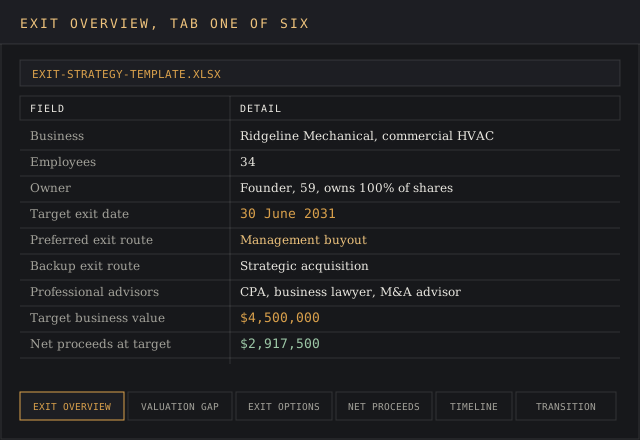
Get the exit strategy template
An Excel workbook with six tabs that turn a business exit plan into numbers: exit overview, valuation gap, exit options scorecard, net proceeds, milestone timeline, and a transition and contingency plan. The worked example comes pre-filled.
Download XLSXAn exit strategy template is the written plan for how a business owner leaves the business: who buys it, at what price, by which date, and what happens to the employees, the customers and the owner's own money afterward. This one is a six-tab spreadsheet that turns each of those questions into a number a buyer, a lender or a family member can check.
This page covers the types of exit open to a private business, what goes in each tab of the file, how to fill it in step by step, and a full worked example: a fictional 34-employee HVAC contractor closing a $1,220,000 value gap over five years before a management buyout. It closes with the exit strategy mistakes that cost owners the most and a short FAQ.
It's built for company owners of private, owner-run firms planning a sale or handover within the next decade, and for founders writing the exit strategy section of a business plan for investors. Half of business owners have no plan to exit their business, according to William Buck's 2024 Exit Smart report, while 76% plan to exit within the next 10 years. A business exit strategy written down closes that gap, and the first draft takes an afternoon.
Download the free exit strategy template
Download the template (XLSX)Six tabs with the worked example pre-filled, covering the overview, valuation gap, exit options scorecard, net proceeds, timeline, and transition plan.
The workbook opens in Excel, Google Sheets, LibreOffice Calc and Apple Numbers. Every calculated cell is a plain formula, so the valuation gap, the option scores and the net proceeds recalculate the moment you replace the example values with your own business data.
What an exit strategy template is
A business exit strategy is the owner's plan for transferring ownership of the business and turning business value into personal wealth. The template is the written form of that plan: a structured blueprint that the business owner, a co-owner or business partner, and outside investors can all read the same way, and a roadmap that tells each of them what happens to the business in the future.
Ansarada's exit planning guide splits a business exit plan into three parts: exit goals, the exit strategy chosen (one or several, to cover different scenarios), and the supporting documents buyers will ask for in due diligence. This template keeps that order and adds the numbers each part needs. The core components:
- An executive summary: the exit route, the target date, the price and the people involved.
- A valuation baseline from an appraiser, and the gap between it and the price the owner needs.
- A side-by-side comparison of the exit routes open to the business.
- A net proceeds model that shows what reaches the owner's bank account after costs, debt and tax.
- A milestone timeline that ties each action to a date and a named person.
- A transition plan, plus a contingency plan for the business exit nobody schedules.
The same structure answers the "sample business plan with exit strategy" search. Investors reading a startup business plan want one section that says how they get their money back, through an acquisition, an initial public offering or a sale to a later investor. The Overview tab of this file is that section in table form, and it reads well pasted into a pitch document.
Why business exit planning pays off
Business owner readiness is poor. William Buck's 2024 report found 5 of 10 business owners have no plan to exit, down from 6 in 10 a year earlier. The Exit Planning Institute's 2022 Colorado State of Owner Readiness report, built on a survey of over 400 owners, found 65% had no formal or written transition plan.
Selling is also harder than many owners assume. DealRoom, citing an Exit Planning Institute survey, reports that only 2 out of 10 businesses listed for sale close a transaction, and about half of those close only after the seller makes large concessions. A successful sale is the exception.
A written business exit plan changes three things. It sets a price target from a valuation, it buys time to fix what drags that price down, and it lets the owner time the sale for tax. Wise's exit strategy guide notes that exit planning can reduce tax burdens later on, because the owner decides when the gain lands.
The benefits reach past the price. Owners who prepare early keep control of the timing, so they can sell into a strong market and maximize the result, and they hand buyers a business that runs without its founder. Each of those sits among the financial considerations buyers price in, and a stitch in time saves nine: in business exit planning the stitch is three years of clean books.
Types of exit and when each one fits
The scorecard tab compares the types of exit strategy side by side. Most company owners end up choosing between selling to an outside buyer, selling to insiders, or closing the doors, and the table below covers the eight routes a business exit strategy usually weighs.
| Exit route | Who buys | Fits when | Watch for |
|---|---|---|---|
| Strategic acquisition | A competitor, or a company in an adjacent market | The owner wants the top price and a clean break | Integration can reshape company culture fast |
| Sale to a financial buyer | Private equity or an investor group | Cash flow is steady and the management team stays | Earn-outs and a retained stake keep the owner tied in |
| Management buyout | The current management team | Leaders want ownership and can raise the money | Buyers usually need seller financing |
| Employee buyouts | A wider group of employees, often through a trust | The owner wants the business to stay local | Slower, with more legal paperwork |
| Family succession | Children or other family members | A successor is willing and able | Friction between family members inside and outside the firm |
| Initial public offering | Public market investors | The company is large and still growing | SEC registration and ongoing regulatory requirements |
| Acqui-hire | A company buying your people | The team is worth more to a buyer than the product | Little gets paid for assets or intellectual property |
| Liquidation | Asset buyers, piece by piece | A failing business with no buyer | The lowest financial return of any route |
Xero's exit guide says a merger or acquisition "often results in the highest sale price and a clean break", which is why strategic acquisitions get the lion's share of attention. Strategic acquisitions pay maximum value when the buyer can cut overlapping costs or sell its own products to your customers, which lets it maximize the price it can justify.
A management buyout, in DealRoom's definition, is a sale to the company's current management team, the people who already know the business, the customers and the process behind every job. Employee buyouts widen the same idea to a larger group of employees, and family succession hands ownership to the next generation.
The initial public offering is the exit most founders picture when they imagine hitting the jackpot. The SEC describes going public as an initial public offering in which the company sells shares to the public after filing a registration statement, and it then carries Exchange Act reporting duties for good, which puts the route out of reach for most owner-run firms.
An acqui-hire, per Wise, is a purchase made mainly to acquire talent, with products, assets and intellectual property a side issue. Liquidation sits at the bottom: Wise lists it as the option when a company is failing or underperforming, and Xero notes it typically yields the lowest financial return of any route because buyers pay only for the assets.
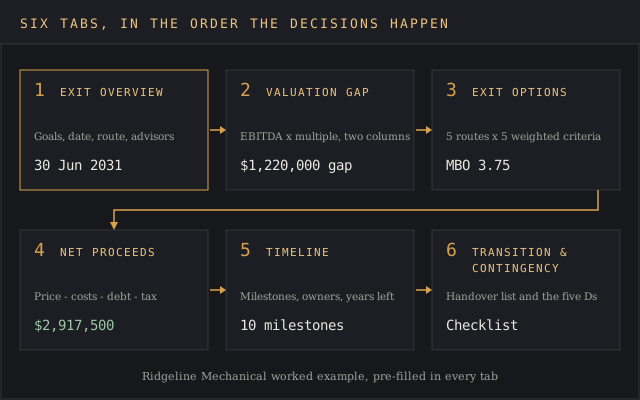
The six tabs of the business exit plan template
| Tab | What you enter | What it calculates |
|---|---|---|
| 1. Exit Overview | Business, owner, exit date, preferred and backup route, advisors | Pulls target value and net proceeds from the other tabs |
| 2. Valuation Gap | Adjusted EBITDA and multiple, today and at target | Current value, target value, value gap |
| 3. Exit Options | Five criteria weights, a 1-5 score per route | Weighted score and rank for each route |
| 4. Net Proceeds | Price, selling costs, debt, tax basis, tax rate, personal goal | Cash to the owner, selling today versus at target |
| 5. Timeline | Milestones, dates, owners, status | Years left before the exit date for each milestone |
| 6. Transition & Contingency | Knowledge transfer, post-close role, the five Ds | A checklist; no formulas |
The tabs follow the order the decisions happen in. You can't score exit routes until you know the value you're defending, and the exit timeline means little until the route is picked. Owners who already ran a SWOT analysis on the business can carry its weaknesses straight into the value improvement milestones.
How to fill in the business exit strategy template
Fill the tabs in order, one sitting per tab; the Overview tab is the quickest way to get the ball rolling. The seven steps below follow the same order as the workbook and help you develop a business exit strategy you can defend to a buyer.
- Write your exit goals. On the Overview tab, enter the date you want to hand over ownership, how long you'll stay involved after closing, and the net cash you need to meet your financial goals. Ansarada lists those decisions, plus any creditors or investors you must pay, as the first step.
- Get a professional business valuation. Vistage calls a credible valuation from a qualified appraiser the first step in any exit strategy. The SBA's guide to selling a business names the three standard methods used to determine value: income, market and asset approaches.
- Set the target and read the gap. Enter the earnings and multiple you aim to achieve. The value gap cell is the work list for the next few years.
- Score every exit strategy. Set the five weights first so they match your business goals and maximize what matters to you, then score each route 1 to 5, including the ones you dislike.
- Model net proceeds. Compare selling today with selling at target, net of costs, debt and tax. Ask your tax advisor for the rate; the 25% in the file is a placeholder.
- Create the timeline backward. Start at the exit date and work back, one milestone per row, each with a named person.
- Plan the handover and the contingencies. Fill in the last tab, then take the whole exit plan to your professional advisors (an accountant, a lawyer and an M&A advisor or broker) and prepare for due diligence.
Revisit the business exit plan every year. Vistage advises updating the valuation every 12 to 24 months while the plan runs, and each new valuation either shrinks the gap or sends you back to the drawing board on the milestones.
Worked example: a five-year business exit plan sample
Ridgeline Mechanical is a fictional 34-employee commercial HVAC contractor with $6.2 million in annual revenue. Its founder is 59, owns 100% of the shares, and wants out by 30 June 2031. This exit strategy is the scenario pre-filled in the download, so every figure below matches a cell in the file.
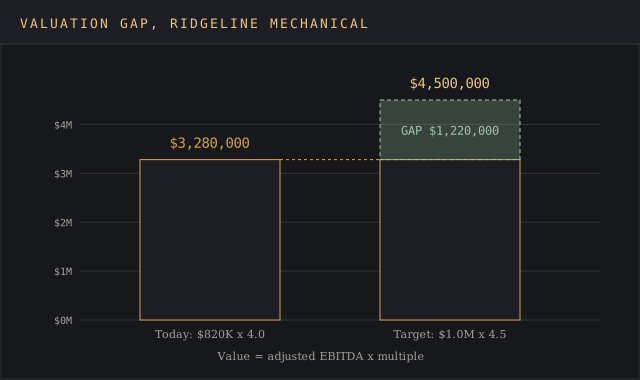
Valuation Gap tab. The appraiser normalizes the founder's salary and lands on adjusted EBITDA of $820,000, at a 4.0x multiple for a business this size that still leans on its founder. Current business value: $3,280,000. The target is $1,000,000 of EBITDA at a 4.5x multiple, or $4,500,000. The value gap is $1,220,000.
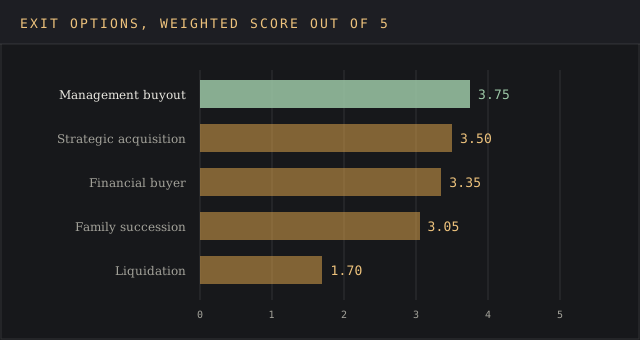
Exit Options tab. Five routes, scored 1 to 5 against five weighted criteria. The management buyout wins at 3.75 because the operations manager and two division leads want to buy, and the founder cares about keeping the 34 jobs local. A strategic acquisition by a regional competitor scores 3.50 and stays in the plan as the backup route.
| Criterion (weight) | Strategic | Financial buyer | MBO | Family | Liquidation |
|---|---|---|---|---|---|
| Price and financial return (35%) | 5 | 4 | 3 | 2 | 1 |
| Speed and certainty (20%) | 3 | 3 | 4 | 2 | 4 |
| Fit with the owner's post-close role (15%) | 3 | 3 | 4 | 5 | 1 |
| Employee and culture continuity (20%) | 2 | 3 | 5 | 4 | 1 |
| Tax efficiency (10%) | 3 | 3 | 3 | 4 | 2 |
| Weighted score | 3.50 | 3.35 | 3.75 | 3.05 | 1.70 |
Net Proceeds tab. Selling today at $3,280,000, after 6% selling costs ($196,800), $380,000 of debt payoff and $645,800 of estimated tax on the gain over a $500,000 tax basis, leaves the founder $2,057,400. The personal financial goal is $2,800,000, so selling today misses it by $742,600. The devil's in the details here: selling costs and tax take $842,600 out of a $3,280,000 price.
At the $4,500,000 target the same math gives $270,000 of selling costs, $932,500 of tax and $2,917,500 net, which clears the goal by $117,500. The $860,100 difference between the two columns is the business case for a five-year plan.
The value improvement plan does three things to close the gap. It grows service-agreement revenue from 22% to 40% of sales to create recurring income, it develops the operations manager into a general manager so the business runs without the founder, and it moves to CPA-reviewed financial statements from 2027, giving potential buyers three clean years before the 2030 letter of intent.
Exit timeline: when to start planning
Start planning a business exit years ahead. Xero puts business exit planning at three to five years of preparation plus at least one year for the sale process itself. Vistage says exit planning should begin 3 to 10 years before a sale or transfer. Wise, citing HSBC Innovation Banking, says the full exit strategy timeline should allow at least 2 to 3 years.
The binding constraint is usually the books. DealRoom advises a clean, well-maintained set of financial statements going back at least three years, and Vistage suggests owners prepare with a quality-of-earnings review 24 to 36 months before a sale so problems surface before buyers find them.
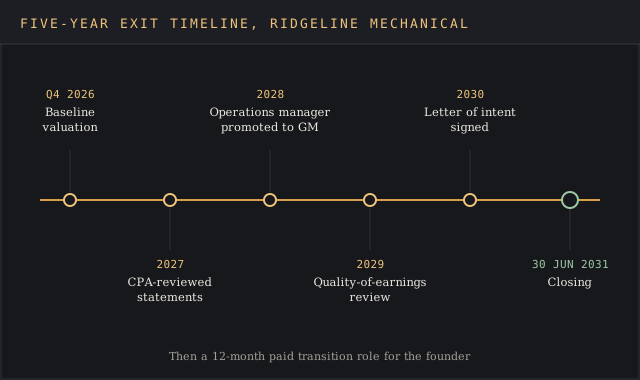
Ridgeline's milestones, as they sit on the Timeline tab:
- Q4 2026: baseline valuation; exit goals signed off with the founder's spouse and advisors.
- 2027: CPA-reviewed statements begin; service-agreement program launched.
- 2028: operations manager promoted to general manager; founder steps out of daily estimating.
- 2029: quality-of-earnings review; the MBO team meets lenders.
- 2030: updated valuation; letter of intent signed.
- 30 June 2031: closing, followed by a 12-month paid transition role.
Market conditions set the window too. Interest rates decide how much buyers can borrow to buy a business, and a sector downturn lowers the multiple an appraiser will apply. Keeping the backup route scored means a bad market year moves the date while the business exit strategy stays intact, and you can cross that bridge when you come to it with a plan already in hand.
Transition and contingency planning
The sale closes in a day, and the handover takes months. The transition tab lists what has to move from the owner's head to the new owners: top customer relationships, supplier contracts, the estimating method, licenses, and any intellectual property. It also records how long the owner will stay involved after closing, in what role, with how much control, and for what pay. A smooth exit process depends on that list being written before closing day.
Employee communication belongs here as well. The U.S. Chamber of Commerce exit planning guide tells owners to be empathetic and transparent with employees, and to introduce new owners to clients if the business continues. It adds that investors need a strategy telling them how they will be repaid, so list every party with a stakeholder map and get them on the same page about dates and payouts.
Contingency planning covers the exit nobody schedules. The Exit Planning Institute's five Ds are divorce, disagreement, disability, distress, and death, and DealRoom says a business exit strategy should be flexible enough to allow for unforeseen contingencies.
| The D | What it looks like | Ridgeline's contingency |
|---|---|---|
| Death | The founder dies before the sale | Buy-sell agreement funded by life insurance |
| Disability | The founder can't work for months | General manager holds signing authority; key-person disability cover |
| Divorce | A spouse gains a claim on the shares | Shareholder agreement; spouse signs off on the exit goals |
| Disagreement | The MBO team or a partner splits or stalls | Strategic sale stays scored as the backup route |
| Distress | A downturn or a lost anchor customer | Liquidation floor value from the asset appraisal; six months of cash reserve |
For a scored version, rate each D by likelihood and impact in a risk assessment matrix and carry the top two into the timeline as milestones, so the future of the business never rests on one person's health.
Common exit strategy mistakes to avoid
Xero's guide lists five recurring exit strategy mistakes, and the template has a cell aimed at each one:
- Starting too late. In Xero's words, "Waiting until you're ready to leave means you've missed the window to maximise value." The Timeline tab forces the start date into view.
- Overestimating business value. Xero, citing ICAEW guidance, says sellers often target 6 to 7 times net profit while realistic prices land at 2 to 3 times. The Valuation Gap tab starts from an appraiser's number.
- Messy financial records. Buyers read three years of business financial statements, so the gaps show up during the due diligence process, when the price is already on the table.
- Depending on the owner. If every key customer calls the founder, that's a red flag to buyers: the buyer is buying a job, and the business is worth less. Create a second layer of management, develop it, and document the processes before selling.
- Ignoring tax implications. The U.S. Chamber warns that large asset sales within one tax year can trigger higher tax liabilities.
Add a sixth: one buyer and no backup. Putting all your eggs in one basket with a single interested party leaves the owner negotiating against nobody, which is why the scorecard keeps a second exit strategy alive until closing and the owner keeps control of the process.
Excel, Google Sheets, Word or Docs
The business exit plan file is a spreadsheet because the valuation gap, the weighted scores and the net proceeds are formulas. In Excel or Google Sheets they recalculate as you change an input, while a Word or Google Docs version would need retyping every time a number moves. When a lender or business partner wants a document, paste the Overview tab and the Net Proceeds summary into Word as tables, and that is your exit plan sample in narrative form.
The research behind an exit strategy needs its own tools. Owners who prepare a list of potential buyers can pull firm lists from company data providers, check comparable deals in PitchBook, and budget for the virtual data room a buyer's due diligence will run through.
FAQ
What should an exit plan include?
Exit goals, an appraiser's valuation, the exit routes considered and the one chosen, a net proceeds estimate, a milestone timeline, a transition plan, and a contingency plan for the five Ds. The six tabs of this template map to those parts.
How do you write an exit strategy?
A business exit strategy starts with the date and the cash you need. Value the business, score the exit routes, model what you take home, then build the timeline backward from the exit date. Review it every 12 to 24 months.
What is an exit strategy in a business plan?
The section that tells a company's investors how they get their money back, usually through an acquisition, an IPO or a sale of their stake. Early-stage plans keep it to a paragraph and a target range.
What are the five Ds of exit planning?
Divorce, disagreement, disability, distress and death, as the Exit Planning Institute lists them. Each one can force an exit, so the plan needs a written response to all five.
What are the most common exit strategies?
Strategic acquisitions, a sale to a financial buyer, a management buyout, employee buyouts, family succession, an IPO, and liquidation. Most owner-run businesses choose among the first four.
What is the most effective exit strategy for a business?
The exit strategy that scores highest against your own weights. A strategic sale often pays the most; a management buyout often keeps the company culture intact, and those benefits can outweigh a lower price. The scorecard tab settles it for your numbers.
Can you give an example of a business exit strategy?
Ridgeline Mechanical, above: a $4,500,000 MBO planned five years out, with a strategic sale as backup and $2,917,500 net to the founder. The download carries the full example.
Bottom line
Reach for this template when you own a private business and expect to leave it within ten years, or when an investor asks how they get paid back. It handles a sale, an MBO or a family succession, and the scorecard tells you which one fits your goals. A successful business exit strategy starts with the numbers on these six tabs.
A different business template fits a narrower question: a risk-benefit analysis for one go or no-go decision inside the plan, or an OKR tracker to run the value improvement milestones quarter by quarter once the exit plan is set.
Ridgeline's numbers carry the argument. Selling today nets the founder $2,057,400 and misses the goal; careful planning over five years nets $2,917,500 and clears it, and the only cost of starting early is an afternoon with the template, set against $860,100 of benefits.