Crystallized intelligence: definition, examples, and how market intelligence teams build it
 By Jan Suski. I go deep on every review, checking every number against its source and digging up details other coverage misses, a habit from six years of SEO and link building for tech companies. Bylines at Surfer, Brand24, and Senuto. How the scoring works.
The short version 11 points · 40 seconds
- 01Crystallized intelligence is stored knowledge you can applyRaymond Cattell named it in 1943
- 02Fluid reasoning builds the store that crystallized ability keepsCattell's investment theory ties the two
- 03Vocabulary peaks in the late 60s, processing speed at 18Hartshorne and Germine, nearly 50,000 people
- 04Word-knowledge and general-knowledge tests measure itWAIS-5 Verbal Comprehension, WJ IV Gc cluster
- 05Fluid reasoning reads a price cut, stored knowledge explains it20 minutes for one half, a minute for the other
- 06Everyday examples run from a second language to tax rulesPlus a competitor's pricing history
- 07Job knowledge tests predict performance better than ability tests.40 against .31 in a 2022 meta-analysis
- 08Domain knowledge predicted forecasts as well as reasoning did.22 each across 743 forecasters
- 09The analysts who know the most have the most to unlearnRichards Heuer, CIA, 1999
- 10Knowledge leaves the team with the analyst who holds itUS median job tenure was 4.1 years in 2026
- 11Reading and years in one domain raise crystallized intelligencePuzzle apps target fluid scores
Crystallized intelligence is the stock of knowledge and skills a person has already learned and can call up on demand: words, facts, concepts, methods, and the unwritten rules of a field. Psychologists set it beside fluid intelligence, the ability to reason through problems you've never seen, and treat the pair as the two pillars of adult intelligence. Crystallized intelligence grows with age and education. Fluid intelligence peaks early.
This guide covers the psychology first: the definition, where Cattell's theory came from, how the two types of intelligence differ, how crystallized intelligence is measured, and what the age research shows. The second half moves the construct into a market intelligence team, where an analyst's stored understanding of a market decides how fast a signal gets read & how often it gets read wrong.
It's written for market intelligence analysts, research leads and hiring managers, plus students who need the textbook definition with its sources. The stakes are practical: the knowledge a 10-year analyst carries is the part of the job a reasoning test can't see and a resignation letter takes with it.
What crystallized intelligence is
Crystallized intelligence (Gc in the research literature) is the ability to use previously acquired knowledge to solve problems.
It's one of the two types of intelligence in Cattell's theory, and the one that education feeds most directly. In problem solving it supplies the starting point: the formula, the precedent, the known answer to a similar question. People with a large store solve problems in familiar territory by recognising them.
It covers declarative knowledge, meaning facts you can state, and procedural knowledge, meaning methods you can run. Word knowledge is the textbook example of crystallized learning, because every word a person knows was learned once and then stored in long term memory.
Raymond Cattell split general intelligence into two parts in a 1943 Psychological Bulletin paper on adult intelligence, pages 153 to 193 of volume 40. He tested the theory twenty years later in "Theory of fluid and crystallized intelligence: A critical experiment", published in the Journal of Educational Psychology (volume 54, pages 1 to 22).
The critical experiment used factor analysis to show the two cognitive abilities separating into distinct factors.
In Cattell's theory, the word "crystallized" describes the mechanism. Reasoning ability, applied to schooling, culture & experience, sets into a fixed body of knowledge, the way a solution sets into crystals. That's why crystallized intelligence reflects education and culture so heavily: a person raised in one language and one school system crystallizes a different set of facts than a person raised in another.
Three features define it in cognitive psychology:
- It depends on prior learning. Nobody reasons their way to the capital of Peru or the meaning of "amortization"; somebody taught it to them once and they kept it.
- It's domain-specific. A cardiologist's crystallized intelligence and a commodities trader's barely overlap, even when both show the same ability on intelligence tests.
- It keeps growing through adulthood. Every year of reading, work, learning & social interactions adds to the store, so crystallized intelligence grows long after fluid intelligence has started to slip.
Educational psychology leans on the construct because most of what a school teaches is crystallized learning: concepts, definitions, and the understanding students are expected to keep. Developmental psychology leans on it because it's the one part of adult intelligence still rising decades after childhood.
Crystallized and fluid intelligence: how the two types of intelligence differ

Fluid intelligence is the ability to solve novel problems and engage with new situations with no help from stored knowledge: spotting the rule in a sequence, abstract thinking, logical reasoning, and holding several pieces of information in working memory at once. Crystallized intelligence is the ability to solve problems by retrieving what you already know.
One answers "what's the pattern here?" and the other answers "where have I seen this before?"
The two constructs feed each other. Cattell's investment theory holds that fluid intelligence is invested, through learning, into crystallized intelligence: children with strong fluid reasoning ability pick up new concepts faster through education and so build a bigger store.
Later the store pays back. Learning new concepts gets easier when there's a frame to file them in, and a reader with high crystallized intelligence in a field gets through a technical paper in a fraction of the time a novice needs.
| Dimension | Fluid intelligence | Crystallized intelligence |
|---|---|---|
| What it does | Helps solve novel problems and unfamiliar challenges | Solves problems with previously acquired knowledge and skills |
| Depends on | Working memory, processing speed, abstract thinking | Education, culture, reading, life experiences |
| Typical test | Matrix reasoning, Raven's Progressive Matrices | Word definitions, general knowledge, verbal similarities |
| Age pattern | Fluid intelligence peaks in early adulthood, then declines | Rises into middle age and holds into the 60s |
| Everyday example | Working out the controls of a rental car in a foreign country | Recalling the road rules you learned at 17 |
| Market intelligence example | Reading a competitor's first-ever product launch | Knowing that competitor cut prices before its last two launches |
Most real problem solving draws on fluid and crystallized intelligence together. An analyst handed an unfamiliar dataset uses fluid intelligence and working memory to work out its structure and crystallized intelligence to know which column matters. In everyday life they run in the same head, often in the same second, and individual differences between people show up in how much of each they bring.
Horn and Cattell's theory tied the decline in fluid intelligence to the physiological base of intelligence, the biological capacity and neurological health that lose ground with age, and the growth in crystallized intelligence to continued learning. Raven's Progressive Matrices, a test built to need no word knowledge at all, became the standard way to measure fluid intelligence.
How crystallized intelligence changes with age
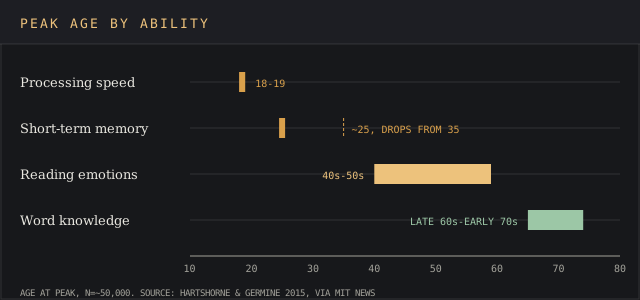
Crystallized and fluid intelligence age on different schedules. John Horn and Raymond Cattell reported the age differences in "Age differences in fluid and crystallized intelligence" in Acta Psychologica (volume 26, 1967, pages 107 to 129): fluid scores fell across adulthood while crystallized scores rose.
The largest modern dataset sharpened the timing. Joshua Hartshorne of MIT and Laura Germine of Massachusetts General Hospital tested nearly 50,000 people online and published the results in Psychological Science in March 2015.
According to MIT's summary of the study, processing speed peaked around age 18 or 19, short-term memory improved until about 25 and began to drop around 35, and vocabulary peaked in the late 60s or early 70s.
Older Wechsler data had put the word-knowledge peak in the late 40s. So the old line that human intelligence peaks in early adulthood only holds for fluid scores. Fluid intelligence peaks by the mid-20s on the measures Hartshorne and Germine tracked, while most young adults are still in education or a first job, and the fluid intelligence decline after that is gradual for decades.
Crystallized intelligence grows for another 40 years, then declines slowly.
Phillip Ackerman of Georgia Tech tested the claim that middle-aged adults are less intelligent than young adults. His research on 228 educated adults aged 21 to 62, published in 2000 in the Journals of Gerontology, found the middle-aged group knew more across many knowledge domains, with individual differences in interests tracking what each person knew.
Ackerman's PPIK theory (intelligence-as-process, personality, interests, intelligence-as-knowledge) treats that knowledge as the bulk of adult intelligence and credits its growth to interests and personality traits as much as to raw ability.
For a hiring manager that's a red flag. A test that measures only fluid intelligence will rank a 25-year-old above a 55-year-old category veteran every time, and miss the part of human capability that does most of the work in a knowledge job.
How psychologists measure crystallized intelligence
To measure crystallized intelligence, a test asks for knowledge the test-taker had to acquire through learning: word meanings, general facts, an understanding of how two concepts relate. The Wechsler Adult Intelligence Scale is the standard instrument for adult cognitive abilities. Its fifth edition, the WAIS-5, published by Pearson in 2024, covers ages 16 to 90.
Straight from the horse's mouth, Pearson's WAIS-5 overview builds the Verbal Comprehension Index from two subtests:
- Similarities: how two words or concepts are alike, which tests verbal reasoning ability over stored knowledge.
- Vocabulary: defining words, the purest crystallized measure on the battery.
Information (general knowledge questions) and Comprehension (social rules and practical judgment) sit in the same verbal domain as secondary subtests. The Fluid Reasoning Index runs on matrix reasoning and Figure Weights, which test the opposite ability: how well a person can solve a visual puzzle without leaning on anything they learned in education.
The full-scale IQ draws on 7 subtests and takes about 45 minutes. IQ is a composite score across several types of intelligence and cognitive abilities, and crystallized intelligence feeds one of its five primary indexes, next to fluid reasoning, working memory, processing speed and visual spatial ability.
The Woodcock-Johnson IV, published by Riverside Insights, measures crystallized abilities with different items. Per Riverside's WJ IV cognitive test descriptions, Test 1, Oral Vocabulary, has two subtests: Synonyms, where the examinee hears a word and gives one with the same meaning, and Antonyms, where they give the opposite.
Test 8, General Information, also splits in two. The Where subtest asks where an object is found; the What subtest asks what people do with given objects. General Information feeds the battery's Comprehension-Knowledge (Gc) cluster, the WJ IV's name for crystallized intelligence.
Every one of these items has the same shape: a question whose answer the examinee stored years ago or never stored at all. That shape transfers to a market team. A 20-question quiz built from the team's own battlecards (which vendor bought which, which plan tier caps seats, which metric a competitor stopped reporting) measures an analyst's crystallized knowledge of one category the way General Information measures it for everyday objects.
Batteries that score fluid and crystallized intelligence separately share two limits. The word and general-knowledge subtests reward the culture and education system the test was written in, so a fluent second-language speaker can understate their knowledge. And general intelligence tests carry no domain knowledge: the WAIS has no subtest for freight rates or SaaS pricing models, which is why employers build their own job knowledge tests.
A worked example: fluid and crystallized intelligence on one market problem
Take one problem every competitive team gets and split it by ability. A rival cuts the price of its entry plan by a third overnight, and it's a race against time: the head of sales wants to know by noon what it means. Two kinds of problem solving start at once.
The fluid intelligence half of the problem solving is working out what changed. The analyst compares the old and new pricing pages, holds four plan tiers and their limits in working memory, and uses logical thinking to infer which buyer segment the cut targets. A sharp new hire with no history on this rival can solve it in twenty minutes, which is why fluid intelligence carries new situations so well.
The crystallized intelligence half is knowing what it means. The veteran remembers that this rival cut entry prices once before, three months ahead of a funding round, and that the category's small-business buyers churn on price within two renewal cycles. That understanding came from years of learning the market, and the veteran can solve the second half in about a minute.
An analyst with high fluid intelligence and thin domain learning will solve the first half and guess at the second. An analyst with deep crystallized abilities and no curiosity about the new page will answer the second half from memory and miss that the cut only applies to annual contracts.
Teams that pair the two profiles on the same question get the best of both worlds, creativity on the new page and memory of the old ones, and the Mellers study of 743 forecasters backs the pairing with numbers.
Everyday examples of crystallized intelligence
Every example of crystallized intelligence in everyday life shares one trait: the answer is already in memory and only has to be retrieved. A few everyday examples, from the ordinary to the professional:
- Recalling facts off the top of your head on a quiz show, or knowing that Canberra is the capital of Australia.
- Reading a contract and knowing what "indemnify" commits you to.
- Speaking a foreign language you studied for six years.
- A mechanic hearing a noise and naming the failed part before opening the hood.
- A chess master recognising an opening and recalling the main lines that follow, a form of pattern recognition built from stored positions.
- An accountant applying the rules for depreciating equipment without opening the tax code.
- A market analyst seeing a rival's job ads for 30 sales reps in Germany and reading it as a DACH expansion, because the same rival ran that play in France two years earlier.
The last example is the one this site cares about. It's crystallized intelligence about one market, stored by one analyst, applied in seconds. Quick thinking gets the credit in the meeting, though the work was done two years earlier, when the analyst watched the France expansion unfold.
Why domain knowledge predicts job performance
For most knowledge jobs, what a person knows about the work predicts performance better than their reasoning ability. Frank Schmidt and John Hunter's 1998 meta-analysis in Psychological Bulletin made general mental ability the headline predictor of job performance for two decades. A 2022 re-analysis by Paul Sackett, Charlene Zhang, Christopher Berry and Filip Lievens in the Journal of Applied Psychology corrected for range restriction and reordered the list.
The revised estimates, as summarised by the Society for Industrial and Organizational Psychology: structured interviews at .42, job knowledge tests at .40, work sample tests at .33, and general cognitive ability at .31.
Job knowledge tests, for example, are crystallized intelligence measures for one domain. They beat general intelligence tests by .09.
That's the career success argument for crystallized intelligence in a nutshell. High crystallized intelligence in the domain you're paid to work in is worth more on the job than a high score on abstract puzzles, and it's the part of one's intelligence a person can keep adding to at 50. The importance for hiring follows: test candidates on the domain, then teach the rest.
What crystallized intelligence looks like in market intelligence work
A market intelligence analyst spends most of the day on problem solving with stored knowledge and new information. A competitor's pricing page changes; the analyst who knows the old page, the last three changes, and what followed each one reads the change in a minute. A new analyst with the same reasoning ability sees a number go up.
A new hire can learn the market intelligence fundamentals in a week and still need years to build up a rival's pricing history.
That stored understanding is crystallized intelligence in the strict sense of Cattell's theory: learned once, kept in long term memory, recalled on demand. It covers vendor histories, category concepts, which data sources overstate, which executives over-promise, and how a market moved the last time interest rates shifted. Most of the method in market intelligence analysis assumes the analyst already has it.
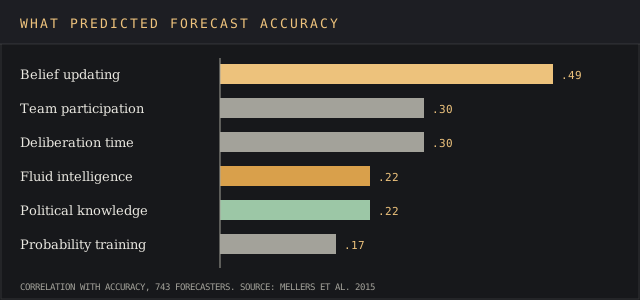
The best research evidence comes from forecasting. Barbara Mellers, Philip Tetlock and eight co-authors studied 743 forecasters who made predictions on 199 geopolitical questions between September 2011 and April 2013, producing more than 150,000 forecasts.
Their paper, "The Psychology of Intelligence Analysis" in the Journal of Experimental Psychology: Applied (2015), measured each forecaster's fluid intelligence with Raven's matrices and their political knowledge with a test of its own.
Fluid intelligence and domain knowledge both predicted accuracy, by the same margin: a correlation of .22 for the intelligence factor and .22 for the political knowledge factor. The intelligence advantage shrank with practice and learning, from .22 over the first 50 questions to .10 over the last 50.
Belief updating, meaning how often a forecaster revised a prediction as news arrived, correlated at .49, the strongest predictor in the study.
Read for a market team, the numbers say three things. Domain knowledge earns its keep. Raw reasoning ability, the fluid intelligence side, helps most at the start, before an analyst knows the ropes. And the knowledge only pays off when it's updated, which is why the .49 for belief updating beat every ability measure in the paper.
This is also why secondary market intelligence rewards tenure. Annual reports, filings & trade press are public to everyone; an analyst with ten years of them in memory can read between the lines of the eleventh in a way a newcomer can't.
When accumulated knowledge turns into a blind spot
The same store that speeds an analyst up can lock them in place. Richards Heuer wrote the warning into Psychology of Intelligence Analysis (CIA Center for the Study of Intelligence, 1999): "When faced with a major paradigm shift, analysts who know the most about a subject have the most to unlearn."
He made the same point twice more in the first two chapters. "Mind-sets tend to be quick to form but resistant to change," he wrote, and "an experienced specialist may be among the last to see what is really happening when events take a new and unexpected turn." His way to solve the problem kept the knowledge and changed the process: "Analysts do not achieve objective analysis by avoiding preconceptions; that would be ignorance or self-delusion."
A market example of the failure: a category veteran knows the three incumbents and how each reacts to price cuts. A fourth entrant arrives with a different cost structure, the veteran files it under "small player," tries to solve a new problem with old patterns, and the team misses the boat. Crystallized intelligence answers "where have I seen this before?" and the honest answer here is "nowhere."
The fixes are procedural, because adding facts to the same store makes the mind-set firmer. Assign one person per review to play devil's advocate against the house view, so different perspectives reach the table on schedule.
Run a win-loss analysis on every lost deal, because buyers describe a new competitor in words the team hasn't learned yet. Dates carry more importance than most teams assume: put one on every claim in a competitor battlecard, so a fact from 2023 can't pass for a fact from today.
Each of these forces cognitive flexibility on a process that would otherwise run on habit, and each buys a little creativity, because an argued-against view has to be rebuilt from different parts. They also make analysts engage with evidence that contradicts what they already believe, the one input a large store of crystallized intelligence filters out by default.
How a market intelligence team builds and keeps crystallized knowledge
An individual's crystallized intelligence leaves when they do.
The US Bureau of Labor Statistics' employee tenure release of September 2026 put median tenure for wage and salary workers at 4.1 years in January 2026. Workers aged 25 to 34 had a median of 3.0 years; workers aged 55 to 64, 9.6 years. Management, professional and related occupations had the highest median, 4.9 years.
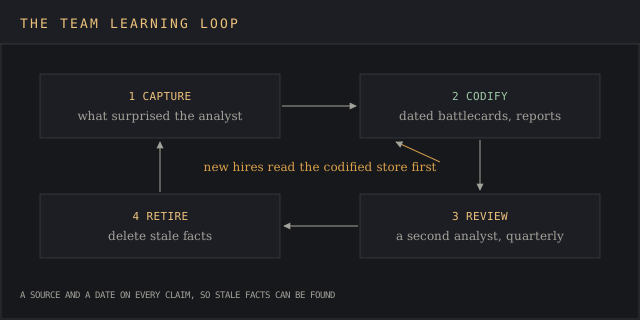
A team that relies on what lives in its analysts' heads therefore goes back to square one roughly every four to five years. The fix is to turn individual learning into team learning, written down as shared understanding the next hire can find.
A stitch in time saves nine here: an hour of documentation now replaces a month of a new analyst's learning by rediscovery, working out why a vendor's numbers can't be taken at face value. In practice that loop has four steps, and each one is cheap:
- Capture: after every briefing, the analyst writes three lines on what surprised them and why, which is the only moment the reasoning is still fresh.
- Codify: those lines go into a standard format, for example a market intelligence report template or a battlecard, with a source and a date on every claim, using the citation formats in our guide to data source attribution techniques.
- Review: once a quarter, someone other than the author has to engage with each competitor file and flag what no longer holds.
- Retire: a stale fact gets deleted outright, which nips a bad citation in the bud before it reaches a 2027 deck.
New hires should read the codified store before their first briefing. It's the part of a market intelligence strategy most teams skip until the senior analyst hands in notice.
Software helps with the capture and search steps. The platforms in our competitive intelligence tools ranking, Crayon and Klue among them, store battlecards, track competitor changes and push alerts, which handles the collection side of gathering market intelligence. Deciding which facts have gone stale stays with a person.
How to increase crystallized intelligence
Crystallized intelligence grows the way it was built: by learning things and keeping them. The concepts that stick are the ones a person uses, so the best learning plan for an analyst is the job itself, done with notes as a learning record. Consumer guides on the topic mix advice that adds knowledge with advice aimed at other cognitive processes, so it helps to sort the two.
Reading and structured learning add to crystallized intelligence directly, because the words, facts and concepts they supply are exactly what the Vocabulary and Information subtests count. Ackerman's PPIK theory points the same way: adults who keep up intellectual interests build more knowledge across domains.
For a market analyst, that means reading filings, earnings calls and trade press in one sector for years and learning to engage with the primary documents. A jack of all trades who skims ten sectors for a week each keeps little.
Teaching others is a learning method too. Explaining a market to a new hire forces an analyst to retrieve, order and check their understanding, and the gaps show up fast. Analysts who engage in social interactions with customers, sales reps and other analysts pick up knowledge no report carries, and adult learning that sticks usually comes from that kind of repeated use.
Puzzles and brain-game apps are a dime a dozen, and they sit with working memory training on the fluid side. Working memory drills are sold as a route to higher fluid intelligence scores; whatever they do there, the facts in long term memory stay where they were.
Mindfulness meditation is promoted for cognitive flexibility & working memory, which are again fluid-side cognitive processes. Guides also recommend getting enough sleep to protect cognitive function and memory, which keeps the existing store in working order.
Creativity draws on fluid and crystallized intelligence at once. A creative analyst combines stored facts (crystallized) in arrangements nobody has tried (fluid), so creativity in a market team depends on how much each person knows and how willing they are to recombine it. Analysts who solve the same problem the same way every quarter show high crystallized intelligence and low creativity, and a quarterly review by a second analyst is the cheapest correction.
FAQ
Is crystallized intelligence the same as IQ?
IQ is a composite score built from several cognitive abilities. On the WAIS-5, crystallized intelligence feeds the Verbal Comprehension Index, one of five primary indexes. A person can have high crystallized intelligence and an average full-scale IQ, or the reverse.
At what age does crystallized intelligence peak?
In Hartshorne and Germine's 2015 study of nearly 50,000 people, word knowledge, the standard crystallized measure, peaked in the late 60s or early 70s. Crystallized intelligence increases through middle age, holds steady into the 60s, and declines slowly after that.
What is the difference between crystallized intelligence and fluid intelligence?
The main differences: fluid intelligence is problem solving in new situations without stored knowledge, measured with matrix reasoning tasks. Crystallized intelligence is applying knowledge from past learning, measured with word-knowledge and general knowledge tests. Fluid intelligence peaks in early adulthood; crystallized intelligence keeps rising for decades.
In short, fluid intelligence is how you solve a problem you've never seen, and crystallized intelligence is how you solve one you have. Crystallized and fluid intelligence work together in most real tasks.
Which best describes crystallized intelligence?
Previously acquired knowledge, skills and understanding that a person can retrieve and apply: words, facts, concepts, procedures and domain rules. It depends on education, learning, culture and experience.
Can you give me an example of crystallized intelligence?
Examples from everyday life: defining a word, recalling a historical date, speaking a language you studied, or a market analyst knowing that a competitor raised prices after each of its last three funding rounds.
What is the rarest type of intelligence?
Cattell's theory names two types of intelligence, and everyone has both fluid and crystallized intelligence. Standard intelligence tests report each index separately and rank none of the types of intelligence by rarity; a high score on both in one domain is the uncommon profile.
Bottom line
Of Cattell's two types of intelligence, crystallized intelligence is what a person has learned and kept, and fluid intelligence is the reasoning that got it there. Cattell's 1943 Psychological Bulletin paper separated fluid and crystallized intelligence, Horn and Cattell showed in 1967 that the two age differently, and the modern data put the word-knowledge peak in the late 60s, decades after fluid intelligence starts to slide.
For a market intelligence team, crystallized understanding of the market is the main asset and the main risk. It predicts job performance better than raw reasoning ability and gives an analyst the ability to read a signal in minutes. It also hardens into the mind-sets Heuer warned about, and it walks out the door every four years or so.
Get this wrong and the team pays twice: once when a veteran files a new entrant under an old pattern, and again when that veteran leaves and the next hire starts from scratch. Write the knowledge down, date it, review it, and make someone argue against it; that's also where a team's creativity comes from.