Fluid intelligence: definition, examples, and how it's measured
 By Jan Suski. I go deep on every review, checking every number against its source and digging up details other coverage misses, a habit from six years of SEO and link building for tech companies. Bylines at Surfer, Brand24, and Senuto. How the scoring works.
The short version 11 points · 40 seconds
- 01Fluid intelligence is reasoning on problems you haven't metCattell named it in 1963, testing 277 pupils
- 02Crystallized intelligence is the knowledge already storedCattell's investment theory links the two
- 03A matrix puzzle and a new pricing model both test itNeither one can be answered from memory
- 04Pattern tests measure it with the words stripped outRaven's 2 covers ages 4 to 90
- 05The WISC-V reports a separate Fluid Reasoning IndexMatrix Reasoning plus Figure Weights
- 06Some reasoning tests peak at 22, with a drop by 27Salthouse, about 2,000 adults over 7 years
- 07Vocabulary and general knowledge keep rising to 60Same University of Virginia dataset
- 08Brain training raises the trained task and little else87 publications, no reliable far transfer
- 09Lumos Labs paid the FTC $2 million in January 2016Ads promised gains at work and school
- 10Novel market signals load on fluid intelligenceRoutine reads run on stored category knowledge
- 11Analyst hiring has to test reasoning and market knowledgeA matrix score can't tell who sells what
Fluid intelligence is the capacity to solve problems you haven't seen before, using logic and pattern-spotting in place of anything you've memorized. Psychologists set it against crystallized intelligence, the stock of facts and skills you've already built up. The guide is written for analysts, research leads and anyone hiring for a market intelligence team who wants the psychology straight, with the sources linked.
This page covers the definition as Cattell framed it, real examples, the intelligence tests that measure it, the age curve, and what the evidence says about training it. The last part ties it to market intelligence work, where an analyst switches between the two all day.
What fluid intelligence is
Fluid intelligence refers to reasoning that works on new material, the problem solving people use in novel situations: spotting a rule in a set of shapes, inferring a pattern from a few data points, holding several possibilities in working memory and testing them. Psychologists write it as Gf. It's one of the cognitive abilities nearly every modern model of human intelligence includes.
The term comes from Raymond Cattell. His paper Theory of fluid and crystallized intelligence: A critical experiment, published in the Journal of Educational Psychology in 1963, tested 277 seventh and eighth graders on 12 measures:
- Eight Thurstone tests of verbal, spatial, reasoning & number ability
- Four culture-fair tests of series, classification, matrices and topology, where classification items tap categorical thinking
The culture-fair tests mattered for the critical experiment. They used visual stimuli with no words, so a child's ability to solve them leaned on reasoning in the moment, with little help from previously acquired knowledge or previous knowledge of the format. That isolates cognitive abilities from schooling. Cattell found those four tests clustered apart from the vocabulary-heavy ones, which is the split the theory predicted.
So fluid intelligence involves three things working together: abstract reasoning, working memory and processing speed. Take away the prior knowledge and what's left is how fast and how well someone builds mental representations of a problem they've never seen and runs mental operations on them.
Fluid and crystallized intelligence in Cattell's model
Crystallized intelligence is the other half. It's accumulated knowledge: vocabulary, facts, procedures, the rules of a game you already play. Vocabulary tests and general-knowledge questions measure acquired knowledge, so they score crystallized intelligence: the answer depends on what you've learned.
In Cattell's model they're considered separate abilities that still depend on each other. In his later book, Abilities: Their Structure, Growth, and Action, he set out an investment theory: fluid intelligence gets invested in learning, and what's learned becomes crystallized abilities. It's a theory of cognitive development. A student who reasons well through algebra once ends up knowing algebra.
Both sit under general intelligence, the g factor that shows up when scores on unrelated tests correlate. Most intelligence tests report a composite measure of g, then break it down into indexes for crystallized and fluid intelligence, working memory and speed. General intelligence is the shared part; the cognitive skills and cognitive processes below it are the rest. Cognitive psychology, educational psychology and experimental psychology all use the split.
The practical difference between the two types of intelligence is easy to see. Crystallized and fluid intelligence answer different questions: what do you know, and what can you work out? An analyst who knows the ropes in one market leans on the first; the same analyst dropped into an unfamiliar sector, a fish out of water, leans on the second.
| Dimension | Fluid intelligence | Crystallized intelligence |
|---|---|---|
| What it is | Reasoning on problems you haven't seen | Knowledge already stored: vocabulary, facts, procedures |
| Typical test items | Matrices, series, classification, Figure Weights | Vocabulary, general information, comprehension |
| Named measures | Raven's 2, WISC-V Fluid Reasoning Index | Vocabulary and information subtests in the same batteries |
| Age curve (Salthouse, 2009) | Top scores on some tests at 22, a measurable drop by 27 | Still rising at 60 |
| Response to training | Trained task improves; no reliable far transfer (2016 meta-analysis) | Grows with learning, per Cattell's investment theory |
| Market intelligence task | A competitor's new pricing model | A quarterly share update |
Fluid intelligence examples in everyday problem solving
Most examples of fluid intelligence share one trait: the person can't solve the task off the top of their head from memory, so they have to reason. A few common ones:
- Completing a 3 by 3 grid of shapes where the last cell is missing and the rule has to be inferred
- Learning the rules of a board game nobody at the table has played, with no previous knowledge to lean on
- Working out a math word problem that doesn't match any memorized formula
- Fixing software you've never opened through logical thinking about what each setting does
- Reading a competitor's new pricing page and inferring the model behind it
The last one is a fluid intelligence example drawn from market intelligence work. When a vendor switches from per-seat to usage-based pricing, there's no prior benchmark to look up. The analyst has to infer the relevant features, map the identified features to buyer segments and estimate what a typical account pays, which is how pricing intelligence works in its first week on any new model.
Signs of higher fluid intelligence follow from the same definition: quick pattern-spotting, abstract thinking, mental flexibility when the first approach fails, and comfort with complex problems that have no worked example. Lower fluid intelligence scores show up as slower progress once a task stops matching anything familiar.
How intelligence tests measure fluid intelligence

Psychologists measure fluid intelligence with tasks built from unfamiliar visual material, so prior knowledge can't carry the score. Three test families do most of the work.
Best known is the Raven's Progressive Matrices test. Each item tests spatial organization: a grid of patterns with one cell missing, and the test-taker picks the piece that completes it. Pearson describes Raven's 2, the second edition, as a nonverbal test for ages 4 to 90, with paper and digital forms.
The Wechsler Intelligence Scale for Children reports fluid reasoning as its own index. Pearson's WISC-V, published in 2014 for ages 6:0 to 16:11, splits the old WISC-IV perceptual reasoning index into a Visual Spatial Index and a Fluid Reasoning Index. The complete print kit lists at $1,679. The fluid score comes from two subtests:
- Matrix Reasoning, carried over from the WISC-IV
- Figure Weights, new in the WISC-V
Woodcock-Johnson batteries cover fluid intelligence too, alongside crystallized abilities, under the Cattell-Horn-Carroll framework. Any matrix reasoning test in these batteries works on the same principle Cattell used in 1963: strip out words and the score tracks reasoning. To measure crystallized intelligence, the same batteries use vocabulary, general information and comprehension subtests.
Repeat testing is where the devil's in the details. A matrix item seen twice turns a measure of fluid intelligence into a memory test, which is why Pearson builds Raven's 2 digital forms from an item bank to limit overlap between test-takers.
When fluid intelligence peaks and declines

Fluid intelligence peaks in early adulthood. Timothy Salthouse at the University of Virginia followed about 2,000 healthy adults aged 18 to 60 for seven years, and the university's 2009 summary reported top performance on some tests at age 22.
By 27 the drop was measurable. It showed up first in abstract reasoning, processing speed and puzzle-solving, the tasks closest to fluid intelligence. Memory declines became detectable around 37, so the figure of 40 often quoted for the age fluid intelligence declines lags the data by more than a decade.
Crystallized intelligence runs the other way. Vocabulary and general knowledge in the Salthouse data kept rising until at least 60. The study measured performance, so it dates the decline without explaining the age-related brain changes behind it.
A larger dataset blurs the single-peak picture. Joshua Hartshorne & Laura Germine analyzed 48,537 online participants plus normative test data in Psychological Science in 2015. Some abilities peaked around high-school graduation, some held through early adulthood and fell in the 30s, and others didn't peak until the 40s or later.
Individual differences sit on top of those averages. The curves describe group means, so a 50-year-old with higher fluid intelligence than average can still outscore a typical 25-year-old on a matrix test.
Can you improve fluid intelligence?
The claim that you can improve fluid intelligence through brain training traces to one study. Susanne Jaeggi and colleagues trained adults on a dual n-back working memory task for 8, 12, 17 or 19 days, and reported in PNAS in April 2008 significant effects on a reasoning test, with gains growing with the number of training days.
Replications sent the idea back to square one. Monica Melby-Lervåg, Thomas Redick & Charles Hulme pooled 87 publications and 145 experimental comparisons in Perspectives on Psychological Science in 2016. Training reliably raised working memory scores right after the sessions.
Against an active control group, the meta-analysis found no convincing evidence of reliable gains on nonverbal ability, verbal ability, reading or arithmetic. Those are the far-transfer measures that would show a change in fluid intelligence.
Regulators reached the same place by another route. The FTC announced on January 5, 2016 that Lumos Labs would pay $2 million to settle charges over Lumosity ads, with a $50 million judgment suspended because of its financial condition. The ads claimed 10 to 15 minutes of play three or four times a week would improve performance at work and school.
Subscriptions ran $14.95 a month or $299.95 for life. Talk is cheap in a market priced like that, and the trial evidence shows trained tasks getting better while untrained reasoning tests stay put.
New experiences, aerobic exercise, sleep and mindfulness show up in most improvement lists. Deep and REM sleep support memory consolidation, exercise raises blood flow to the brain, and meditation trains focused attention. Each supports general cognitive skills. The jury's still out on any of them moving a matrix score.
Fluid intelligence in market intelligence work
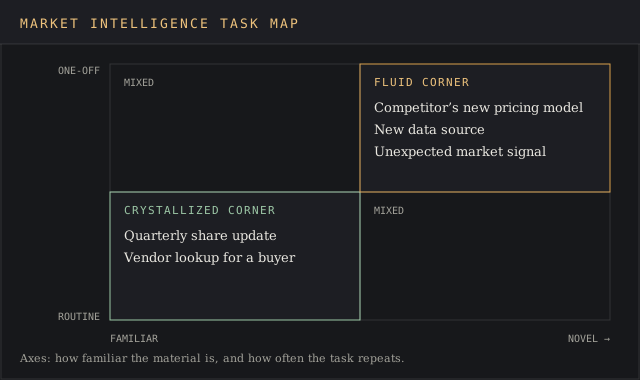
In the business world, market intelligence is a field that runs on both types of intelligence. The job data puts a number on the role.
The US Bureau of Labor Statistics counts 952,700 market research analyst jobs, at a May 2025 median of $78,760, and lists analytical skills and critical-thinking skills among the four qualities the role needs.
Those two qualities map to Cattell's split. Analytical work on a familiar market leans on crystallized intelligence, the accumulated knowledge of the category: which vendors sell what, how the category prices, what last year's numbers looked like. Critical thinking on a market that has just changed leans on fluid intelligence, because no stored answer fits.
Routine tasks sit in the crystallized intelligence corner. A quarterly share update, a secondary market intelligence pull from known sources, or a vendor lookup for a buyer runs on what the analyst already knows. Speed there comes from memory.
Novel tasks sit in the fluid corner. A new data feed with unfamiliar fields needs data source attribution before anyone trusts it. A spike in real-time market intelligence feeds is one of the unexpected stimuli the job throws up with no playbook, and finding the signal is a needle in a haystack until the analyst works out the rule behind it.
The market intelligence analysis process is where the two meet. The analyst starts by identifying patterns with fluid intelligence, then checks them against stored knowledge of the category. Reading between the lines of a competitor's job ads is fluid work; knowing which roles that competitor usually hires is crystallized intelligence.
That's also why the market intelligence analyst role suits a mixed team. The UVA age curve gives young adults on the team the edge on raw pattern speed; older analysts hold the vocabulary of the market, which kept rising to at least 60 in the same data.
Testing both halves when hiring analysts
A fluid intelligence test alone misses the mark for analyst hiring. A strong matrix score shows how someone handles novel problems. A sector's vendors, buyers and price points sit outside what it measures.
The reverse fails too. A candidate high in crystallized intelligence who knows every vendor in a category but can't solve problems outside it will stall the first time the category changes. A balanced loop tests fluid and crystallized intelligence together, in three parts:
- A short reasoning task, such as inferring a pricing model from a page the candidate hasn't seen
- Questions on the market itself: who sells what, to which buyers, at what price
- A case that tests cognitive flexibility once the first approach stops working
The market intelligence fundamentals page covers the knowledge side: product, customer & market understanding. The market research methods page covers the procedures an analyst learns once and then applies, which is crystallized intelligence by Cattell's definition.
Tools shift the balance without removing it. The platforms in the competitive intelligence tools ranking automate the lookups that used to take stored knowledge, which leaves more of an analyst's week on the novel cases. A team's market intelligence strategy should plan for that mix.
FAQ
What is a good example of fluid intelligence?
Solving a Raven's matrix item is the textbook fluid intelligence example: a grid of shapes with one cell missing and a rule you have to infer. In work, inferring a competitor's new pricing model from its public page uses the same reasoning.
What is the difference between fluid and crystallized intelligence?
Fluid intelligence is reasoning on problems you haven't seen; crystallized intelligence is knowledge you've already stored. In the Salthouse data, fluid measures peaked around 22 while vocabulary kept rising to at least 60.
Is fluid intelligence the same as IQ?
IQ is a composite score across several indexes, and fluid reasoning is one of them. The WISC-V reports five: verbal comprehension, visual spatial, fluid reasoning, working memory and processing speed.
What is the peak age for fluid intelligence?
Salthouse found top performance on some reasoning tests at 22 and a measurable decline by 27. Hartshorne and Germine's 48,537-person dataset shows different abilities peaking at different ages, some around high-school graduation.
How can I test my fluid intelligence?
A licensed psychologist can give a Raven's 2 or a full battery such as the Wechsler Intelligence Scale for Children (WISC-V). Free online matrix puzzles give a rough read, though they aren't normed the way the published tests are.
How do you practice fluid intelligence?
Practicing on new puzzles raises your score on those puzzles. The 2016 meta-analysis of 87 publications found working memory training didn't transfer to reasoning tests against an active control, so variety in real problems is the honest advice.
Bottom line
Fluid intelligence is reasoning without a stored answer, the first of Cattell's two types of intelligence. Cattell separated it from crystallized intelligence in 1963 with culture-fair tests, and the split still runs through Raven's 2 and the WISC-V Fluid Reasoning Index.
It peaks in the early 20s and declines from the late 20s, while crystallized intelligence keeps climbing for decades. Brain training raises scores on the trained task, and the 2016 review of 87 publications and the $2 million FTC settlement both cap what a buyer should expect past that.
For a market intelligence team, the cost of ignoring the split is concrete. A team hired only for stored category knowledge stalls the first time a vendor changes its pricing model. A team hired only on matrix scores spends the opening weeks of every project re-learning who sells what.