Top 10 purchase requisition software tools for 2026
 By Jan Suski. I go deep on every review, checking every number against its source and digging up details other coverage misses, a habit from six years of SEO and link building for tech companies. Bylines at Brand24 and Senuto. How the scoring works.
· Prefer this source on Google
Purchase requisition software compared
Requester seats decide most of the bill, so that column sits next to price.
| # | Provider | Requester seats | Entry price | Best fit |
|---|---|---|---|---|
| 1 | Procurify | Unlimited basic users | Quote; Vendr median $15,000/yr* | Mid-market teams with many requesters |
| 2 | Precoro | Tier-based | $499/mo, billed annually | Teams that want a published price |
| 3 | ProcureDesk | 10 included, $20/mo per extra user | $830/mo ($9,960/yr) | QuickBooks and Xero shops of 100 to 1,000 staff |
| 4 | Zip | Quote | Vendr median $88,000/yr (75 purchases)* | Enterprises routing legal and security review |
| 5 | Ramp Procurement | Per-user Plus plan | AI Intake free; add-on to Plus at $15/user/mo | Companies already on Ramp cards |
| 6 | Coupa | Quote | Vendr median $95,000/yr (127 purchases)* | Large enterprises across 50+ countries |
| 7 | ProcurementExpress | Plans capped by monthly spend | $415/mo for up to $10k/month spend | Small organisations and 501(c)(3) nonprofits |
| 8 | Kissflow Procurement | User-based tiers, quote | Quote, fixed annual agreement | Teams that want low-code form changes |
| 9 | Tradogram | 1+ users, fee per extra user | $99/mo; requisitions are an add-on | Small teams that need POs first |
| 10 | SAP Ariba | Quote | Vendr median $61,513/yr (16 purchases)* | Companies already running SAP |
Medians marked * are anonymized buyer-reported contract values published by Vendr. Everything else is the price the vendor publishes itself.
Where these figures come from
Entry prices, seat rules and go-live windows are each vendor's own published figure, read on 16 October 2026. The four medians marked * are Vendr's anonymised buyer-reported contract values for Procurify, Zip, Coupa and SAP Ariba. User quotes come from TrustRadius, Capterra and Gartner Peer Insights and link to the review page.
Kissflow publishes no price, Ramp publishes none for its procurement add-on, and Precoro publishes no seat count per tier, so no row invents one.
Two sibling pages cover adjacent ground: the AI procurement software ranking for sourcing and contract tools, and the procurement intelligence ranking for supplier and market data. This page stays on the requisition process itself.
Purchase requisition software turns an employee's internal request for goods or services into an approved purchase order, with budget control and an approval workflow in between. The ten tools below range from $99 a month to a $95,000 annual median, and the gap between them comes down to five things a buyer can test before signing.
This ranking covers requisition management for finance teams & procurement teams at companies from 20 to 50,000 staff. Every price links to the vendor's own pricing page or to Vendr's anonymised buyer data, and every entry carries at least one verbatim quote from a user.
Prices moved this year, so last year's price comparison is water under the bridge. Precoro now starts at $499 a month on annual billing, ProcureDesk at $830, and Ramp sells procurement as an add-on to its Plus plan. Figures below were checked on 16 October 2026.
Evaluation criteria for purchase requisition software
Five criteria decide the shortlist, and the ranking below applies them in this order. Each one returns a yes, a no, or a number from a public page.
Cost of adding a requester
Count what one more employee who can raise purchase requests costs per month. Procurify publishes unlimited basic users; ProcureDesk publishes $20 per extra user past 10. A tool that charges per requester pushes companies to share logins, and shared logins break the audit trail.
Published entry price or a Vendr median
Either the vendor prints a number, or Vendr's anonymised purchase data gives a median with a purchase count. A median from 127 purchases carries more weight than one from 16.
Approval routing rules in the entry tier
Check the pricing page for routing by dollar threshold, department, budget or preferred vendors, and confirm it ships in the cheapest plan. Tradogram's Essentials plan lists custom approvals as an add-on; Precoro's Core plan includes rules that automate approvals.
Native accounting and ERP connectors
Count the accounting systems and ERPs named on the pricing page as native connectors. Four named connectors in the base plan beat two plus a Zapier link, because the approved purchase requisition has to reach accounts payable as a coded bill with no second round of data entry.
Ask how the purchase requisition software integrates with each one, field by field, because the devil's in the details.
Published go-live window
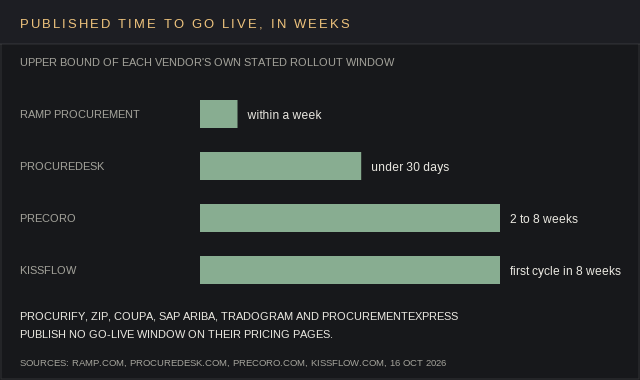
Take the vendor's own stated rollout time in weeks. Ramp says most teams are live within a week; Kissflow says the first full cycle runs in eight weeks.
The 10 best purchase requisition software tools, ranked
Procurify
Best fit
A mid-market finance team with 50 or more people who need to submit purchase requests but won't approve anything.
Procurify is purchase requisition management software built around order requests, purchase orders, catalogs and vendors, with AP and spend cards sold as separate products. Its pricing page says hundreds of finance and operations teams run "$100B+" through the platform.
The pricing model is the headline. Basic users, the people who request or receive items, are unlimited; only Pro users with approval and admin roles set the price. That one rule makes Procurify the cheapest way to put every employee in the requisition process without shared logins, all in one centralized system.
Key features
- Automated workflows for approvals, budgets, account codes and role-based permissions in the base Purchasing package
- Native connectors for QuickBooks, NetSuite, Sage Intacct and Microsoft Dynamics 365
- PunchOut catalogs, a platform API and a Spend Analyst module
- Mobile app for approvals, plus MFA, SSO and SOC 2 Type 2
- Implementation team, 24/5 support and a named Customer Success Manager
Pricing
Quote-based, built from products, add-ons, Pro users and integrations. Vendr's anonymised buyer data shows a median contract value of $15,000 a year, with a range of $4,210 to $40,000.
Pros
- Unlimited requesters, so the entire company can submit purchase requests
- Four named accounting connectors in the base package
- Temporary approver delegation for staff on leave
Cons
- No published price; the quote depends on Pro user count
- Budget setup expects the fiscal year's budgets loaded on day one
- AP and spend cards cost extra on top of Purchasing
The mobile approval flow is the feature reviewers name. An executive at a 51-200 employee company wrote on TrustRadius on 23 November 2021 that "Approvals are routed to approvers (I approve on my mobile phone anywhere in the world)." The budget rule draws the sharpest complaint:
"Not requiring a budget to start the new year. We never have our budgets ready by 1/1."
Controller, Finance and Accounting, Premium Parking, TrustRadius, 1 March 2021
Why it’s ranked #1. It wins the first criterion outright: unlimited basic users against Precoro's tier-based seats, and four named accounting connectors against Precoro Core's two. A $15,000 Vendr median keeps it within reach of mid-market budgets.
Precoro
Best fit
A company of 20 to 500 people that wants a printed price and unlimited documents before it talks to sales.
Precoro is requisition software with a public price list, which is rare in this category. Its homepage claims 1,000+ customers in 80+ countries and $150B in spend managed, and puts typical go-live at 2 to 8 weeks.
Key features
- Unlimited documents on every plan, covering purchase requests, purchase requisitions and purchase orders
- Automated approvals, plus Slack and Microsoft Teams approval notifications
- Real-time budget tracking on the Automation plan
- QuickBooks Online and Xero on Core; NetSuite, Sage Intacct and Business Central named on the site
- Mobile app on every plan
Pricing
Core starts at $499 a month and Automation at $999 a month, both billed annually, per Precoro's pricing page. Enterprise is custom. Keep an eye on the AP module, which starts at another $499 a month.
Pros
- Published entry price of $499 a month
- Unlimited documents, so a busy month doesn't change the bill
- Approval roles per colleague set in just a few clicks
Cons
- User limits are "Tier-based" with no published seat count
- Real-time budget control starts at the $999 Automation plan
- Comments and attachments on a requisition don't carry onto the PO
A marketing manager at a 51-200 employee company praised "Fast approvals with specific roles for colleagues" on TrustRadius on 13 June 2022. An account manager at a 1-10 person firm flagged the handoff gap:
"All notes & comments and documents submitted in PR were not flow thru to the PO so we need to attach the docs"
Account Manager, Finance and Accounting, TrustRadius, 1 December 2022
Why it’s ranked #2. Its $499 entry price undercuts ProcureDesk's $830 by $331 a month with unlimited documents. It trails Procurify because seats are tier-based and Core names two accounting connectors against Procurify's four.
ProcureDesk
Best fit
A company of 100 to 1,000 staff on QuickBooks, Xero or Bill.com that wants requisitions, receiving and invoices in one plan.
ProcureDesk prints three tiers and the user math behind them. Its product page says most teams implement in less than 30 days, and that budgets can be set by vendor, spend category, department, individual or project.
Key features
- Requests, POs, receiving and invoices with basic three-way matching and OCR on Startup
- Purchase requests approved by desktop, mobile app, email or Slack
- Budget hierarchies with tolerance levels and rules for requests with no budget
- Month-end close lock and a complete audit trail on Growth
- Supplier onboarding with EIN and W-9 collection on Growth
Pricing
Startup is $830 a month, billed annually at $9,960, with 10 users and $20 a month per additional user. Growth is $1,250 a month ($15,000 a year) with 20 users. Enterprise is custom with unlimited requisitioners, per ProcureDesk's pricing page. The seat math isn't rocket science: a 25-user team on Startup pays $1,130 a month.
Pros
- Every user cost is published, down to $20 per extra seat
- Budget checks deny over-budget orders and tell the buyer why
- 15% discount for nonprofits and charter schools
Cons
- SSO and 2FA sit on Growth, not Startup
- Unlimited requisitioners need the custom Enterprise tier
- Invoice sync errors after approval appear in reviews
Jeremy, in biotechnology, wrote on Capterra on 14 October 2025 that "Ease of use was the first things I noticed when I started setting up ProcureDesk." A construction reviewer was blunter:
"we're paying for software that only partially handles invoice approvals and even that feature is flawed."
Laura, Construction, Capterra, 20 October 2025
Why it’s ranked #3. At $9,960 a year it costs about a ninth of Zip's $88,000 Vendr median and publishes a 30-day rollout. It loses to Precoro on the $331 monthly gap and on seats capped at 10.
Zip
Best fit
An enterprise where a single software request needs legal, security and finance sign-off before a purchase order exists.
Zip calls itself intake-to-procure: employees file purchase requests through one front door, and Zip routes each one through every reviewer in the procurement process, so legal, security and finance end up on the same page. Its homepage claims $1T in spend processed and $10.5B in platform savings, with OpenAI, Snowflake and T-Mobile among named customers. Our Zip review covers the platform in more depth.
Key features
- Guided intake that collects a request once and sends it to each reviewing team
- AI agents for request review, listed on the homepage without a count
- A Forrester TEI study citing 386% ROI over three years and 70% cycle-time reduction
- Invesco runs $1.1B in managed spend with a 19-person team, per Zip
Pricing
Quote-based. Vendr's data across 75 purchases puts the median at $88,000 a year, with a range of $26,586 to $214,750.
Pros
- Clears approval bottlenecks across several review teams
- Vendr purchase count of 75 gives a reliable price benchmark
- Named enterprise customers at $35B spend scale
Cons
- $26,586 Vendr floor rules out small companies
- Workflow customisation draws complaints from reviewers
- A 2026 review reports lost request data
A Gartner Peer Insights reviewer titled an 18 August 2026 review "Functional and Straightforward Intake Tool, But Lacks Flexible Workflow Customization." A one-star review posted eight days later reads:
"they lost all the work we submitted in the course of many hours"
Reviewer, Gartner Peer Insights, 26 August 2026
Why it’s ranked #4. It beats Ramp on enterprise intake depth, with $1T processed and a median priced across 75 purchases. It loses to ProcureDesk, which publishes its $9,960 price where Zip's median runs $88,000.
Ramp Procurement
Best fit
A company already paying for Ramp Plus that wants purchase requests, POs and card payments in one system.
Ramp built procurement on top of its corporate card, so approved requests can issue a card straight from the PO, killing two birds with one stone. Its procurement page says most teams are operational within a week and that AI Intake is free for every Ramp customer.
Key features
- Plain-language intake: Ramp turns an employee's description into purchase requests
- Uploading a quote pre-fills the intake form and starts approvals
- Routing requests in parallel by budget, department or vendor type, set in a no-code builder
- 2-way and 3-way matching with overbilling flags
- PO sync with QuickBooks Online and NetSuite; Ironclad, DocuSign, Jira and Vanta connectors
Pricing
Plus costs $15 per user a month plus a platform fee, and procurement is an add-on to Plus or Enterprise with no published add-on price, per Ramp's pricing page.
Pros
- One-week go-live, the shortest published window in this ranking
- Free AI Intake for all customers
- Per-employee spending limits on cards
Cons
- Procurement add-on price isn't printed
- PO sync names two accounting systems
- Permission setup confuses new admins
Jill, in construction, wrote on Capterra on 21 July 2026 that "The ability to monitor expenses for each employee and set spending limits is also invaluable." Stacey, in machinery, noted on 15 October 2025 that "The user account details and permissions were the one confusing part we ran into with setup."
Why it’s ranked #5. Its one-week go-live beats Coupa, which publishes no window and carries a $95,000 median. It trails Zip because procurement is a priced-on-request add-on and PO sync names two systems.
Coupa
Best fit
A multinational that needs requisitions in 30+ languages and benchmarking against other buyers.
Coupa is a full spend management suite, the whole nine yards, and requisitions are one module in it. Its procurement page says customers achieve average savings of 8.1% on total spend and cites "$6 trillion in real-world transactions" behind its community benchmarks. Read our Coupa review for the full suite.
Key features
- Guided, AI-driven intake and approvals for purchase requests
- Benchmarking from the Coupa Community transaction data
- Availability in 50+ countries and 30+ languages
- 4.8 on Gartner Peer Insights from 682 reviews, per Coupa
Pricing
Quote-based. Vendr's data across 127 purchases shows a $95,000 median and a range of $20,761 to $331,445 a year.
Pros
- Largest Vendr sample in this ranking at 127 purchases
- 8.1% average savings claim on total spend
- Financial control and spend visibility across business units
Cons
- $95,000 median is the highest here
- Reviewers find PO creation hard to learn
- Mobile app limits on expense reports
A manager of enterprise app architecture at a 5,001-10,000 employee company summed up the upside on TrustRadius on 5 June 2025: "Visibility and control over Spendings." A social impact program manager at Uber wrote on 6 February 2020 that "Many parts of Coupa are unclear, especially in the "how to create a PO,"" a complaint about the most basic step of the purchasing process.
Why it’s ranked #6. It beats ProcurementExpress on scale, with 127 Vendr purchases and 30+ languages. It loses to Ramp on cost: a $95,000 median against free AI Intake and a one-week rollout.
ProcurementExpress
Best fit
A small business or nonprofit spending under $10,000 a month through POs.
ProcurementExpress prices on spend managed, which no other tool here does, so it goes against the grain of seat-based billing. Its pricing page lists four tiers by monthly spend and a 14-day free trial with no credit card.
Key features
- QuickBooks on Basic; Sage 50 and Amazon punch-outs on Better
- Amazon plus 100+ store punch-outs and Scan & Match on Best
- Up to 5 organisations on Best, unlimited on Enterprise
- NetSuite, Dynamics and Okta/Azure on Enterprise
Pricing
Basic is $415 a month for up to $10k of monthly spend, Better $900 for up to $1m, Best $2,550 for up to $10m. Enterprise covers up to $50m and is quoted. 501(c)(3) nonprofits get special pricing on request.
Pros
- 14-day trial with full features
- No seat counting, so purchase requests from any staff member cost nothing extra
- Amazon punch-out for office supplies from the Better tier
Cons
- Basic caps managed spend at $10k a month
- Changes to setup often need tech support
- Jumping from $10k to $1m spend more than doubles the fee
Sam, at a nonprofit, called it "easy to navigate and simple to use" on Capterra on 13 January 2026. Christine, at a civic and social organisation, wrote on 9 June 2025: "The inability for us to make changes, we have to reach tech support."
Why it’s ranked #7. A printed $415 price and a 14-day trial beat Kissflow's quote-only model. It falls below Coupa because Basic stops at $10k of monthly spend and names one accounting connector.
Kissflow Procurement
Best fit
An operations team that wants to edit custom request forms and approval steps without a developer.
Kissflow sells procurement on its low-code platform, so forms, workflows and company rules change in a builder, and the operations team stays in the driver's seat. Its procurement page lists intake, requisition and approval, purchase orders, supplier management, goods receipt and three-way match as modules, and says most teams run their first full cycle in eight weeks.
Key features
- Native connectors to SAP, Oracle, NetSuite, Dynamics 365, JD Edwards and Sage
- Unlimited applications and integrations in the enterprise rollout
- 25+ AI automation features with no surcharge for AI or API use
- Customer testimonial citing 80% of manual tasks automated
Pricing
Custom quote on user-based tiers and fixed annual agreements, per Kissflow's pricing page.
Pros
- Six named ERP connectors
- Forms for purchase requests change without code
- No AI or API surcharges
Cons
- No published price
- Eight-week first cycle trails Ramp's one week
- Gartner rating rests on 12 ratings
A Head of Finance at a services firm under $50M in revenue wrote on Gartner Peer Insights on 29 September 2023 that "KF is flexible and can be configure easily to suit all business needs."
Why it’s ranked #8. Six named ERP connectors beat Tradogram, which sells ERP integration as an add-on. It sits below ProcurementExpress because it prints no price and its first cycle takes eight weeks.
Tradogram
Best fit
A team of one to five buyers whose first need is purchase orders and supplier records, with employee purchase requests second.
Tradogram has the lowest published price here, and the catch is in the add-on column. Its pricing page lists requisitions, receiving, real-time budget tracking and custom approvals as add-ons on Essentials.
Key features
- Purchase orders, supplier management and AP invoices on Essentials
- TradoScan AI for OCR on requisitions, POs and invoices
- Requisitions, custom approvals and multi-entity on Premium
- TradoCart PunchOut, SSO and API as add-ons on every plan
Pricing
Essentials is $99 a month or $950.40 a year with 20% off for annual billing, plus a per-user fee. Premium (20+ users) and Scale (unlimited users) are quoted.
Pros
- $99 a month entry price
- Mobile apps on the cheapest plan
- Responsive support staff, per reviewers
Cons
- Requisitions themselves are an add-on on Essentials
- Chat support isn't included on Essentials
- Reporting changes cost extra
"Reporting is really rigid and not customizable (except at an additional fee)"
Director, Finance and Accounting, 501-1000 employees, TrustRadius, 30 October 2023
Why it’s ranked #9. At $950.40 a year it costs under 2% of SAP Ariba's $61,513 median. It loses to Kissflow because a requisition form, the core of this category, is an add-on on its $99 plan, which misses the mark for a requisition buyer.
SAP Ariba
Best fit
A company already on SAP S/4HANA that wants requisitions inside the same vendor contract.
SAP Ariba Buying handles guided buying, spot buys and approvals for SAP customers. Its product page describes budget checks inside shopping and approval, plus mobile requisition approval. Our SAP Ariba review covers the wider suite.
Key features
- Guided buying with policy and budget checks
- Spot Buy for one-off and non-sourced purchase requests
- Spend analysis across multiple ERP systems
- Mobile apps for requisition approvals
Pricing
Quote-based. Vendr's data across 16 purchases shows a $61,513 median and a range of $15,531 to $371,134.
Pros
- Native fit with SAP finance data
- Spot Buy lets finance track purchases made off contract
- 756 TrustRadius ratings give a deep review record
Cons
- Vendr sample is 16 purchases
- Reviewers report too many clicks for basic edits
- Procurement still spends hours on manual ordering, per a 2026 review
Two reviewers at 5,001-10,000 employee companies posted this month on TrustRadius. An administrator wrote on 8 October 2026: "Too many clicks to do a simple action like upload, edit." A manager added on 12 October 2026:
"Procurement is still spending a tremendous amount of time managing the ordering process."
Verified User, Manager, TrustRadius, 12 October 2026
Why it’s ranked #10. It earns a place for SAP shops with a $61,513 median across 16 purchases. It loses to Tradogram on price and on its 7.6 TrustRadius score, and no tool sits below it.
What purchase requisition software does
A purchase requisition is an internal document: an employee asks for goods or services and states the estimated cost, the vendor details and the cost center. A purchase order is the external document sent to the supplier, and once accepted it becomes a legally binding document. Requisition software sits between the two and runs the requisition process that turns an approved requisition into a PO.
Paper forms, email chains and other manual workflows still run this step at many companies. Ramp's own analysis puts manual requisition management at an average of 46 hours a month, a figure its procurement page says includes planned features. Moving that work into a centralized system gives finance teams real-time tracking of purchase requests without follow-up emails.
Requisition management software also blocks duplicate purchases. Precoro, Procurify and ProcureDesk each check a request against a live budget, so two managers can't order the same office supplies against one budget line in the same week. Automated systems also stamp a time and a name on every step, so nobody can pass the buck on who approved what.
Purchase requisition vs purchase order
The purchase requisition (PR) asks permission; the purchase order (PO) commits money. A PR never leaves the company and carries no legal weight. A PO goes to the supplier, names negotiated pricing and terms, and forms a legally binding contract once the supplier accepts it.
How the purchase requisition process works
Every tool in this ranking automates the same five steps. They differ on step three, where approval rules decide who signs.
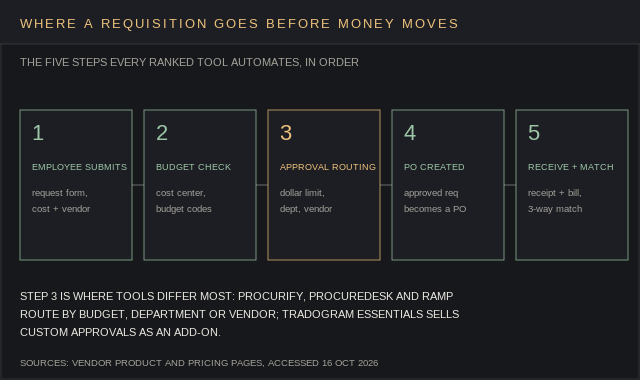
- An employee submits purchase requests through custom request forms, with purchase details such as item, quantity, estimated cost and preferred vendors.
- The system checks the cost center's budget codes against the live balance.
- Rules send the request by dollar threshold, department or vendor type. Ramp routes in parallel; ProcureDesk can auto-approve, deny or route.
- The approved purchase requisition converts into a purchase order with no re-keying, eliminating manual data entry.
- Goods arrive, invoices arrive, and three-way matching ties PO, receipt and invoice data together for accounts payable.
Tools that automate approvals cut the follow-up loop. Ramp says structured approval workflows close approvals 3 times faster, a figure it attributes to its 2025 State of Procurement Report on its procurement page.
Mobile approval is now par for the course. Procurify, ProcureDesk, Precoro, Tradogram and SAP Ariba all list approval from a phone, so a travelling approver can clear a request from an airport gate.
Purchase requisition software pricing across the category
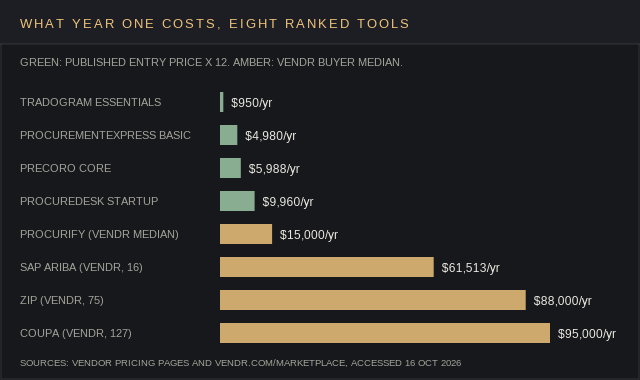
Year-one cost runs from $950.40 to a $95,000 median. That's a hundredfold spread, and it tracks company size more than features.
Four vendors print prices: Tradogram, ProcurementExpress, Precoro and ProcureDesk. The other six quote, and for four of them Vendr's purchase data fills the gap: Procurify at $15,000, SAP Ariba at $61,513, Zip at $88,000 and Coupa at $95,000.
Read between the lines of the billing unit. ProcureDesk charges per user past 10, ProcurementExpress charges by spend managed, and Procurify charges by Pro user. A 25-person team that sends 400 purchase requests a month pays ProcureDesk $1,130 a month for seats, while ProcurementExpress Basic stops working past $10,000 of monthly spend.
The hidden costs sit in add-ons. Precoro's AP module adds $499 a month, Tradogram sells requisitions and custom approvals as add-ons, and ProcureDesk prices contract and inventory modules on a demo call.
Implementation time for requisition management software
Four vendors publish a go-live window, and the range is one to eight weeks.
ProcurementFlow, a European tool outside this ranking, goes further and says on its product page that implementing its requisition management takes less than an hour, with a free plan for one purchaser. That claim fits a single-approver setup with no ERP connector.
Rollout time grows with the number of rules in the approval process. A company with three dollar thresholds, five departments and an ERP sync will land near Kissflow's eight weeks on any tool.
Purchase requisition statistics and where they come from
Most figures cited across this category come straight from the horse's mouth: vendor blogs. Read them as vendor claims with the source attached.
- Ramp says getting upstream visibility right saves an average of 16% a year on vendor spend, a median from its own customer data, per its purchase requisition guide.
- Order.co's enterprise guide cites Amazon Business for the claim that 52% of procurement decision-makers purchase across multiple locations.
- The same Order.co page cites Lido for a $21.40 median cost to process one invoice by hand, and APQC data for $3 to $5 per automated invoice.
- Order.co also cites Planergy for a 40% reduction in manual workloads among procurement teams that automated in 2024.
- Coupa states 8.1% average savings on total spend for its customers.
The key benefits show up in the invoice figures. At $21.40 against $3 to $5, automated invoice processing saves $16.40 to $18.40 per invoice, so 500 invoices a month is worth $8,200 to $9,200 in labour, before any cost savings on the purchases themselves.
Common mistakes when buying purchase requisition software
Buying for the approvers and forgetting the requesters is the first. If 200 employees need to submit purchase requests and the tool charges per seat, the bill grows with headcount, and finance ends up keying requests on behalf of staff, which brings back manual processes.
Skipping the budget test comes second, and a stitch in time saves nine here. Load one real department with real budget codes during the trial and send a request that exceeds it. ProcureDesk denies it and tells the buyer why; Procurify's reviewers warn the system expects budgets on 1 January.
Connector logos cause the third mistake. Ask which fields sync to the accounting software: GL code, department, tax, attachment. A PO that syncs without its cost center code means manual effort at month-end.
The fourth is ignoring company policies until the demo. Write down your company rules before the demo: who signs above $5,000, which categories need IT review. Vendors demo predefined templates, so ask them to rebuild one with your exact customizable workflows in the trial.
How to run a purchase requisition management trial
ProcurementExpress gives 14 days with no credit card. Precoro, Procurify and Zip run demos before a sandbox. Use the trial to run the purchase requisition process end to end, one full procurement cycle.
- Create three authorized users: a requester, a manager, a finance approver.
- Submit five purchase requests across two departments, one above budget.
- Convert the approved requests to POs and sync one to your accounting software.
- Receive a partial shipment and match the invoice.
- Export the complete audit trail and check the entire process, every timestamp and comment, is in it.
Frequently asked questions
What is requisition management?
Requisition management is the control of internal purchase requests from submission to approval, covering budget checks, the approval process and conversion to a purchase order. Purchase requisition management software runs it in one centralized platform.
What is a requisition system?
A requisition system is the requisition management tool employees use to submit purchase requests and managers use to approve them. Tradogram, Precoro and ProcureDesk each sell one starting under $1,000 a month.
What is the difference between procurement and requisition?
Requisition is the internal request step. Procurement covers the whole procurement process: sourcing, negotiating with multiple vendors, issuing the PO, receiving and paying.
Who approves a purchase requisition?
The requester's manager or budget owner approves first, then finance above a dollar threshold. Approval rules in the software set who signs at each level.
What must a purchase request include?
The purchase details: item or service, quantity, estimated cost, supplier details, cost center, budget code, needed-by date and a business reason. Custom request forms make each field mandatory.
Is there a free app that can create purchase orders?
Ramp's AI Intake is free for Ramp customers, and ProcurementFlow offers a free plan for one purchaser. ProcurementExpress gives a 14-day trial.
What is create purchase requisition in SAP?
In SAP, the purchase requisition is created inside the ERP's purchasing module before it becomes a PO. SAP Ariba Buying layers guided buying and an approval workflow over that step.
What is the best purchase order software?
As a purchase requisition tool for a mid-market team, pick Procurify for unlimited requesters or Precoro for a $499 published price. Enterprises on heavy review flows pick Zip or Coupa.
Bottom line
Procurify wins for a mid-market company that wants every employee requesting without paying per seat, and its $15,000 Vendr median keeps it affordable. Precoro wins on price transparency at $499 a month, and ProcureDesk wins for QuickBooks and Xero shops that want every user cost printed.
Zip and Coupa are enterprise tools priced at $88,000 and $95,000 medians, and they earn it only when a request needs legal and security review. Ramp is the pick for Ramp card customers who want to hit the ground running and go live in a week.
ProcurementExpress suits small nonprofits under $10,000 of monthly spend, Kissflow suits teams that want to edit forms without code, Tradogram suits PO-first teams on $99 a month, and SAP Ariba stays the default for SAP shops.