Procurement Orchestration Software: 10 Platforms Ranked & Priced (2026)
 By Jan Suski. I go deep on every review, checking every number against its source and digging up details other coverage misses, a habit from six years of SEO and link building for tech companies. Bylines at Surfer, Brand24, and Senuto. How the scoring works.
· Prefer this source on Google
Quick comparison of procurement orchestration platforms
Ten platforms in ranked order, with each one's G2 rating, review count and ease-of-setup score out of 10, the price evidence a buyer can check, and the buyer each fits.
| # | Platform | G2 rating (reviews) · ease of setup | Entry price evidence | Best fit |
|---|---|---|---|---|
| 1 | Zip | 4.6 (139) · 8.5 | $88,000 Vendr median*, 75 purchases | Enterprises replacing email intake across 5+ review teams |
| 2 | Omnea | 4.7 (70) · 8.7 | $72,750 Vendr median* | Mid-market teams with heavy SaaS and indirect spend |
| 3 | ORO Labs | 4.7 (52) · 8.6 | Custom quote | SAP Ariba and S/4HANA shops |
| 4 | Tonkean | 4.6 (30) · 7.8 | Quote, billed per monthly tracked user | Procurement and legal sharing one intake |
| 5 | ServiceNow Source-to-Pay Operations | 4.2 (82) · 7.7 | Quote, 2 packages | Companies already running ServiceNow |
| 6 | Opstream | 4.9 (20) · 8.9 | Quote, banded by headcount | Mid-market teams live in 3 months |
| 7 | Levelpath | 4.8 (10) · 8.8 | Quote | Teams that want sourcing and intake in one tool |
| 8 | Coupa | 4.2 (570) · 7.4 | $95,000 Vendr median*, 127 purchases | Existing Coupa P2P customers |
| 9 | SAP Ariba Intake Management | 4.1 (799, all Ariba) · 7.7 | Per user per year, blocks of 100 | SAP Ariba Buying customers |
| 10 | Ivalua | 4.3 (116) · 7.1 | Quote | Multi-ERP enterprises buying a full suite |
Medians marked * are anonymised buyer-reported contract values published by Vendr. Every other row states the pricing model the vendor publishes itself.
Where these figures come from
G2 figures come from each product's page in G2's procurement orchestration category and from G2 comparison pages such as Coupa versus ServiceNow, read in October 2026. Vendr medians are anonymised buyer data from Vendr's marketplace. ServiceNow's Vendr median spans every ServiceNow product, so its row reads quote. Six of the ten have no buyer data on Vendr, and their rows carry the pricing metric each vendor states, or say quote where it states none.
Buyers after autonomous sourcing or negotiation agents will find that shortlist on our AI procurement software ranking, and supplier market research tools sit on the procurement intelligence ranking. Zip, ORO Labs, Levelpath and Omnea also rank on the first, and Coupa on the second, each judged there on a different job.
Procurement orchestration software puts one front door in front of every purchase request, then routes that request through legal, security, finance and IT review before it writes the result back into the ERP. It sits above the systems a company already owns. Zip calls it an "AI platform layer above your existing tech stack" on its procurement orchestration explainer.
This page ranks 10 procurement orchestration platforms on five tests a buyer can rerun: published connector counts, G2 review volume, months to go live, price evidence and native scope. Every figure links to the page it came from.
It's written for procurement leaders and finance teams choosing an intake-to-procure layer.
G2 defines the category as software that coordinates procurement processes, technology and resources across business units, and G2's procurement orchestration category already lists 148 products against a definition dated November 2024. Gartner runs a separate procurement orchestration platforms market on Peer Insights with 20 products in it.
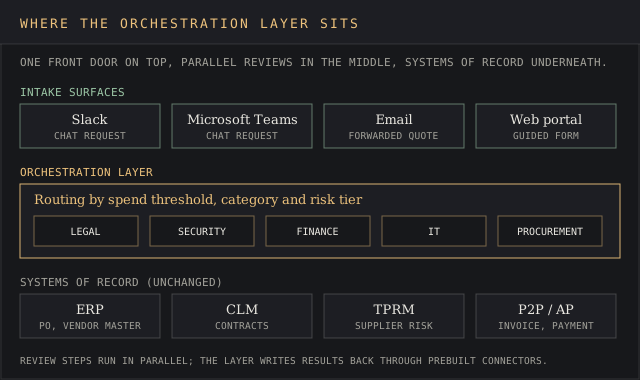
Evaluation criteria for procurement orchestration software
Five criteria decide this procurement orchestration shortlist, and the ranking below applies them in this order. Each one returns a number or a yes/no that procurement teams can check without a sales call.
Prebuilt connectors to ERP systems and contract management tools
An orchestration layer earns its keep only when it writes approved requests back into ERP systems, CLM and third-party risk tools without a developer. The test is the connector count the vendor publishes and the named systems behind it: Tonkean lists 250+ applications, Zip and Omnea each list 200+.
G2 review volume in the procurement orchestration category
A 4.9 rating from 20 reviews carries less weight than 4.6 from 139. The test is the review count and rating on the vendor's G2 profile, and how many reviewers describe intake or approval workflows in their own words.
Time to implement and ease of setup
G2 asks reviewers how many months the rollout took and scores ease of setup out of 10. Zip averages 3 months across 27 responses on the ORO versus Zip comparison, and Ivalua 9 months across 22 on the Ivalua versus ORO comparison.
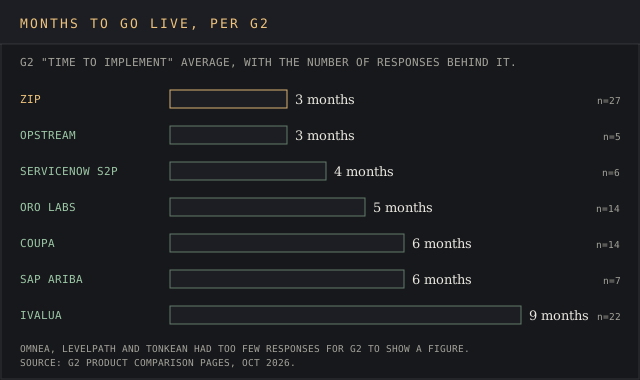
Anything past 6 months usually means an implementation partner sits on the invoice too.
Price evidence a buyer can check
A Vendr median with a purchase count beats a "contact sales" button. Where Vendr has no data, the test drops to the pricing metric the vendor publishes, such as per active user or per monthly tracked user.
Native scope after the request is approved
Procurement processes after approval vary most. Some platforms stop at intake and approvals; others carry sourcing, contract management, vendor onboarding and invoice processing natively. The test is the module list on the vendor's own product pages, counted. Workflow automation that stops at approval leaves someone to re-key the PO.
The 10 procurement orchestration platforms, ranked
Zip
Best fit
Enterprises whose purchase requests touch five or more review teams and still travel by email.
Zip hit the ground running in 2020 as an intake-to-procure tool and now sells itself as an AI platform for enterprise procurement. Its homepage claims $1T in spend processed, $10.5B in customer savings and 10.1M days of cycle time saved, with OpenAI, Snowflake, T-Mobile and Canva on the customer list. Our Zip review covers the platform module by module.

Key features
- 200+ integrations and 50+ procurement AI agents, per Zip's orchestration guide
- Prebuilt connectors to Coupa, Ironclad, Docusign, Conga CLM, EcoVadis and Jira
- Parallel review routing for legal, security, IT and finance on one request
- Vendor onboarding with bank detail capture and a supplier portal
- Slack and Microsoft Teams request intake
Pricing
Vendr's Zip HQ page puts the median contract at $88,000 a year across 75 anonymised purchases, with a range of $26,586 to $214,750. Zip prices by module: core platform, CLM, vendor management, and integrations with advanced analytics.
Pros
- Most G2 reviews of the intake-first platforms ranked here: 4.6 from 139
- Tied fastest reported rollout with Opstream, 3 months across 27 G2 responses
- Admins change workflows without engineering tickets
Cons
- Reporting is the most repeated complaint on Capterra
- Field mapping into NetSuite drops custom fields, per a 2023 TrustRadius review
- Direct and production spend sit outside its design point
A Director of Finance at Gong wrote on TrustRadius in December 2022: "No coding - Ability for the administrator to make changes without development resources helps us be agile as a procurement org."
"I also find the approval workflow routing isn't configured properly and often, approvals are asked of the wrong individual."
Matt G., Director, insurance, 2 out of 5 on Capterra, April 2026
Why it's ranked #1. Zip beats Omnea on the price-evidence criterion with a Vendr median backed by 75 purchases, against Omnea's undisclosed count, and on review volume with 139 G2 reviews to 70. It sits at the top of the list.
Omnea
Best fit
Mid-market procurement teams where software renewals and indirect spend make up most of the volume.
Omnea launched in London in 2022 and pitches an "Agentic Operating System" across intake, approvals, renewals and third-party risk. Its homepage claims $5bn of indirect spend under management, 99% customer retention and a 38% cut in total request time, with Spotify, PayPal and NetApp named as customers. The Omnea review on this site tracks the module list.
Key features
- 200+ integrations, plus Slack, Microsoft Teams and MCP access
- Six named agents: Intake, Review, Approval, Performance, Doc Review and Mitigation
- Supplier management, TPRM and continuous monitoring modules
- Renewal workflows that trigger 90 days before a contract ends
- SOC 2 Type II, SSO and a full audit trail
Pricing
Vendr's Omnea page lists a $72,750 median, with buyer contracts running from $72,750 to $129,150 a year. That's the lowest median on this list with Vendr data.
Pros
- 4.7 on G2 from 70 reviews, with 9.7 for quality of support
- Omnea claims maverick spend falls from 30% to 5% for customers
- No-code workflow changes, per multiple 2026 G2 reviewers
Cons
- No native P2P module, so finance still lives elsewhere
- API depth trails the 200+ connector headline, per G2 reviewers
- Renewal tracking misses requests at some accounts
A G2 reviewer named Matt B. wrote in February 2026 that "we have the ability to make changes to all of our workflows without any coding," then added: "I feel like the integrations are a little bit harder to get done than what I expected." A General Counsel on G2 in March 2026 put the gap plainly: "The P2P component is missing, where we could also bring Finance in."
Why it's ranked #2. Omnea's 70 G2 reviews at 4.7 beat ORO's 52, and its $72,750 Vendr median gives buyers a price anchor ORO lacks. It trails Zip's 75-purchase Vendr sample and 139 reviews.
ORO Labs
Best fit
Enterprises running SAP Ariba or S/4HANA that want a friendlier front end on top.
ORO was founded in Palo Alto in 2020 and sells a GenAI procurement orchestration platform to Pfizer, Roche, Coca-Cola, Novartis and BASF. Its homepage claims an 80% cut in supplier onboarding time and $10M+ saved through bank fraud checks, and ORO says it was the first company to earn ISO 42001 certification for responsible AI. Its SAP partnership is the feather in its cap for Ariba shops. See the ORO Labs review for the module detail.
Key features
- Prebuilt integration into SAP Ariba Buying and Invoicing
- Vendor onboarding with bank account validation
- No-code workflow builder for intake and approval workflows
- Supplier risk screening inside the request
- SOC 1 and SOC 2 reports
Pricing
ORO sells on custom quote through its sales team. G2 reviewers report a 6-month payback across 12 responses on the ORO versus Zip comparison.
Pros
- 4.7 on G2 from 52 reviews, 9.4 for quality of support
- Strong uptake among large pharma buyers
- Bank validation catches fraud at supplier onboarding
Cons
- 5 months to implement, per 14 G2 responses
- Reporting and documentation lag the product's growth
- International bank coverage in the validation tool has gaps
An enterprise pharma reviewer gave ORO 4.5 on G2 in April 2025: "The standout of ORO labs product is the flexibility to meet complex integrations with many mature existing systems." The same reviewer listed the cost of that flexibility: "Limited reporting capabilities and software bugs."
Why it's ranked #3. ORO's 52 G2 reviews and 5-month rollout beat Tonkean's 30 reviews and 7.8 ease-of-setup score. It loses to Omnea, which has a $72,750 Vendr median where ORO has none.
Tonkean
Best fit
Companies where procurement, legal and IT want one intake and the same routing engine for complex processes.
Tonkean dates to 2015 and is the jack of all trades on this list: procurement is one of three packaged products, alongside LegalWorks and ServiceWorks. Its homepage claims 288M requests and 7.7B steps automated a year and a 50% cut in cycle times, with Google, Lenovo, Workday and Cisco among the logos.
Key features
- 250+ application integrations, including Coupa, SAP, Oracle, Ironclad and DocuSign
- AI Front Door intake through Microsoft Teams, Slack, email and custom portals
- Drag-and-drop no-code process builder
- SAP Store listing covering SAP ERP, S/4HANA, Ariba, Fieldglass and Concur
- Single-tenant, customer-cloud and on-premise hosting on the Enterprise plan
Pricing
Tonkean's pricing page bills on Monthly Tracked Users, the average number of people who touch a process each month across the subscription year. Premium support adds 24/7 chat, a shared Slack channel and two training sessions a year.
Pros
- The largest published connector count on this list
- One platform covers procurement, legal and internal service requests
- Four intake surfaces, all routed to the same workflow
Cons
- 30 G2 reviews, too few for G2 to report implementation time
- 7.8 ease of setup on G2, below the procurement-only tools
- Large datasets slow the builder, per a 2023 G2 reviewer
A purchasing specialist rated Tonkean 4.5 on G2 in December 2024 for "doing the work so much faster than you normally do by your own." An IT infrastructure manager on the same page wrote that it "slows down a lot and stutters" once datasets grow.
Why it's ranked #4. Tonkean's 250+ connectors top ServiceNow's ERP framework, and its 4.6 G2 rating beats ServiceNow's 4.2. It trails ORO on review volume, 30 reviews to 52.
ServiceNow Source-to-Pay Operations
Best fit
Companies already paying for ServiceNow that want procurement cases on the same platform as IT and HR.
ServiceNow built Source-to-Pay Operations on the case-management model it uses for IT tickets, so for an existing customer the same portal, records and admins are par for the course. The pricing page claims $5M in cost savings through procurement automation, a 40% reduction in time to solve supplier cases and 50% lower procurement case volume.

Key features
- Procurement, supplier and invoice case management
- Supplier Collaboration Portal for real-time messages that keep supplier relationships off email
- ERP Integration Framework and Workflow Data Fabric
- Sourcing and purchasing automation, PO management and AP invoice processing in Prime
- Moveworks and ServiceNow Otto agents in both packages
Pricing
ServiceNow sells two packages, Foundation and Prime, both on custom quote. Vendr's ServiceNow page shows a $129,871 median across 109 purchases, a figure that spans every ServiceNow product.
Pros
- 82 G2 reviews at 4.2, with 4 months to implement across 6 responses
- One portal for procurement, IT and HR requests
- Invoice processing ships natively in Prime
Cons
- Custom approval hierarchies take technical effort
- Heavy dependence on ERP integrations
- 7.7 ease of setup on G2
A G2 reviewer, Marcin S., wrote in August 2026 that "the system automatically routes everything to the right person."
"setting up custom approval hierarchies and mapping complex enterprise workflows demand significant technical effort"
Kara P., Senior Accountant, mid-market, 3.5 out of 5 on G2, August 2026
Why it's ranked #5. ServiceNow's 82 G2 reviews outweigh Opstream's 20, and its 4-month rollout is one month behind. It trails Tonkean, which publishes 250+ connectors and scores 4.6 to ServiceNow's 4.2.
Opstream
Best fit
Mid-market companies that want to go live in a quarter without a systems integrator.
Opstream is a diamond in the rough: it sells agentic procurement orchestration to Fiverr, LastPass, Lytx and Pentera, and carries the top G2 rating here. Its homepage claims a 73% reduction in request handling time, 45% more spend under management and a 99% drop in shadow procurement.
Key features
- Intake and workflow automation with autonomous workflows
- AI document comparison for contracts and quotes
- Invoice reconciliation and spend management
- Renewal workflows triggered 90 days before the renewal date
Pricing
Opstream's pricing page quotes after a form that bands companies by headcount, from under 200 to 10,000+ employees.
Pros
- 4.9 on G2 from 20 reviews, the highest rating on this list
- 8.9 ease of setup, also the highest
- 3 months to implement, per 5 G2 responses
Cons
- ERP integration leaves some teams running two processes
- Notification volume, per an October 2026 reviewer
- Edge-case settings are thin
A manufacturing reviewer wrote on G2 in October 2026: "Limitations in full integration with the ERP mean we still have to use both systems and both processes." A CEO on the same page wrote: "What used to take weeks now takes days, sometimes hours."
Why it's ranked #6. Opstream's 20 G2 reviews double Levelpath's 10, and its 3-month rollout is documented where Levelpath's isn't. It falls behind ServiceNow's 82 reviews.
Levelpath
Best fit
Procurement teams that want intake, sourcing events and contract management in one tool.
Levelpath raised more than $55 million in a Series B led by Battery Ventures in June 2025, taking total funding past $100 million, per its funding announcement. The homepage claims $26B+ in spend run through the platform and a 76% cut in cycle times, with American Airlines, Western Union and Ace Hardware as customers. Our Levelpath review covers the suite.
Key features
- Ranger, which runs five procurement workflows autonomously
- Intake and orchestration, sourcing, supplier management and risk modules
- Integrations with Oracle Fusion, NetSuite, Coupa, Ironclad, OneTrust and Docusign
- RFP tooling that Levelpath says gives 10x capacity
Pricing
Levelpath quotes through its sales team; no buyer data sits on Vendr.
Pros
- 4.8 on G2, with 9.8 for quality of support
- Sourcing events live in the same tool as intake
- Strong contract-date and clause tracking
Cons
- Only 10 G2 reviews, so the jury's still out on Ranger
- Learning curve on advanced configurations
- No spend analytics module yet
A Head of Procurement gave Levelpath 4.5 on G2 in December 2025 and wrote: "Some users found the learning curve steep, and we've had to invest in ongoing training." A purchasing manager on the same page said it "has helped formalize our capital request intake and tracking procedures."
Why it's ranked #7. Levelpath's 8.8 ease-of-setup score beats Coupa's 7.4, and it runs above any ERP where Coupa orchestrates its own suite. It trails Opstream on review count, 10 to 20.
Coupa
Best fit
Companies already running Coupa P2P that want to kill two birds with one stone: intake and invoicing on one contract.
Coupa sells Intake & Orchestration as part of its procure-to-pay suite and trains its AI on what it calls $10 trillion of community spend data, per its intake-to-pay post. The same post says top performers that unify intake and orchestration on a P2P platform report 8.1% in overall spend savings. Our Coupa review covers the full suite.
Key features
- Intake & Orchestration tied to approvals, supplier data and payments
- Coupa Navi AI agents for knowledge, analytics and supplier assistance
- Coupa Compose for building AI workflows
- Native invoicing, expenses and supplier network
Pricing
Vendr's Coupa page shows a $95,000 median across 127 purchases, with a range of $20,761 to $331,445 a year. Our procurement software pricing report breaks the suite down further.
Pros
- 570 G2 reviews, second only to SAP Ariba's 799 on this list
- Intake, PO and invoice live in one system
- Configurable approval flows
Cons
- 6 months to implement and 23 months to ROI, per G2 reviewers
- 7.4 ease of setup on G2
- Direct procurement needs extra work with S/4HANA
A Director rated Coupa 9 out of 10 on TrustRadius in July 2021 for its "Customized approval flow processes." An IT professional at a 10,001+ employee company wrote in May 2023: "Direct procurement does not work out of the box."
Why it's ranked #8. Coupa's 6-month rollout matches SAP Ariba's, and its 4.2 G2 rating edges Ariba's 4.1. It trails Levelpath, whose 8.8 ease-of-setup score beats Coupa's 7.4.
SAP Ariba Intake Management
Best fit
SAP Ariba Buying customers that want a guided front door without a second vendor.
SAP sells Intake Management as an AI-powered single front door for demand intake, with Joule handling the chat and a no-code process builder behind it, per its features page. The SAP Ariba review covers the wider suite.
Key features
- AI-powered single front door for non-catalog requests
- Intake dashboard and prebuilt process content
- Joule assistant for request capture and routing
- Prebuilt connectors to SAP and third-party systems
Pricing
SAP's pricing page charges per user per year in blocks of 100 active users, on contracts of 1 to 5 years that auto-renew.
That auto-renewal is a red flag for any team without the notice date in its calendar.
Pros
- No extra integration for existing Ariba customers
- Prebuilt SAP process content
- Contract terms published up front
Cons
- Auto-renewal is the default contract term
- 16 months to ROI for SAP Ariba overall, per 7 G2 responses
- Ariba's user experience draws repeat complaints
An analyst at a manufacturer wrote on TrustRadius in October 2026 that "SAP Ariba provides one intake method for requisitions." A director on the same page wrote: "There is no one-landing page/guided Buying for anything more complex [than] office supplies."
Why it's ranked #9. SAP publishes a per-user metric in blocks of 100, which beats Ivalua's quote-only pricing, and Ariba's 6-month rollout beats Ivalua's 9. It trails Coupa's 4.2 G2 rating.
Ivalua
Best fit
Enterprises with several ERPs that want one source-to-pay suite underneath the intake.
Ivalua defines procurement orchestration as the "coordinated management of people, systems, and policies across the entire intake-to-pay process," per its orchestration guide. The same page says its agents automate 40 to 70% of procurement tasks, and names customer Körber, which runs more than seven ERP systems. The Ivalua review covers the suite.
Key features
- An intake module as the entry point to the suite
- Intelligent Virtual Assistant (IVA) and autonomous agents
- No-code configuration across sourcing, contracts and P2P
- Multi-ERP data model
Pricing
Ivalua sells on quote through its sales team. Its orchestration guide cites customers reporting payback in under 6 months.
Pros
- 116 G2 reviews at 4.3
- Deep configuration without code
- Full suite from intake to payment
Cons
- 9 months to implement, per 22 G2 responses
- 7.1 ease of setup, the lowest on this list
- Rollouts lean on implementation partners, and buyers bite the bullet on the timeline
A procurement professional rated Ivalua 3 out of 5 on G2 in January 2026: "the platform can feel complex and overwhelming, especially during initial setup and onboarding." A systems manager on the same page wrote in October 2026: "Flexibility of configuration makes it simple to implement."
Why it's ranked #10. Ivalua's 116 G2 reviews make the list on evidence alone, but its 9-month rollout and 7.1 setup score trail SAP Ariba's 6 months and 7.7. It closes the list.
What an orchestration layer does above fragmented systems and data silos
Procurement orchestration creates one entry point for requests and then coordinates complex work across systems the company already pays for. Zip's comparison table describes the scope as the "full intake-to-pay lifecycle including intake, routing, approvals, sourcing, contracts, and payment." Procurement activities that used to sit in five inboxes end up in one request record.
Key components of a procurement orchestration platform
Seven key components recur across the ranked vendors' documentation:
- Procurement intake: one guided form or chat entry for all purchase requests, on Slack, Teams, email or a portal
- Routing rules: dynamic criteria such as spend thresholds, category and risk tier decide which reviewers see a request
- Parallel review: legal, security and finance work the same request at once, which removes queue bottlenecks
- Connectors: results write back into ERP systems, CLM and TPRM tools without manual data entry
- Audit trail: procurement activities, approvals, comments and documents are logged against the request
- AI agents: the ranked vendors ship between 6 named agents (Omnea) and 50+ (Zip) for triage, document review and data validation
- Analytics: spend visibility by department, supplier and cycle stage
Tonkean's own State of the Procurement Tech Stack survey found 88% of procurement leaders say employees log into at least 2 external systems per request, per its 2026 platform guide. That's the data silos problem the orchestration layer exists to close.
Procurement orchestration vs procure-to-pay
P2P systems run the transactional lifecycle from requisition to payment. Orchestration covers what happens before the requisition exists and coordinates every function that touches it. Zip's comparison table sets the two side by side:
| Procure-to-pay | Procurement orchestration | |
|---|---|---|
| Scope | Purchase requisition through payment | Intake, routing, approvals, sourcing, contracts and payment |
| Approach | Linear, sequential workflow | Parallel workflows with intelligent routing |
| Technology | Traditional ERP modules | AI platform layer above the existing stack |
| People involved | Procurement and finance teams | Procurement, legal, IT, security and finance |
Coupa and SAP Ariba sell both halves in one contract, which is why they rank on this page at all. Zip, Omnea, ORO and Tonkean sit above whichever P2P system a company runs. For contract-heavy requests, the contract intelligence software ranking covers the CLM side of the handoff.
AI powered intake and AI agents in procurement workflows
Every procurement orchestration vendor ranked here now ships AI agents, and the published results come from vendor case studies. Talk is cheap, so treat them as claims with names attached and ask for the reference customer:
- Canva cut procurement cycle times by over 70% on Zip, per Rudy Batts, Head of Global Spend, on Zip's orchestration guide
- OpenAI's manual data validation dropped from 15 to 20 minutes per request to seconds, per the same page
- Cribl reported 12 to 15% savings per request from historical price benchmarking
- Omnea claims 96% of spend routed through compliant, pre-approved channels on its homepage
The automation tools in these platforms target data validation and compliance checks: bank details at supplier onboarding, duplicate supplier records and policy routing. Policy enforcement is where maverick spend falls, because a request can't skip the security review the routing rules require. Predictive analytics on renewals and supplier performance is newer; Levelpath's own G2 reviewers say the AI features "show promise but require further development and refinement."
The third-party risk management ranking covers the dedicated risk mitigation tools these agents call during vendor checks.
Signs procurement teams need procurement orchestration
The trigger is usually request volume against headcount.
Invesco manages $1.1B of spend with a 19-person team on Zip, per Zip's homepage.
These signs are each testable inside a week:
- Fragmented processes: purchase requests arrive by email, Slack and spreadsheet, and someone re-keys them into the ERP. That manual work is where OpenAI's 15 to 20 minutes of validation per request came from
- Disparate tools: business users log into 2 or more systems per request, and collaboration tools carry approvals with no audit trail
- Slow supplier onboarding: ORO claims an 80% cut in onboarding time, which makes faster supplier onboarding the first win most buyers can measure
- Compliance risks after the PO: Omnea claims indirect maverick spend falls from 30% to 5% once routing rules enforce compliance at intake
- Duplicate buying across business units: Omnea claims a 50% reduction in software vendors across its customers
- Long approval chains: 27% of respondents in Zip's research need 10 or more approvals for one purchase
Supply chain teams buying direct materials follow a different buying process. Supply chain purchasing runs on forecasts, MRP and supplier networks tied to production schedules, and most ranked platforms target indirect spend; a TrustRadius reviewer called Zip hard to use for direct purchases. Supply chain buyers should test that case first; our supply market intelligence guide covers the research side.
Measuring operational efficiency and cost savings from automated workflows
Procurement performance after go-live comes down to five numbers, and every ranked vendor reports at least one. Pull them from the operational data inside the platform, then reconcile against the ERP so the procurement performance dashboard runs on accurate data. Tools on our process intelligence software ranking measure the same cycle times from ERP event logs.
- Cycle time from request to PO. Omnea claims purchase requests fall from 9 days to 3; Tonkean cites Semrush going from 19 days to 10
- Share of spend through compliant channels. Omnea claims 96%
- Savings per request from price benchmarking. Cribl's 12 to 15% on Zip is the published high mark
- Supplier performance scores captured at renewal, stored against the contract
- Days from supplier request to first PO
Ensuring compliance at intake is the cheapest form of risk mitigation, because a security review before signature costs hours and a finding after payment costs a renegotiation. ORO, Omnea and Coupa run supplier risk checks inside the request, so risk mitigation and ensuring compliance happen in one step for procurement teams.
Supplier relationships improve when suppliers can see where a PO or invoice sits. ServiceNow's Supplier Collaboration Portal is built for that, and ServiceNow claims a 40% reduction in time to solve supplier cases. Stronger supplier relationships then show up in the supplier performance and performance management records the platform already keeps.
Predictive analytics on renewals is where procurement shifts toward planning. Omnea and Opstream both trigger renewal workflows 90 days before the end date, which gives procurement functions a full quarter to benchmark price with AI agents and other automation tools. Performance management for procurement functions then starts from the renewal calendar.
For procurement organizations with global operations, integrating processes across business systems is the hard part: Ivalua's Körber case runs more than seven ERP systems behind one procurement intake. Each connector replaces a manual handoff between the point solutions in a procurement management stack, such as CLM, TPRM and ERP.
Pricing across procurement orchestration platforms
Four of the ten ranked procurement orchestration vendors have buyer data on Vendr, and the medians sit within $57,121 of each other. The ranges tell a longer story: Coupa contracts run from $20,761 to $331,445.

The devil's in the details. These costs don't show in a median:
- Implementation partners. Ivalua's G2 reviewers name partner guidance as the main rollout problem, and the 9-month average shows it
- Auto-renewal. SAP Ariba Intake Management contracts run 1 to 5 years and auto-renew by default
- User metrics. SAP sells in blocks of 100 active users; Tonkean bills on Monthly Tracked Users averaged across the year
- Modules. Zip prices CLM, vendor management and advanced analytics as separate modules
- Hosting. Tonkean charges extra for single-tenant or on-premise deployment outside the Enterprise plan
Vertice, which runs its own procurement orchestration product, bought Vendr on 1 June 2026 and now owns 2 million+ pricing data points across 32,000+ vendors, per its acquisition post. Keep an eye on that when a Vendr median is the anchor for a negotiation. The contract management software pricing report carries the CLM costs that sit next to these platforms.
How enterprise teams should run an evaluation
Get the ball rolling with a single high-impact procurement orchestration workflow; a big-bang rollout across every category puts all your eggs in one basket. Zip's own guide recommends measuring results within the first 90 days, and that's a fair test for every vendor on this list. Software purchases are the usual pick for procurement teams because those procurement activities touch legal, security, IT and finance at once.
- Map the current intake process and the procurement processes behind it: count the systems a requester logs into and the approvals a $50,000 purchase needs
- Pick one workflow and write its routing rules down before any demo
- Ask each vendor to build that workflow live against your ERP sandbox, then show how an admin would optimize workflows after go-live
- Check the connector against your actual ERP, CLM and TPRM vendors by name
- Get the Vendr median, or the pricing metric, in writing before the second call
- Measure cycle time, approval count and compliant spend share at day 90
If a single purchase needs 10 or more approvals, cut approvals first; software only routes the steps it's given.
Procurement orchestration market in 2026
Gartner's Peer Insights lists 20 products in its procurement orchestration platforms market, with ServiceNow Sourcing and Procurement Operations carrying the most reviews at 15. G2's category counts 148 listings, many of them P2P and AP tools that added an intake form.
Funding has followed procurement orchestration. Levelpath's $55 million Series B in June 2025 took it past $100 million raised, and Vertice's purchase of Vendr put a procurement orchestration vendor in charge of the category's most-cited price benchmark. Supply chain teams buying for direct materials sit outside most of these tools; the supply chain risk management ranking covers that side, and our procurement market intelligence guide covers the research layer.
Procurement orchestration software FAQ
What is orchestration in procurement?
Procurement orchestration is the coordination of people, policies and systems across the entire procurement lifecycle, from the first request to payment. A procurement orchestration platform routes each request to the right reviewers in parallel and writes the result back to the ERP.
What is an orchestration platform?
Software that coordinates multiple systems and teams through one workflow engine. In procurement that means intake, routing, approvals and connectors to ERP, CLM and risk tools, wrapped around existing procurement processes.
How can I automate the procurement process?
Replace the manual processes at intake first: one front door for procurement requests and business users, routing rules by spend and risk, and connectors that create the PO in the ERP. Zip and Opstream both average 3 months to go live on G2.
What are the steps in a procurement workflow process?
Request intake, triage, parallel review by legal, security, IT and finance, supplier onboarding, contract signature, PO creation, receipt, invoice and payment. Orchestration covers the first six; P2P covers the last four.
What is the best ERP for procurement?
An orchestration layer works with SAP S/4HANA, Oracle, NetSuite and Coupa alike, so the ERP choice matters less than the connector. Check that the vendor names your ERP on its integrations page.
How much does procurement orchestration software cost?
Vendr's buyer data puts the median annual contract at $72,750 for Omnea, $88,000 for Zip and $95,000 for Coupa. ServiceNow's $129,871 median covers every ServiceNow product, and the other six vendors on this page sell on quote or on a per-user metric.
Bottom line
Zip wins for enterprises that want the most reviewed intake-first layer, the deepest Vendr price record and a 3-month rollout. Omnea is the pick for mid-market procurement teams with SaaS-heavy spend and a $72,750 Vendr median, and ORO Labs fits SAP Ariba shops that want a friendlier front door.
Tonkean suits companies where legal and IT want the same intake as procurement. ServiceNow belongs with existing ServiceNow customers. Coupa, SAP Ariba and Ivalua make sense when the suite is already signed and the intake module costs less than a second vendor.