VRIO Analysis Template
 By Jan Suski. I go deep on every review, checking every number against its source and digging up details other coverage misses, a habit from six years of SEO and link building for tech companies. Bylines at Brand24 and Senuto. How the scoring works.
Get the VRIO analysis template
An Excel workbook that scores each resource on value, rarity, imitability and organization, writes its competitive implication, and counts the results per outcome.
Download XLSXA VRIO analysis tests each of your company's resources and capabilities against four questions: is it valuable, is it rare, is it costly to imitate, and is the organization set up to capture value from it? The answers sort every resource into one of five competitive positions, from competitive disadvantage to sustained competitive advantage.
This VRIO analysis template puts that test into one Excel workbook, so you can evaluate every resource with the same rules. You list resources, answer four Yes/No columns, and a formula writes the competitive implication for each row.
This page covers the download, what VRIO stands for, where the VRIO framework came from, the five outcomes, a step-by-step fill-in, a worked example for a freight software company, the SWOT comparison, common mistakes, and the software question.
It's for strategy leads, business owners, founders, product and corporate development teams, and anyone writing a strategic plan who needs to know which assets deserve investment and which ones a rival could copy in a year. Strengths are a dime a dozen in most strategy decks. The VRIO analysis is a strategic tool to evaluate resources against the competition and identify which strengths would survive a well-funded rival, and that list is usually shorter.
Download the free VRIO analysis template
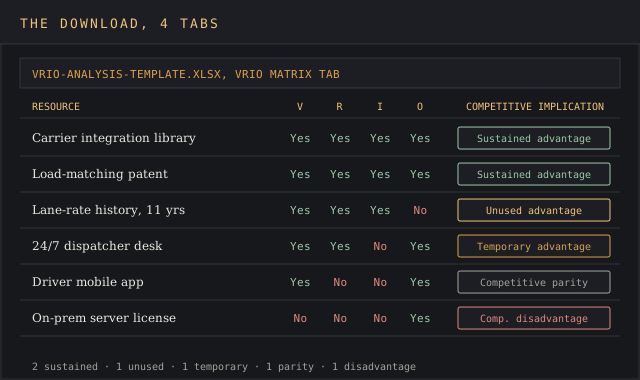
Download the template (XLSX)The workbook has four tabs, covering instructions, a 20-row VRIO matrix that writes each resource's competitive implication, a summary that counts resources per outcome, and a blank copy, pre-filled with the Northfield Freight Software example.
The free template opens in Excel, Google Sheets and LibreOffice Calc. It runs on nested IF and COUNTIF formulas, which all three apps support, so nothing breaks on import. Yes/No answers come from dropdown lists, and conditional formatting colors each implication so the sustained advantages stand out at a glance.
What VRIO stands for
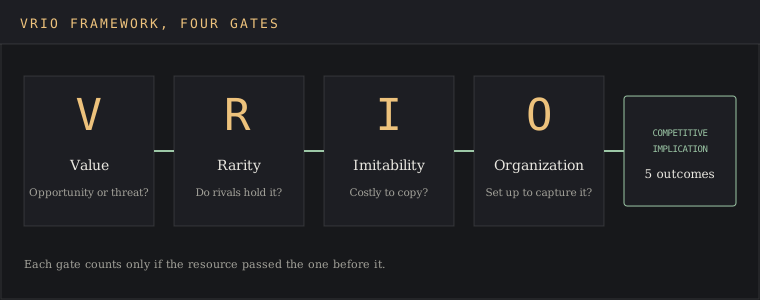
VRIO stands for value, rarity, imitability and organization. The four criteria run in that order, and each one only matters if the resource passed the one before it. A resource nobody values can't be a rare advantage, and a rare resource competitors can copy cheaply holds its competitive edge only until they do.
| Criterion | The question in the template | Evidence that earns a Yes |
|---|---|---|
| Value | Does it let the company exploit an opportunity or neutralize a threat? | Revenue, margin or cost data tied to the resource |
| Rarity | Do few or no current competitors hold it? | A competitor benchmark showing who else has it |
| Imitability | Would a rival face a cost disadvantage acquiring or substituting it? | Years, money or legal barriers a rival would have to clear |
| Organization | Are processes, reporting lines and incentives in place to capture its value? | A named owner, a budget and a process that uses it |
The definitions in the second column follow the open strategic management textbook from Oregon State University's VRIO chapter. It describes value as the ability to exploit opportunities or negate threats, and organization as the control systems, reporting relationships and compensation policies that let a firm capture the value a resource generates.
Imitability is the criterion teams rush. The same chapter notes that hard-to-copy resources tend to come from history, ambiguity or social complexity, such as organizational culture, a reputation built over decades, or customer relationships no salesperson can transfer.
Raw materials, standard software and machinery anyone can buy almost never pass it. A licensed film catalogue that every streaming services rival can bid on fails rarity as well. Proving imitability is easier said than done, so the template asks for years and money in the evidence column.
Where the VRIO framework comes from
Jay Barney laid the groundwork in "Firm Resources and Sustained Competitive Advantage", published in the Journal of Management, volume 17, issue 1, in 1991. That paper proposed four indicators of a resource's potential to generate sustained competitive advantages: value, rareness, imitability and substitutability.
The organization question arrived in Barney's 1995 article "Looking inside for competitive advantage", in the Academy of Management Executive, volume 9, issue 4. It framed the analysis as four questions (value, rarity, imitability and organization), and the acronym stuck. Strategy courses have taught the VRIO framework under that name since.
The model belongs to the resource-based view of the firm. It looks at internal factors, what the company owns and knows how to do, and leaves external factors such as market growth or regulation to other tools. That split matters when you decide which template to open first, and when you assess which valuable resources to fund for the long term.
The five outcomes of a VRIO analysis
Every row in the VRIO analysis ends in one of five competitive implications, and the order of value, rarity, imitability decides which one. The formula stops at the first No, which matches how the framework reads: a failed criterion caps the outcome no matter how well the resource scores later.
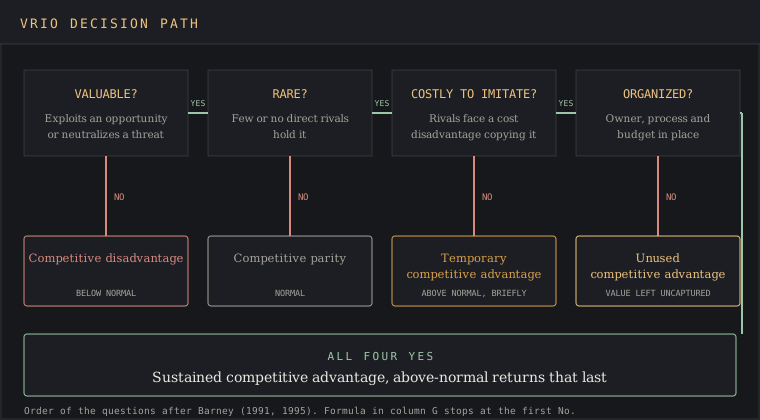
| Valuable | Rare | Costly to imitate | Organized | Competitive implication |
|---|---|---|---|---|
| No | Any | Any | Any | Competitive disadvantage |
| Yes | No | Any | Any | Competitive parity |
| Yes | Yes | No | Any | Temporary competitive advantage |
| Yes | Yes | Yes | No | Unused competitive advantage |
| Yes | Yes | Yes | Yes | Sustained competitive advantage |
The Oregon State table lists four outcomes and handles a missing organization score in prose. The template gives that case its own row, the unused competitive advantage, because it is the one outcome a team can fix internally in a quarter. A valuable, rare, hard-to-copy resource with no owner is money left on the table.
A temporary advantage pays off when the company spends it fast. The resource is valuable and rare, but a competitor can replicate it, so the window closes on the rival's timeline and the speed of the response decides how much you gain. A lasting advantage needs all four criteria, and passing them today guarantees nothing about next year.
What's inside the template
- Instructions. How to use the analysis template, with the four questions, what counts as evidence for each, and the order to fill the columns in.
- VRIO Matrix. 20 rows with columns for resource, type, the four Yes/No criteria, competitive implication, evidence, benchmark competitor and action. Column G holds the formula.
- Summary. A COUNTIF per outcome, so you see how many sustained, unused, temporary, parity and disadvantage rows the analysis produced.
- Blank Matrix. A clean copy of the matrix with the same formulas, ready to edit for your own organization's resources.
The type column splits resources into tangible assets, intangible assets and capabilities. Plant, inventory and supply chain infrastructure count as tangible assets, while brand, data and intellectual property count as intangible ones. Capabilities are the skills and business processes a team runs well, such as onboarding a new carrier in two days.
How to fill in the VRIO analysis template, step by step
- List 10 to 20 resources. Name each one specifically, rare resources and ordinary ones alike. "Our technology" fails the test by being too vague, while "the load-matching algorithm and its patent" can be scored.
- Tag the type. Tangible, intangible or capability, so the summary shows where your advantages cluster and which processes create them.
- Answer value first. Write the evidence in column H before you pick Yes. A resource with no revenue, margin or cost figure attached stays at No until someone finds one.
- Benchmark rarity against named rivals. Put the closest competitor in column I. Rarity is relative to the companies your customers compare you with, so a capability that's rare across the whole industry can still be common among your three direct rivals.
- Price the imitation. Estimate the years and budget a rival would need to copy or substitute the resource. Under a year and a budget a funded competitor could find earns a No.
- Check organization last. Name the owner, the budget and the process that turns the resource into revenue. A resource without a named owner gets a No.
- Write one action per row. Protect sustained advantages, assign owners to unused ones, spend temporary ones before they expire, keep parity at parity, and retire or fix disadvantages.
Conducting the session with three to six people from strategy, product, sales and finance makes the scoring more efficient. One person scoring alone tends to mark every resource valuable and rare, and the devil's in the details of the evidence column. Disagreements over a single Yes are the most useful 20 minutes of the meeting.
Worked example: Northfield Freight Software
Northfield is a fictional route-planning software company with 140 staff and 410 customers, mostly regional trucking carriers. Its leadership team ran the VRIO analysis ahead of its 2027 business strategy review to determine where to put next year's investment and which capabilities to keep developing. The same six rows are pre-filled in the download.
| Resource | V | R | I | O | Implication | Action |
|---|---|---|---|---|---|---|
| Carrier integration library, 310 connectors | Yes | Yes | Yes | Yes | Sustained competitive advantage | Protect the 14-engineer integrations team |
| Patented load-matching algorithm | Yes | Yes | Yes | Yes | Sustained competitive advantage | License it only under NDA |
| 11 years of lane-rate history | Yes | Yes | Yes | No | Unused competitive advantage | Assign a product owner, ship rate benchmarks in two quarters |
| 24/7 dispatcher support desk | Yes | Yes | No | Yes | Temporary competitive advantage | Tie support to annual contracts now |
| Driver mobile app | Yes | No | No | Yes | Competitive parity | Maintain at current spend |
| On-premise server license for two legacy customers | No | No | No | Yes | Competitive disadvantage | Migrate both customers, retire the license |
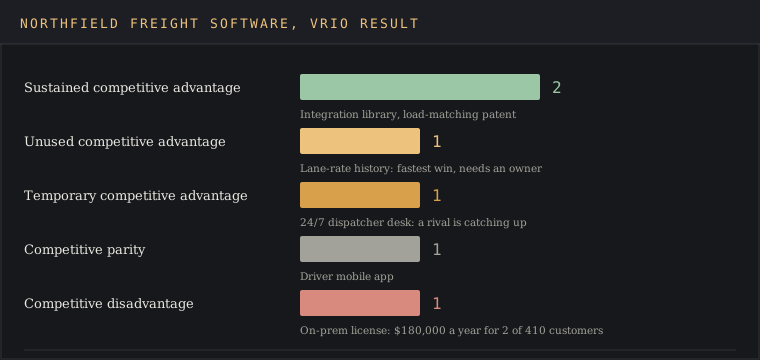
The integration library passes all four tests. The nearest rival lists 120 connectors, and Northfield spent eight years building its 310, so a competitor would need years and a large budget to close the gap. The support desk is valuable and rare today, but a rival hired a night shift in 2025, which makes it a temporary advantage with a short clock.
The lane-rate dataset row carries the biggest finding. Eleven years of pricing data is valuable, rare and impossible to rebuild, yet it sits in a support warehouse with no product owner.
That unused competitive advantage became the top line of Northfield's strategic plan, since the fix took an owner and two quarters of work from the existing budget. The on-premise license costs $180,000 a year to keep for 2 of 410 customers, so leadership chose to bite the bullet and retire it.
VRIO analysis vs SWOT analysis
A SWOT analysis template lists strengths, weaknesses, opportunities and threats, so it covers internal and external factors in one grid. VRIO goes deeper on one quadrant. It takes the strengths and asks which of them would still be an advantage after competitors respond.
The two analysis tools work best in sequence. Run a SWOT analysis or a PEST analysis template first to map the market and explore opportunities and threats, then use the VRIO analysis template to evaluate the strengths that matter for those opportunities and identify the ones worth a plan. Barney's 1991 paper makes the same split, contrasting the internal analysis of strengths and weaknesses with the external analysis of opportunities and threats.
Common mistakes
- Scoring categories. "Our people" or "our brand" can't be benchmarked, so name the specific team, skill or asset and the data behind it.
- Marking rarity against the whole market. Benchmark against the three to five competitors your customers shortlist in the industry you sell into.
- Treating a patent as permanent. Intellectual property expires and can be designed around, and a rival with access to the same suppliers can get ahead of the curve. Note the expiry date in the evidence column.
- Skipping organization. Teams stop at imitability and miss the unused advantages, the cheapest wins in the analysis.
- Filing it away. A VRIO analysis ages as competitors move. Re-run it with each annual strategy cycle and whenever a rival launches something that touches a sustained-advantage row.
Excel, Google Sheets or a whiteboard tool
Whiteboard tools such as Miro and Creately publish VRIO analysis templates as visual canvases where a team can change colors, fonts and layout, drag sticky notes and attach documents and links. They suit a live workshop. The canvas leaves the arithmetic to the team, so the competitive implication gets worked out by hand for every resource.
A spreadsheet suits the VRIO analysis template once the workshop is over. The formula applies the rules the same way to every row, and the summary updates as answers change.
The file sits next to your competitive analysis template and financial models. Google Sheets adds real-time editing for distributed teams, and both tools can import the resource list from other planning tools. Many teams use both, a whiteboard to create the resource list and a spreadsheet to score it.
FAQ
How to make a VRIO analysis?
Open a VRIO analysis template and list 10 to 20 specific resources and capabilities. For each one, answer four questions in order: is it valuable, is it rare among your direct competitors, is it costly to imitate, and is the organization set up to use it? Stop at the first No, read off the competitive implication, and write one action per resource.
Is the VRIO framework internal or external?
VRIO is an internal tool. It examines the organization's resources and capabilities, what the company owns and does well. Market conditions, regulation and competitor moves enter only through the rarity and imitability benchmarks, so pair it with an external tool such as SWOT or PEST.
Who proposed the VRIO framework?
Jay Barney proposed it. His 1991 Journal of Management paper set out value, rareness, imitability and substitutability, and his 1995 Academy of Management Executive article added the organization question that completed the VRIO acronym.
How is VRIO different from SWOT analysis?
SWOT maps strengths, weaknesses, opportunities and threats across the business and its market. VRIO tests if each strength produces a competitive advantage and how long it would last. In short, VRIO narrows a SWOT strengths list down to the items competitors would struggle to take.
How often should a VRIO analysis be updated?
Once a year with the strategic planning cycle, plus an ad hoc update when a competitor launches a product, acquires a company, or hires into a capability you marked rare. A temporary advantage can flip to parity within months.
Does passing all four VRIO tests guarantee a sustained advantage?
Passing all four means the resource has the properties that make an advantage last, judged against today's competitors. A new entrant, a substitute technology or an expired patent can change any of the four answers, and the template keeps an evidence column per row for that reason.
Bottom line
Use this VRIO analysis template when you need to analyze your resources and decide which resources deserve protection and investment, and which strengths are common across your market. The four Yes/No columns and the formula keep the scoring consistent, and the evidence column keeps it honest. The unused competitive advantage rows are usually the fastest returns in the whole file, and they're how you achieve a sustainable competitive advantage from the existing budget.
For the market side of the picture, start with the SWOT or PEST template and bring the strengths into VRIO afterwards. For turning the results into goals and budgets, the strategic plan template picks up where this one stops.