Scenario Planning Template
 By Jan Suski. I go deep on every review, checking every number against its source and digging up details other coverage misses, a habit from six years of SEO and link building for tech companies. Bylines at Brand24 and Senuto. How the scoring works.
Get the scenario planning template
An Excel workbook that ranks drivers, builds a two-axis matrix of four scenarios, models revenue and margin for each, and flags no-regret moves and triggered indicators.
Download XLSXScenario planning is a structured framework for preparing a business for multiple plausible futures. You pick the two critical uncertainties that matter most to a decision, cross them into four different scenarios, and test your strategic options against each one before committing money.
This scenario planning template runs that process in one Excel workbook. It walks from the focal question and planning horizon to a ranked list of drivers, a two-axis scenario planning matrix, a quantified model per scenario, a response table that flags no-regret moves, and a set of early warning indicators with owners.
This page covers the download, what scenario planning is and where it came from, the key elements of the file, a step-by-step method, a worked example for a pump manufacturer weighing a new plant, the indicators that tell you which future is arriving, how scenario planning differs from sensitivity analysis, common mistakes, and the software question.
It's for strategy teams, finance leads doing strategic planning and business strategy work, operations heads, and business leaders facing an investment that has to work across a range of potential outcomes. Forecasts give one number and break when the business environment shifts. Scenarios give four futures to plan against, and effective scenario planning changes the questions a leadership team asks about strategic challenges, future trends and competitive advantage.
Download the free scenario planning template
Download the template (XLSX)Seven tabs covering instructions, the focal question, a driver ranking, the scenario matrix, a model per scenario, strategic responses and early warning indicators, pre-filled with the Calder Pumps example.
The free template opens in Excel, Google Sheets and LibreOffice Calc. It uses SUMPRODUCT, RANK, COUNTIF and IF, which all three apps support. Each tab carries a grey instruction line under its header row, and the worked example sits in italics so you can overwrite it.
Scenario planning and where it came from
Scenario planning builds a small set of distinct, internally consistent stories about how the world outside the company could develop over a fixed horizon, usually three to ten years.
Each scenario is plausible, and the set spans conditions that are good and bad for the business in equal measure. The point is to rehearse strategic decisions against each future before any of them arrives, so the team can make informed strategic decisions with the potential outcomes already mapped.
The method has military roots. SRI's history of the technique ascribes the origins of scenario planning to Herman Kahn at the RAND Corporation, the Cold War futurist who used scenarios to think through nuclear strategy. RAND's own account dates its work on the Delphi method and scenario analysis to the late 1950s and 1960s. Delphi, a structured communication technique for polling experts in rounds, is still a common way to gather input for scenario development.
Royal Dutch Shell brought the method into business. According to strategy+business's profile of Pierre Wack, Shell's scenario team delivered a 1972 report to the managing directors anticipating the coming energy crisis, and its scenarios alerted them in advance to the 1973 crisis and the 1979 price shock. Wack described the work in "Scenarios: Uncharted Waters Ahead" in the Harvard Business Review in September 1985.
Why use scenario planning
A single forecast fails quietly. The plan looks fine until future events move one big variable, and by then the budget is spent. Teams that plan to cross that bridge when they come to it end up making a multi-million decision in a week. Scenario planning puts the biggest variables on the table up front, forces a response for each of the different scenarios, and moves decision making ahead of the shock.
- Risk management. Each scenario surfaces potential risks and future outcomes a base-case plan hides, so you can identify risks and mitigate risks before they land.
- Resource allocation. Spending that pays off in all four futures goes ahead now, and the template parks one-future bets until an indicator triggers. No-regret moves are the stitch in time that saves nine, since they pay off in every future.
- Contingency plans. You develop contingency plans in advance, with owners, so the response to a shock is a decision already made.
- Strategic agility. Early warning indicators tell the team which future is unfolding, so it can respond effectively months ahead of competitors still reading last year's forecast, a competitive edge that compounds.
Teams that use scenario planning also feed it into business continuity planning, crisis management and risk mitigation. The worst case scenario in the matrix is a ready-made stress test for the continuity plan, and the indicators double as triggers for it.
Key elements of the scenario planning template
| Tab | What goes in | What it produces |
|---|---|---|
| Focal Question | The decision, horizon, owner, strategic objectives, review date | One sentence everyone scores against |
| Drivers | Up to 20 external forces, each scored 1 to 5 for impact and uncertainty | A ranked list and a flag for the two critical uncertainties |
| Matrix | Two axes, four scenario names, a narrative per quadrant | The scenario planning matrix |
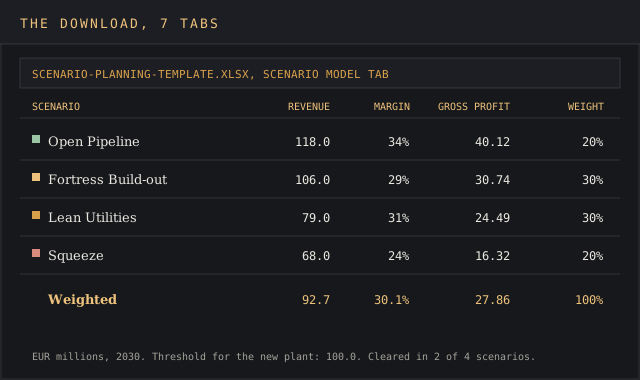
| Scenario Model | Revenue, margin and optional weights per scenario | Gross profit per scenario and a weighted total |
| Responses | Strategic options rated Works, Partly or Fails per scenario | No-regret, contingent and high-risk flags |
| Indicators | Signals, current values, trigger thresholds, owners | A Triggered or Watching status per signal |
The Drivers tab sorts forces into three groups. High impact and high uncertainty becomes a critical uncertainty and a candidate axis. High impact and low uncertainty becomes a predetermined element, which Pierre Wack described as events already under way or almost certain whose consequences are not yet clear. Everything else goes on the watch list.
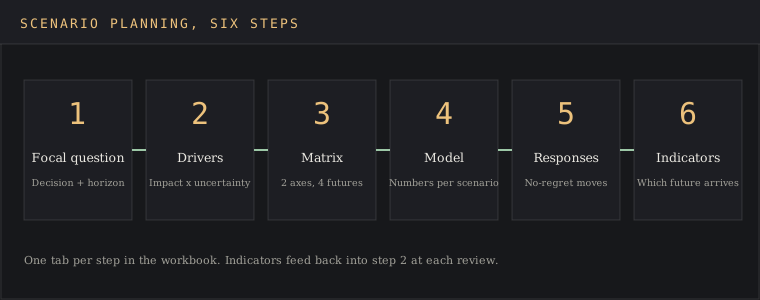
How to build scenarios with the template, step by step
- Write the focal question and horizon. Tie it to a real decision with a date, such as "Should we build a second plant by 2029?" The question frames every later step of the scenario planning process.
- List the drivers. Pull 10 to 20 external forces from a PEST analysis template, your trend tracker and interviews. Cover geopolitical events, technological advancements, environmental regulations, emerging trends and customer demand.
- Score impact and uncertainty. Rate each driver 1 to 5 on both. Use historical data and relevant data for the scoring, with expert judgment filling the gaps.
- Pick the two critical uncertainties. Take the two highest-scoring drivers that are independent of each other. They become the axes of the scenario matrix.
- Name and write the four plausible scenarios. Give each quadrant a short name and a one-paragraph narrative explaining how the world got there by the end of the horizon.
- Quantify each scenario. Put revenue, margin and any other driver into the Scenario Model tab so the team can compare scenarios on the same numbers.
- Rate strategic responses and set indicators. Score each option against all four futures, assign an owner and a deadline, and write the signals that would tell you a scenario is arriving.
Engage stakeholders early and involve key stakeholders from finance, sales, operations and procurement. Diverse stakeholders catch blind spots a strategy team misses, and a two-hour workshop with eight people covers steps 2 to 5. Getting the ball rolling is the hard part, and a pre-filled driver list cuts the first hour down.
The scenario planning matrix
Developing scenarios with a two-axis matrix is the most common way to turn two critical uncertainties into four basic scenarios. Each axis runs between two extremes of one uncertainty, and each quadrant is one combination. The matrix keeps the set balanced, so the team can't quietly write three optimistic futures and one gloomy one.
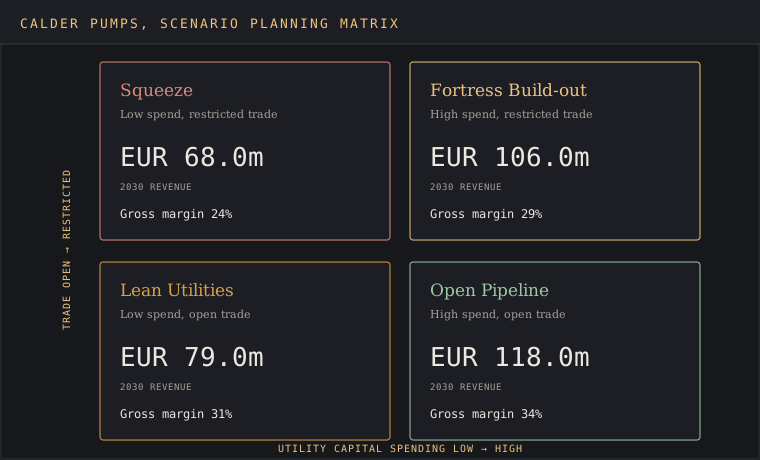
Axes have to be independent. If high spending always comes with open trade, the two drivers are one uncertainty in disguise, and two quadrants describe impossible worlds. Swap one axis for the next driver on the ranked list.
Worked example: Calder Pumps
Calder Pumps is a fictional 450-person manufacturer of industrial pumps for European water utilities, with 2026 revenue of €84 million. Its focal question is "Should we build a second assembly plant in Central Europe by 2029?" The plant only pays off above €100 million in annual revenue. The horizon runs to 2030, and every value below is pre-filled in the download.
Eight drivers went into the ranking. Utility capital spending scored 5 for impact and 5 for uncertainty, a score of 25. Tariffs on imported motors scored 5 and 4, a score of 20. Those two became the axes. Skilled-labor supply, steel castings and drought frequency each scored 4 for impact and 3 for uncertainty, so they went in as predetermined elements every scenario carries.
| Scenario | Utility spending | Trade | 2030 revenue | Gross margin | Gross profit | Weight |
|---|---|---|---|---|---|---|
| Open Pipeline | High | Open | €118.0m | 34% | €40.12m | 20% |
| Fortress Build-out | High | Restricted | €106.0m | 29% | €30.74m | 30% |
| Lean Utilities | Low | Open | €79.0m | 31% | €24.49m | 30% |
| Squeeze | Low | Restricted | €68.0m | 24% | €16.32m | 20% |
| Weighted | €92.7m | €27.86m | 100% |
Revenue clears €100 million in two of the four futures, and the weighted figure of €92.7 million sits below it. Building the plant now bets the company on high utility spending, and counting chickens before they hatch is an expensive habit with a plant. The Squeeze scenario, the worst case scenario at €16.32 million gross profit, would leave the new plant half empty.
The Responses tab sorted Calder's options into three groups:
- No-regret moves work in all four futures. Calder's two were a second casting supplier inside the EU and a three-year option on the plant site.
- Contingent moves work in two or three futures, such as building the plant once two high-spending indicators trigger, or adding a service-contract business line for the Lean Utilities world.
- High-risk moves fail in two or more futures. Building the plant in 2027 at full capacity was the one on Calder's list.
The decision was to stage it. Calder bought the site option and paused the build behind two indicators. That's adaptive strategies in practice, with a dated plan for each future and a trigger that tells the board which plan to run. The weighted revenue also went into an NPV calculator as the base for the plant's discounted cash flow analysis.
Early warning indicators and review cadence
Indicators are measurable signals that show which scenario is unfolding. Each one gets a current value, a trigger threshold, the scenario it points to, an owner and a check frequency. The Indicators tab flags a signal as Triggered once the current value crosses its threshold.
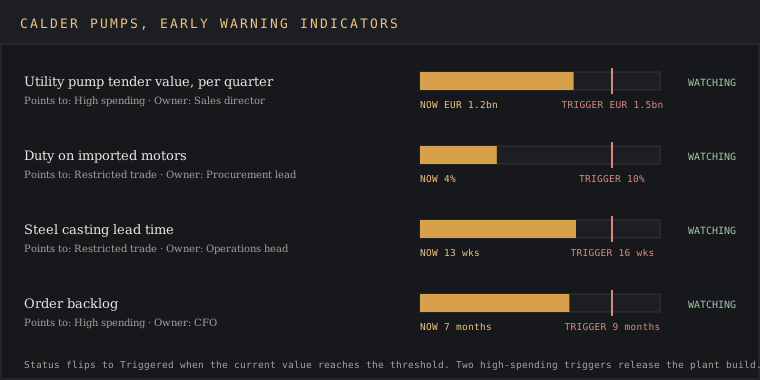
| Indicator | Trigger | Points to | Owner | Check |
|---|---|---|---|---|
| Utility pump tender value in Calder's six markets | Above €1.5bn for two quarters | High spending | Sales director | Quarterly |
| Duty on imported motors | Above 10% | Restricted trade | Procurement lead | Monthly |
| Steel casting lead time | Above 16 weeks for three months | Restricted trade | Operations head | Monthly |
| Order backlog | Above 9 months of output | High spending | CFO | Monthly |
Review the full set of scenarios once a year with the strategic planning cycle, and go back to the drawing board on the driver ranking any time an indicator triggers or a shock lands outside the four stories. Adapting scenarios to new information keeps the future scenarios useful. A scenario set that hasn't changed in two years has stopped informing decisions.
Scenario planning, scenario analysis and sensitivity analysis
The three terms get used interchangeably, and they do different jobs.
- Sensitivity analysis changes one input at a time, such as price or volume, and shows how far the output moves. It's a financial analysis tool for a model you already trust.
- Scenario analysis changes several inputs together to model named cases, often base, upside and downside. Excel's Scenario Manager does this, and Microsoft's guide notes that a scenario can hold up to 32 changing values.
- Scenario planning starts outside the spreadsheet with the forces that shape the business environment, builds multiple future scenarios from them, and only then moves into scenario modeling with quantitative methods.
The template covers all three. The Scenario Model tab is a scenario analysis, and you can run sensitivity analysis on any single cell in it. The Drivers, Matrix and Responses tabs are the planning layer that makes the numbers worth trusting.
Common mistakes
- Writing a best, base and worst case. Three points on one line test one uncertainty. Build the matrix from two independent ones.
- Picking internal axes. Your own hiring plan is a decision, so keep the axes for external forces you can't control.
- Stopping at the stories. Narratives need numbers and owners before they change strategic decision making, so quantify each one and assign every response.
- Treating weights as forecasts. The probability column is optional and subjective. Use it for financial forecasting, and keep it away from the narratives.
- Burying your head in the sand. A scenario set without indicators can't tell the board which plan to run, and teams that skip them only learn which future arrived from the quarterly results.
Excel, Google Sheets or scenario planning software
A spreadsheet handles a scenario set of this size with room to spare. Excel adds the Scenario Manager and Data Tables for sensitivity work, and Google Sheets adds real-time editing for a workshop where finance and operations fill in tabs at the same time.
Dedicated FP&A and scenario modeling platforms earn their cost when scenarios have to link to a live general ledger, roll across business units, or refresh from data analysis pipelines every week.
For a leadership team testing one big decision, a workbook gives the same strategic agility with a shorter setup, and the same file can hold operational scenarios for a single plant, such as an energy-price spike tested against an operational efficiency target. Pair it with a risk register template to track the risks each scenario surfaces.
FAQ
What is scenario analysis?
Scenario analysis estimates how an outcome, such as revenue or project value, changes under a set of named cases where several inputs move together. It's the quantitative step inside scenario planning, and Excel's Scenario Manager is a common tool for it.
What do you mean by scenario planning?
Scenario planning is a strategic planning method that builds several plausible futures from the two or three uncertainties that matter most, then tests strategies against each one. Its aim is to develop strategies that hold up across multiple scenarios, turn them into actionable strategies with owners, and support informed decisions with signals that show which future is arriving.
Can you provide an example of an Excel scenario?
The Calder Pumps example above is one, with four scenarios built from utility spending and trade conditions, each with 2030 revenue, gross margin and gross profit, and a weighted total of €92.7 million revenue. All of it is pre-filled in the downloadable workbook.
How to find scenario manager in Excel?
Go to the Data tab, select What-If Analysis in the Forecast group, and choose Scenario Manager. Click Add to name a scenario and pick its changing cells, then use Summary to put every scenario side by side on a new sheet.
How can I write a scenario?
Start from the end state on your horizon and work back. Name the scenario in two or three words, state where each critical uncertainty landed, and describe in one paragraph the chain of events that got there. Close with what it means for your customers, costs and competitors.
How many scenarios should a scenario planning template have?
Four is the standard, since two critical uncertainties produce four quadrants. Three tends to collapse into high, middle and low, and five or more is hard for a leadership team to keep in mind during strategic decisions.
Bottom line
Use this scenario planning template when one large decision has to survive futures you can't forecast: a new plant, a market entry, an acquisition, a multi-year contract. The workbook turns drivers into four quantified scenarios and sorts your options into no-regret, contingent and high-risk moves, with indicators that tell you when to act.
For scoring a list of options against fixed criteria, the decision matrix template is the quicker tool. For checking which internal strengths hold up in each scenario, run the VRIO analysis template on the resources the plan depends on.