Business Continuity Plan Template
 By Jan Suski. I go deep on every review, checking every number against its source and digging up details other coverage misses, a habit from six years of SEO and link building for tech companies. Bylines at Brand24 and Senuto. How the scoring works.
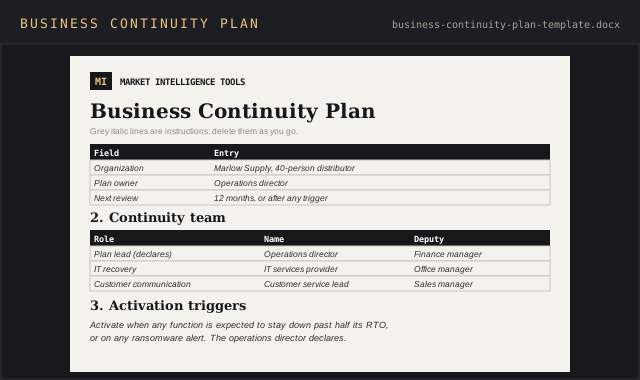
Get the business continuity plan template
A Word document with eleven sections, from the continuity team and activation triggers to a business impact analysis with RTO and RPO targets and a testing schedule, pre-filled for a 40-person distributor.
Download DOCXA business continuity plan template is a fill-in document that records how an organization keeps its essential functions running through a disruption and how it gets the rest of its business operations back. The file on this page is an 11-section Word document built on the Ready.gov plan outline, with a risk assessment table, a business impact analysis (BIA) that sets recovery targets, restore procedures, a crisis communication plan and a testing schedule.
This page covers what a business continuity plan is, each section of the template, how recovery time and recovery point objectives work, how to write the plan step by step, and a worked example for a 40-person distributor. It also covers where a business continuity plan stops and a disaster recovery plan starts.
It's built for operations managers, small business owners, IT leads and compliance staff who need a working plan without buying business continuity software. A 15-person agency and a 300-person manufacturer fill in the same sections; the manufacturer's tables run longer.
The standard reference is NIST Special Publication 800-34 Rev. 1, the US government's contingency planning guide, published in May 2010. It defines a business continuity plan as procedures for sustaining business operations while recovering from a significant disruption, and the template follows its order.
Download the free business continuity plan template
Download the business continuity plan template (DOCX)An 11-section Word document: plan administration, continuity team, activation triggers, risk assessment, BIA, recovery strategies, manual workarounds, crisis communication, vendor contacts, testing schedule and revision history, pre-filled with the Marlow Supply worked example.
The document opens in Microsoft Word, Google Docs and LibreOffice Writer. Every table is a plain Word table, the instructions are grey italic lines you delete as you go, and the worked example sits in italic rows you overwrite.
What a business continuity plan is
A business continuity plan lists the business functions an organization can't afford to lose, how long each can stay down, and the procedures that keep it running or bring it back. It covers personnel, premises, suppliers, IT services and data, and it names who does what in the first hour and which resources each step needs.
NIST separates it from the narrower plans that sit under it. The disaster recovery plan relocates information systems to an alternate site after a major disruption; the business continuity plan keeps the business running while that happens. Most small organizations write one document and keep IT recovery as a section inside it.
The certifiable version is ISO 22301:2019, the requirements standard for a business continuity management system. Its 2024 amendment added climate change as an issue an organization has to consider, so climate-related risks now belong in the risk assessment.
Why write a continuity plan before an outage
A business continuity plan exists to minimize downtime when unforeseen events hit: a ransomware attack, a flood, a supplier that goes under, a key person who leaves. Without one, the first hours of a disruption go to working out who's in charge and where the backups are, and those are the hours the recovery time objective was counting on. From the first alert, it's a race against time.
The potential impact runs past lost sales. Customers who can't place an order buy from someone else, service delivery commitments slip, and contracts with service-level clauses start costing money. A solid business continuity plan gives critical services a route back to normal operations, and its BIA sets the order they come back in.
Each industry has unique needs. A distributor's critical systems are the ERP and the carrier; a clinic's are patient records and the phone line; a software company's are its hosting and support queue. The sections stay fixed and the rows change, so the same small business continuity plan template works for all three. Ensuring business resilience starts with that list of what can't stop.
The eleven sections of the template
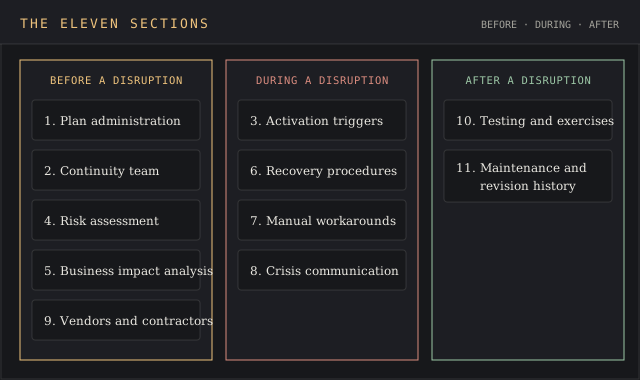
This continuity plan template's outline follows the Ready.gov business continuity plan published by FEMA, with activation triggers and a risk assessment pulled out into their own sections.
| Section | What goes in it |
|---|---|
| 1. Plan administration | Scope, objectives, assumptions, plan owner, review date |
| 2. Continuity team | Roles and responsibilities, deputies, lines of authority, contact numbers |
| 3. Activation triggers | What starts the plan, who declares it, the call tree |
| 4. Risk assessment | Potential threats scored on likelihood and impact, with mitigation |
| 5. Business impact analysis | Critical business functions, maximum tolerable downtime, RTO, RPO, dependencies |
| 6. Recovery strategies and procedures | Detailed procedures per function, alternate site, IT and data restoration |
| 7. Manual workarounds | Paper forms and offline steps that maintain operations during an outage |
| 8. Crisis communication plan | Audiences, message owners, channels and timing |
| 9. Vendors and contractors | Supplier and service contacts, emergency numbers, backup suppliers |
| 10. Training, testing and exercises | Schedule of tabletop, restore and call-tree tests |
| 11. Maintenance and revision history | Review triggers, lessons learned, change log |
Sections 4 and 5 do the thinking. The risk assessment says what could happen; the BIA says what each hour of downtime costs. Every recovery strategy in section 6 should trace back to a row in one of them, and section 6 outlines procedures for each function in the order the BIA ranks them, so recovery efforts start on the right application first.
RTO, RPO and maximum tolerable downtime
Three numbers per function drive the whole plan, and NIST SP 800-34 defines all three. The devil's in the details: each one sets a different part of the continuity strategies.
- Maximum tolerable downtime (MTD): the total time the business owner will accept a function being unavailable before the damage is permanent.
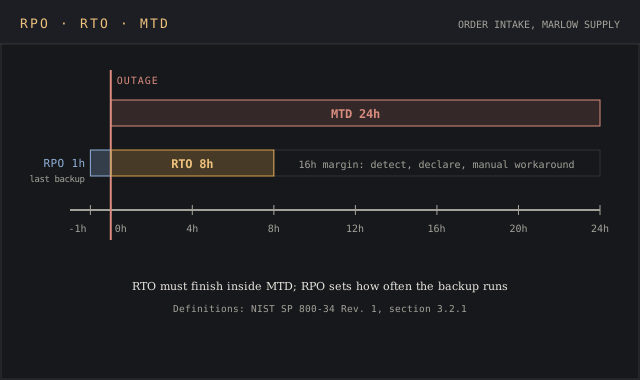
- Recovery time objective (RTO): the maximum time a system can stay unavailable before it puts the MTD at risk.
- Recovery point objective (RPO): the point in time to which data must be recovered, measured backwards from the disruption. An RPO of one hour means the business can lose at most an hour of orders.
The rule the template checks: RTO has to be shorter than MTD, with room for the time it takes to notice the outage and activate the plan. An RPO, in turn, sets the backup schedule, and a restore from a backup older than the RPO sends the team back to square one. A one-hour RPO with nightly backups is a plan that fails on paper before it fails in practice.
How to write a business continuity plan
NIST's seven-step process starts with a policy statement and a BIA, and ends with testing and maintenance. The template compresses it into six working steps.
- Set scope and owner. Name the sites, functions, services and people the plan covers, and one owner who keeps it current. Fill in section 1 and identify the resources the plan can draw on.
- Run the risk assessment. List potential threats, from natural disasters and cyber attacks to the loss of a single supplier, and score each on likelihood and impact from 1 to 5. Identify potential risks with the managers who run each function; identifying risks from the IT desk alone misses the carrier and the warehouse.
- Run the business impact analysis. Identify the business processes behind each function, list the IT processes they depend on, and ask the manager who runs them what a day, three days and a week of downtime cost. Set MTD, RTO and RPO from the answers.
- Develop strategies. For every function with an RTO under a week, write step-by-step recovery procedures, plus the manual workaround that bridges the gap. Focus first on strategies that mitigate risks scoring 12 or more.
- Assign clear roles and contacts. Fill in the continuity team, deputies and responsibilities, create the call tree and the vendor list. Every task in section 6 needs a name.
- Test and schedule reviews. Run a tabletop exercise with the employees named in the plan before calling it done, and book the next one. Plans that regularly test their call tree find the dead numbers first.
Developing the plan in this order matters for one reason: the first step in business continuity planning is the scope and the risk assessment. Teams that start by writing restore steps end up with detailed steps for a server room fire and nothing for the morning their only carrier doesn't show up, which is also when they learn which strategies they never wrote.
Worked example: a 40-person wholesale distributor
Marlow Supply is a hypothetical 40-person distributor of restaurant supplies with one warehouse, a B2B web storefront and a cloud ERP. Customers order by 4pm for next-day delivery, so a lost afternoon is a lost day of revenue. The operations director owns the plan.
Risk assessment
| Threat | Likelihood | Impact | Score | Mitigation |
|---|---|---|---|---|
| Ransomware on office PCs or the ERP account | 3 | 5 | 15 | MFA on every account, offline backups restored quarterly |
| Only freight carrier fails to collect | 3 | 3 | 9 | Rate agreed in advance with a second carrier |
| Power cut over 24 hours | 2 | 4 | 8 | Generator hire contract; ERP reachable from home |
| Both warehouse leads off in the same week | 2 | 3 | 6 | Two pickers cross-trained on dispatch |
| Office internet outage | 3 | 2 | 6 | Cellular failover router |
| Warehouse fire | 1 | 5 | 5 | Insurance; third-party logistics contact list |
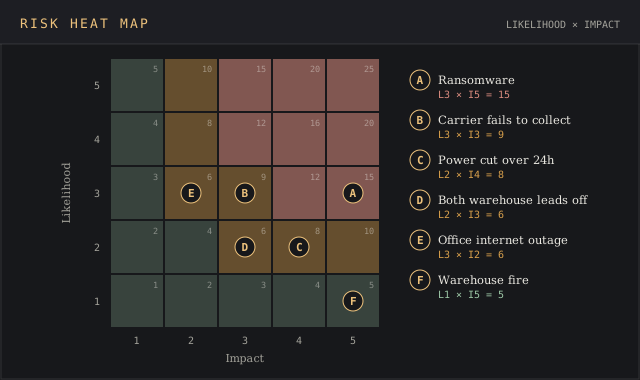
Disruptions cluster, and when it rains it pours: a regional storm can bring the power cut, the internet outage and the absent warehouse lead in the same week, so the plan treats natural disasters as a trigger for several rows at once.
Ransomware scores highest, so it gets the most detailed procedure and the first tabletop exercise; MFA and offline backups mitigate it before an incident, and section 6 covers the rest. The carrier risk scores 9 and costs almost nothing to fix: one agreed rate with a second carrier is cheap supply chain resilience, and it stops the business from putting all its eggs in one basket.
Business impact analysis
| Function | MTD | RTO | RPO | Depends on |
|---|---|---|---|---|
| Order intake (storefront and ERP) | 24 hours | 8 hours | 1 hour | ERP, internet, payment gateway |
| Customer service phone line | 24 hours | 4 hours | None | VoIP provider |
| Warehouse pick and dispatch | 72 hours | 48 hours | 24 hours | ERP pick lists, carrier, forklifts |
| Supplier purchasing | 5 days | 72 hours | 24 hours | ERP, email |
| Payroll | 7 days | 5 days | 24 hours | Payroll provider |
Every RTO sits under its MTD, which is the check the table exists to make. Order intake is the critical function. An 8-hour RTO inside a 24-hour MTD leaves 16 hours to detect the outage, declare it and fall back to the manual workaround: create a shared spreadsheet, key phone orders into it and re-enter them when the ERP comes back. The aim is to minimize downtime for the customer, even while the ERP is still down.
Activation and crisis communication
The emergency plan activates when any function is expected to stay down past half its RTO, or on any ransomware alert whatever its expected duration. The operations director declares; the finance manager is first deputy. The crisis communication table tells each group of stakeholders who calls them and when.
| Audience | Channel | Within | Owner |
|---|---|---|---|
| Employees | SMS call tree | 30 minutes | Operations director |
| Customers | Email and storefront banner | 2 hours | Customer service lead |
| Suppliers and carrier | Phone, then email | 24 hours | Purchasing manager |
| Insurer | Phone | 24 hours | Finance manager |
Business continuity plan vs disaster recovery plan
A business continuity plan covers the whole business: staff, premises, suppliers, customers and data. A disaster recovery plan covers IT systems only, and in NIST's definition it's activated after major disruptions with long-term effects. The DRP answers how the ERP gets restored; the business continuity plan answers how orders get taken while that's happening.
Small organizations rarely need two documents, and developing both doubles the maintenance work. Section 6 of this template carries the IT recovery steps, and a separate disaster recovery plan becomes worth writing once a dedicated IT department owns more applications than one section can hold.
Testing and maintaining the plan
A plan nobody has rehearsed fails at the first wrong phone number, and testing is the first job put on the back burner when a quarter gets busy. NIST's sample policy says recovery capabilities shall be tested annually and the plan reviewed annually, and Ready.gov's outline asks for orientation, tabletop and full-scale exercises. The worked example schedules three kinds of test.
- Quarterly: restore one backup to a test machine and time it against the RTO and RPO. A restore that runs long is a red flag for the whole recovery plan.
- Twice a year: a 90-minute tabletop exercise on the top-scoring risk.
- Annually: a full call-tree test and a plan review against the latest risk assessment.
Update the plan after every test and every real incident, with the lessons learned logged in the revision history. For a real incident, a root cause analysis report records why it happened before the plan changes. Also revisit it after regulatory changes, a new supplier, new IT services, a new site or a staff change in the continuity team. Each review is also a check that the essential resources listed still exist.
Common mistakes with a business continuity plan
- Writing it for IT only. Business resilience depends on people and suppliers as well as servers. A plan that restores servers and forgets who answers the phones covers one of five critical functions in the worked example.
- RTOs nobody can hit. A 4-hour RTO with a restore that takes 9 hours on test day is a paper target. Test, then set the number.
- One name per role. If the operations director is on vacation, the plan needs a deputy who has read it.
- Storing it only on the server that went down. Ready.gov's template says to keep printed copies and electronic copies on a secure site and a USB drive.
- No review date. Contact lists go stale within months. Teams that plan to cross that bridge when they come to it find out mid-incident that half the call tree has left.
Word, Google Docs or continuity software
Word or Google Docs covers a single-site business, and a small business continuity plan template in .docx format covers most needs. The plan has to be readable on a phone in a parking lot with no network, so export a PDF after every update and keep it offline.
Business continuity management software earns its cost past several sites or when compliance audits want evidence of an ISO 22301 program: it stores the BIA as data, tracks tests, and sends call-tree alerts. For one site and five critical functions, the Word plan template and a calendar reminder do the job.
FAQ
What is a business continuity plan?
A document that records which business functions an organization can't lose, how long each can stay down, and the procedures, people and resources that keep each running or restore it after a disruption. Its job is to support the business through a crisis and back to normal service.
What is the first step in business continuity planning?
Set the scope and run a risk assessment, then a BIA. NIST's seven-step process opens with a policy statement and the BIA, because every recovery target comes from it.
How do you build a business continuity plan?
Create a scope statement, score potential risks, run a BIA to set MTD, RTO and RPO for each function, write recovery steps and manual workarounds, assign people with deputies, then test it with a tabletop exercise and schedule reviews.
What's another way to say business continuity?
Business resilience and operational resilience are the closest terms, and each industry tends to pick its own label. US federal agencies use continuity of operations, or COOP, for the government version, and ISO 22301 calls the management system around the plan business continuity management.
What are the key components of a business continuity plan?
No standard fixes the number. The essential parts every version carries are a continuity team with clear roles, a risk assessment, a BIA with recovery targets, recovery procedures, a communication plan and a testing schedule.
Can you provide a sample disaster recovery plan for a small business?
The worked example above is one: a 40-person distributor with an 8-hour RTO and a 1-hour RPO for order intake, offline backups restored quarterly, and a manual workaround for phone orders. Section 6 of the template holds the IT recovery steps and the restore strategies for each application.
Where can I find templates for business continuity plans?
Ready.gov publishes a free outline and BIA worksheet for developing a plan from scratch. The template on this page follows that outline and adds a scored risk assessment, activation triggers and a filled-in example.
Bottom line
Use this business continuity plan template when an organization has a handful of essential functions that can't stop for a day and nobody has written down what happens when they do. The BIA is the section that earns the time: once MTD, RTO and RPO exist, every other section, and each of its strategies, has a number to work to.
For scoring a wider set of risks, a risk assessment matrix holds more rows. For mapping who needs to hear what during an incident, a stakeholder analysis template feeds section 8.