Strategic Plan Template
 By Jan Suski. I go deep on every review, checking every number against its source and digging up details other coverage misses, a habit from six years of SEO and link building for tech companies. Bylines at Brand24 and Senuto. How the scoring works.
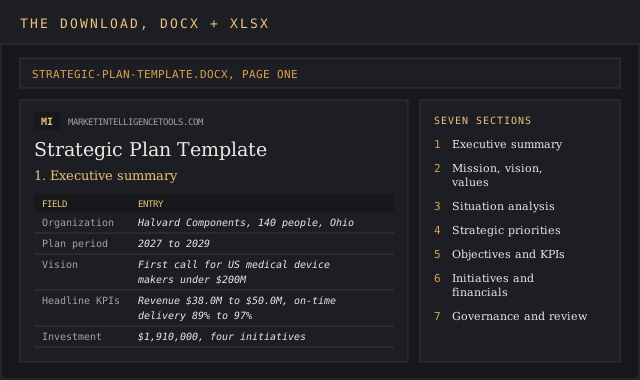
Get the strategic plan template
A Word plan with seven sections, from mission and vision to a balanced scorecard and review calendar, plus an Excel scorecard that flags each KPI every quarter.
Download DOCXA strategic plan template is a ready-made document for deciding where an organization is headed over the next three to five years and how it gets there. It walks a leadership team through the mission and vision, a situation analysis, a short list of strategic priorities, objectives with key performance indicators, the initiatives that deliver them, and the review rhythm that keeps the plan current.
This page gives you a free strategic plan template in Word, an Excel scorecard that tracks every objective quarter by quarter, a walk through the seven sections, a five-step strategic planning process, and a worked example: a fictional 140-person electronics manufacturer planning 2027 to 2029.
It's for a leadership team writing its first plan, a manager asked to turn a two-day offsite into a document people will read, a nonprofit board that needs community engagement built into the plan (its revenue targets then go into a fundraising plan template), and consultants who want a format clients can edit. The structure works for a 12-person startup and a 2,000-person company alike, because only the number of objectives changes.
The plan has a known failure point. In a 2005 Harvard Business Review article, Robert Kaplan and David Norton reported that on average 95% of a company's employees are unaware of, or do not understand, its strategy. A short plan with one owner per objective and a quarterly review is the cheapest fix for that gap.
Download the free strategic plan template
Download the strategic plan template (DOCX)A seven-section Word document with instruction lines under every heading, a mission, vision and core values box, SWOT and environmental scan tables, a focus-area table, a balanced scorecard of objectives and KPIs, an initiatives roadmap and a governance calendar, with the Halvard example filled in.
Download the strategic plan scorecard (XLSX)Four tabs cover instructions, a scorecard that calculates progress and status for each KPI every quarter, an initiatives tracker with budget totals, and a three-year revenue projection.
The strategic plan template Word file opens in Microsoft Word, Google Docs and LibreOffice, and its tables paste into PowerPoint templates for the board version. The scorecard uses IF, COUNT and basic arithmetic only, so it behaves the same in Excel and Google Sheets.
What a strategic plan is
A strategic plan is a document that records the organizational profile and purpose, where the organization wants to be in three to five years, and the handful of strategic decisions that get it there. It sets the organization's direction, gives managers actionable direction for the strategies under it, and leaves the week-to-week work to operational plans and team budgets.
Most organizations call it by several names: a strategic roadmap, a long-range plan or a corporate plan. Henry Mintzberg's 1987 paper in the California Management Review listed five meanings of strategy (plan, ploy, pattern, position and perspective), and the document covers the first one. The other four show up in what the organization does once the plan is live.
It sits above the other planning documents. A marketing plan covers one function for one year, and a business plan argues for funding. The strategic plan ensures both point at the same long-term goals and the business's future the leadership team has agreed on.
Key components of an effective strategic plan
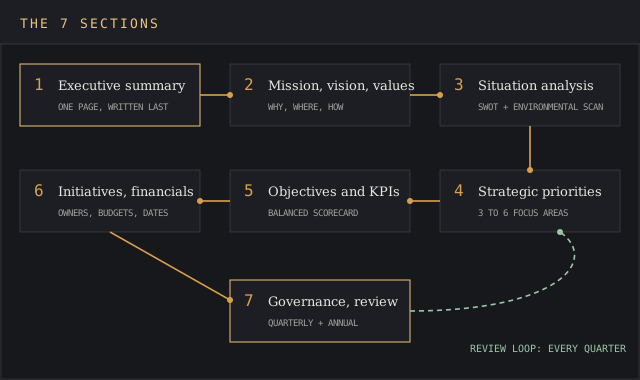
The template has seven sections. Each one answers a single question, and the answers depend on the sections before them.
| # | Section | The question it answers | Tables in the file |
|---|---|---|---|
| 1 | Executive summary | What are we committing to, on one page? | Summary box |
| 2 | Mission, vision and core values | Why do we exist, where are we headed, how do we behave? | Statement box |
| 3 | Situation analysis | Where do we stand today? | SWOT grid, environmental scan, current position |
| 4 | Strategic priorities | Which 3 to 6 focus areas get the resources? | Focus-area table |
| 5 | Objectives and KPIs | What does success look like, measured, and who owns it? | Balanced scorecard |
| 6 | Initiatives, resources and financials | Which projects deliver it, at what cost, by when? | Roadmap, budget, financial projections |
| 7 | Governance and review | Who checks progress, and how often? | Review calendar |
Mission and vision statements
A mission statement defines the organization's purpose, meaning who it serves and what it does for them. Vision statements describe the organization's vision of its long-term aspirations, usually in one sentence with a date attached. Keep both short enough to remember, because a team that can recite the vision has a better understanding of what to say no to. Core values sit underneath as three to five behaviors the team can be held to.
Situation analysis and environmental scan
Start the situation analysis with the current position in numbers: revenue, margin, headcount, market share where you have it, and the KPIs you already track. A SWOT analysis covers internal capabilities, and an environmental scan covers external factors such as industry trends, regulation and labor supply. The PEST analysis template works as that scan, and both show where the competitive edge sits today.
Strategic priorities
Pick between three and six focus areas, the range Baton Global's planning template recommends. Below three, parts of the business run without direction. Above six, resource allocation gets spread too thin to move any of them. Each focus area becomes a heading for strategic objectives in the next section.
Objectives and key performance indicators
The balanced scorecard is the most widely recognized way to structure this section. Robert Kaplan and David Norton introduced it in 1992, measuring performance from four perspectives: financial, customer, internal process, and learning and growth, per Harvard Business School Working Knowledge.
The strategic plan template's scorecard uses those four as rows. Every objective gets measurable targets, a baseline, a time-bound deadline, one named owner, and a KPI tagged leading or lagging.
Lagging indicators such as revenue tell you if the strategy worked. Leading indicators such as certified technicians hired tell you early if it's going to, so keep an eye on them every month. Together they track progress toward organizational goals from both ends.
Initiatives, resource allocation and financial projections
Strategic initiatives are the funded projects that move the KPIs. Each gets an owner, a budget, a start and an end date. Workforce planning lives here too, with human resources owning the hiring and training lines, alongside three years of financial projections that show the initiatives are affordable.
Governance and review
Treat the plan as a living document. The leadership team reviews the scorecard every quarter, the board sees it twice a year, and the whole plan gets a refresh each autumn. Continuous refinement keeps the plan current, because the organizational change the plan sets off will change the assumptions it started from. Keep the top risks to the plan in a risk assessment matrix and score them at the same meeting.
The strategic planning process in five steps
The planning process takes four to eight weeks for a mid-size company. Cutting corners here costs three years, because the first draft sets the agenda for the whole period, and time spent on strategic thinking up front lets the team make informed decisions later.
- Gather input. Get the ball rolling by interviewing the leadership team. Run an anonymous staff survey, and talk to five to ten customers. Diverse perspectives catch blind spots a leadership offsite misses, and a stakeholder map shows who else needs a voice.
- Analyze the current position. Fill in the SWOT grid, the environmental scan and last year's numbers.
- Set direction. Confirm the mission and vision statements and choose three to six focus areas.
- Translate it into objectives. Write the scorecard, assign owners, then cost the strategic initiatives and confirm the financial projections cover them.
- Launch and review. Share the plan, start the quarterly reviews, and act on the feedback you collected in step one so staff can see the plan achieve what they asked for.
Stakeholder engagement in step one pays back in step five. Staff who saw their survey answers reflected in the plan show up to the reviews with fresh insights, and leadership owns every revision, so changes stay aligned with the strategy.
Worked example: Halvard Components, 2027 to 2029
Halvard Components is a fictional company built for this example: a 140-person contract electronics manufacturer in Ohio that builds circuit boards and box assemblies for medical and industrial device makers. In 2026 it booked $38.0M in revenue at a 21% gross margin, delivered 89% of orders on time, and drew 31% of revenue from its largest customer. The download ships with this plan filled in.
Mission, vision and values
- Mission. Build the circuit boards and box assemblies that small medical and industrial device makers can't build themselves, on time and to spec.
- Vision. By 2029, the first call for any US medical device maker under $200M in revenue that needs a contract manufacturer.
- Core values. Ship what we promise. Document everything. Fix the process before blaming a person.
Four focus areas
Halvard's SWOT analysis showed a medical-device quality certification as the main strength, customer concentration and manual scheduling as the weaknesses, reshoring of medical electronics as the opportunity, and a shortage of trained surface-mount (SMT) technicians as the threat. That produced four focus areas, which are to grow medical revenue, reduce dependence on one customer, raise on-time delivery, and build the technician bench.
The scorecard
| Perspective | KPI | Type | Owner | 2026 | 2027 | 2029 |
|---|---|---|---|---|---|---|
| Financial | Trailing 12-month revenue | Lagging | CEO | $38.0M | $41.6M | $50.0M |
| Customer | Medical share of revenue | Lagging | VP Sales | 44% | 49% | 60% |
| Customer | Largest customer's share of revenue | Lagging | VP Sales | 31% | 27% | 19% |
| Internal process | On-time delivery | Lagging | VP Operations | 89% | 92% | 97% |
| Learning and growth | Certified SMT technicians | Leading | HR Director | 12 | 16 | 24 |
| Learning and growth | Voluntary staff turnover | Leading | HR Director | 18% | 15% | 10% |
Revenue grows 9.6% a year: $38.0M to $41.6M, $45.6M and $50.0M. You can check the compound rate with the CAGR calculator.
Initiatives and budget
| Initiative | Focus area | Owner | Budget | Timing |
|---|---|---|---|---|
| Medical sales program, two account managers | Grow medical revenue | VP Sales | $360,000 | Q1 2027 to Q4 2029 |
| Finite-capacity scheduling software | On-time delivery | VP Operations | $140,000 | Q2 2027 to Q1 2028 |
| Technician apprenticeship with a community college | Technician bench | HR Director | $210,000 | Q3 2027 to Q4 2029 |
| Second SMT production line | Grow medical revenue | CFO | $1,200,000 | 2028 |
| Total | $1,910,000 |
Of the $1.91M, the second SMT line takes the lion's share, so it waits until 2028, after the medical sales program has shown it can fill the capacity. Every initiative maps to one of the four strategic goals, and each one names the KPI it's meant to move.
The Q1 2027 review
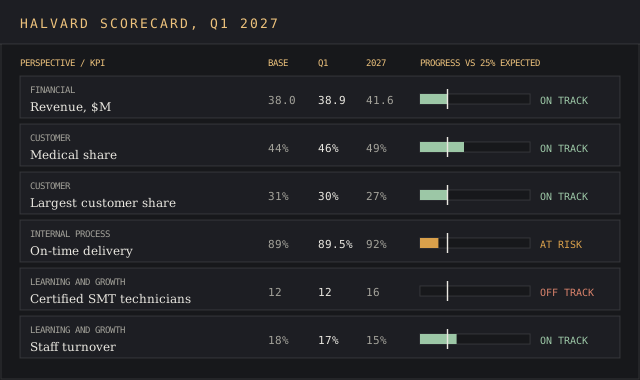
Each KPI's progress is compared with the share of the year gone, which after one quarter is 25%. Revenue moved from $38.0M to $38.9M, a quarter of the way to $41.6M, so it reads On track. Medical share reached 46% and the largest customer fell to 30%, both on pace. Turnover dropped to 17%.
On-time delivery reached 89.5%, only 17% of the way to 92%, so it flags At risk. Certified technicians stayed at 12 and flags Off track, which is expected, because the apprenticeship only starts in Q3. The team moved the scheduling software kickoff forward one month and added a note to the technician row so the next review doesn't make a mountain out of a molehill.
Common mistakes with a strategic plan
- Too many priorities. With nine focus areas, the leadership team has bitten off more than it can chew. Cut to six at most and park the rest on the back burner.
- Objectives with no owner. Put one name on every row, so one person chases each number.
- Only lagging KPIs. Revenue and margin report the past. Add at least one leading KPI per focus area.
- A plan written at the top. Leadership owns the decisions, and staff and customer input adds what the front line already knows.
- A plan set in stone. Markets move in three years. Review quarterly, refresh annually, and record why each change was made.
Word, Excel, PowerPoint or strategy software
Write the strategic plan in Word or Google Docs, the format the strategic plan template Word file uses, and run the scorecard in Excel or Google Sheets. The narrative changes once a year and the numbers change every quarter, so splitting them saves time and keeps easy editing for both. Board decks come last, built from the finished document.
Popular templates and downloadable templates from software vendors cover the same ground, and strategy software makes sense once you're tracking dozens of objectives across several business units. An IT strategic plan template follows the same seven sections, with objectives tied to systems, security and service levels.
FAQ
What are the 7 elements of a strategic plan?
An executive summary, mission, vision and core values, a situation analysis, strategic priorities, objectives with KPIs, initiatives with resources and financial projections, and governance with a review schedule. Those are the critical elements, and the template follows that order.
What are the 5 steps in strategic planning?
Gather input, analyze the current position, set direction, translate the direction into objectives and initiatives, then launch and review. Repeat step five every quarter, because that check shows how much business success the plan has delivered so far.
What are the 5 P's of strategy?
Plan, ploy, pattern, position and perspective, from Henry Mintzberg's 1987 paper in the California Management Review. A strategic plan document covers the first P.
How do I create a 5-year strategic plan?
Use the same seven sections and extend the scorecard to five annual targets per KPI. Keep the objectives fixed for the full period and revisit the targets each year, because year-five numbers written today are estimates.
Can you provide a template for a strategic plan on a page?
Yes. The executive summary in the free strategic plan template works as a one-page plan, the strategy in a nutshell. It holds the mission, vision, focus areas and the headline KPI for each, with the full scorecard behind it.
What is another term for strategic plan?
Strategic roadmap, long-range plan, corporate plan and strategic framework are the common ones. They describe the same document with a three to five year horizon.
Bottom line
Use the strategic plan template when the leadership team needs one document that links the mission to three to six priorities, measurable goals with owners, and funded initiatives. A well crafted strategic plan is short, reviewed every quarter, and honest about which KPIs are slipping. That's how the plan helps the organization achieve long-term success and protects the business's future.
For one year of marketing activity, the marketing plan template fits better. For quarterly team goals, use the OKR tracker, and for testing a single new venture before it enters the plan, the feasibility analysis template. When one of the priorities is a technology program, schedule its initiatives quarter by quarter in the digital transformation roadmap template.