Marketing Plan Template
 By Jan Suski. I go deep on every review, checking every number against its source and digging up details other coverage misses, a habit from six years of SEO and link building for tech companies. Bylines at Brand24 and Senuto. How the scoring works.
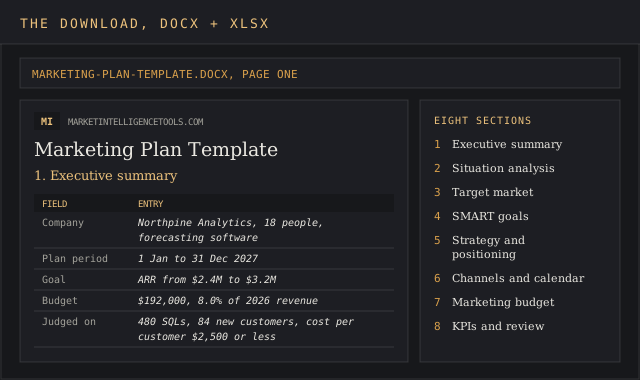
Get the marketing plan template
A Word plan with eight sections and instruction lines, plus an Excel budget and KPI tracker, both filled in with a worked example you can overwrite.
Download DOCXA marketing plan template is a pre-built document that walks a team through the eight decisions every marketing plan has to record: the situation, the target market, the goals, the strategy, the channels, the budget, the schedule and the measures. Filled in once a year, it becomes the one place across the organization where the marketing team, sales and finance read the same numbers.
This page gives you a free marketing plan template in Word, a companion Excel budget and KPI tracker, a section-by-section walk through the file, a step-by-step fill-in, and a worked example: a fictional 18-person software company planning a $192,000 marketing budget for 2027.
It's for a founder writing the first plan for a small business, a marketing manager who inherited a folder of disconnected campaigns, and the agencies and startups that need a plan clients or investors can read in ten minutes. You don't need to start from scratch, because every section carries instruction lines telling you what goes there and how much detail it needs.
Budgets are tight enough that every line has to defend itself. The Gartner 2026 CMO Spend Survey puts the average marketing budget at 7.8% of company revenue, and the 2025 edition found half of CMOs working with 6% or less, per Gartner's 2025 symposium highlights. A written plan shows where that money goes and what it buys.
Download the free marketing plan template
Download the free marketing plan template (DOCX)An eight-section Word document with instruction lines under every heading, tables for the SWOT analysis, buyer personas, SMART goals, channel plan, marketing budget and KPIs, and the Northpine worked example filled in. Key features include a one page summary box and a 7Ps table.
Download the marketing budget and KPI tracker (XLSX)Four tabs cover instructions, a budget sheet that splits the annual plan by quarter and tracks actual spend, a monthly KPI tracker with status flags, and a marketing calendar.
The Word file opens in Microsoft Word, Google Docs and LibreOffice Writer. The workbook uses SUM, IF, COUNT and plain division, so it calculates the same in Excel and Google Sheets.
What a marketing plan is
The short answer is that a marketing plan is the document that turns a marketing strategy into dated actions, owners and a budget. The marketing strategy says who you sell to and why they should pick you. The plan says which marketing channels carry that message, what each one costs, who runs it, and how the team will measure results.
Without one, marketing efforts drift toward whatever was loudest last month, and content, paid and partner strategies pull in different directions.
Most marketers plan one year at a time with quarterly checkpoints, and a plan helps the business achieve a target it has already agreed to. A one page plan suits a business with one product and one channel, and a company with several product lines can fill dozens of pages. The template sits in between, with eight sections, each short enough to fill in an afternoon once the research is done.
Two neighbors get confused with it. A go-to-market plan covers one launch, start to finish. A strategic plan sets company direction for three to five years. The marketing plan sits between them and covers all marketing activities for the year ahead.
Benefits of a written marketing plan
A solid marketing plan pays off in five places across the business:
- It ties marketing goals to business goals and keeps campaigns focused, so the revenue target and the lead target come from the same arithmetic.
- It fixes the marketing budget before the year starts, so every mid-year request has to name the budget line it comes out of.
- It gives the marketing team a roadmap and a calendar, and keeps marketing, sales and finance on the same page about who owns which campaigns.
- It gives investors and lenders a structured way to check your go-to-market assumptions before they put money in.
- It saves time at review, because the quarterly meeting compares actuals with targets someone wrote down in January.
Book the reviews when you write the plan. Queensland's government guide to writing a marketing plan tells owners to check the plan on a quarterly basis and adjust marketing objectives based on progress. The tracker in the download is built around that rhythm.
Key elements of a marketing plan: the eight sections
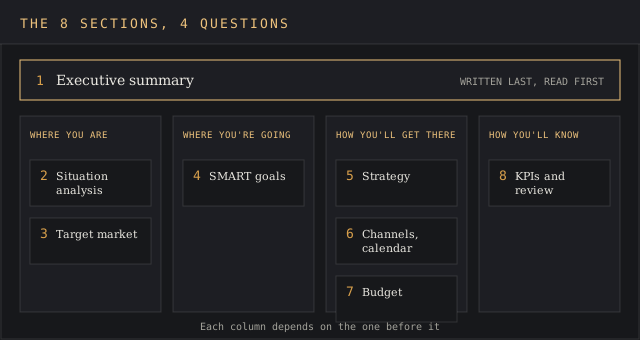
The executive summary is the plan in a nutshell, and the rest of the file backs it up. The marketing plan template gives a clear framework that follows the order in which the decisions depend on each other. You can't price a channel before you've picked it, and you can't pick it before you know the target audience.
| # | Section | What it records | Tables in the file |
|---|---|---|---|
| 1 | Executive summary | A one page snapshot of goals, strategy, budget and the three numbers the plan is judged on | Summary box |
| 2 | Business overview and situation analysis | Products, revenue, SWOT analysis and the competitive landscape | SWOT grid, competitor table |
| 3 | Target market and buyer personas | Segment, firmographics or demographics, pain points, buying triggers | Persona table |
| 4 | Marketing goals and SMART objectives | Baseline, target and deadline for each goal | Goals table |
| 5 | Marketing strategy and positioning | Positioning statement, key differentiators, the marketing mix | Positioning box, 7Ps table |
| 6 | Channels, tactics and calendar | Marketing channels, campaigns, owners and months | Channel plan, quarterly calendar |
| 7 | Marketing budget | Cost per channel per quarter, plus a test reserve | Budget table |
| 8 | KPIs, measurement and review | KPIs, where each is tracked, review dates | KPI table, review schedule |
Situation analysis and SWOT
The situation analysis states where the company stands today and helps you identify what will change the business's performance next year. Its core is a SWOT analysis, which sets internal strengths and weaknesses next to external opportunities and threats. Add three to five named competitors with their price and positioning, pulled from a competitive analysis if you've run one. Market research belongs here too, with the date of every figure.
Target market and buyer personas
Define the target market tightly enough that a salesperson could say yes or no to a prospect from the description alone. Then develop one persona per buying role, covering demographics or firmographics, pain points and buying triggers. The user persona template and the ideal customer profile template go deeper on both.
SMART goals
George T. Doran introduced the SMART acronym in the November 1981 issue of Management Review, per the SMART criteria entry. Today the letters usually read specific, measurable, achievable, relevant and time-bound. The goals table forces all five by asking for a baseline, a target, a deadline and an owner on every row.
The marketing mix
E. Jerome McCarthy published the 4Ps (product, price, place, promotion) in 1960, and Booms and Bitner added people, process and physical evidence in 1981 to fit services, per an encyclopedia entry from Bournemouth University. The template's 7Ps table gives each P one line on what changes this year, and the positioning statement template helps with the one-line positioning above it.
How to write a marketing plan, step by step
A good marketing plan comes out of a planning process with a fixed order. Work through the file in this order. The executive summary comes last even though it sits first.
- Pull last year's revenue by product, leads by channel, cost per lead, win rate and revenue from existing customers. Every goal needs that baseline to be measurable.
- Run the situation analysis with the SWOT grid and three to five competitors.
- Define the target market and write one persona per buying role.
- Set three to five SMART marketing goals that roll up to the revenue target.
- Pick the marketing channels and marketing tactics, then put each campaign in the calendar with an owner, a month and the stage of the customer journey it serves.
- Price every line of the marketing budget and hold back about 10% as a reserve for tests.
- Choose the KPIs that measure ROI per channel, book the four quarterly reviews, and write the executive summary.
Most plans miss the mark at step five. Teams list every channel they've heard of. Cap it at what the budget and the team can run well, because a channel with half an owner gets half the effort and produces half the leads.
Worked example: Northpine's 2027 marketing plan
Northpine Analytics is a fictional company built for this example: an 18-person software business selling inventory forecasting to independent outdoor-gear retailers in the US. It closed 2026 with $2.4M in annual recurring revenue (ARR) after spending $168,000 on marketing. The download ships with this plan filled in, so every number below matches the file. Writing it in November let the team hit the ground running in January.
Goals
| Goal | 2026 baseline | 2027 target | Where the number comes from |
|---|---|---|---|
| ARR | $2.4M | $3.2M by 31 Dec 2027 | Board growth target, +33% |
| New customers | 58 | 84 | $800,000 new ARR ÷ $9,600 average contract |
| Sales-qualified leads | 312 | 480 (40 a month) | 84 ÷ 18% lead-to-customer rate = 467, rounded up |
| Marketing cost per new customer | $2,897 | $2,500 or less | $192,000 ÷ 84 = $2,286 at plan |
The goals table shows the logic in one place, and the devil's in the details here. The board's revenue number sets the customer count, the customer count sets the leads, and the leads set what the channels have to deliver.
Target market and situation
Northpine sells to US outdoor-gear retailers running 2 to 15 stores. The plan records the persona and the SWOT in six lines:
- Buyer: the owner or head buyer.
- Pain point: end-of-season overstock that ties up cash.
- Buying triggers: a bad markdown season, or a new point-of-sale rollout.
- Strengths: forecasts tuned to seasonal gear and a 4-week setup.
- Weaknesses: one full-time marketer and little brand awareness outside two regions.
- Opportunity and threat: co-marketing with point-of-sale vendors, against ERP vendors bundling basic forecasting into their suites.
Marketing budget
The $192,000 budget is 8.0% of 2026 revenue. That sits close to Gartner's 7.8% average and under the 9.0% of revenue that the 2026 edition of The CMO Survey from Duke, Deloitte and the American Marketing Association reports. It splits across six lines:
| Channel | Share | Annual | Q1 | Q2 | Q3 | Q4 |
|---|---|---|---|---|---|---|
| Paid search | 25.0% | $48,000 | $12,000 | $12,000 | $12,000 | $12,000 |
| Trade shows | 22.5% | $43,200 | $21,600 | $0 | $21,600 | $0 |
| Content marketing and SEO | 20.0% | $38,400 | $9,600 | $9,600 | $9,600 | $9,600 |
| Partner co-marketing | 12.5% | $24,000 | $0 | $12,000 | $6,000 | $6,000 |
| Email and automation tools | 10.0% | $19,200 | $4,800 | $4,800 | $4,800 | $4,800 |
| Test reserve | 10.0% | $19,200 | $4,800 | $4,800 | $4,800 | $4,800 |
| Total | 100% | $192,000 | $52,800 | $43,200 | $58,800 | $37,200 |
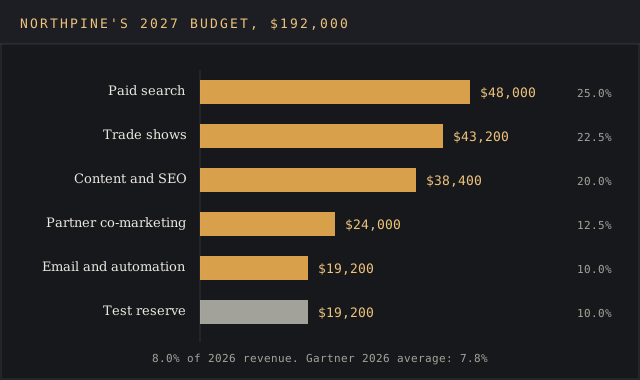
The marketing initiatives are deliberately few, so a team with one marketer can create and run all of them. Trade shows land in Q1 and Q3 because that's when retailers place orders for the next season, and the partner program starts in Q2 once the first point-of-sale vendor signs.
The Q1 review
At the end of March the tracker read as follows. Spend was $52,350 against a $52,800 plan, so the question was channel performance. Sales-qualified leads came in at 113 against 120, which is 94% and flags At risk. New customers reached 20 against 21, or 95%, which flags On track. Marketing cost per new customer worked out at $52,350 ÷ 20 = $2,618, above the $2,500 ceiling.
The team moved the unspent $2,700 from the Q1 test reserve into a retargeting test on paid search and pushed one webinar from Q3 into Q2. Both changes were small and made early. A stitch in time saves nine, and a lead gap found in March leaves nine months to close it.
Common mistakes with a marketing plan
- Goals with no baseline. Write every goal with its starting number, as in "grow sales-qualified leads from 312 to 480", so the tracker has a start and an end.
- A budget with no reserve. Every year produces a test worth running, and a plan with zero slack pays for it by cutting a channel mid-flight.
- Channels picked before the target market. Choosing a channel because a competitor uses it is barking up the wrong tree. The persona decides the channel.
- Too many channels. Spreading a small budget and thin resources across eight channels leaves each one under-funded. The opposite risk is putting all your eggs in one basket, so two or three channels plus a reserve is a sane default for a small business.
- A plan nobody reviews. If the document only comes out in January, it's a wish list. Book the four quarterly reviews when you write it.
Word, Excel, Google Docs or a planning tool
Write the plan in a document and track it in a spreadsheet, a split that keeps the planning tools simple for a small business or for agencies running plans for clients. Word or Google Docs suits the narrative planning documents, the SWOT grid and the personas, which change once a year. Excel or Google Sheets suits the marketing budget and the KPI tracker, which change every month and need formulas.
A project tool such as Asana or monday.com earns its place once the calendar has more than one or two owners and the campaigns have dependencies. Even then, keep the plan document as the source of the goals and the budget, and let the tool hold the tasks.
FAQ
What do you include in a marketing plan?
It needs eight sections, starting with an executive summary and a situation analysis with a SWOT, then the target market and personas, SMART goals, the marketing strategy and positioning, channels and a calendar, the marketing budget, and KPIs with review dates. The template carries all eight in that order.
What are the 7 P's of marketing?
Product, price, place and promotion from McCarthy's 1960 marketing mix, plus people, process and physical evidence, which Booms and Bitner added in 1981 for service businesses.
How do you plan a marketing budget?
Start from a share of revenue to set the ceiling, then build it bottom-up by channel. Gartner's 2026 survey average is 7.8% of revenue, The CMO Survey's 2026 edition puts it at 9.0% of revenue and 9.6% of overall company budgets, and the industry you sell in moves the figure up or down. Split each channel by quarter, hold about 10% as a test reserve, and track actual spend monthly so the variance shows up before the quarter closes.
What are the 5 steps of the marketing planning process?
Analyze the situation, set objectives, choose the strategy and target market, plan the tactics and budget, then measure and review. The seven-step fill-in above splits the last two into smaller pieces.
Why are one page marketing plans so valuable?
An effective marketing plan on one page forces priorities. Anything that doesn't fit is probably a nice-to-have. The executive summary in this template works as a one page plan for a small business, and the remaining sections back it up when someone asks how a number was reached.
Is there a marketing plan template in Word?
Yes. The free marketing plan template above is a DOCX file that opens in Word, Google Docs and LibreOffice, with the budget and KPI tracker as a separate Excel file.
Bottom line
Reach for the marketing plan template when you need a year of marketing activities tied to a revenue target, a budget and an owner per channel. Fill it in from last year's numbers, review it every quarter, and let the tracker show where the plan and reality part ways. Marketing success then becomes a number you can check, and the free marketing plan template becomes next year's starting point for future planning.
For a single product launch, the go-to-market plan template fits better. For direction over three to five years, use the strategic plan template, and for quarterly team goals, the OKR tracker.