Ideal Customer Profile Template
 By Jan Suski. I go deep on every review, checking every number against its source and digging up details other coverage misses, a habit from six years of SEO and link building for tech companies. Bylines at Surfer, Brand24, and Senuto. How the scoring works.
Get the ideal customer profile template
An Excel workbook that finds your ideal customer in your own CRM data, writes the profile with must-haves and disqualifiers, and scores new accounts against it from 0 to 100.
Download XLSXAn ideal customer profile (ICP) is a detailed description of the type of company that gets the most value from your product and gives you the most value back: it buys quickly, stays, and grows. An ICP template turns that description into fields a team can fill, check and score accounts against. The ideal customer profile template on this page starts from your CRM data, so the profile describes the customers you have and can prove.
This page covers the free ideal customer profile template, how an ICP differs from a buyer persona, the key components of a strong ICP, six steps to create an ideal customer profile, and a worked example in which a fleet software company finds that 9 of its 30 customers hold 44% of its contract value. It also covers common mistakes and how sales teams, marketing teams, customer success teams and customer support teams each use the finished profile.
The target audience is B2B founders, product marketing leads, sales leaders and RevOps teams who have at least 20 customers and suspect not all of them are worth winning again. With fewer than 20 customers, interviews carry more weight than the spreadsheet, and customer profiling starts with conversations.
Targeting matters because most of the market isn't buying at any given time. John Dawes of the Ehrenberg-Bass Institute estimated in his 2021 "95-5 rule" paper that "up to 95% of business clients are not in the market" for many services at once. A clear ideal customer profile tells you which of the 5% to chase first, and which potential customers to leave for later.
Download the free ideal customer profile template
Download the ideal customer profile template (XLSX)Six tabs: a customer analysis sheet, segment analysis by industry, size and tech stack, the ICP profile with must-haves and disqualifiers, a weighted account-scoring sheet, and a quarterly review log, pre-filled with the fleet software example on this page.
The file opens in Excel, Google Sheets and LibreOffice Calc, free, with no email needed. Formulas are COUNTIFS, AVERAGEIFS, SUMIFS and SUMPRODUCT, so a Sheets copy returns the same numbers. Clear the italic example rows and the ICP template is a blank customer profile template ready for your own CRM export. It's a free template with every cell unlocked, so the profile template can grow with extra fields.
What is an ideal customer profile?
ICP stands for ideal customer profile. An ideal customer profile (ICP) describes your perfect customer at the level of the company, and the ICP defines the company you sell to: its industry, company size, geographical location, technology stack and the situation that makes it ready to buy. It describes a type of account, and every account that matches it should be worth the sales cycle it costs.
Salesforce's guide to ideal customer profiles groups the inputs into six areas: demographic, geographic, psychographic, behavioral, technographic and firmographic. In practice an ICP leans on three of them:
- Firmographic data: industry, company size by headcount or revenue, growth stage, location.
- Technographic data: the tech stack a company already runs, which often predicts fit better than size does.
- Behavioral and environmental data: buying triggers, buying behaviors, regulation, and the events that put a company in the market.
A good ideal customer profile describes your most successful customers as they are today, with evidence for every line. A profile built on gut feeling describes the customers the founders wish they had, and sales teams figure out the difference in about one quarter. Customer profiling done from data skips that quarter.
Ideal customer profile vs buyer persona
The two get mixed up because both describe a customer. An ICP describes a company and a buyer persona describes a person inside it. A buyer persona represents an individual's job title, goals, objections and how they research, and one ICP usually has three or four personas under it. Most companies keep one buyer persona file per role in the buying group.
| Ideal customer profile | Buyer persona | |
|---|---|---|
| Describes | The ideal company | A person in the buying group |
| Built from | CRM data, revenue, churn, firmographics | Interviews, call notes, behavior data |
| Main fields | Industry, company size, tech stack, triggers, disqualifiers | Job title, goals, pain points, channels, objections |
| Used for | Choosing accounts and markets | Writing messages and sequences |
| How many | One per market segment, often one to three | Several per ICP |
Personas matter because the buying group is big. Gartner's May 2025 survey of 632 B2B buyers found buying groups "ranging from five to 16 people across as many as four functions." Forrester's State of Business Buying 2024 puts the average at 13 people. The ICP picks the company, and the user persona template handles the 13 people in it.
Why an ICP is worth the work
An ICP pays off in four places, each of them a decision a team makes every week:
- Prospecting. Sales teams prioritise the prospects most likely to convert and generate revenue, focus sales strategies on high value accounts, and stop spending discovery calls on accounts that churn in year one.
- Budget. Marketing campaigns, paid media and account based marketing lists target the accounts with the most revenue potential, so marketing efforts and the marketing strategy follow the same list as sales.
- Alignment. An ICP helps align sales with marketing: sales and marketing teams work from one definition of a good lead and the same target customer. A 2016 Entrepreneur piece by John Rampton cites a MarketingProfs and MathMarketing study in which tightly aligned teams saw "36 percent higher customer retention rates and achieved 38 percent higher sales win rates." That measures alignment, and a shared ICP is one input to it.
- Retention. Customer success teams can see early which new customers fit the profile and which need extra help to stay. Keeping your most valuable customers protects revenue growth that new logos would otherwise have to replace.
Speed adds a fifth reason. 6sense's 2025 Buyer Experience Report, built on nearly 4,000 buyer responses, found buyers pick from their day-one shortlist "95% of the time," and "the vendor contacted first continues to win 8 out of 10 deals." Reaching the right accounts early beats reaching every account late, and the early bird catches the worm in B2B as much as anywhere. An ICP gives the team a short list of target buyers to reach first.
The six tabs of the ICP template
Each tab of the workbook does one job, in the order a data driven ICP gets built:
| Tab | What you enter | What it calculates |
|---|---|---|
| How to use | Nothing | Order of work, scoring rules, colour key |
| Customers | One row per customer from the CRM, churned ones included: industry, vehicles or headcount, region, tech stack, contract value, sales cycle, status, months as customer | Size band, revenue to date, and an ICP match flag |
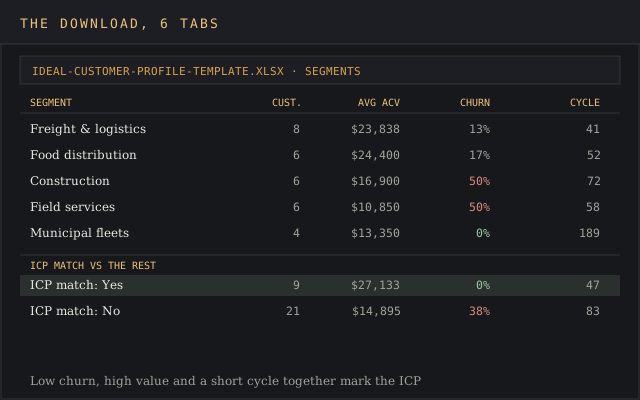
| Segments | Nothing | Customer count, average contract value, churn rate, average sales cycle and share of revenue by industry, size band, tech stack and ICP match |
| ICP profile | Seven match rules, then the profile fields with Must, Nice or DQ and the evidence for each | The match rules drive the flag on the Customers tab |
| Account scoring | Weights, then a 0 to 3 score per prospect on five criteria | Weighted score out of 100, tier A, B or C, or DQ |
| Review log | What each quarterly export showed and what changed | Nothing; it's the record of why the ICP looks the way it does |
The match rules close the loop most ideal customer profile templates leave open. Change "Min vehicles" from 75 to 50 on the ICP profile tab and every customer is re-flagged, so you see at once if the looser profile still holds its churn rate.
Key components of an ideal customer profile
The profile section of the template carries ten fields. Each one gets a value, a tag (Must, Nice or DQ) and the evidence behind it:
| Field | What goes in it | Where the evidence comes from |
|---|---|---|
| Industry | The one to three industries where customers stay and grow | Segments tab, churn rate by industry |
| Company size | A range, by headcount, revenue or a unit your product scales with | Segments tab, size bands |
| Geography | Countries or regions you can sell, support and comply in | Customers tab, region column |
| Tech stack | The technology stack a customer must already run, or must not | CRM enrichment from data enrichment tools, sales notes, website traffic tools that detect technologies |
| Annual revenue | A band, if your pricing tracks it | Enrichment data |
| Pain points | The operational or financial pain points your product fixes | Won-deal call notes, interviews, customer insights from support tickets |
| Buying triggers | Events that put a company in the market: a hire, a failed audit, a new site | Sales notes on closed-won deals, industry reports, market trends, intent data |
| Buying group | Decision makers and their criteria: champion, budget owner, sign-off | Opportunity contact roles |
| Disqualifiers | Traits that mark a poor fit, however keen the lead | Churned-customer rows |
| Success metrics | How you measure a good customer: retention, expansion, lifetime revenue | Customers tab, revenue to date |
Disqualifiers are the field most templates miss. Cognism's, Salesforce's and HubSpot's ICP guides list firmographics, pain points, business goals, technologies and the buying committee, but none of their templates has a field for the accounts to walk away from. A strong ICP says who to avoid as plainly as who to chase, because a bad-fit customer costs a sales cycle to win and an onboarding to lose.
How to create an ideal customer profile in six steps
1. Export your existing customers
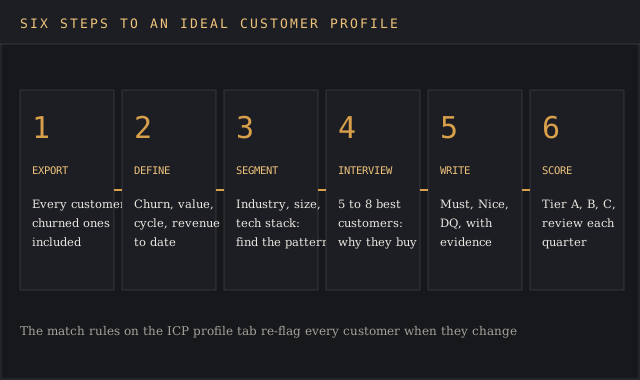
Pull every customer from the CRM, active and churned, into the Customers tab. Your best existing customers are half the evidence, and churned customers are the other half: they show which traits predict leaving. Add the fields you can fill for most rows: industry, company size, region, tech stack, contract value, sales cycle in days, status and months as a customer.
2. Decide what "best" means
Customer profiling works only if success is defined first. Pick the measures that define your best customers before looking at segments, or you'll pick the measure that flatters a favourite segment. The template uses four: churn rate, average contract value, sales cycle length and revenue to date. Customer lifetime value works too if your CRM tracks it. Whatever you pick, the high value customer should be obvious from the numbers alone.
3. Segment and identify patterns
Read the Segments tab one block at a time to identify patterns in customer behavior. Look for the segment where churn is low, contract value is high and the sales cycle is short, all three together. A segment that wins on one and loses on two is a trap: municipal fleets in the worked example never churn but take 189 days to close.
4. Talk to your best customers
Numbers show which customers share a pattern. Direct customer interviews show why.
Talk to five to eight of your most successful customers, the valuable customers who renewed and expanded, and ask what problem made them buy, what they tried first, who signed off and what would make them leave. The win-loss analysis template has an interview guide that covers the same ground.
Those answers fill the pain points, buying triggers, buying behaviors and buying group fields, and they're where the decision makers' real criteria show up. Ask which decision makers joined late and slowed the deal; that answer shapes the buying group field.
5. Write the profile and its disqualifiers
Turn the pattern into match rules on the ICP profile tab, then write each field with its evidence. Tag each line Must, Nice or DQ. Keep the must-haves to four or five; a profile with ten must-haves matches nobody, and that's a common way to paint yourself into a corner.
6. Score accounts, align teams, review quarterly
Turn the profile into the five weighted criteria on the Account scoring tab and score every open prospect. Share the tiers with sales, marketing and customer success so all three work from the same page. Marketing teams use the tiers to align sales outreach with campaigns, and the pain points on the profile become the first line of every sequence.
HubSpot's ICP guide says to "review and update your ICP at minimum once per quarter"; the Review log tab is where each quarter's CRM data and the decision it led to go.
Worked example: a fleet software company finds its ICP
Fleetwise sells maintenance software to companies that run their own vehicles, and this ideal customer profile example follows its first ICP from export to call list. It has 30 customers across five industries, $557,000 in annual contract value, and a churn problem: 8 of the 30 have left. Company names and figures are illustrative, and they're the same rows that ship in the download.
The Segments tab shows the pattern by industry:
| Industry | Customers | Avg contract value | Churn rate | Avg sales cycle |
|---|---|---|---|---|
| Freight & logistics | 8 | $23,838 | 13% | 41 days |
| Food distribution | 6 | $24,400 | 17% | 52 days |
| Construction | 6 | $16,900 | 50% | 72 days |
| Field services | 6 | $10,850 | 50% | 58 days |
| Municipal fleets | 4 | $13,350 | 0% | 189 days |
Freight and food distribution win on all three measures. Two more blocks sharpen it. Fleets under 75 vehicles churn at 60%, three of five. Customers with telematics already installed churn at 11%, against 55% for those without, because the software reads mileage and fault codes straight from the telematics box.
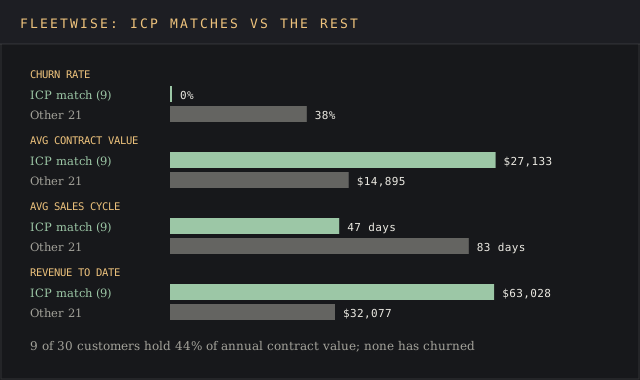
Fleetwise turns the pattern into customer profiling rules, then writes the match rules: freight or food distribution, 75 to 350 vehicles, telematics installed, US or Canada. Nine of the 30 customers match. That's the ideal customer for Fleetwise today. Here's how those customers compare with the other 21:
- Churn: none of the 9 has left, against 8 of the other 21 (38%).
- Average contract value: $27,133 against $14,895.
- Average sales cycle: 47 days against 83.
- Revenue to date per customer: $63,028 against $32,077.
- Share of total contract value: 44% from 30% of the customer base. That's predictable growth from a third of the customers.
The disqualifiers come from the churned rows: fewer than 20 vehicles, a rival contract with 12 or more months left, or no in-house maintenance staff. Then the Account scoring tab ranks eight open prospects on five weighted criteria:
| Prospect | Score | Tier | Next step |
|---|---|---|---|
| Granite Ridge Haulers | 100 | A | Book a demo; failed two roadside inspections in Q3 |
| Brookside Cold Storage | 75 | A | Sequence on the cold-chain inspection checklist |
| Coastal Fresh Distributors | 70 | B | Nurture with the telematics-integration guide |
| County of Ashby | 67 | B | Watch for the RFP; public-sector cycle runs six months |
| Thornbury Logistics | 63 | B | Route to the UK partner; outside two must-haves |
| Metro Plumbing Pros | 42 | C | Self-serve plan; outside the ICP |
| Quickfix Handyman | DQ | DQ | Under 20 vehicles |
| Lakeview Transport | DQ | DQ | Rival contract, 18 months left |
Lakeview is the instructive one among these potential customers. On fit alone it scores 83, near the top of the list, but it's locked into a competitor for 18 more months, and the DQ column stops a rep from spending a quarter on it. The Review log records the first version of the ICP in October 2026, with the next export due in January.
Ideal customer profile examples
The fields stay the same across business models, and the values change. Three short ideal customer profile examples show the shape, each one a summary of the profile tab for a different target audience:
| Business | Firmographics | Tech stack and triggers | Disqualifiers |
|---|---|---|---|
| B2B SaaS selling to mid-market | Software or fintech, 200 to 1,000 employees, Series B or later, North America | Runs Salesforce and a data warehouse; trigger: new RevOps hire | Under 50 employees; no CRM admin |
| Agency selling lead generation | B2B services firms, $5M to $50M revenue, sales team of 5 to 30 | Uses a sales engagement tool; trigger: missed pipeline target two quarters running | Fully inbound sales motion; no budget owner in marketing |
| B2C subscription box | Households, ages 30 to 45, urban, dual income | Shops online weekly; trigger: moving house or a new baby | Delivery address outside the courier network |
The B2C row stretches the term, since a consumer ICP sits close to a buyer persona. The template still works for it: swap industry and company size for life stage and household income, and the Segments tab finds the pattern the same way.
Common ICP mistakes
Most weak ICPs share one of six faults, and each has a fix built into the template:
- Built from the logo wall. The biggest-name customers aren't always the best customers. Rank customers by churn, value and cycle, then look at names.
- Active customers only. Leaving out churned rows hides the evidence for disqualifiers.
- Too broad. "B2B companies with 50 to 5,000 employees" covers most of the market, puts every market segment on the list and prioritises nothing. Narrow it until the match count is a minority of your customers.
- No disqualifiers. Without them, any enthusiastic lead gets a full sales cycle.
- Confused with a persona. Job titles and goals belong in the persona file. The ICP is about companies.
- Written once, never reviewed. Markets move and the business evolves. A profile last updated two years ago describes the customers you used to want.
The fix for all six is the same habit: tie every field to a cell or a call note, and re-run the numbers each quarter. Customer profiling is a routine, and the target customer it produces should change only when customers do. Profiles drift when nobody checks them, and the drift goes unnoticed until win rates drop.
How sales, marketing and customer success use the ICP
A finished ICP shows up in different tools for each team, and the same tiers drive all of them:
- Sales. Tier A accounts get a named rep and outbound within a week. Tier C customers go to self-serve, and potential customers outside the ICP still get a marketing campaigns path that costs no rep time. The sales motion, from first call to proposal, gets built around the buying group and triggers on the profile.
- Marketing. Tier A and B lists feed account based marketing campaigns (our ABM statistics report has the adoption data), paid audiences and website personalisation, so the target audience for every campaign is the ICP. Product marketing writes messaging to the ICP's pain points and the personas under it, and marketing teams build the marketing strategy for the quarter around the tier A list.
- Customer success. New customers who match the ideal customer profile get the standard onboarding, and customer support teams see the tier on every ticket. Non-matches get an early health check, since the data says they're the likeliest to churn.
- Product. Product strategies favour requests from ICP accounts, because those customers stay long enough to use what gets built.
Tools help at scale, once marketing and sales teams agree on the profile. Our ICP tools ranking compares platforms that build and score ICPs from CRM and enrichment data, and the ABM platforms ranking covers the ones that turn the tier list into campaigns.
Excel, Google Sheets, Word or your CRM
The analysis needs a spreadsheet, because churn rates and averages by segment have to calculate from customer data. The profile itself can live anywhere people will read it.
- Excel or Google Sheets for the Customers, Segments and Account scoring tabs. The template runs unchanged in both.
- Word or Google Docs for a one-page ICP document to share with the wider company, copied from the ICP profile tab.
- Your CRM for the live version: add an ICP tier field to account records so reps see it next to every account.
Whichever you pick, keep the spreadsheet as the source, since it holds the customers and the evidence. The doc and the CRM field are copies, and the quarterly review re-runs the numbers there first.
Ideal customer profile FAQs
What does ICP stand for?
ICP stands for ideal customer profile: a description of the company that gets the most value from your product and brings the most revenue, retention and growth back to you.
What is an example of an ICP?
A fleet software company's ideal customer profile (ICP) from the worked example: freight or food distribution companies running 75 to 350 vehicles with telematics installed, in the US or Canada, triggered by a failed roadside inspection or a new depot. Under 20 vehicles is a disqualifier.
How do you create an ICP?
Export your existing customers, churned ones included, decide what makes a customer good, compare churn, contract value and sales cycle by segment, interview your best customers, then write the profile with must-haves and disqualifiers and score new accounts against it.
What is an ICP document?
An ICP document is the written profile: one page listing the industry, company size, geography, tech stack, pain points, buying triggers, buying group, disqualifiers and success metrics, each with the evidence behind it. The ICP profile tab of the template is that document.
What is the difference between an ICP and a buyer persona?
An ideal customer profile describes the ideal company. A buyer persona describes a person inside it, with a job title, goals and objections. Most companies have one ICP per market and several personas under each.
How often should an ICP be updated?
HubSpot recommends reviewing it at least once per quarter. Re-run the segment analysis on a fresh CRM export each quarter, and change the profile when the numbers move, after a pricing change, or after a product launch.
Can you have more than one ICP?
Yes, one per distinct market segment you sell to, each with its own evidence. Two or three is common for most companies. More than that usually means the profiles are too broad to prioritise anything.
Bottom line
Reach for this ideal customer profile template when you have 20 or more customers, some of them churned, and a sales team spending time on accounts that don't stay. The Segments tab turns CRM data into a profile you can defend, and the scoring tab turns the profile into a call list.
It's the wrong first file for a company with five customers: interviews will tell you more. Once the ICP exists, the customer segmentation template splits a broad market into groups, the perceptual map template shows how ICP accounts see you against rivals, and the customer acquisition strategy template turns the tier list into a plan.