Fundraising Plan Template
 By Jan Suski. I go deep on every review, checking every number against its source and digging up details other coverage misses, a habit from six years of SEO and link building for tech companies. Bylines at Brand24 and Senuto. How the scoring works.
Get the fundraising plan template
An Excel workbook with a plan summary, revenue goals by source, a gift range chart, a 12-month fundraising calendar that checks itself against the goals, and a KPI tab with donor retention built in.
Download XLSXA fundraising plan is the document that turns a nonprofit's mission into a revenue number, splits that number across sources, and puts every ask on a date with an owner's name next to it. A fundraising strategy decides which sources of funding to grow and why. The fundraising plan is where that strategy becomes rows, months and dollar amounts that board members can check at board meetings.
This fundraising plan template is a free fundraising workbook in Excel, built around that idea. You set fundraising goals by source, size the major gifts you need with a gift range chart, schedule every campaign on a fundraising calendar, and track five key performance indicators.
The page covers the download, the six tabs, a seven-step process to create a fundraising plan, a full worked example, retention, digital fundraising, KPIs, common mistakes and the software question.
It's written for executive directors and development directors at small teams of one to ten people, board members who sign off on the annual budget, and volunteers who run fundraising events and need to know where their event sits in the year. Larger nonprofits with a donor CRM can still use it as the one-page view the board sees.
The stakes for nonprofits are concrete. Giving USA's 2026 report put total US giving at $617.2 billion for 2025, and the Fundraising Effectiveness Project found that only 42.9% of donors gave again the year after their gift in 2024. Successful fundraising depends on knowing early. A plan written down in January is how a nonprofit knows by June that it's behind, while there's still half a year and enough resources to recover.
Download the free fundraising plan template
Download the template (XLSX)Six tabs: instructions, a plan summary, revenue goals by source, a gift range chart, a 16-row fundraising calendar and a KPI tracker, pre-filled with the Harbor Literacy Project 2027 example.
The workbook opens in Excel, Google Sheets and LibreOffice Calc. It runs on SUM, SUMIF and plain division, so nothing breaks on import, and conditional formatting turns any gap between a goal and the calendar red. Delete the example values to create your own plan, and the formulas stay in place for your numbers.
What a fundraising plan is, and how it differs from a fundraising strategy
The two words get used as synonyms, and the confusion costs nonprofits a year of drift. A fundraising strategy is the big picture: which revenue sources the nonprofit will rely on, which donors it wants more of, and how fundraising supports its strategic priorities over three to five years. It answers "where should our money come from?" An effective fundraising strategy names three or four sources and the donor groups behind each.
A fundraising plan is the annual operating version. It answers "how much, from whom, by when, and who asks?" One strategy can produce five annual plans. A strategy with no annual plan underneath stays a slide deck. A plan written without a strategy usually repeats last year's calendar with a bigger number at the bottom.
| Question | Fundraising strategy | Fundraising plan |
|---|---|---|
| Time horizon | Three to five years | One fiscal year |
| Main output | Target revenue mix and priorities | Dollar goals, dates, owners |
| Who signs off | Board, once | Board, then reviewed monthly |
| Changes when | The mission or market shifts | A campaign misses its number |
| Tab in this file | Plan summary | Goals, Gift range, Calendar, KPIs |
The template holds both. The Plan summary tab carries the strategy in six short fields, and the other four working tabs carry the plan. If you want a longer three-year strategy document first, the strategic plan template is the better starting point, and this file picks up where it ends.
What's inside the annual fundraising plan template
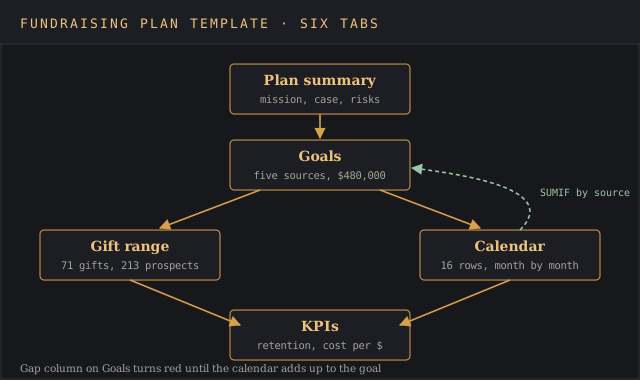
Six tabs, in the order you fill them in, cover the key components of a fundraising plan. Every number on the Goals and KPIs tabs is either an input you type or a formula that reads another tab, so there's one place to change each figure.
| Tab | What you enter | What it calculates |
|---|---|---|
| Instructions | Nothing | A brief overview of each tab and the order to fill them in |
| Plan summary | Mission, case for support, strategic priorities, plan owner, top risks | None. This is the narrative the board reads first |
| Goals | Last year's actuals, this year's goal and cost to raise per source | Net revenue, share of goal, change vs last year, scheduled total, gap |
| Gift range | Gift sizes and gifts needed per level | Subtotals, cumulative total, prospects needed at three per gift |
| Calendar | Month, activity, channel, donor segment, owner, source, revenue target | Feeds the scheduled total on the Goals tab |
| KPIs | Donor counts, gift counts, retained donors | Cost per dollar raised, donor retention rate, average gift size |
The link between the Calendar and the Goals tab is the critical aspect of the design. Each calendar row names a revenue source, and the Goals tab sums every row for that source with SUMIF. If your fundraising goals say $190,000 from individual giving and the calendar only schedules $160,000, the gap column shows $30,000 in red before anyone presents the plan to the board.
How to create a fundraising plan in seven steps
Order matters in the planning stage. Nonprofits that start with the calendar end up with a list of events and no idea if the events add up to the budget gap. Start from the funding the mission needs and work outward to the fundraising activities that will raise it.
- Write the case for support. Two or three sentences on what the money pays for and what changes if you raise it. This goes in the Plan summary tab.
- Pull past results. Last year's revenue by source, cost to raise, donor count, retained donors and gift count. The KPIs tab needs all five.
- Set the funding goal. The gap between the operating budget and earned revenue, checked against last year's growth and the resources your team has.
- Split the goal by source. Individual giving, major gifts, events, grants, corporate sponsors and payroll giving each get their own row on the Goals tab.
- Size the major gifts. Build the gift range chart for the major gifts line and count the prospective donors you'd need.
- Schedule every ask. Put each campaign on the Calendar tab with a month, a segment, an owner and a revenue target, until the gap column reads zero.
- Agree the review rhythm. Monthly regular check-ins with staff, a quarterly report at board meetings, and one mid-year rewrite if a line is off by more than 15%.
Together the steps make up the whole fundraising process. Steps 1 to 3 take an afternoon if your donor data is clean. Step 6 takes a week, because the devil's in the details. It's usually the step where people discover the year-end appeal has been quietly carrying half the plan.
Setting fundraising goals that hold up
Good fundraising goals are SMART goals, a format George T. Doran introduced in the November 1981 issue of Management Review. His letters stood for specific, measurable, assignable, realistic and time-related. "Grow individual giving" fails three of the five. "Raise $190,000 from individual giving by 31 December 2027, owned by the development director" passes all of them.
Realistic goals start from past results. Look at three years of actuals per source, because a single bequest or an emergency appeal can make one year look twice as good as the trend. A line that grew 6% a year for three years and is now planned at +38% is a red flag until the Plan summary names the reason, like a new employer partnership.
Then check the mix of funding sources. A strategy that leans on one funder or one gala puts all your eggs in one basket. Giving USA's figures show individuals gave 64% of US charitable dollars in 2025 (Candid's summary of the report), with foundations at 19%. For nonprofits, diversifying across sources means a lost grant costs you one row on the Goals tab and leaves the other four standing.
Time-bound goals per source. Give each source its own deadline. Grants have award dates, galas have event dates, and the year-end appeal closes on 31 December. Separate dates let you see in May that the gala missed, while the year-end appeal can still make it up.
Break the annual number into benchmarks. A $480,000 goal with nothing scheduled until December looks fine at every board meeting until the year comes down to the wire. The Calendar tab forces each source into monthly pieces, so the board sees a cumulative target it can compare with actual money in the bank each quarter.
The gift range chart: sizing major gifts before you ask
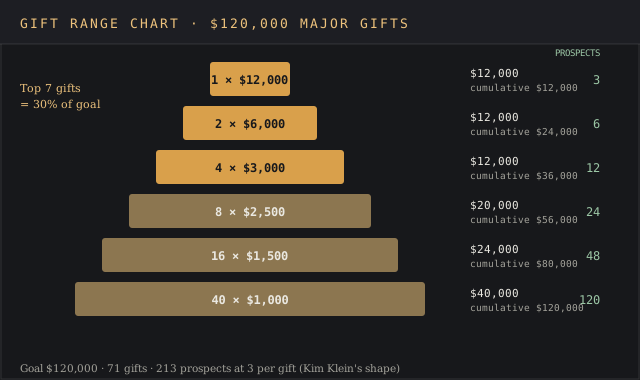
A gift range chart works backward from a goal to the number of gifts you need at each size. Kim Klein, writing in the Grassroots Fundraising Journal, gives the standard shape: one gift equal to 10% of the goal, the next two gifts together worth another 10%, and the next three to five gifts worth a further 10%. The top handful of donors carries 30% of the line.
Most plans meet reality in the prospect column. Klein's follow-up on starting a major gifts program recommends looking for about three times as many prospects as gifts needed, because some will say no and some will give less than asked. The template multiplies gifts by three automatically. If the prospect total is bigger than your list of people with the linkage, ability and interest to give, the goal is too high.
Major gifts depend on personal relationships and one-on-one asks to major donors, so the gift range chart is also a workload chart. Seventy-one gifts and 213 prospects means 213 conversations. For an executive director who also runs programs, the count of conversations sets the ceiling on the goal.
The same table drives capital campaign planning, with steeper tiers. For a capital campaign, which raises one-off money for a building or endowment, the top gift often lands at 10% to 20% of the goal, and the chart usually runs to fewer, larger gifts. The template's Gift range tab works for both. Change the gift sizes and the counts, and the cumulative column tells you when you've reached the goal.
Building the fundraising calendar
The fundraising calendar keeps the team on the same page about what happens when, and it stops three asks from landing on the same donors in the same month. Mapping campaigns across 12 months is how you avoid donor fatigue on one side and a staff bottleneck on the other, since the same development director usually writes the appeal, runs the gala and files the grant report.
Mark key dates first, then fill the fundraising activities around them. Fixed dates in a typical US nonprofit year include grant deadlines, the gala, the fiscal year-end and GivingTuesday, which falls on 30 November 2027 (also written Giving Tuesday).
US donors gave $4.0 billion on GivingTuesday 2025, according to GivingTuesday's own data commons, so it belongs on any calendar with an online fundraising line. Harbor's plan uses the day for a matching-gift campaign to boost donations from its existing file.
Each Calendar row has seven columns, and every one earns its place in coordinating fundraising efforts:
- Month, when the money is expected to arrive in the bank.
- Activity, the specific fundraising initiative or fundraising campaign, such as "Spring email appeal".
- Channel, from email campaigns and direct mail to events, grants and in-person asks.
- Segment, the donor group the ask goes to, such as monthly donors, lapsed donors or major donors.
- Owner, one named role per row, such as grants manager.
- Source, which row on the Goals tab this activity counts toward.
- Revenue target, the dollars expected from this row.
Review the calendar at every monthly check-in and move rows that slip. When a grant decision moves from March to May, move the row too. Left in March, it makes the first-quarter numbers look worse than they are and pushes the board into the wrong conversation.
Worked example: Harbor Literacy Project, 2027 annual fundraising plan
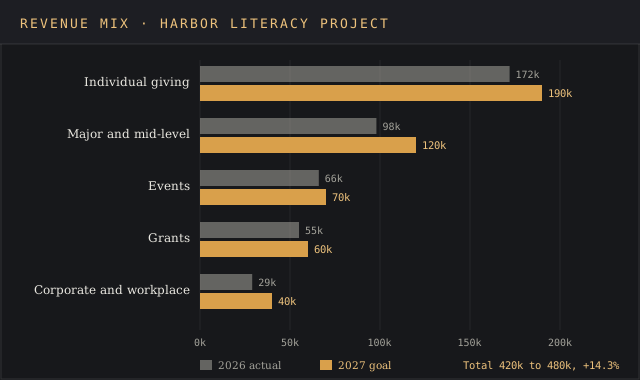
Here's the template filled in for one nonprofit. Harbor Literacy Project is a community literacy nonprofit with six staff, a $1.2 million operating budget and 1,240 donors in 2026. Program contracts cover most of the budget, and the board needs $480,000 from fundraising in 2027, up from $420,000 raised in 2026. This is the example pre-filled in the download, so every number below matches the file.
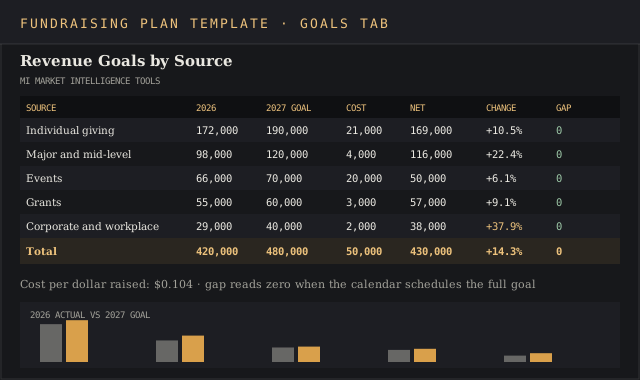
To get the ball rolling, the development director opens the Goals tab. Five sources, each with a 2026 actual, a 2027 goal and the cost to raise it:
| Source | 2026 actual | 2027 goal | Cost to raise | Net | Share of goal | Change |
|---|---|---|---|---|---|---|
| Individual giving | $172,000 | $190,000 | $21,000 | $169,000 | 39.6% | +10.5% |
| Major and mid-level gifts | $98,000 | $120,000 | $4,000 | $116,000 | 25.0% | +22.4% |
| Events | $66,000 | $70,000 | $20,000 | $50,000 | 14.6% | +6.1% |
| Grants | $55,000 | $60,000 | $3,000 | $57,000 | 12.5% | +9.1% |
| Corporate and workplace | $29,000 | $40,000 | $2,000 | $38,000 | 8.3% | +37.9% |
| Total | $420,000 | $480,000 | $50,000 | $430,000 | 100% | +14.3% |
The total rises 14.3%, and cost to raise is $50,000, so the plan spends 10.4 cents per dollar raised. Events cost the most per dollar, $20,000 to raise $70,000, which is why the plan holds events flat and puts the growth into major gifts and the corporate line.
That corporate line is the weakest number in the plan. It jumps 37.9% on the back of a payroll giving pitch to three local employers and two new corporate sponsors for the gala. The Plan summary lists it as the top risk, and the board agrees to cut the target to $32,000 at the September review if the August pitch hasn't produced a signed employer by then.
Next comes the gift range chart for the $120,000 major and mid-level gifts line, using Klein's shape and three prospects per gift:
| Gift amount | Gifts needed | Prospects needed | Subtotal | Cumulative |
|---|---|---|---|---|
| $12,000 | 1 | 3 | $12,000 | $12,000 |
| $6,000 | 2 | 6 | $12,000 | $24,000 |
| $3,000 | 4 | 12 | $12,000 | $36,000 |
| $2,500 | 8 | 24 | $20,000 | $56,000 |
| $1,500 | 16 | 48 | $24,000 | $80,000 |
| $1,000 | 40 | 120 | $40,000 | $120,000 |
| Total | 71 | 213 | $120,000 |
Harbor has 140 donors who gave $500 or more in the last two years. That's short of 213, so the executive director and two board members commit to adding 75 prospective donors from the gala guest list and local business owners by March. Without that commitment, the plan would have dropped the line to about $80,000.
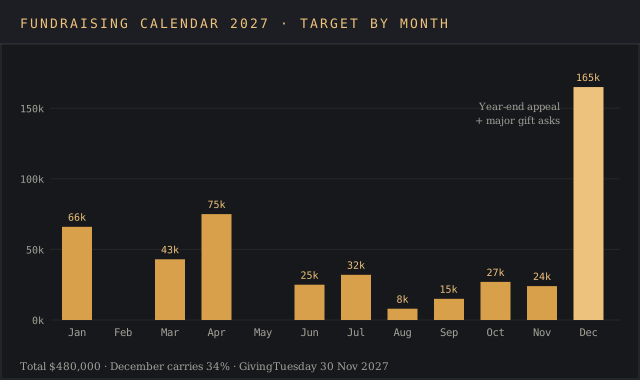
Finally the Calendar tab. Sixteen rows schedule all $480,000, and the gap column on the Goals tab reads zero for every source:
| Month | Activity | Channel | Owner | Source | Target |
|---|---|---|---|---|---|
| Jan | Monthly giving program, full year | Online | Development director | Individual giving | $36,000 |
| Jan | Renewal visits with 2026 top donors | In person | Executive director | Major and mid-level | $30,000 |
| Mar | Spring email appeal | Development director | Individual giving | $18,000 | |
| Mar | Community foundation literacy grant | Grant | Grants manager | Grants | $25,000 |
| Apr | Spring gala, 24 April | Event | Board events committee | Events | $55,000 |
| Apr | Gala table and program sponsors | In person | Executive director | Corporate and workplace | $20,000 |
| Jun | Mid-year asks after impact report | In person | Executive director | Major and mid-level | $25,000 |
| Jul | Summer appeal with program results | Email, mail | Development director | Individual giving | $12,000 |
| Jul | Family foundation program grant | Grant | Grants manager | Grants | $20,000 |
| Aug | Payroll giving pitch, three employers | Workplace | Board chair | Corporate and workplace | $8,000 |
| Sep | Read-a-thon peer to peer campaign | Online | Volunteer coordinator | Events | $15,000 |
| Oct | State humanities council grant | Grant | Grants manager | Grants | $15,000 |
| Oct | Corporate sponsor renewals | In person | Executive director | Corporate and workplace | $12,000 |
| Nov | GivingTuesday match, 30 November | Email, social | Development director | Individual giving | $24,000 |
| Dec | Year-end appeal | Mail, email | Development director | Individual giving | $100,000 |
| Dec | Year-end major gift asks | In person | Executive director | Major and mid-level | $65,000 |
December carries $165,000, or 34% of the year. The year-end appeal and the December major gift asks create that concentration, and it's the plan's second risk. The board sets an October checkpoint: if the year to date is more than $40,000 behind the calendar, the development director adds a second year-end email and a board phone bank before Thanksgiving.
Donor retention: the cheapest way to boost donations
Most fundraising plans count dollars and forget to count people. That's a costly blind spot, because a donor base that loses half its donors every year has to replace them before it can grow. The Fundraising Effectiveness Project put the sector's 2024 donor retention rate at 42.9%, its fifth straight year of decline.
Repeat giving is the lever, and studying donor behavior across first, second and third gifts shows why. FEP data reported by NonProfit PRO showed retention of 18.6% for donors who had given once, 38.1% for those who'd given twice and 61.2% for those who'd given three to six times. One-time donations are the leakiest part of the file, so the plan should schedule a second ask to every new donor within their first year and nip the drop-off in the bud.
Harbor retained 520 of its 1,180 donors from 2025, a 44.1% donor retention rate, slightly above the FEP figure. The 2027 target is 48%, which means keeping 595 of the 1,240 donors from 2026. The KPIs tab computes both numbers from donor counts, so the rate updates when someone enters the actuals.
Thank donors within 48 hours. Penelope Burk's research for Donor-Centered Fundraising found that donors who got a thank-you call from a board member within 48 hours gave 39% more the next time they were asked, according to Claire Axelrad's summary of the study. A board thank-you call list belongs on the Calendar tab as an activity with an owner.
Stewardship planning also means segmenting, which keeps your fundraising strategy and your donor communications consistent. First-time donors get a welcome sequence and a second-gift ask, monthly donors get impact updates without asks, and major donors often want a detailed impact report before they renew. Each of those is a row type on the calendar, so donor relationships get scheduled time on someone's calendar.
Digital fundraising, email campaigns and fundraising events
Online fundraising keeps growing from a small base. The Blackbaud Institute reported that online sources rose from almost 8% of giving in 2022 to over 12% for the average organization in 2023, and to nearly 17% for organizations under $1 million in revenue. A plan that puts 40% of its goal online is betting against the averages.
Digital fundraising in the template is split by channel so each can be judged on its own numbers:
- Email campaigns reach the whole donor file for the cost of the platform, which makes them the cheapest second ask after a gift.
- Monthly giving turns a $25 donor into $300 a year, and recurring gifts don't need a new ask every month.
- Peer-to-peer campaigns, like Harbor's read-a-thon, let volunteers and families ask their own networks, which reaches new donors the nonprofit has never contacted.
- Social media works best for GivingTuesday and event promotion, with a donation link that lets supporters accept donations straight from the post.
- Direct mail stays on Harbor's calendar for the year-end appeal because its 2026 mail donors gave larger gifts than its email-only donors.
Fundraising events are the most expensive line per dollar and the best for visibility. Of all the fundraising efforts in the plan, they need the most volunteers and staff hours.
Track gross and cost separately on the Goals tab, plan event invitations at least six weeks out, and give every event a revenue target that covers its cost before anyone talks about awareness. If the gala's net drops below what a second appeal would raise, it's time to go back to the drawing board on the event.
Key performance indicators to measure success
Five KPIs are enough for small nonprofits, and they show where fundraising efforts pay off. Each one on the KPIs tab has a 2026 actual, a 2027 target and the formula that produces it, so the numbers can't drift from the data underneath:
| KPI | Formula | 2026 actual | 2027 target |
|---|---|---|---|
| Total raised | Sum of all sources | $420,000 | $480,000 |
| Cost per dollar raised | Cost to raise ÷ total raised | $0.110 | $0.104 |
| Donor retention rate | Retained donors ÷ last year's donors | 44.1% | 48.0% |
| New donors | Donors minus retained donors | 720 | 705 |
| Average gift size | Individual giving ÷ number of gifts | $83.90 | $88.37 |
Track donation volume and donor count together, since donations and donors can move in opposite directions. Total raised can rise while donors fall, the pattern FEP has reported for several years, and a nonprofit in that position depends on fewer people every year. Keep an eye on both lines at once. The average gift amount explains which of the two is moving.
Conversion rate is worth adding if you run online campaigns at scale: donations divided by visits to the donation page. The template leaves it as an optional row for small teams without clean page data. Review all five at every board meeting and adjust the calendar after each one.
Common fundraising plan mistakes
Most plans that fail were missing a column. These five gaps show up most often:
- Goals with no calendar behind them. The goal says $480,000, the scheduled campaigns add up to $410,000, and nobody notices until November. The gap column exists to catch this.
- One source carrying the year. If one gala or one foundation grant is over a third of the goal, write down what happens to the funding plan if it falls through.
- No owner per activity. Give every row one role, and have that person report on it at the monthly check-in.
- Counting gross event revenue as success. A $55,000 gala that costs $18,000 nets $37,000. Plan and report net, because successful fundraising is measured in money the mission can spend.
- Ignoring the team's size. A plan with 213 major-gift prospects and one part-time fundraiser bites off more than the team can chew. Fit the number of asks to the hours people have.
A sixth mistake is writing the plan and then filing it. Make the plan the first attachment in every board pack, so the board compares the bank balance with a target each quarter.
Fundraising tools: Excel, Google Sheets or donor software
The right tools depend on the size of the donor file. A spreadsheet handles the plan itself at any size, because the plan has a few dozen rows. Donor data is different, and the tools that hold it split into four groups:
- Donor management software keeps gift history, contact records and retention reports. Once you pass a few hundred donors, pull the KPIs tab's inputs from the donor software.
- Online fundraising platforms host donation forms, monthly giving and peer-to-peer pages, and let a small nonprofit accept donations by card and bank transfer.
- Event management software handles registration and ticket sales, and exports a net revenue figure for the Goals tab.
- Email marketing tools segment the donor file and track opens and gifts per campaign.
Keep the plan in Excel or Google Sheets even after you buy software.
For small teams the spreadsheet stays the essential tool for the board view, since board members can open a spreadsheet without a login, the formulas are visible, and the plan doesn't change when you switch vendors. The financial plan template uses the same approach for the full operating budget, and the cash flow statement template shows when the December-heavy fundraising year leaves the bank account thin in summer.
For goal tracking across the whole organization, fundraising targets can sit as key results in an OKR tracker. To segment donors properly before writing the calendar, the customer segmentation template works for donor groups with its column names changed.
FAQ
What should be included in a fundraising plan?
A fundraising plan should include the case for support, the mission it serves, fundraising goals by revenue source, the cost to raise each one, a gift range chart for major gifts, a month-by-month fundraising calendar with owners, and the KPIs you'll report to the board. The template above has a tab for each.
How do I write a fundraising strategy?
Start with what the mission needs funded over three to five years, review past results by source, decide which sources to grow or reduce, and name the donor segments you want more of. Then turn year one of that fundraising strategy into an annual fundraising plan with dollar goals and dates. Revisit the strategy every few years, and the plan every year.
What are the most effective fundraising strategies?
For most nonprofits, the most effective fundraising strategies keep existing donors giving: prompt thank-yous, a second ask to first-time donors, monthly giving and personal major gift asks. FEP data shows retention climbing from 18.6% after one gift to 61.2% after three to six, so the plan should schedule a second and third ask to every donor who gives once.
What are the 5 steps of the fundraising cycle?
The donor cycle used in fundraising training runs identification, qualification, cultivation, solicitation and stewardship. Stewardship then leads back into cultivation for the next gift, which is why retention belongs inside the annual plan.
What are the three C's of fundraising?
Versions differ by author, but the usual three are connection, capacity and concern: a prospect who knows someone at the nonprofit, can afford the gift and cares about the cause. Prospect researchers often use the same idea under the name linkage, ability and interest.
How often should a fundraising plan be reviewed?
Review the calendar and KPIs monthly with staff and quarterly with the board. Rewrite the plan once at mid-year if any source is more than 15% behind its benchmark, and build next year's plan in the fourth quarter from this year's actuals.
Bottom line
Use this fundraising plan template when you have an annual goal to hit and two or more sources to hit it with. Its value is the link between the Goals tab and the Calendar tab, which shows every dollar of the goal sitting on a month with an owner, and the gift range chart, which tells you before January if you have enough prospects for the major gifts line.
If you're still deciding which revenue sources the nonprofit should depend on over several years, write the strategy first in a strategic plan and run a SWOT analysis on your fundraising program. If the plan is already set and you need to assign tasks week by week, an action plan template fits that job better.