Executive Summary Template
 By Jan Suski. I go deep on every review, checking every number against its source and digging up details other coverage misses, a habit from six years of SEO and link building for tech companies. Bylines at Brand24 and Senuto. How the scoring works.
Get the executive summary template
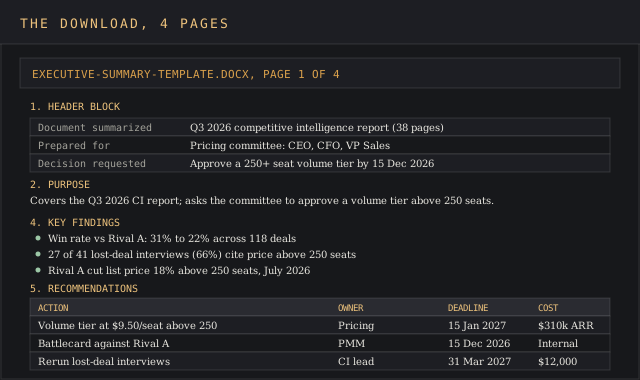
This executive summary template is a Word document with seven fill-in parts and the worked example filled in across pages one and two, a business plan version on page three, and a length check on page four.
Download DOCXAn executive summary is the one-to-two-page section at the front of a report, proposal or business plan that states the purpose, the key findings and the decision the reader is asked to make. This executive summary template gives that section a fixed shape: seven parts in the order a decision maker reads them, with a filled-in example so nobody starts from scratch.
Below, explore what goes in each part, a step by step guide to writing one, a full executive summary example from a competitive intelligence report, the business plan version, and the length rules four writing guides publish.
It's built for whoever writes the executive summary for somebody else to act on: an analyst sending a quarterly market study to the leadership team, a founder sending a business plan to a lender, a product marketer sending a project proposal to the internal stakeholders who sign it off.
That reader often stops at page one. The University of Maryland Global Campus writing center calls the executive summary "often the first and only part read by key decision makers" (UMGC), so the page has to carry the decision on its own.
Download the free executive summary template
Download the executive summary template (DOCX)Four pages: the seven-part report summary pre-filled with the Harbor HR pricing example, a funding-pitch version in the SBA's section order, and a length check against the source document.
The free executive summary template opens in Microsoft Word, Google Docs, LibreOffice Writer and Apple Pages. It's a free template with no email gate, and its headings use Word's built-in styles, so the navigation pane lists every part, and there's no title page to delete.
What an executive summary is
An executive summary is a concise overview of a longer document, written so a reader who stops at the end of it still knows the main points, the evidence behind them and the next step. It's a stand alone document in miniature, short enough to read in two minutes and complete enough to decide from: UMGC's test is to have someone read it once and explain the basics of the entire proposal back to you.
A strong executive summary gives decision makers the essential information from the entire document as a high level overview, which speeds up decision making, and leaves the proof to the report. An effective executive summary also names the desired outcomes, so the reader knows what a yes changes.
An abstract describes what a paper studied, and an introduction sets up what follows. The executive summary goes further and states the conclusions and the proposed actions up front, so the main report becomes the evidence file behind them.
That top-down order has a long pedigree. Barbara Minto's Pyramid Principle, a book she wrote in 1987 that is now a standard text at the major consulting firms, organizes a whole document as a pyramid under a single point. A good executive summary is the tip of that pyramid, cut off and handed over first.
The seven parts of the template
Each part of the executive summary template answers one question a reader has before signing off. Together they hold the essential elements every writing guide below agrees on: purpose, key findings and recommendations.
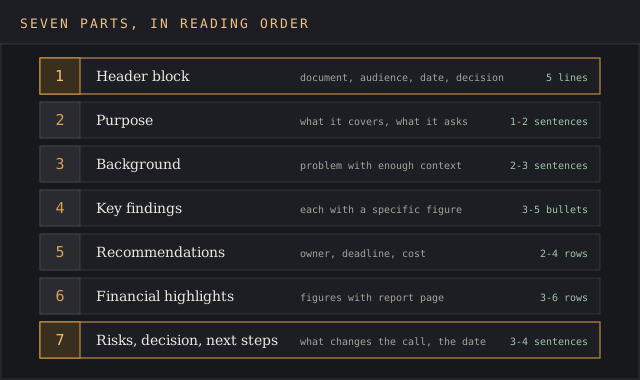
| Part | What goes in it | Length |
|---|---|---|
| 1. Header block | Document summarized, audience, author, date, decision requested | 5 lines |
| 2. Purpose | The main purpose of the document, in present tense | 1 to 2 sentences |
| 3. Background | The problem or opportunity as a brief overview, with enough context for a reader who skips the full report | 2 to 3 sentences |
| 4. Key findings | Main findings as bullet points, each with a specific figure | 3 to 5 bullets |
| 5. Recommendations | Proposed actions with an owner, a deadline and a cost | 2 to 4 rows |
| 6. Financial highlights | The figures the decision turns on, each with its page in the main document | 3 to 6 rows |
| 7. Risks, decision, next steps | What would change the recommendation, the decision requested and its date | 3 to 4 sentences |
UMGC's writing center asks for the same sections in the same order as the report being summarized, which it calls perfect miniaturization. If your report runs in a different sequence, move parts 3 to 6 to match it and keep the header block and the decision where they are.
Download the executive summary template (DOCX)
How to write an executive summary, step by step
Draft it last. Boise State's College of Business style guide says to write the executive summary "after you have completed the report and decided on your recommendations" (Boise State), and Diligent's board-report guidance gives the same order.
- Name the reader and the decision, then focus every line on that decision. A pricing committee wants the price change first; the same full document summarized for the sales team leads with the new battlecard.
- Write the purpose in one concise sentence, in present tense: what the document covers and what it asks for.
- Pull three to five key points from the full report, each with specific figures. "Win rate fell from 31% to 22%" replaces "win rates dropped".
- Turn every finding that needs a response into one of your actionable recommendations, with an owner, a deadline and a cost. UMGC says to present recommendations as a list "whenever possible".
- Add the money figures the decision rests on, with the page where each number is proven.
- State the risks, the decision requested and its date, then a brief conclusion of one or two lines.
- Cut to length, then ask someone who hasn't read the whole document to review it and tell you what they'd decide.
Write it in plain English. The Plain Writing Act of 2010 made it a requirement that federal content for the public is written for its specific audience (Digital.gov). The same test works inside a company: swap acronyms, product codenames and team shorthand for the words the CFO uses.
Read the room before step 1. A board, a lender and a project steering group each want different important takeaways from one report, so write one summary per audience and keep the main report identical.
Executive summary example: a competitive intelligence report
This sample executive summary is the one pre-filled in the download. Harbor HR is a fictional 140-person HR software company, and every number below is illustrative but consistent, so the arithmetic from finding to recommendation can be checked line by line.
The source is a 38-page, 14,000-word Q3 2026 competitive intelligence report built on the market intelligence report template, with lost-deal interviews run through the win-loss analysis template. This executive summary example fits on two pages.
Header and purpose
| Field | Entry |
|---|---|
| Document summarized | Q3 2026 competitive intelligence report (38 pages) |
| Prepared for | Pricing committee: CEO, CFO, VP Sales |
| Prepared by | Competitive intelligence lead |
| Date | 4 December 2026 |
| Decision requested | Approve a volume tier for accounts above 250 seats by 15 December 2026 |
Purpose: this summary covers the Q3 2026 competitive intelligence report and asks the pricing committee to approve a volume price tier for accounts above 250 seats. Background: Harbor HR's win rate against its largest rival fell in Q3, and the drop sits almost entirely in deals above 250 seats.
Key findings
- Win rate against Rival A fell from 31% in Q2 to 22% in Q3 2026, across 118 head-to-head deals.
- 27 of 41 lost-deal interviews (66%) named the per-seat price above 250 seats as the main reason.
- Rival A cut its list price 18% for accounts above 250 seats in July 2026.
- Deals under 250 seats held a 38% win rate in both quarters.
Recommendations
| Action | Owner | Deadline | Cost |
|---|---|---|---|
| Add a volume tier above 250 seats at $9.50 per seat per month, down from $11.00 | Head of Pricing | 15 Jan 2027 | $310,000 lower ARR on existing renewals |
| Ship a competitor battlecard against Rival A to the sales team | Product marketing | 15 Dec 2026 | Internal time only |
| Rerun the lost-deal interviews in Q1 2027 to measure the effect | CI lead | 31 Mar 2027 | $12,000 in interview incentives |
Financial highlights
| Item | Figure | Report page |
|---|---|---|
| Quarterly pipeline above 250 seats | $2.4M | 14 |
| Win-rate recovery target | 22% to 28% | 21 |
| New ARR per quarter from the recovery | $144,000 (6 points of $2.4M) | 22 |
| ARR reduction on renewals from the new tier | $310,000 | 23 |
| Payback | About two quarters ($310,000 / $144,000) | 23 |
Risks, decision and next steps
Rival A could match the new tier with a further cut; if the Q1 2027 win rate stays under 25%, the tier comes back to the committee. Decision requested: approve the 250-plus seat tier at the 15 December 2026 meeting. If approved, sales gets the battlecard the same day and the new price goes live on 15 January 2027.
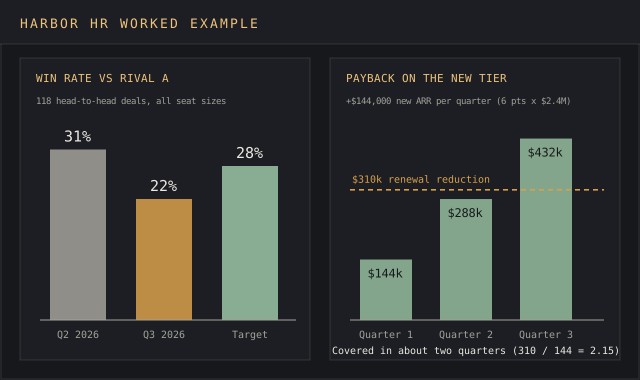
In this executive summary example, every recommendation traces to a finding, every cost appears in the money table, and the conclusions follow from both. The devil's in the details here: a 6-point recovery on a $2.4 million pipeline is $144,000 of new ARR a quarter, which covers the $310,000 renewal hit in about two quarters, and the committee can review that in ten seconds.
Download the executive summary template (DOCX)
Executive summary template for a business plan
A business plan summary answers a different question: is this company worth funding. The U.S. Small Business Administration says it should "briefly tell your reader what your company is and why it will be successful" (SBA).
The SBA lists the mission statement, the product or service, and basic facts about leadership, employees and location, plus financial information and high-level growth plans for anyone seeking financing. Page three of the download follows the order of the SBA's traditional section list, so the executive summary previews it in the same sequence:
- Company description: mission, legal structure, location, headcount
- Product line or service: what you sell and to which customer base
- Market analysis: market opportunities, target segment, market share goal
- Competitive advantage: the one thing a rival can't copy within a year
- Organization and management: founders and key hires
- Funding request: amount, use of funds, timing
- Financial projections: revenue, margin and break-even, three to five years out
For the SBA's lean startup format, which usually fits on one page, the whole thing doubles as its own summary; the business model canvas template covers that shape. Both business types, traditional and lean, still need the funding request and its expected impact stated up front.
Ideal length of an executive summary
Four published guides agree within a narrow band, and all of them land between one page and two for a typical report.
| Source | Rule | What it means in practice |
|---|---|---|
| Asana | 5 to 10% of the main document | Typically one to two pages |
| Diligent | 5 to 10% of the source document | One page for a board report |
| UMGC | About 10% of the full proposal | One page or less for a 10-page proposal |
| Boise State | 10 to 15% of the report | Most run one to two pages |
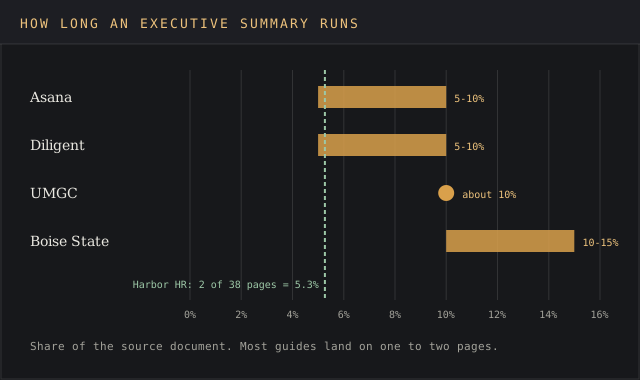
For Harbor HR's 38-page source document, the 5 to 10% band works out to roughly two to four pages; the summary uses two. Past that point the executive summary starts to repeat the entire content of the report.
42% of directors want fewer presentations and more discussion, according to What Directors Think 2026 from Diligent Institute and Corporate Board Member, as reported in Diligent's executive summary guide. A board pack that opens with a one-page summary hands that meeting time back for discussion.
Download the executive summary template (DOCX)
Common mistakes in an executive summary
Most weak summaries miss the mark in one of six places, and all six are fixable in a second draft:
- Writing it first. A summary drafted before the analysis ends describes the plan for the report and skips its findings.
- Findings with no figures. "Competition intensified" gives a reader nothing to check; "Rival A cut list price 18%" gives them key data.
- New information. Boise State's guide says the executive summary shouldn't add anything the source doesn't contain.
- Pointers to tables and appendices. UMGC tells writers to give findings in condensed form without sending the reader to a table.
- Recommendations with no owner, date or cost, which leaves the committee nothing to approve.
- Burying the decision under the main points. If the ask sits in the last line of page two, the reader who stops at page one never sees it.
Don't beat around the bush with background, either. Two to three sentences of context keep the focus on the decision and the summary concise; the rest belongs in the longer document, where a reader can review it.
Word, Google Docs or a single slide
The .docx file covers both Word and Google Docs, so you can explore it in either; upload it to Drive and the styles and tables carry over. For a meeting, the same content fits one slide: the decision as the headline, three findings on the left, the recommendations table on the right, and the payback figure in the footer.
AI writing tools can draft a concise summary from a long report, and that saves the first hour. Use one to explore a first draft. It can't know which decision your reader faces, so review every figure against the source page and rewrite the recommendations yourself before anyone signs off.
Download the executive summary template (DOCX)
FAQ
What should be written in an executive summary?
A concise overview: the purpose of the document, the background in two or three sentences, three to five key findings with figures, the recommendations with owners and dates, the money figures and the decision requested. This template holds those as seven parts, and the executive summary example above shows all seven filled in.
What are the 5 parts of an executive summary?
Asana's five-part version is an introduction stating the problem, the proposed solution, its value and impact, key findings and analysis, and a conclusion with next steps. UMGC's list is close: purpose, problem, methods, results and recommendations.
How long should an executive summary be?
One to two pages for most reports, or 5 to 10% of the source document by Asana's and Diligent's rule. Boise State allows 10 to 15%. For a board report, Diligent calls one page the gold standard.
What not to include in an executive summary?
Leave out information the report doesn't contain, references to tables and appendices, jargon and uncommon acronyms, and personal comments; Boise State's guide names that last one too.
Can ChatGPT write an executive summary?
It can produce a first draft from the full report. It doesn't know the reader's decision, the owner of each action or which figures matter to the budget, so the recommendations and the figures need a person to write and check them.
What are the 7 parts of a business plan?
The SBA's traditional format lists eight sections: executive summary, company description, market analysis, organization and management, service or product line, marketing and sales, funding request and financial projections. The seven after the executive summary are the parts the summary previews.
Can you provide an example of an executive summary slide?
Use the Harbor HR executive summary example above, cut to its key points: headline "Approve a 250-plus seat tier by 15 December", three findings (win rate 31% to 22%, 66% of lost deals cite price, Rival A cut 18%), the three-row recommendations table, and the two-quarter payback in the footer.
Bottom line
Reach for this executive summary template when a report, a proposal or a project update goes to someone who will decide from page one. A well crafted executive summary keeps the focus on one decision: fill in the seven parts after the analysis is done, tie every finding to a figure, and give each recommendation an owner, a date and a cost.
For the report behind the executive summary, explore the market research report template or the market intelligence report template. For a lender pitch, page three of this file follows the SBA's order, and the key takeaways go in its funding request.