White Space Analysis Template
 By Jan Suski. I go deep on every review, checking every number against its source and digging up details other coverage misses, a habit from six years of SEO and link building for tech companies. Bylines at Surfer, Brand24, and Senuto. How the scoring works.
· Prefer this source on Google
A white space analysis maps what an account already buys against everything it could plausibly buy, then turns those blank cells into a scored list of expansion targets. The matrix has two axes: your product or service lines across the top, and the account's buying centers down the side. Every cell with no revenue and no open deal is the white space the practice is named for.
This page covers the four-state matrix, a five-factor scoring model for triaging blank cells into Pursue, Park, or Pass, a worked example, and the mistakes that turn a white space analysis into a spreadsheet nobody opens twice. The template ships as one Excel workbook with formulas wired in, so scores compute once you fill in the account data.
It's built for account managers, customer success leads, and B2B sales teams expanding a customer base they already sell into. A business still chasing its first customer in a category needs a different tool.
A white space analysis assumes the relationship already exists: a signed contract and at least one active buying center. Prolifiq's guide to account expansion puts the acquisition-cost gap at five to seven times, citing Harvard Business Review; that gap is the economic case for running the exercise every quarter.
The white space analysis template is part of our market intelligence templates library, and it downloads free as a single workbook.
Download the free white space analysis template
Download the white space analysis template (XLSX)The Matrix, Cell Scoring, and Worked Example tabs, pre-filled with the Acme Manufacturing scenario and ready to clear for your own account.
The workbook opens in Excel or Google Sheets without conversion, and every formula recalculates once sales or account-management staff replace the sample data with their own account.
What white space analysis is
A white space analysis identifies revenue sitting inside an account a company has already won: products the customer hasn't bought, buying centers you haven't reached, and customer needs you haven't mapped to an offering.
ARPEDIO's practitioner guide defines it the same way: the structured practice of finding revenue opportunities inside accounts you've already sold into. Kayako's guide frames the same idea as a grey area: no matter how many companies chase one market, some need goes unserved by every one of them.
The term gets used two ways. In enterprise sales, white space means gaps inside an existing customer. In broader corporate strategy, Exploding Topics uses the same phrase for gaps across a market overall, the space between what competitors already serve and what a whole category of buyers needs. This template covers the narrower sense: growth inside accounts you can already call.
Janek's guide splits white space mapping into two kinds: internally focused mapping, which looks at your company's strengths and the market barriers blocking a push into new groups or new markets, and externally focused mapping, which looks outward at competitor offerings to see where competitors have left a gap. Custify's guide extends the idea into three forms, internal, external, and future white space, the last built from unmet needs your roadmap hasn't reached yet.
A white space analysis also helps separate a real gap from a wish list. A competitor analysis alone flags where rivals are strong; identifying revenue opportunities means combining that with your own sales data, then scoring what's left so a rep can identify areas worth an afternoon and surface gaps a single seller would never spot alone.
Why white space analysis matters for existing accounts
Existing customers and unmet customer needs
Existing customers convert at a rate that makes cold sales prospecting look inefficient. Genroe's research on cross selling puts the probability of selling to an existing customer at 60 to 70%, against 5 to 20% for a new prospect. A Forbes Agency Council analysis found existing customers are 50% more likely to try a new product and spend 31% more, on average, than new customers do.
A cold prospect has usually already talked to your competitors. Current customers picked you once already, and they'll name their pain points directly if a rep asks.
Buying centers inside a large account move faster than CRM records do. Prolifiq's guide counts 15 to 40 distinct buying centers in a typical enterprise account, each capable of an independent purchase decision, and a department that didn't exist in your records two years ago can own a six-figure decision today.
Net revenue retention rides on this number
For a subscription business, net revenue retention decides if the company grows without a single new logo. Prolifiq's research found that teams who operationalize white space analysis routinely hit 115 to 130% NRR, against the roughly 100% a company gets from pure renewals with no expansion. Every point above 100 is revenue growth pulled from a cell that was previously blank. Running the exercise every quarter, on a fixed calendar, is what keeps that number moving.
Our revenue intelligence rankings cover the platforms built to track NRR movement automatically, once a program outgrows a quarterly spreadsheet review.
Mapping buying centers to current offerings
The white space matrix runs on two axes. Down the side go the account's buying centers: divisions, regions, or functions that buy independently. Across the top go your current offerings, grouped at the level of a real buying decision: a product line or a bundle a buyer signs one contract for.
Pick the row dimension by how the account decides its budget, since CRM territory fields rarely match that. A conglomerate needs rows by business unit; a centralized customer needs rows by buying persona; a company with strong regional P&Ls needs rows by geography. A buying center also matters more when it maps to the account's strategic initiatives. Pick once per account and revisit annually.
Populate cells from opportunity records, signed contracts, and activity history first, then walk it with the account team: the data shows where revenue sits, and the team explains why a cell is empty, a prior loss, or one of the potential gaps nobody's tried yet.
Feed the matrix from customer data already in the CRM: purchase history, support tickets, and survey answers on customer preferences and pain points. Score against one target market and its target customers: whichever segment the account expansion plan is funding this quarter. The same data flags potential customers and emerging trends nobody has contacted yet.
The stakeholder map template covers who inside each buying center holds the decision, and the customer segmentation template covers how to draw those groups before they ever reach this matrix.
The four cell states and where cross sell opportunities come from
Once the grid exists, every cell falls into one of four states, a framework ARPEDIO's guide lays out in four parts:
| Cell state | Definition | Typical action |
|---|---|---|
| Expand | Existing revenue, room to grow | Structured upsell, usually AE plus customer success |
| Maintain | Existing revenue, fully deployed, stable | Protect the renewal, watch for change |
| Target | No revenue yet, active opportunity in pipeline | Standard qualified deal management |
| White space | No revenue, no active opportunity | Identify the buyer, build the relationship, move it to Target |
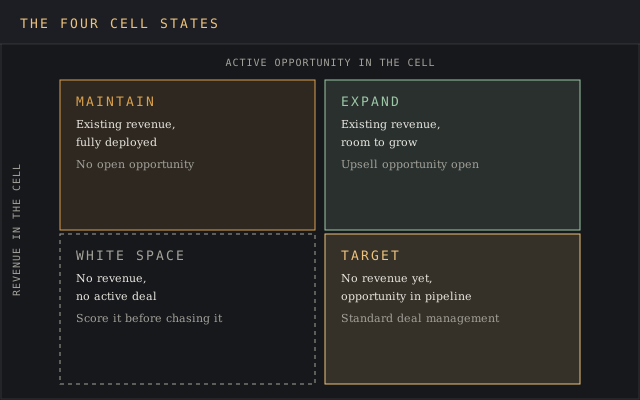
Cross sell and upsell opportunities live in different states. An upsell, more seats or a higher tier of a product the account already has, comes from an Expand cell. A cross sell, a different product line, usually starts as a Target or a White space cell, since the account has no revenue in that column yet. Confusing the two states is how a white space analysis turns into a pipeline forecast it was never meant to be.
Gap identification: scoring the white space cells
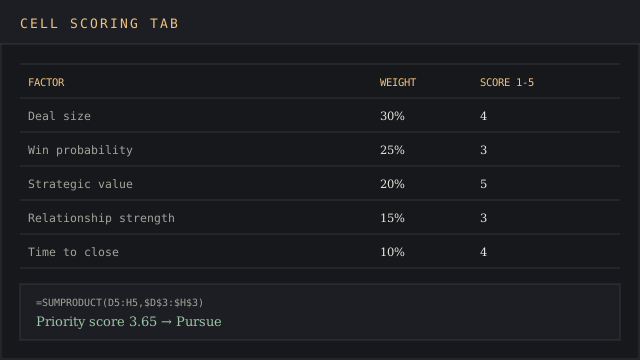
Not every white space cell is worth chasing. Score each one so the sales team spends its time on the cells worth pursuing: a scored list of six cells beats an unscored grid of twelve, and chasing all twelve spreads a sales team thin. Prolifiq's framework scores four factors; the template adds a fifth to separate relationship strength from raw fit:
| Factor | What it measures | Weight |
|---|---|---|
| Deal size | Estimated annual contract value if the gap closes | 30% |
| Win probability | Product fit plus any live trigger, such as a renewal or a new sponsor | 25% |
| Strategic value | Does landing this cell open adjacent cells | 20% |
| Relationship strength | Do you already have a champion in this buying center | 15% |
| Time to close | A quick win versus a multi-quarter campaign | 10% |
Score each factor 1 to 5, multiply by its weight, and sum the row for a priority score out of 5. The Cell Scoring tab runs the math with a SUMPRODUCT formula, recalculating without a manual pass. A scored white space matrix also sharpens competitive positioning: when a named competitor already owns a buying center, that should pull the win-probability score down until the sales process turns up a reason to think otherwise.
Sort white space cells into three buckets: Pursue above roughly 3.5, Park for a genuine gap with no path, and Pass for poor fit. ARPEDIO's guide found most teams mark 60 to 70% of their white space cells Park or Pass: the scoring is working as intended when most cells land there. Our competitive intelligence tools ranking covers the platforms that keep the win-probability inputs current.
A complete guide to filling in the template, step by step
List your current offerings. Every product, module, and service line relevant to this account, one column per line. Skip individual SKUs; group at the level of a real buying decision.
Map the buying centers. List every unit inside the account capable of an independent purchase, one row per unit, sourced from account team knowledge; the default CRM territory field rarely matches it.
Populate current state. Mark each cell Expand, Maintain, Target, or White space using real revenue, contract, and opportunity data. Leave nothing on a guess.
Score the white space cells. Fill in the five factors on the Cell Scoring tab for every White space cell and let the formula sort Pursue, Park, and Pass.
Assign an owner and a next action. Every Pursue cell needs a name and a 90-day next step, or it reverts to a spreadsheet nobody updates.
Review on a fixed cadence. Quarterly for most strategic accounts, and immediately after a reorganization, acquisition, or leadership change.
Worked example: a field-service software vendor's largest account
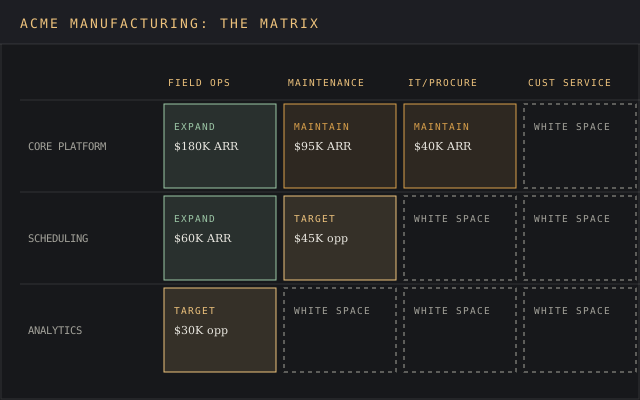
The scenario below is hypothetical, built to show how white space analysis works with realistic numbers; it isn't a report on a real company. A 60-person B2B vendor sells field-service software in three lines: Core Platform, Scheduling, and Analytics. Its largest customer, called Acme Manufacturing here, buys through four buying centers: Field Operations, Maintenance, IT/Procurement, and Customer Service.
That's a 3-by-4 matrix, 12 cells, populated from CRM records and billing data:
| Field Operations | Maintenance | IT/Procurement | Customer Service | |
|---|---|---|---|---|
| Core Platform | Expand: $180K ARR, live in 3 of 6 depots | Maintain: $95K ARR, fully deployed | Maintain: $40K ARR, admin licenses | White space |
| Scheduling | Expand: $60K ARR, live in 2 of 6 depots | Target: $45K opportunity, demo done | White space | White space |
| Analytics | Target: $30K opportunity, proposal stage | White space | White space | White space |
Existing revenue across the Expand and Maintain cells totals $375K ARR. Two Target cells add $75K already in the pipeline, leaving six White space cells scored on the table above.
Two cells score above the Pursue threshold: Core Platform into Customer Service, strategic value high since it opens a new buying center, deal size $25K, and Analytics into Maintenance, adjacent to an existing relationship, deal size $35K. The other four land in Park or Pass, mostly on weak relationship strength or poor fit for that department.
The two Pursue cells add $60K of newly identified white space opportunities on top of the $75K already in Target. Against $375K of existing footprint, that's real growth. It's 36% more expansion pipeline from one 12-cell matrix, without a single new account, and every closed Pursue cell feeds the win-loss analysis template once it lands, so the reason it won or stalled sharpens the next scoring pass.
Common mistakes
These are the patterns that turn a white space analysis into a wasted quarter:
Treating it as a one-time exercise. ARPEDIO's guide calls this the first pattern to avoid: the matrix is wrong by next quarter if nobody refreshes it. Prolifiq's research is blunter, calling an unrefreshed list of white space accounts worthless within two quarters.
Confusing white space with pipeline. Pipeline is what's actively in motion; white space isn't yet, though it plausibly could be. Reporting the two together turns a planning tool into an inflated forecast.
Building the matrix without the account team. A matrix one seller fills in alone is a guess. A matrix the account team builds together is a plan. Run it across the full team, AE, customer success, sales engineer, so private knowledge surfaces in one shared document.
Using insufficient or biased data. Kayako's guide flags this as the biggest driver of bad output: white space mapping and identifying gaps both depend on CRM and billing records first, a seller's memory second.
Measuring activity over outcomes. Counting white space reviews run tells you about adoption; counting Pursue cells converted to Target tells you if it made money.
Most of these mistakes trace back to one thing: treating the white space matrix as a one-off report. Treat it as a recurring habit and the list keeps compounding. Identifying gaps is only half of a white space analysis; a company that stops there, whatever its market or size as a business, never converts the list into revenue.
New accounts versus new opportunities inside existing accounts
Compare the cost. Chasing a brand-new logo starts from zero: no contact, no trust, no history of on-time payment. A white space cell inside a current account starts with all three in place, since the account has already cleared procurement once. That's not an argument to stop prospecting for new customers; it's an argument to run white space analysis with the same discipline as a fresh pipeline, since the return on that hour usually runs higher.
New opportunities inside a customer base also close faster, since current customers already trust the account manager and adding a module skips most of a full procurement cycle. Some buying centers respond to a soft sell better than a direct pitch; note that on the cell so sales strategy matches the buying center's culture.
Which software to use
A white space analysis helps most when the business running it picks the right tool for its size. The template ships as a single Excel workbook, and opens the same way in Google Sheets; every formula keeps working after upload. Word and Docs aren't options, since the scoring depends on formulas a word processor can't run.
Spreadsheets work fine for one account or a handful of strategic accounts reviewed by hand each quarter. Once a sales org runs white space analysis across dozens of market-facing accounts with multiple buying centers each, a CRM-native tool keeps the matrix current automatically.
Wired into Salesforce the way Prolifiq CRUSH, ARPEDIO, or DemandFarm are, that kind of tool keeps the matrix connected to live opportunity and contract data so it doesn't go stale between reviews. Our sales intelligence rankings cover platforms built for account-based expansion at that scale.
This spreadsheet is the right starting point either way, and sales leadership can graduate to paid software once the manual sales process proves its worth.
FAQ
What is the concept of white space?
White space is the area where a company can innovate, expand, or capture revenue nobody has fully claimed yet. Inside an account it's a product the customer hasn't bought or a buying center you haven't reached; across a market it's unmet customer needs and pain points none of your competitors serve well.
What is white space vs green space?
White space refers to gaps inside accounts you already serve; green space refers to net-new accounts you don't serve at all. Some teams use "greenfield" for green space; define the boundary once and stay consistent.
What is the purpose of whitespace?
A white space analysis converts a vague sense that an account holds more revenue into a scored, owned list of gaps. Without the matrix, expansion depends on whichever seller remembers a contact at a subsidiary; with it, informed decisions replace guesswork.
What does "market white space" mean?
Market white space describes an underserved segment, geography, or need across an entire market. White space inside one account is the narrower, account-level version this template covers. Exploding Topics' framework for the market-wide sense runs scope definition, analysis, and a strategic report, the shape it applies to how Apple, Amazon, and Netflix each found unclaimed ground.
What is an example of white space?
In the worked example above, Core Platform sold into Field Operations and Maintenance but not Customer Service is white space: real product, real account, zero revenue, no active deal, one of the white space opportunities the matrix surfaced.
How does white space analysis differ from TAM analysis?
Prolifiq's guide draws a clean line: TAM analysis estimates the total addressable market across every potential customer in a category. White space analysis operates inside one account, comparing current product penetration against what that customer could plausibly buy. TAM sets market strategy; white space sets account strategy.
Who should own white space analysis?
Account executives and account managers own the matrix for their own strategic accounts; sales operations keeps data quality up, and customer success supplies adoption signals a CRM alone won't show. Assign a named owner to the exercise and to each cell, folded into the existing sales process cadence.
Bottom line
Used on a fixed cadence, a white space analysis helps an account team spot revenue before competitors do, on a 12-cell account or a 200-cell one alike. Score the empty cells, assign owners, and turn them into real expansion opportunities; skip the refresh and it's a slide from last year's quarterly review nobody trusts.
Reach for this template when expansion inside the account makes sense for the business: a customer base you already sell into, with real revenue in some cells and nothing in others. Reach for a TAM or market-sizing template when the target is a brand-new market. Reach for a straight account plan once the matrix has no white space left, only renewal risk to manage.