Wappalyzer vs BuiltWith: per-user lookups or a 551-million-domain index
 By Jan Suski. I go deep on every review, checking every number against its source and digging up details other coverage misses, a habit from six years of SEO and link building for tech companies. Bylines at Brand24 and Senuto. How the scoring works.
| WHAT EACH ONE DOES | BUILTWITH | WAPPALYZER |
|---|---|---|
| Core job | Index of 551M domains | Live page lookups |
| Technologies | 128,000+ | 8,189 |
| Detection timing | Crawl, monthly refresh | Live in your browser |
| Trend history | Back to January 1985 | No history product |
| Chrome extension | 300,000 users | 3,000,000 users |
| Contacts included | Names, emails, titles | Emails + verification |
| CRM sync | 6 CRMs, daily sync | 3 CRMs + Gmail |
| APIs | 20+ APIs, MCP, Live Feed | Lookup, lists, verify |
| Skip it if | You need 5 cheap seats | You need history |
| WHAT YOU GET | BUILTWITH | WAPPALYZER |
|---|---|---|
| Entry price | $295/mo Basic | $250/mo Pro |
| 1 user, all tech | $495/mo Pro | $450/mo Business |
| Five users | $995/mo Team | $450/mo Business |
| Logins, lower plans | 1 on Basic and Pro | 1 Pro, 5 Business |
| Lookups | Free site lookups | 5,000/mo on Pro |
| Free tier | Free lookups forever | 50 lookups/mo |
| Yearly billing | $2,950/yr on Basic | 17% off toggle |
| Minimum term | 1 month or 1 year | Pause up to 3 months |
| Founded | 2007, Sydney | 2008, Elbert Alias |
StrongerWeakerNo edge
Thirty-one further documented limits sit behind the button below: BuiltWith’s keyword and report caps, data feeds and API credit pricing, and Wappalyzer’s credit, verification and CRM gates by plan. Scenario: a B2B team buying one technographic subscription at one, five and ten users. Figures come from both vendors’ plans, coverage, feature and API pages and the two Chrome Web Store listings, read 21 November 2026, as monthly list prices before any annual discount.
| BuiltWith | WHAT IT DOCUMENTS |
|---|---|
| Keywords tracked | 2 on Basic; unlimited on Pro and Team |
| Retail reports | 2 on Basic; unlimited on Pro and Team |
| Team Ultra | Listed as also available, no published price |
| Exports | Excel and CSV on every plan |
| Spend and revenue data | Included on every plan |
| Support | Phone and email, seven days a week |
| Payment | Visa, Mastercard, Amex, PayPal, Bitcoin; wire on yearly |
| Plan changes | Pro-rated refund on any plan change |
| eCommerce coverage | 2,500+ eCommerce technologies, 26M+ eCommerce sites |
| Trends updates | Weekly |
| Traffic rank | Top 1M sites, Tranco and Alexa |
| Live Feed | WSS feeds: technology, new, new historical, premium |
| Extension lookups | Standard, details, meta, relationship |
| Relationships API | Up to 500 records per page, 1 credit per page |
| MCP registry API | Free, 1 request per second |
| Pay per lookup | x402 in USDC on Base, no account or key |
| Bulk datasets | Technology history from 2000, Snowflake and BigQuery |
| Wappalyzer | WHAT IT DOCUMENTS |
|---|---|
| API credits | None on Pro; 20,000 Business; 200,000+ Enterprise |
| CRM enrichment | Business and Enterprise only |
| Email verifications | 5,000 Pro; 20,000 Business; 200,000+ Enterprise |
| Enterprise lookups | 200,000+ a month, custom terms |
| Lead list targets | 2 on Pro; unlimited from Business |
| Credit cost | Typically 1 credit per website |
| Credit expiry | Plan credits 60 days, bundle credits 365 days |
| Refunds | Account credit or pro-rata refund, per terms |
| Free lead lists | Sample lists on the free plan |
| Browsers | Chrome, Firefox, Edge, Safari |
| Lead list filters | Geography, traffic, company profile, contact coverage |
| Google Workspace | Gmail add-on |
| Lookup API returns | Technologies, emails, phones, social, company details |
| Other APIs | Lead lists, subdomain finder, email verification |
BuiltWith’s technology count reads differently on four of its own pages read the same day: 128,713+ on the homepage, 128,732 on the plans page, 128,720 in the FAQ and 127,982+ on the feature list. They are snapshots of one live counter, so the decision block rounds to 128,000+ and the body gives the range.
Where the 551 million domains, the 8,189 technologies and the per-seat math come from
Both vendors publish their rates, so every price on this page is a list price read off builtwith.com/plans and wappalyzer.com/pricing on 21 November 2026, before any annual discount. Wappalyzer’s plan table renders in the browser, and its per-plan lookups, verifications, API credits and CRM gate were read from that render.
- BuiltWith: plan limits, support and payment terms from builtwith.com/plans; 551,540,987 root domains, 8.1 billion monthly GET requests and 55,152,000 daily scans from its data coverage page; refresh cadence from its FAQ; feeds and extension lookups from its feature list; API pricing from api.builtwith.com.
- Wappalyzer: plan gates, credit rules and refund terms from wappalyzer.com/pricing; 8,189 technologies and 106 categories from its technologies page; browsers, filters and integrations from its BuiltWith alternative page; API outputs from wappalyzer.com/api.
- Extension users, ratings and update dates: the two Chrome Web Store listings.
Neither vendor publishes an accuracy rate, a free trial of paid plans or per-plan API rate limits, BuiltWith publishes no Team Ultra price, and Wappalyzer publishes no crawl volume or domain count, so no row claims one.
Wappalyzer vs BuiltWith comes down to one question: do you need to check websites you already know, or find companies you have never heard of? Wappalyzer prices by user and lookup, and its Pro plan pricing starts at $250 a month for one user and 5,000 technology lookups. BuiltWith prices by how many technologies you track, from $295 a month for two, and builds its lists from an index of 551,540,987 root domains.
This comparison is for sales teams, marketing teams and market researchers choosing one technographic data subscription. Every price and coverage figure below comes from wappalyzer.com, builtwith.com or the two Chrome Web Store listings, read on 21 November 2026.
The two billing units punish different mistakes. Five people on Wappalyzer's Business plan cost $450 a month; five people on BuiltWith's Team plan cost $995. Flip the job to sizing a market across decades of adoption history and the bill matters less than the archive, because BuiltWith's trend data starts in January 1985 and Wappalyzer's pricing and technologies pages list no history product at all.
↑ COMPARISONTechnology data: what each platform counts
The headline gap is catalogue size. Wappalyzer's technologies page lists 8,189 web technologies across 106 categories. BuiltWith gives three counts on three of its own pages read the same day: 128,713+ on its homepage, 128,732 on its plans page and 127,982+ on its feature list. Read it as a live counter that sits around 128,000.
| Coverage figure | Wappalyzer | BuiltWith |
|---|---|---|
| Technologies tracked | 8,189 | 127,982 to 128,732 |
| Technology categories | 106 | Unpublished as one total |
| Root domains indexed | Unpublished | 551,540,987 |
| Crawl volume | Unpublished | 8.1 billion GET requests a month |
| Domains scanned per day | Unpublished | 55,152,000 |
| Refresh cadence | "Continuously validated and updated" | Active sites monthly, top sites more often |
| Technology tracking history | No history product listed | Back to January 1985 |
| Chrome extension users | 3,000,000 | 300,000 |
| Extension last updated | 26 October 2026 | 11 May 2022 |
| Founded | 2008, by Elbert Alias | 2007, Sydney, by Andrew Rogers and Gary Brewer |
Sources: BuiltWith's data coverage page for the domain, GET and daily-scan counts, its FAQ for refresh, its about page and Wappalyzer's about page for founding, all read 21 November 2026.
Catalogue size matters most for niche software. If your target market runs a regional payment gateway or a little-known ecommerce plugin, BuiltWith's 15-times-larger catalogue is the likelier of the two to carry its fingerprint. For mainstream website technologies, a CMS, an analytics tool, a tag manager or a framework, both catalogues carry them, because those fingerprints are a dime a dozen.
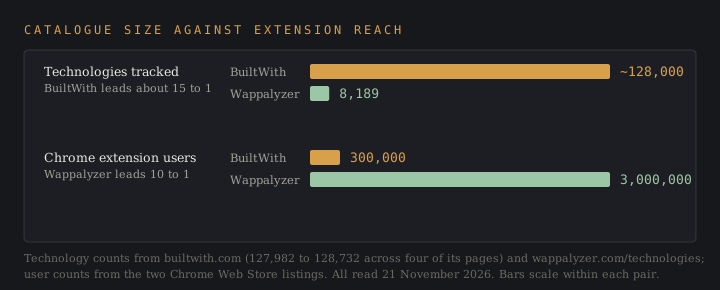
The extension numbers flip the picture. Wappalyzer's Chrome browser extension lists 3,000,000 users and a 4.0 rating from about 2,000 ratings. BuiltWith's extension lists 300,000 users, a 3.6 rating from 414 ratings, and a last update on 11 May 2022. Those are facts about the store listings, read 21 November 2026, and say nothing about data quality.
↑ COMPARISONHow web technology detection works, and how accurate each one is
Both tools read what a site exposes publicly: script tags, HTTP headers, session cookies, meta tags and DNS records. That is why both catch surface technologies such as analytics, tag managers, CMS platforms and ad pixels, and why both miss backend software that never reaches the browser. A database, an internal ERP or a server-side framework that strips its own headers leaves nothing for either method to see.
The difference is when the read happens. Wappalyzer's extension analyzes a page in your own browser as it loads, and its API page says lookups "combine fast cached results with live analysis." BuiltWith crawls on its own schedule, and its FAQ says all other active websites are "updated monthly", with top-traffic sites refreshed more often.
A site that switched tools last week can show the old technology stack in BuiltWith until the next crawl, and the new stack in Wappalyzer the moment you visit. For example, a backend move from one hosting provider to another shows up in DNS records and headers, so both tools detect it, while a backend switch between two databases stays hidden from both.
Tracking that kind of change over time is the job BuiltWith's Change API is focused on: it reports technology additions and removals across websites, which a one-off lookup cannot. BuiltWith's crawler has to detect the change first, so an alert can only be as fresh as the last crawl, and a monthly refresh can miss the boat on a fast-moving account.
Consent banners add a wrinkle. A site that holds analytics scripts and session cookies until a visitor clicks accept shows a thinner stack to a crawler than to a person who clicked through, so a browser extension that runs after your click can see tools a crawl missed. Browser extension signals also feed Wappalyzer's data: its BuiltWith alternative page credits its "widely used extension" for traffic signals.
How accurate is either one? Neither vendor publishes an accuracy rate with a method behind it, so any percentage you see quoted for either is somebody else's test. The quick and dirty check costs nothing: run both free lookups on ten sites whose stack you already know, including two that migrated recently, and count the misses. That hour of analysis tells you more than any third-party score.
↑ COMPARISONPricing: per user against per technology tracked
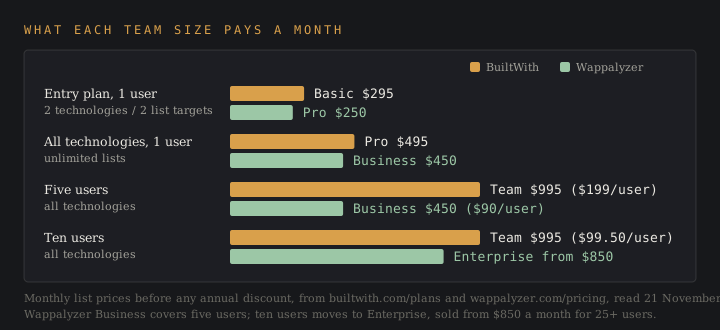
Both vendors publish their rate cards, which is rare in technographic data. Wappalyzer's pricing page sells by users and monthly lookups. BuiltWith's plans page sells by how many technologies you can build lists on, with one system login on its two lower plans. The table runs the same jobs through both price lists, read 21 November 2026.
Both platforms sell the same data three ways: a web interface for search and exports, a browser extension, and API access for automation. Most teams start in the interface and only reach for the API once a list needs refreshing every week.
| Scenario | Wappalyzer | BuiltWith |
|---|---|---|
| One user, lead lists on two technologies | Pro, $250 a month | Basic, $295 a month |
| One user, unlimited technologies | Business, $450 a month | Pro, $495 a month |
| Five users, unlimited technologies | Business, $450 ($90 per user) | Team, $995 ($199 per user) |
| Ten users | Enterprise, from $850 a month, 25+ users | Team, $995 ($99.50 per user) |
| Lookups included | 5,000 a month on Pro, 20,000 on Business | Individual site lookups free, unlimited report downloads |
| Free tier | 50 lookups and 50 email verifications a month, 5 website alerts | Free individual site lookups "forever" |
| Yearly billing | Toggle says "save 17%" | $2,950, $4,950 and $9,950 on the yearly toggle |
| Commitment | Active to the end of the billing period; pause up to three months | Minimum one month on monthly, one year on yearly |
At one user the two sit $45 apart, and the gap barely moves when you go unlimited. Seats carry the lion's share of the gap. Wappalyzer's Business plan covers five users for $450, while BuiltWith's Basic and Pro plans carry one system login each, so a second person pushes a BuiltWith account to the $995 Team plan with unlimited Pro logins.
Neither price list describes a free trial of the paid plans. The free tiers do that job: Wappalyzer's free account and BuiltWith's free lookups both run without a card. On Wappalyzer, plan credits expire after 60 days and bundle credits after 365, at typically one credit per website. BuiltWith's rate card lists no API credit allowance; its API directory prices the Relationships API at one credit per page of up to 500 records.
Wappalyzer's BuiltWith alternative page, set beside the published figures
The first organic result for this query is Wappalyzer's own page, titled "A BuiltWith alternative for modern prospecting." It is one vendor's marketing, and I found no BuiltWith page answering it. Each of its checkable statements sits below beside the figure the two vendors publish, read 21 November 2026.
| Wappalyzer's statement | The published figure |
|---|---|
| A "more accessible starting price than BuiltWith" | Pro $250 a month against BuiltWith Basic $295: $45 lower |
| BuiltWith's "official plans start higher" | Same comparison, same $45 |
| BuiltWith leans on "older snapshots alone" | BuiltWith refreshes active sites monthly and sells a WebSocket Live Feed API and a Dedicated Domain Live API |
| Data "continuously validated and updated" | No cadence published; BuiltWith publishes 8.1 billion GET requests a month |
| Salesforce, HubSpot, Pipedrive and Gmail integrations | BuiltWith lists Salesforce, HubSpot, Dynamics 365, Zoho, Pardot and Close.io |
Wappalyzer's comparison never mentions catalogue size, which is the one figure where BuiltWith leads by 15 to 1. A buyer comparing the two on that comparison alone gets the price half of the story and none of the coverage half.
↑ COMPARISONAPI access, CRM records and integrations
Wappalyzer's API centres on one lookup endpoint, GET https://api.wappalyzer.com/v2/lookup/, which returns technologies plus emails, phone numbers, social profiles and company details for a URL. Lead lists, a subdomain finder and email verification sit alongside it. Wappalyzer's pricing says lead lists, APIs and CRM integrations need paid plans, and Business includes 20,000 API credits a month.
BuiltWith runs a longer menu on its API directory: Domain, Lists, Change, Relationships, Trends, Keywords, Keyword Search, Company to URL, Financial, Trust and Live Feed APIs among 20-plus entries. The Free API and Trends API are marked free. Bulk historical datasets from 2000 onward ship to Snowflake and BigQuery, and an x402 endpoint sells pay-per-lookup in USDC with no account or key.
AI tools get their own doors on the BuiltWith side. The Ask API answers natural-language list requests, an MCP API exposes BuiltWith endpoints as tools for an AI agent, and the Change API attaches AI-generated context when sites add new tools or drop old ones. Wappalyzer's API documentation names no equivalent.
For CRM sync, BuiltWith lists six CRMs on every plan: Salesforce, HubSpot, Dynamics 365, Zoho, Pardot and Close.io, with a daily sync. Wappalyzer names Salesforce, HubSpot and Pipedrive, plus a Gmail add-on for Google Workspace. Third-party comparisons also list Zapier and Make connectors for Wappalyzer; its integrations listing blocks automated reads, so I could not confirm those two on its own domain.
What lands in the record differs too. BuiltWith attaches spend and revenue estimates, estimated employees for company size, and traffic rank. Wappalyzer's lookup returns company details and contacts. If your scoring model runs on technology spend, BuiltWith carries the field; if it runs on reachable people, Wappalyzer's output is closer to ready.
↑ COMPARISONContact data, prospect lists and lead generation
Both platforms turn a technology into a list of companies. Wappalyzer's lead lists filter by geography, traffic, company profile and contact coverage, and its entry tier caps a list at two technology targets, with unlimited targets from Business up. Email verification is bundled: 5,000 a month on Pro and 20,000 on Business, which keeps bounce rates in check before any outreach starts.
A technology match is a fit signal. Timing signals, such as a company adding a competitor's tool, come from the alerts both sell: Wappalyzer's website alerts and BuiltWith's usage alerts. Pair the two kinds of signals and your outreach lands on companies that fit and are changing their stack right now.
BuiltWith's plans include contact names, emails and titles "within GDPR limits" on every tier, plus LeadsDiscovery, usage alerts and keyword reports. Its feature list adds Future Customers, Net New Leads and Predictive Leads, which find companies likely to adopt a tool from their current stack. The BuiltWith review on this site found contact data to be the weak spot users report, so treat it as a starting point.
For technographic prospecting at volume, both work best as the first filter. Build the prospect lists from a technology, then run them through an enrichment tool from the data enrichment ranking before sales prospecting starts. Lead generation that cuts corners on enrichment stalls, because a domain match tells you a company bought something and nothing about who signed for it.
Lead lists are the one feature both price on. Wappalyzer gates list targets by plan, two on Pro; BuiltWith gates list technologies by plan, two on Basic. Two technologies covers a team selling one integration into one platform, for example a Shopify app targeting Shopify and Shopify Plus stores. Anything wider puts you on the second tier of either vendor.
Account intelligence by buyer: sales teams, market researchers, security
| Team | Better fit | The figure that decides it |
|---|---|---|
| Outbound sales teams of five focused on outreach | Wappalyzer Business | $450 for five users with 20,000 verifications |
| GTM teams on Pipedrive | Wappalyzer | Pipedrive is on its integration list only |
| GTM teams on Dynamics 365 or Zoho | BuiltWith | Both are on its six-CRM list only |
| Marketing teams building audience lists | BuiltWith Pro | Unlimited technologies for $495, one login |
| Market researchers sizing adoption | BuiltWith | Trend data back to January 1985 |
| Developers checking one site | Either free tier | Wappalyzer's extension updated 26 October 2026 |
| Fraud and security teams | BuiltWith | Trust API for website trust scoring |
Market research is where BuiltWith sits in the driver's seat. Its technology market share reports, historical reporting and customer movement lists answer questions like which CMS lost the most sites last year, and Wappalyzer publishes no equivalent. A researcher who needs that archive will find Wappalyzer a fish out of water for the job, however cheap its seats are.
Research workflows split the same way. Account research on a named list of 200 target companies is a lookup job, and Wappalyzer's 5,000 monthly lookups cover it 25 times over. Market research across a whole category is an index job, and BuiltWith's index of 551,540,987 root domains is built for it. Identifying which of the two research jobs your team runs most is the fastest way to pick.
Security tools are a side use for both. BuiltWith's Trust API scores websites for fraud detection, and both extensions help an analyst map an unfamiliar domain fast. Teams doing this full time usually pair them with dedicated tools from the open source intelligence ranking, since neither vendor reaches past the public web.
The third options: a BuiltWith alternative, or a free one
Wappalyzer sells itself as a strong BuiltWith alternative, and on price per seat it earns the label. On coverage BuiltWith leads 15 to 1, so buyers who need that depth at a different price point look further. The technographic data providers ranking places both against eight other vendors, with the method behind each score.
Three options come up most often. HG Insights attaches spend and renewal data to each install for enterprise buyers on a procurement contract. ZoomInfo keeps technographic data and contact data on one record, which suits a CRM-first sales org. Bloomberry, on its own blog, says it covers non-web technologies such as CRMs, ERPs, security tools and finance products that a crawler like BuiltWith's cannot see; that is Bloomberry's claim about itself.
The free alternative to Wappalyzer is BuiltWith's own free lookup, and the reverse holds too. Both let you analyze single sites without paying, so the cheapest BuiltWith alternative for occasional checks is Wappalyzer's free plan, and the cheapest Wappalyzer alternative is BuiltWith's free lookup.
The combination of both free tiers gives you the best of both worlds for a one-off audit of a competitor's website stack at no cost. For competitor monitoring beyond tech stacks, the competitor analysis tools ranking covers other technologies and signals.
Wappalyzer vs BuiltWith FAQ
What is the difference between Wappalyzer and BuiltWith?
Wappalyzer prices by user and lookup and leans on a browser extension with 3,000,000 Chrome users and a web app. BuiltWith prices by technologies tracked, indexes 551,540,987 root domains and tracks about 128,000 technologies with trend data back to 1985.
How reliable is BuiltWith?
BuiltWith is reliable for front-end website technologies on domains it has crawled recently. It refreshes active sites monthly, so a technology stack that changed last week can lag, and server-side tools that never reach the browser stay invisible to it.
How accurate is Wappalyzer?
Wappalyzer publishes no accuracy rate. Its extension reads the live page, which helps it detect recent migrations, and its 8,189-technology catalogue covers the mainstream stack. Niche tools outside that catalogue go undetected.
What is the free alternative to Wappalyzer?
BuiltWith's free individual site lookup, which BuiltWith says stays free "forever." Wappalyzer's own free plan is limited to 50 lookups a month, enough to research a short list of websites by hand.
What are the best BuiltWith alternatives?
Wappalyzer for cheaper seats, HG Insights for spend research on enterprise contracts, and ZoomInfo when contacts and technology need to live on one record.
Is Wappalyzer cheaper than BuiltWith?
Yes, at every published tier. Pro is $250 against $295, Business $450 against $495, and five users cost $450 on Wappalyzer against $995 on BuiltWith's Team plan.
↑ COMPARISONVerdict: BuiltWith vs Wappalyzer
Buy Wappalyzer if your team has more than one person, researches sites one at a time, and wants verified contacts with each match. Five users cost $450 a month, the extension reads live signals off the page, and email verification comes in the box. It hits the ground running for outbound with a short tool list.
Buy BuiltWith if the job is finding every company on a technology, reading adoption over time, or wiring technology data into a warehouse or an agent for market research. It tracks about 15 times the technologies, indexes 551,540,987 root domains, and its API directory runs past 20 entries. For one researcher with unlimited technologies, $495 a month buys the whole nine yards of its archive.
Sources: BuiltWith figures come from builtwith.com, its plans, data coverage, FAQ, feature list and about pages, and api.builtwith.com; Wappalyzer figures from wappalyzer.com, its pricing, technologies, API, about and BuiltWith alternative pages; extension figures from the Chrome Web Store. All were read 21 November 2026.