Outreach vs Salesloft: which sales engagement platform fits your team in 2026
 By Jan Suski. I go deep on every review, checking every number against its source and digging up details other coverage misses, a habit from six years of SEO and link building for tech companies. Bylines at Brand24 and Senuto. How the scoring works.
| WHAT EACH ONE DOES | OUTREACH | SALESLOFT |
|---|---|---|
| Core job | Rule-driven sequencing | Ranked rep task queue |
| Prioritization | Triggers and rulesets | Conductor AI ranking |
| Branching | 30 conditions/trigger | Plays feed Rhythm |
| Deal score | 0 to 100, 3 statuses | Deal Priority Model |
| Live call help | Kaia coach cards live | Recorded call analysis |
| Native CRMs | SFDC, Dynamics | SFDC, Dynamics, HubSpot |
| Mobile app | Amplify Plus and up | Own claim: has an app |
| Forecasting | Amplify Pro | Clari Forecast |
| Skip it if | No admin to own rules | You need live coaching |
| WHAT YOU GET | OUTREACH | SALESLOFT |
|---|---|---|
| List price | Request pricing | Talk-to-sales form |
| Packages | 4 Amplify tiers | No tiers listed |
| AI credits | 10K to 100K per tier | Not published |
| Vendr median | No sample data | $29,485 (536 deals) |
| Owner | Private, VC-backed | Clari + Salesloft |
| Last valuation | $4.4B+ (Jun 2021) | $2.3B (Dec 2021) |
| Gartner MQ 2025 | Leader | Visionary |
| Forrester Wave | Q3 2026, 15/22 top | Leader, Q3 2024 |
| Support | Included per user | Live Office Hours |
StrongerWeakerNo edge
Thirty-three further documented limits sit behind the button below: Outreach’s agents, storage and Salesforce sync caps, and Salesloft’s Rhythm rules and CRM coverage. Scenario: ten or more seats on Salesforce choosing one sales engagement platform. Figures come from Outreach’s pricing page, support.outreach.io, salesloft.com, help.salesloft.com, trust.salesloft.com and the header block of Vendr’s Salesloft page, all read 21 November 2026.
| Outreach | WHAT IT DOCUMENTS |
|---|---|
| Platform fee | None; per-user pricing, support included |
| Knowledge storage | 500 MB Core, 750 MB Plus, 1,500 MB Pro |
| Add-ons sold | Data Sharing, Connectors, Additional Instances, Listener Licenses |
| Essentials agents | Omni, Research, Deal, Meeting Prep agents |
| Plus extras | AI Summaries, Sentiment Analysis, Slack app |
| Pro forecasting | Scenario Planner, Multi-Currency, Parallel Forecasts |
| MCP | Outreach MCP in Essentials and Core |
| Deal health window | Buyers and departments engaged, last 30 days |
| Deal health statuses | On-track, Needs review, At-risk |
| Outbound sync | Changes usually in Salesforce in 30-45 seconds |
| Poll capacity | 2,000 records detected, 200 imported per API call |
| API share guidance | Keep Outreach to 20-30% of Salesforce API calls |
| Error log export | Last 10,000 errors or 90 days, whichever is fewer |
| Email history import | Up to 12 months with a connected mailbox |
| One-way objects | Events and Tasks sync Outreach to Salesforce only |
| Kaia coverage | Native dialer, Zoom, Teams, Google Meet |
| Salesloft | WHAT IT DOCUMENTS |
|---|---|
| Rhythm Focus Zones | 3: Rhythm, Cadence, Close |
| Engagement Score window | Meeting or open opportunity within 7 days |
| Rhythm task sources | Cadence steps, manual tasks, Meeting, Email and Integration Plays |
| Rhythm default filter | Today and Overdue |
| Rhythm prerequisites | Calendar Sync; CRM opportunity Amount, Stage, Probability, Close date |
| Rhythm package gating | Task set varies by package; links Advanced |
| Dynamics 365 sync | Bidirectional leads, contacts, accounts, opportunities since 22 Aug 2022 |
| Salesforce sync | Bidirectional, automation rules, sync log |
| HubSpot sync | Activity transfer to HubSpot |
| Zoho | Via Zoho Flow, no native sync |
| Marketplace size | 160+ other apps |
| Account-team products | Cadence, Conversation Intelligence, Deals, Rhythm |
| Revenue-leader products | Clari Forecast, Inspect, Analytics |
| Other offerings | AI Agents, MCP, Signals, Consulting Services |
| Named agents | Account Research, Person Research, Ask Salesloft |
| Certifications | ISO 27001, ISO 27701, SOC 2 Type II, CSA, GDPR, CCPA, EU-US DPF |
| Customer count | 4,000+ organizations |
Outreach states one gate two ways. Its pricing page lists Deal Health & Alerts in Amplify Essentials, while its deal health support article says the feature needs an Orchestrate Subscription; the pricing table above marks the Essentials cell and follows the pricing page, since Amplify Essentials is the package a buyer can purchase and the article still uses the older package name.
Salesloft’s trust center gives two dates for engaging Mandiant, 26 August and 28 August 2025, so this page uses only the 30 September 2025 close of the investigation.
Where the Outreach and Salesloft figures come from, and the four numbers neither vendor will put on a page
Every figure on this page was read from the vendor’s own domain on 21 November 2026.
- Outreach: the Amplify pricing page, support.outreach.io (deal health, triggers, CRM connection, Salesforce configuration), Outreach’s newsroom and its June 2021 PR Newswire release.
- Salesloft: salesloft.com (pricing, CRM integration, its Salesloft vs. Outreach page, newsroom), help.salesloft.com (Rhythm) and trust.salesloft.com (Drift incident timeline).
- Contract data: Vendr’s header stat block from 536 tracked Salesloft purchases; Vendr shows no sample data for Outreach.
Neither vendor publishes a per-seat list price, a minimum seat count, notice and export terms, or an uptime percentage.
Outreach vs Salesloft comes down to one choice: Outreach if your revenue operations team wants to configure every rule a rep follows, Salesloft if your sales managers want reps to open one ranked task list and work it top to bottom. Both run email, phone calls, sequences, conversation intelligence and deal management. Both hide their price behind a sales call.
This page is for sales teams of ten or more seats choosing a sales engagement platform, or re-signing one. It matters more in 2026 than it did two years ago, because Salesloft is now half of a merged company and spent part of 2025 cleaning up a breach that ran through its Drift app. Every figure below links to the vendor's own domain or to Vendr's tracked contract data, checked on 21 November 2026.
↑ COMPARISONOutreach vs Salesloft: a quick overview
Outreach and Salesloft sell into the same category, and in 2026 each platform offers sequencing, calls, conversation intelligence, deal management and forecasting. Outreach and Salesloft also both sell to the same buyer: sales teams that need sales reps to run multi-step sequences at volume. The Outreach vs Salesloft decision therefore turns on operating style.
To cut to the chase, the split is about who calls the shots inside each platform. Outreach exposes the controls to admins. Salesloft hands reps a prioritized queue.
| Question | Outreach | Salesloft |
|---|---|---|
| Who owns it | Independent, venture-backed, $4.4B valuation (June 2021) | Clari + Salesloft, merged 3 December 2025 |
| Published packages | 4 Amplify packages, all "Request pricing" | No tiers on the pricing page |
| Tracked contract median | No sample data on Vendr | $29,485 across 536 purchases (Vendr) |
| How a rep's day is ordered | Sequences plus triggers with up to 30 branching conditions | Rhythm, ranked by Conductor AI |
| Deal scoring | Deal health 0 to 100, recalculated daily at 10 am | Deal Score and Deal Priority Model |
| Native CRMs | Salesforce, Microsoft Dynamics 365 Sales | Salesforce, Microsoft Dynamics 365, HubSpot |
| 2025 Gartner Magic Quadrant | Leader | Visionary (Clari: Leader) |
Read the table as a map of key areas, then read the sections that match your team's specific constraint. A buyer worried about contract cost should start at pricing. A buyer worried about vendor risk should start with ownership.
↑ COMPARISONWho owns Outreach and Salesloft now
Outreach is a private company headquartered in Seattle. Its last announced round was a $200 million Series G on 2 June 2021, co-led by Premji Invest and STEADFAST Capital Ventures, at a valuation of "more than $4.4 billion", per Outreach's release. The company has since moved its site from outreach.io to outreach.ai.
Salesloft took a strategic growth investment from Vista Equity Partners on 23 December 2021 at a $2.3 billion valuation, having passed $100 million in annual recurring revenue that summer, per Salesloft's newsroom. Clari and Salesloft then announced a merger in August 2025 and completed it on 3 December 2025, with Steve Cox as CEO, per the merger announcement.
| Date | Event | Source |
|---|---|---|
| 2 Jun 2021 | Outreach closes $200M Series G at $4.4B+ | Outreach release |
| 23 Dec 2021 | Vista invests in Salesloft at $2.3B | Salesloft newsroom |
| 22 Aug 2022 | Salesloft ships CRM Sync for Microsoft Dynamics 365 | Salesloft newsroom |
| 8 to 18 Aug 2025 | Stolen Drift OAuth tokens used to export customer data | trust.salesloft.com |
| 5 to 16 Sep 2025 | Drift taken offline, then restored | trust.salesloft.com |
| 3 Dec 2025 | Clari and Salesloft complete their merger | Salesloft newsroom |
| Dec 2025 | First Gartner MQ for Revenue Action Orchestration: Clari Leader, Salesloft Visionary, Outreach Leader | Both newsrooms |
| 13 Oct 2026 | Outreach named a Leader for the second year | Outreach newsroom |
The merger is the elephant in the room for anyone signing a multi-year Salesloft contract. Outreach's comparison page says the integration will take "the next several years". That is a rival's forecast, so weigh it as one. The product names on Salesloft's own pricing page already mix the two companies: Cadence, Conversation Intelligence, Deals and Rhythm for account teams, Clari Forecast, Inspect and Analytics for revenue leaders.
The Drift breach and what it touched
Salesloft's trust center says an attacker reached the Salesloft GitHub account between March and June 2025, moved into Drift's AWS environment, and took OAuth tokens for customers' integrations. From 8 to 18 August 2025 those tokens were used to pull Salesforce data, with queries aimed at Cases, Accounts, Users and Opportunities.
Salesloft rotated its centrally managed OAuth keys, took Drift offline at 6 a.m. ET on 5 September 2025 and brought it back on 16 September.
Mandiant's investigation closed on 30 September 2025 and found no compromise of Salesloft's production environments beyond limited reconnaissance. The incident ran through Drift, a chat product, and the trust center lists a 2026 SOC 2 Type 2 report for the Salesloft platform. Outreach's comparison page states SOC 2 Type II compliance.
↑ COMPARISONWhat each vendor says about the other
Salesloft vs Outreach is also a marketing fight. Both vendors run a page about the other: Salesloft vs. Outreach on salesloft.com and Salesloft Vs. Outreach on outreach.ai. Read them as marketing. The table sets the checkable claims beside what the other vendor's own documentation shows.
| Claim | Made by | What the other side's own pages show |
|---|---|---|
| Outreach has no mobile app | Salesloft (feature grid) | Outreach's pricing page lists a Mobile App in Amplify Plus |
| "4000+ companies" use Salesloft | Salesloft | Outreach claimed 4,800+ customers in its 2021 release and gives no current count |
| "industry's best platform up-time" | Salesloft | Salesloft's page gives no uptime percentage to check it against |
| Consolidating from Salesloft and Clari cuts admin overhead 30 to 40% | Outreach | No study is linked; Salesloft publishes no figure either way |
| Salesloft live call scoring is "only just live" | Outreach | Salesloft lists Conversation Intelligence as a current product |
Read between the lines and each page attacks the other's weak flank. Salesloft leans on G2 user reports, citing higher ratings than Outreach for ease of setup, quality of support and ease of admin. Outreach leans on the merger, arguing that two products stitched together will lag a revenue orchestration platform built as one.
Two Salesloft claims carry no number at all. The page promises "the industry's fastest go-live time and ROI" for onboarding without a figure, and it calls its interface award-winning while linking to a 2023 SaaS Awards finalists list.
↑ COMPARISONOutreach pricing and Salesloft pricing
Neither vendor offers transparent pricing. Both sell on custom pricing set by seat count, term and add-ons, so the total cost depends on your quote. The figures below are what each vendor publishes about its various packages, plus Vendr's header data where it exists. The sales engagement pricing report sets both against Apollo.io, HubSpot and nine more tools.
Outreach's four Amplify packages
The Outreach pricing page says "Per user pricing. No platform fees. Support included." Every package carries a "Request pricing" button, and the page states no minimum seat count. What Outreach offers is a ladder of AI credits and API limits.
| Package | AI credits | API calls | Custom objects | Adds |
|---|---|---|---|---|
| Amplify Essentials | 10,000 | Not stated | Not stated | Conversation intelligence, live coaching, deal health* |
| Amplify Core | 25,000 | 250,000 | 5 | Sequences, dialer, reporting |
| Amplify Plus | 50,000 | 500,000 | 10 | Mobile App, Slack app, win/loss outcomes |
| Amplify Pro | 100,000 | 1,000,000 | 20 | Forecasting, territory management, managed services |
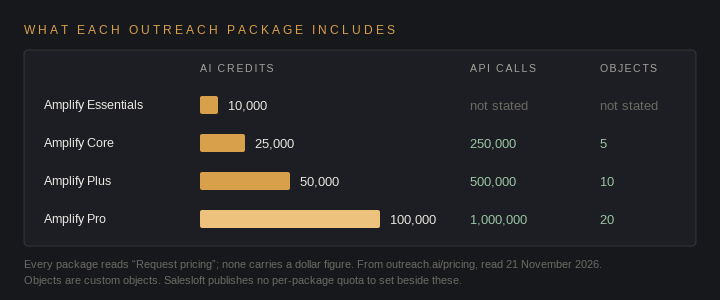
The pricing page sells four Amplify packages and prints no dollar figure on any of them. Vendr's Outreach page shows "No sample data" in its header as of 21 November 2026. Outreach pricing therefore has no tracked reference point this month, which leaves the buyer without a level playing field in a negotiation.
↑ COMPARISONWhat Salesloft buyers pay
Salesloft pricing follows the same custom pricing model as Outreach. Salesloft's /pricing URL is a talk-to-sales form with no tiers on it, although its Rhythm help article still links to an Advanced package.
Vendr's Salesloft page reports an average contract value of $29,484 and a median of $29,485 across 536 purchases, with tracked deals from $4,414 to $119,025 and buyers saving 18% on average.
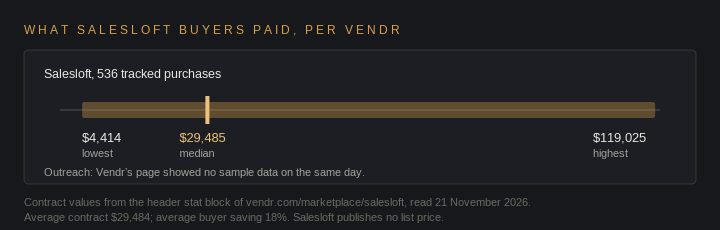
Treat that median as a reference point for your negotiation, since Salesloft publishes no list price to anchor against, and keep an eye on Vendr's header figures when your renewal comes up.
Neither pricing page lists free trials or a free version. Both route new users to a sales engagement demo, so small teams and solo sales reps that want to test the product hands-on before a contract will find no self-serve path on either side. Free trials would let a team test sequences on its own domain, and a free version would let one rep try the product alone. On these two platforms, both have to be negotiated into a pilot of the sales engagement software.
AI capabilities: Outreach AI against Salesloft Rhythm
Both platforms now sell themselves as an AI platform for revenue teams, and the AI capabilities split along the same line as the rest of the product. Outreach AI scores and predicts. Salesloft Rhythm ranks and queues.
↑ COMPARISONDeal management and deal health
Outreach's deal health documentation describes a machine learning score from 0 to 100, representing the relative chance of winning against similar deals at a similar stage. Deals sort into On-track, Needs review and At-risk. The model reads engagement across email, phone calls and meetings, CRM activity such as days in stage and close-date pushes, and how many buyers and departments engaged in the last 30 days.
Scores recalculate once a day at 10 am, so deal activity a rep logs this afternoon shows up tomorrow. Outreach's package list pairs this with Relationship Maps for relationship mapping, Account Planning and a Deal Agent, which gives sales managers pipeline visibility and pipeline management in the same screen as the sequences.
Deal management is where Salesloft vs Outreach looks most alike on paper. Salesloft deals run through the Deals product and Clari's Inspect, which covers pipeline inspection for revenue leaders. Rhythm's Close Focus Zone ranks deal tasks with the Deal Priority Model and shows a Deal Engagement Score. What the Salesloft platform offers on top is Clari's forecasting history, which gives revenue intelligence buyers a reason to consolidate there.
The Salesloft vs Outreach split on revenue intelligence is about whose forecast you trust: Outreach's own, or Clari's.
Salesloft Rhythm and buyer signals
Salesloft's Rhythm article calls it a "signal-to-action engine", and it is the first screen a rep sees after logging in. Conductor AI ranks daily tasks with two models: a Buyer Engagement Score, which estimates the chance that prospecting activity leads to "an open opportunity or a booked meeting within 7 days", and a Deal Score for opportunity work.
Tasks arrive from Cadence steps, manual tasks and Plays triggered by meetings, emails or integrations, so engagement signals from buyer behavior turn into follow ups without a rep hunting for them. Rhythm's Source filter also includes a No Reply view for prospects whose follow ups have gone quiet.
Rhythm splits work into three Focus Zones: Rhythm, Cadence and Close. This saves sales reps valuable time on multi touch sales cycles where the next step depends on what the buyer did last.
↑ COMPARISONConversation intelligence and sales coaching
Outreach's conversation intelligence product, Kaia, surfaces Content Cards and Coach Cards during a live call, which act as suggested responses when a buyer raises pricing or names a competitor, per Outreach's Kaia guide. It covers Outreach's own dialer plus Zoom, Microsoft Teams and Google Meet. Action items are pulled after the call and synced to Outreach tasks.
That real time data gives sales coaching a live channel in Outreach. Salesloft sells Conversation Intelligence as part of the account-team bundle, and its AI agents now include an Account Research Agent, a Person Research Agent and an Ask Salesloft Agent. Both sides use recorded calls to flag coaching opportunities and feed ai driven insights to managers. If live, in-call guidance is the reason you are buying, Outreach documents more of it today.
For a wider view of call-recording tools, see the conversation intelligence software ranking, which also covers standalone tools that plug into either platform.
↑ COMPARISONSequences, branching and the learning curve
Outreach focuses on granular process control. Its triggers support branching conditions with IF, OR and AND operators, up to 30 branching conditions per trigger, per Outreach's branching article. That advanced branching logic, plus sequence rulesets and reusable email templates, lets an admin build conditional routing: inbound leads by country to one sequence, enterprise accounts by segment to another.
That makes Outreach's conditional branching deeper on paper than anything we found in Salesloft's help center, which describes Cadences and Plays feeding Rhythm with no published branching limit.
Comparison blogs describe Outreach as having the steeper learning curve and Salesloft's interface as cleaner and more intuitive, and the configuration surface explains why.
More levers means more to set up before reps hit the ground running, and a clean rollout is easier said than done without an admin who owns it. Salesloft emphasizes guided workflows, with Cadences feeding a single ranked queue, and it runs live Office Hours sessions for customers on top of on-demand training.
Outreach includes support in every package and adds managed services at Amplify Pro. Teams whose admins already know the ropes from a previous Outreach rollout will find the learning curve shorter than the blogs suggest. Teams without a dedicated admin will feel the steeper learning curve for longer, which is the gap Outreach's managed services at Amplify Pro are sold to close for enterprise teams.
↑ COMPARISONCRM integration and switching costs
CRM integration decides how much data you carry in and out, and the Salesloft vs Outreach gap is narrower here than on coaching. On CRM integration, both platforms sync bidirectionally with Salesforce and Microsoft Dynamics, and both are built to sit beside a CRM in your tech stack. Neither one replaces it.
On Salesforce integration, Outreach's CRM connection overview lists five compatible CRM environments: Salesforce Lightning, Salesforce Classic, Salesforce Console, SKUID Overly and Microsoft Dynamics 365 Sales. Every one is a CRM, with no spreadsheet target such as Google Sheets on the list. Outreach pulls from the CRM every 10 minutes by default and batches outbound updates for 60 seconds. Tasks created in the CRM do not sync back.
Its Salesforce configuration guide describes granular field mapping per object, with each mapping set to update in, out or both, and custom objects supported. Hitting the Salesforce API limit stops the sync entirely, and Outreach advises keeping its own share to 20 to 30% of API calls.
What Salesloft offers here is wider CRM coverage. Its CRM integration page lists bidirectional sync for Salesforce and Dynamics 365, and activity sync to HubSpot. Zoho connects through Zoho Flow, outside the native integrations. Its comparison page claims 160+ other platforms in its app marketplace.
The devil's in the details here. Switching between the two means rebuilding sequences or cadences, re-mapping fields and retraining reps. Ask for notice windows and data export rights in writing before you sign, since that is where leaving gets expensive.
↑ COMPARISONWhere each one wins, by buyer
For sales teams, Outreach vs Salesloft is a question of fit. Outreach and Salesloft each cover the same daily loop of sequences, calls and follow ups, and what Salesloft offers against Outreach is mostly a different way of ordering that loop. Outreach and Salesloft also price the same way, which leaves fit as the deciding factor.
Outreach wins for enterprise teams with a revenue operations function that wants to define every rule, for buyers who need live in-call guidance, and for teams that forecast inside the same tool as they sequence. It is the closer thing to an all in one solution for engagement, deal management and forecasting from a single vendor.
Salesloft wins where adoption is the risk and the sales cycles are short: business development teams whose reps need one prioritized list, sales organizations on HubSpot, and buyers who already use Clari for forecasting and want both under one contract. Most sales organizations sit somewhere between, and the sales process you run today should break the tie. Small teams under ten seats will find that neither platform offers a self-serve plan.
Putting all your eggs in one basket cuts both ways. Salesloft and Clari together cover engagement and forecasting, while Outreach says it built both into one platform from day one. The revenue intelligence software ranking covers the forecasting-first tools that sit beside either one.
Outreach vs Salesloft FAQ
Is Outreach a CRM system?
No. Outreach is a sales engagement platform that syncs with a CRM. It writes activity to Salesforce or Dynamics and reads records back every 10 minutes by default. It overlaps with Salesforce on pipeline management and forecasting, and it runs on top of Salesforce's API allowance for the sync.
Who is Outreach owned by?
Outreach is privately held and venture-backed. Its 2021 Series G was co-led by Premji Invest and STEADFAST Capital Ventures.
What does Salesloft do?
Salesloft is a sales engagement platform and, since the merger, a revenue orchestration platform. It helps reps engage prospects through cadences with email and phone steps, records and analyzes calls, and ranks daily work in Rhythm. Since the Clari merger it also sells forecasting and deep analytics.
Who are Outreach's main competitors?
Outreach's own site runs comparison pages against Gong, Salesloft and Clari. In the 2025 Gartner Magic Quadrant for Revenue Action Orchestration, Outreach, Clari and Gong were Leaders and Salesloft a Visionary.
What is better than Salesloft?
It depends on the gap you are filling. Teams wanting more control over routing pick Outreach. Teams wanting cheaper, self-serve sequencing look at tools with published prices, which the pricing report linked above compares.
The verdict on Outreach vs Salesloft
The Salesloft vs Outreach call is closer than either vendor's page admits. Buy Outreach if you want admin-level control, if live coaching matters, and if you prefer a vendor that is not mid-merger.
Buy Salesloft if adoption is your bottleneck, if you run HubSpot, or if Clari already handles your forecast. Salesloft wins on guided simplicity and a tracked contract median.
Outreach wins on configurability and documented limits, and both Salesloft and Outreach reward a buyer who negotiates. Outreach and Salesloft both sell sales engagement on contracts negotiated seat by seat, so the sales engagement budget you approve is only as firm as the order form behind it. For more deals closed per rep, pick the two platforms' strengths that match how your team already sells, then get the contract terms on paper.