Clay vs Apollo (2026): Data Layer or Sales Seat, and What Each Costs
 By Jan Suski. I go deep on every review, checking every number against its source and digging up details other coverage misses, a habit from six years of SEO and link building for tech companies. Bylines at Surfer, Brand24, and Senuto. How the scoring works.
| WHAT EACH ONE DOES | CLAY | APOLLO |
|---|---|---|
| Core job | Enrichment routing | Database + outreach |
| Own database | None, 150+ providers | 240M contacts |
| Waterfall order | Any order you set | Apollo always first |
| Waterfall fields | Any field, web research | Email and phone |
| Dialer | Via integration only | Power + parallel add-on† |
| Email sending | Sequencer 2.0 | Unlimited on Pro |
| CRM sync | Growth tier and up | All paid plans |
| AI research | Claygent on all plans | Agents from Pro |
| MCP server | Local, via Clay CLI | Remote, ~50 actions |
| Skip it if | No one owns workflows | Your ICP is thin there |
| WHAT YOU GET | CLAY | APOLLO |
|---|---|---|
| Billing unit | Usage, unlimited users | Per seat |
| Entry paid plan | $167/mo, annual | $49/seat/mo, annual |
| 5 seats a year | $2,004 Launch | $2,940 Basic |
| 20 seats a year | $5,352 Growth | $18,960 Pro |
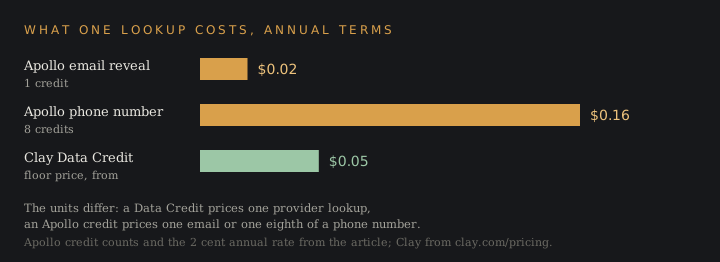
| Unit price | $0.05 per Data Credit | ~$0.02 per credit |
| Free plan | 100 credits, 200 rows | 900 credits a year |
| Credit rollover | Yes, capped* | Expire each cycle |
| Vendr contract | $59,996 median | $19,000 average |
| Last funding | $7.1B, Sep 2026 | $1.6B, Aug 2023 |
| G2 score | 4.6 from 234 | 4.7 from 9,847 |
StrongerWeakerNo edge
Thirty further documented limits sit behind the button below: Clay’s plan-tier ceilings and sync gates, and Apollo’s API credit costs, rate limits and mailbox, dialer and trial caps. Test scenario: five and twenty seats, annual billing, list prices. Clay figures, Vendr contracts and G2 counts were read on 17 October 2026; Apollo seat prices come from apollo.io/insights/apollo-vs-clay (31 July 2026) and apollo.io/pricing (4 October 2026).
| Clay | WHAT IT DOCUMENTS |
|---|---|
| Action tiers, Launch | 15K to 200K a month, $60 to $540 |
| Data Credit tiers | 2.5K to 50K a month, $125 to $2,125 |
| Table version history | Growth 1 month, Enterprise 6 months |
| Source sync frequency | Daily, every 15 min on Enterprise |
| Bulk enrichment | Over 50K records at once, Enterprise only |
| Phone enrichment | Launch and above |
| Ad audience push | Unlimited on Growth: LinkedIn, Meta, Google |
| Audience imports | 250K on Growth, unlimited on Enterprise |
| SSO, SCIM, RBAC | Enterprise only |
| Support | Priority queue on Growth, Slack on Enterprise |
| AI pricing | 80% of models fixed-price |
| AI speed on Clay keys | 2x faster than your own keys |
| Certifications | SOC 2 Type II, ISO 27001, ISO 42001 |
| Apollo | WHAT IT DOCUMENTS |
|---|---|
| API rate limit, free | 50 enrich a minute, 600 a day |
| Non-enrich API cap | 200 a minute, 2,000 a day |
| People enrich cost | 1 to 9 credits, plus 8 for a mobile |
| Phone waterfall cost | 8 to 25 credits, 45+ possible |
| Email waterfall cost | 1 to 4 credits, 20+ possible |
| Bulk enrich batch | 10 people per request |
| Dialer minutes | 10 a dollar, 3 if international |
| Apollo mailbox cap | 200 emails per 24 hours |
| Mailbox credit cost | 300 to 1,500 credits a month |
| Domain registration | 1,500 credits a year |
| Record selection | 25 / 1,000 / 2,500 / 10,000 by tier |
| Workflows per team | 2 / 5 / 50 / 500 by tier |
| AI-written words | 5K to 1M a month by tier |
| Website visitors | 20 companies a month free, 100 paid |
| Trial | 14 days, 50 credits, 25-record cap |
| Free seat rule | Drops to 1 seat after 100 days |
| MCP on free accounts | No search or enrich on personal email |
*A marked figure is one the vendor states two ways on its own domain. Clay’s pricing page gives Data Credit rollover as up to one month’s credits or 15% of annual credits in its plan table and as up to 2x the monthly amount in its FAQ, so the block above shows the cap without a figure.
†Apollo’s Apollo vs Clay page says the Power and Parallel Dialer is included in Professional and Organization, while its dialing article in the knowledge base says both need the advanced dialer add-on. The add-on is used above because a buyer can purchase it and the article is the instruction a customer follows.
Sources, and two vendors who each wrote the other’s spec sheet
Clay rows come from clay.com/pricing and one clay.com blog post; Apollo rows come from apollo.io, docs.apollo.io and knowledge.apollo.io.
- clay.com/pricing: every Clay tier, sync, import, support and AI row. clay.com/blog/clay-vs-apollo: the certifications row.
- docs.apollo.io rate-limits page: the two API cap rows. docs.apollo.io api-pricing page: the enrich, waterfall and bulk batch rows. docs.apollo.io MCP page: the free-account MCP row.
- knowledge.apollo.io: dialer minutes and the free seat rule (plan management article), the mailbox and domain rows (mailbox article) and the trial row (free trial article).
- apollo.io/pricing, read 4 October 2026: record selection, workflows, AI-written words and website visitors.
Both vendors publish a page comparing themselves with the other, Apollo’s dated 31 July 2026 and Clay’s 20 August 2026, and the claims table in the body checks each against the rival’s own documentation. Neither vendor publishes an uptime SLA, an accuracy rate with its method, MCP rate limits or data retention after cancellation, so no row above claims one.
Clay vs Apollo comes down to one question: do you need a contact database with outreach tools attached, or a data layer that pulls from dozens of vendors and feeds whatever tools you already run? Apollo sells the first. Clay sells the second.
Apollo is a sales engagement platform built on its own proprietary database of 240 million contacts and 30 million companies, priced per seat from $49 a month on annual billing. Clay owns no database of its own. It routes data enrichment requests across 150+ data providers, charges by usage, and gives every plan unlimited users from $167 a month.
This page is for the RevOps lead, founder or sales manager holding both options and a budget. It covers what a five-seat team pays on each, how waterfall enrichment compares with one database, the dialer and sequencing gap, what each vendor publishes about the other, and what leaving costs. Every price comes from clay.com, apollo.io or Vendr's contract tracker, read on 17 October 2026.
The short version: Apollo is a jack of all trades for a small team that wants search, sequences and a built in dialer in the same tool. Clay wins when a growth or RevOps person will build enrichment waterfalls and push clean CRM data into the rest of the tech stack. Plenty of teams buy both, and Clay publishes an Apollo integration for exactly that.
↑ COMPARISONTwo different jobs: a data layer against a contact database
Most clay vs apollo articles score the two on a shared feature grid. That grid misleads, because the products sit at different points in the stack.
What Apollo sells: its own contact database plus an outreach seat
Apollo's homepage calls the product "one connected GTM system," and its page title reads "The AI GTM System for Go-to-Market Teams." The pitch is consolidation: find a contact in Apollo's own contact database, reveal the email for one credit, drop the person into a sequence, call them from the dialer, and log it all to Salesforce or HubSpot.
Apollo's meta description calls it "the AI sales platform rebuilt as one connected AI GTM system." Read plainly, one connected system means one bill, one login and one set of records for company data, contacts and activity. The trade is that every seat pays for the whole bundle, used or not.
- Contact data: 240M+ contacts and 30M+ companies, per apollo.io.
- Outreach: sequences, mailboxes, a dialer, call recording and an AI agent layer on the Professional plan and above.
- Billing: per seat, with a credit pool covering emails, phones, enrichment and AI research.
What Clay sells: a workflow builder that routes multiple providers
Clay describes itself as "infrastructure to get any data, run agentic workflows, and launch GTM plays." Clay enriches a row by querying one provider, then the next when the first comes back empty. Clay routes that request through its marketplace, and Clay workflows then score, filter, write copy with Claygent, its research agent, and push the result to a CRM, an ad audience or a sequencer.
Clay sits underneath the rest of a tech stack. It stores only what you load or buy; each table is built from the data sources you call, and each workflow decides where the output goes next. Workflow automation is the product, and the data is bought per lookup.
Clay's own blog splits its provider count two ways: 200+ data and AI providers in total, and 150+ databases reachable for contact info. The second figure is the one that matters for a clay vs apollo decision, since it is the pool a waterfall draws from.
Read between the lines of both homepages. Apollo's numbers describe records it holds. Clay's numbers describe vendors it can call. One is inventory and the other is a routing table.
↑ COMPARISONPricing: Clay against Apollo for the same five-person team
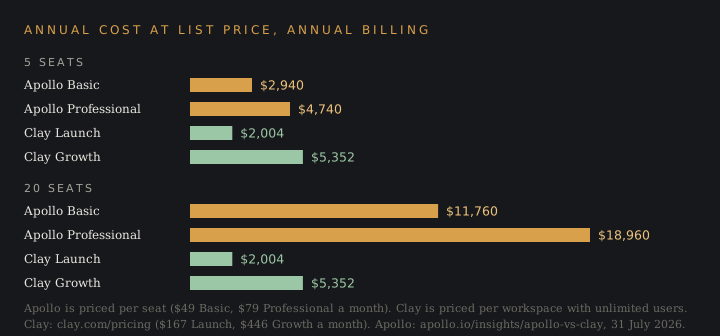
Apollo pricing scales with headcount. Clay pricing scales with usage. That single difference decides most of the total cost, so the table below runs both at five seats and at twenty, on annual billing.
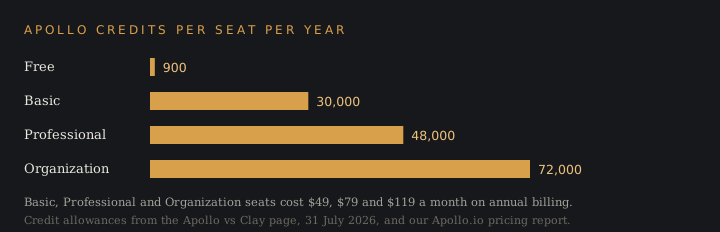
| Plan, annual billing | 5 seats, per year | 20 seats, per year | Credits included per year |
|---|---|---|---|
| Apollo Basic, $49/seat/mo | $2,940 | $11,760 | 30,000 per seat |
| Apollo Professional plan, $79/seat/mo | $4,740 | $18,960 | 48,000 per seat |
| Apollo Organization, $119/seat/mo, 3-seat minimum | $7,140 | $28,560 | 72,000 per seat |
| Clay Launch plan, $167/mo | $2,004 | $2,004 | 30,000 Data Credits, 180,000 Actions |
| Clay Growth, $446/mo | $5,352 | $5,352 | 72,000 Data Credits, 480,000 Actions |
Apollo figures come from Apollo's own Apollo vs Clay page (31 July 2026) and our Apollo.io pricing report. Clay figures come from clay.com/pricing.
↑ COMPARISONClay pricing: unlimited users, two meters
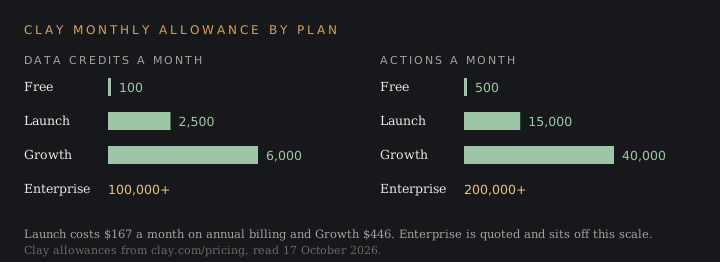
Clay pricing has a free plan and three paid tiers. The self serve plans are Free, Launch and Growth; Enterprise is quoted. Every plan carries unlimited users and unlimited tables.
- Free: 100 Data Credits and 500 Actions a month, 200 rows per table.
- Launch: $185 a month on monthly billing or $167 on annual billing, 2,500 Data Credits and 15,000 Actions a month, up to 50,000 rows per table.
- Growth: $495 monthly or $446 annual, 6,000 Data Credits and 40,000 Actions a month. Clay labels it "Recommended."
- Enterprise: custom, 100,000+ Data Credits and 200,000+ Actions a month, annual commitment.
The devil's in the details of that headline price. Launch at $185 breaks into $60 for Actions plus $125 for Data Credits, and both meters scale in separate steps up to 200,000 Actions and 50,000 Data Credits. Data Credits start at $0.05 each and buy the data; Actions cost under a cent and pay for the platform work. Top-ups cost a 30% premium. Customers on legacy plans from before the March 2026 overhaul are covered in our Clay pricing breakdown.
↑ COMPARISONApollo pricing: per seat, one credit system
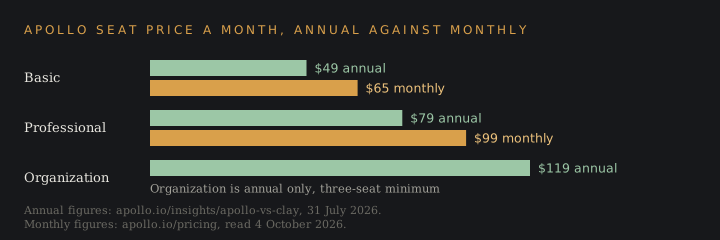
Apollo's credit system runs one currency. An email reveal costs 1 credit and a phone number costs 8. On annual terms every paid tier works out to about 2 cents a credit, so a mobile number lands near 16 cents and an email near 2 cents.
Monthly billing costs more: $65 a seat for Basic and $99 for Professional, per Apollo's pricing page as read on 4 October 2026. Organization is annual only. The free tier gives 900 credits per seat per year, basic filters, two sequences and Gmail as the only sending provider. Basic adds unlimited sequences and advanced filters. Every "unlimited" line on Apollo's paid plans, email sending included, sits under its Fair Use Policy, per the pricing page.
↑ COMPARISONTotal cost once outreach tools are added
At five seats Clay Launch costs less than Apollo Basic, and Clay Growth costs about $600 more than Apollo Professional. At twenty seats the gap flips hard: Apollo Professional costs $18,960 against Clay Growth's $5,352.
That comparison flatters Clay, though. Apollo's seat includes sending, a dialer and a contact database. Clay's subscription buys orchestration and a credit allowance, and teams typically add outreach tools on top. Price both stacks end to end before signing.
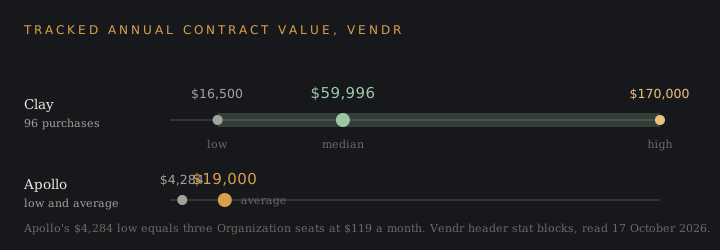
Vendr's contract tracker shows what buyers sign in practice. Its header puts the median Clay contract at $59,996 a year across 96 purchases, from $16,500 to $170,000. Apollo's average reads $19,000, from a low of $4,284. That low matches three Organization seats at list to the dollar.
↑ COMPARISONData enrichment and data quality: waterfall against one database
Data enrichment is where the two philosophies meet head on. Apollo checks its own records first. Clay checks whichever data sources you line up, in the order you set.
↑ COMPARISONClay's waterfall enrichment
Clay's waterfall enrichment queries multiple providers in sequence until one returns a match. Clay's pricing FAQ states that a lookup returning nothing costs no Data Credits or Actions, and every plan lets you bring your own API key, which skips the Data Credit charge and bills one Action.
Clay publishes no single accuracy rate, since coverage depends on which providers sit in the chain. It publishes customer outcomes instead: Vanta reached 80%+ enrichment coverage and Anthropic tripled its enrichment rate, per clay.com. Clay's blog says waterfalls "routinely triple" coverage.
Those are vendor case studies, and talk is cheap until you run the same 500 records through your own chain. The 90 to 98% accuracy band that comparison blogs attach to Clay's waterfall appears nowhere on clay.com.
Deep enrichment goes past emails and phones. Clay pulls technographics, job postings, funding and Claygent web research into the same table, and Growth adds web intent signals and webhook-triggered signal tracking. Launch covers job changes, company news and social signals.
↑ COMPARISONApollo's own records and its waterfall
Apollo answers from its own proprietary database first, and it now runs a waterfall too. Apollo's waterfall enrichment article states that "Apollo always acts as your first data source and can't be moved from the top spot." Admins can reorder or remove the third-party sources below it.
- Data types: email and phone only.
- Apollo-integrated providers charge Apollo credits. Providers connected by your own API key bill you directly.
- A source that returned usable data for the same contact in the past 30 days gets skipped.
- Sources returning unverified data still charge credits.
That last line is a red flag next to Clay's no-match, no-charge rule, though the two policies cover different events.
↑ COMPARISONCRM integrations and CRM data sync
Apollo ships CRM integrations with Salesforce and HubSpot on every paid plan, and its pricing page names Outreach, SalesLoft and Marketo too. Apollo's homepage counts 200+ integrations. A rep's sequence and call activity logs to the CRM from inside Apollo.
Clay gates CRM integrations and auto-sync to Growth. On Launch, enriched rows stay in Clay until you export them or wire up Zapier. Clay enriches existing CRM records on a schedule once Growth is on, which is how most RevOps teams use it: pull accounts from Salesforce, run the enrichment waterfalls, write the fields back. Data warehouse connections sit on the same tier.
Intent signals and job changes
Apollo's intent signals come from its own data, sold as topics per plan. Job changes enrichment starts on Basic. Clay's signals come from providers and from web intent tracking on Growth, and job changes appear on Launch. Clay can stack two or three intent data sources in one table, which a single database can't match on breadth.
Accuracy claims, bounce rates and outdated data
Apollo publishes a 98% email accuracy figure from a seven-step verification process. Comparison blogs quote independent tests far below that and bounce rates in the 5 to 10% range, with no published sample or method, so this page repeats none of those figures.
Outdated data hits both products. Apollo refunds credits for a bounced verified email within 30 days and refunds nothing on a wrong mobile number, a gap we cover on Apollo vs ZoomInfo. Clay inherits each provider's data quality, good or bad, so a weak provider in slot one costs you a slower waterfall and a higher bill.
↑ COMPARISONOutreach execution: Apollo's built in dialer against Clay Sequencer
Outreach execution is Apollo's home ground. Clay rebuilt its sender in September 2026, and it still has no built in dialer.
↑ COMPARISONParallel and power dialing, US dialer and international dialer
Apollo's US dialer bills 1 credit per 30 seconds, with a 30-second minimum per connected call. International dialer rates vary by region. Parallel and power dialing both run through the advanced dialer add-on per Apollo's dialing article, with up to five simultaneous lines and a "Record connected calls" option for call recording.
Clay has no native dialer. Apollo's comparison page says so, and none of Clay's four pricing tiers lists one.
↑ COMPARISONSequences, mailboxes and sender reputation
Apollo's Professional seat unlocks unlimited daily sends, unlimited Google and Microsoft mailboxes, 5 SMTP mailboxes per user and A/Z testing. To protect sender reputation, Apollo's own guidance caps a mailbox at 50 to 100 sends a day.
Clay Sequencer 2.0 shipped on 1 September 2026, per Clay's changelog. It lets Growth customers buy, warm and manage domains and inboxes, and scales a campaign to 500,000 leads with per-campaign credit budgets. Clay's real edge is the step before sending: Claygent research lets a team personalize outreach line by line from live web data.
Chrome extension, job titles and LinkedIn data
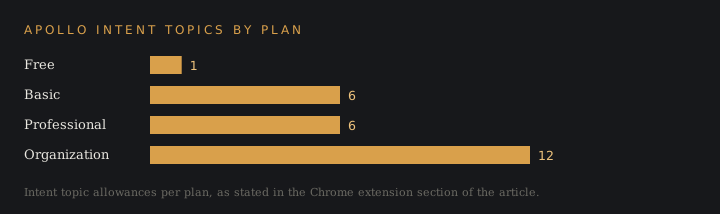
Apollo's Chrome extension reveals verified emails and phone numbers on a LinkedIn profile or company site and adds the person to a sequence. Search filters cover job titles, seniority, headcount and intent topics: 1 topic on Free, 6 on Basic and Professional, 12 on Organization.
Clay for Chrome extracts lists and page data into a Clay table, and Clip to Clay saves whole pages. Clay pulls LinkedIn data through marketplace providers, and several LinkedIn workflows run better with a Sales Navigator seat attached.
↑ COMPARISONWhat each vendor says about the other
Both vendors publish a comparison page about the other, which makes for a rare primary-source check. Apollo's ran on 31 July 2026; Clay's ran on 20 August 2026. Treat both as marketing.
| Claim | Who says it | What the other side's own pages show |
|---|---|---|
| Clay has no proprietary database and no native dialer | Apollo | Correct on both. Clay's pages describe neither. |
| Clay routes across 150+ providers | Apollo | Clay says 200+ data and AI providers, 150+ for contact info |
| Apollo Basic costs $69 a seat monthly | Clay | Apollo's pricing page read $65 on 4 October 2026 |
| Apollo always runs first in its waterfall | Clay | Apollo's own help article says the same |
| Apollo's API needs a Custom plan | Clay | Apollo's pricing page lists API access under Custom |
| Clay offers a 14-day paid trial | Apollo | Clay's pricing page shows a free plan and names no paid trial |
Apollo also publishes two customer counts on its own domain: about 40,000 paying customers on its about page and 100K+ on the Clay comparison page. Its users figure reads 1 million on one page and nearly 5 million on the other.
↑ COMPARISONThe third option: Clay integrates Apollo, and many teams run both
The pair is often a false choice. Clay's Apollo integration is "Included in All Plans" and runs on your own Apollo account. It can enrich people and companies, find people at a company by title, create contacts and add them to an Apollo sequence.
That setup gives the best of both worlds: Clay handles CRM enrichment, scoring and signal tracking, then passes the list to outreach. Apollo handles the sending and calling. It also kills two birds with one stone for teams already paying for Apollo seats, since Apollo's records become one provider in a Clay waterfall at no Data Credit cost.
↑ COMPARISONApollo API, Apollo CLI and Apollo's Model Context Protocol server
Apollo API access sits on the Custom plan per its pricing page, with rate limits of 1,000 enrichment calls a minute on paid accounts per the Apollo API docs. Apollo's Model Context Protocol server exposes about 50 actions to ChatGPT, Claude, Perplexity, Cursor and any remote MCP client: search, enrichment, CRM records, sequences, call transcripts and mailbox purchase. Search costs no credits; enrichment does. Apollo also documents an Apollo CLI.
↑ COMPARISONClay's API, CLI and MCP
Clay's HTTP API integrations start on Growth, and the Clay API itself is listed for Enterprise. Clay ships a CLI and a local MCP server started with clay mcp, documented for Claude Code, Cursor and Claude Desktop. Both vendors are moving toward the same idea: an AI agent outside the product that calls it as a tool.
Apollo also runs its own AI agent inside the product on the Professional plan and above; Clay's equivalent is Claygent plus Sculptor, which builds a workflow from a plain-language description.
↑ COMPARISONSwitching costs, contracts and corporate risk
Data leaves both products easily. Clay tables export to CSV, and Apollo exports records against credits. The switching cost sits in workflow automation. Apollo's Organization plan allows 500 workflows per team, and the automated workflows you build in either tool have to be rebuilt by hand on the other side.
- Apollo annual billing is a 12-month commitment with no refunds for unused time. Organization requires three seats.
- Apollo credits expire each billing cycle and don't roll over.
- Clay Actions reset monthly. Data Credits roll over, though Clay's pricing page states two caps (see the note below).
- Clay Enterprise is an annual commitment with custom rollover.
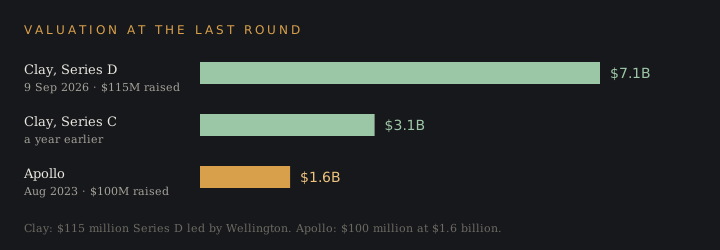
Ownership is quiet on both sides. Clay raised a $115 million Series D at a $7.1 billion valuation on 9 September 2026, led by Wellington, a year after a $3.1 billion Series C. Apollo raised $100 million at $1.6 billion in August 2023 and named Matt Curl chief executive on 3 February 2026, with co-founder Tim Zheng moving to chairman per the Apollo newsroom. A 2018 incident exposed 125.9 million email addresses from an unsecured Apollo database.
Clay's pricing page states Data Credit rollover two ways: the plan table says up to one month's credits or 15% of annual credits, and the FAQ says up to 2x the monthly amount. Get the figure written into your order form.
↑ COMPARISONWhere Clay wins, where Apollo wins
Clay wins for a team with a GTM engineer, a growth lead or growth hackers who will own the workflow builder. It wins on coverage when one database misses your market, on unlimited users, and on pushing CRM data into ads, warehouses and sequencers from one table.
Apollo wins for a small sales team that needs to hit the ground running. It wins on one login for search, sequences and calls, on a usable free tier where Clay's free tier stops at 200 rows, and on per-record cost for plain email lookups at two cents. An all in one platform suits sales processes where reps prospect for themselves.
Mixed buyers exist too. A team that wants Apollo's sending and Clay's coverage on the same platform has no single product for it; the closest fit is the integration above, with Apollo as one of the data sources in Clay's chain.
↑ COMPARISONLearning curve and review scores
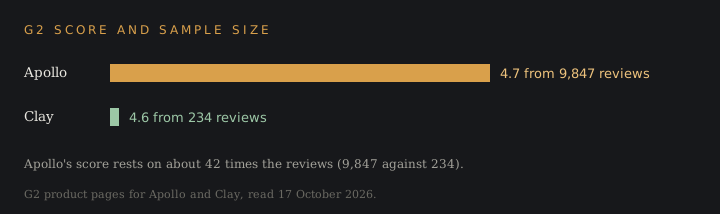
Clay carries the steeper learning curve, and reviewers say so. Apollo's learning curve is short enough for a rep to know the ropes in a day. On G2, Apollo holds 4.7 from 9,847 reviews and Clay holds 4.6 from 234. The sample gap is the story: Apollo's score rests on forty times the reviews.
A learning curve on Clay is also a cost curve, since mistakes burn Data Credits on live data. Test a workflow on 20 records before you bite the bullet on 20,000.
↑ COMPARISONFrequently asked questions
Which is better, Apollo or Clay?
Apollo is better for a small team that wants a built-in database, sequences and a dialer in one seat. Clay is better for a team that needs enriched contacts from multiple providers and has someone to build the workflows.
Is there anything better than Apollo?
For pure data enrichment, Clay's waterfall draws from 150+ databases against Apollo's one. For enterprise-grade records, see our sales intelligence rankings.
Is Apollo AI a legitimate site?
Yes. Apollo was founded in 2015, is backed by Bain Capital Ventures and Sequoia, and holds 4.7 on G2 from 9,847 reviews. Its Apollo.io review covers the complaints too.
Who is Apollo's biggest competitor?
ZoomInfo on contact data, and Clay on enrichment. Apollo's own comparison pages target both.
Does Apollo.io work?
For email prospecting at volume, yes. Phone numbers cost 8 credits each with no refund when wrong, which is par for the course in this category.
Is Apollo better than LinkedIn Sales Navigator?
Sales Navigator gives LinkedIn profiles and InMail without exportable emails or phones. Apollo gives contact details and sending. Clay's LinkedIn workflows often run beside a Sales Navigator seat for the same reason.
Is this about the Clay and Apollo programming languages?
No. Two programming languages share these names, and AI search engines mix them into answers about the software. Both aim at systems development:
- Clay, at github.com/jckarter/clay, is an open-source language "designed for Generic Programming," compiled through LLVM, with its release branch still at v0.1.
- Apollo, at apollolanguage.com, is a low-level, multi-platform language that favors readable DSL syntax and keeps code memory safe with modified rules modeled on Rust's borrow checker.
This page compares the two sales software companies, clay.com and apollo.io.
Read our Clay review for the full picture on Claygent and the Clay data layer.
↑ COMPARISONVerdict on clay vs apollo
Pick Apollo if your reps will prospect, sequence and call from one tool, your team is under ten seats, and your market sits inside Apollo's 240 million contacts. It costs $2,940 a year for five Basic seats and works on day one.
Clay earns its fee if you have the person to run it, your market falls through Apollo's gaps, or headcount makes per-seat pricing cost an arm and a leg. Clay Growth costs the same $5,352 at five seats or fifty.
Buy both if you already own Apollo seats and want Clay's waterfall on top. For that team, clay vs apollo resolves into a stack with two layers: Clay for the data, Apollo for the sending.
Sources: clay.com/pricing; clay.com/blog/clay-vs-apollo (20 August 2026); clay.com/changelog/clay-sequencer-2-0; apollo.io/pricing (read 4 October 2026); apollo.io/insights/apollo-vs-clay (31 July 2026); apollo.io/about; docs.apollo.io; knowledge.apollo.io; the Apollo newsroom announcement of 3 February 2026; vendr.com/marketplace/clay; vendr.com/marketplace/apollo-io; G2 listings for both products. Accessed 17 October 2026.