What is a focus group, and when is it worth paying for one
 By Jan Suski. I go deep on every review, checking every number against its source and digging up details other coverage misses, a habit from six years of SEO and link building for tech companies. Bylines at Surfer, Brand24, and Senuto. How the scoring works.
The short version 14 points · 60 seconds
- 01A focus group is six to ten people in one moderated room90 to 120 minutes, about a dozen questions
- 02The method began at Columbia's radio lab in November 1941Merton and Lazarsfeld, testing wartime radio
- 03Its output is a set of hypotheses, never a market sharePew frames none of its results in numbers
- 04Two one-hour interviews matched one two-hour group51% vs 50% of needs, Griffin & Hauser 1993
- 05Buy a group when the interaction is the evidenceConcepts, ad copy, objections voiced in debate
- 06A two-person team can run the whole studyOne moderates, one takes notes, both code
- 07Plan three or four focus groups per segmentOver 80% of themes appear in two or three
- 08Recruit strangers who share the trait under studyNo power gaps in the room; over-recruit
- 09Write about 12 questions in five typesKey questions get at least half the time
- 10The moderator runs the talk; an assistant takes notesField notes save hours at analysis
- 11Online groups seat four or five people for 90 minutesPew's 2024 study paid $125 per participant
- 12Budget $10,000 to $30,000 for a focus group projectIncentives run $50 to $135 an hour
- 13Four biases bend what a group says out loudDominance, conformity, moderator, self-selection
- 14Note-based analysis takes 1 to 3 hours per groupFull transcripts take about 2 days per group
A focus group is a structured conversation in which a trained moderator asks six to ten participants, chosen because they share a trait, a short list of questions about one product, message or experience. The group's reactions to each other are part of the data.
This lesson covers when focus groups earn their cost against one-on-one interviews and surveys, how a session runs from screener to transcript, how many focus groups and people a study needs, what each budget line costs, and the biases that make every finding a hypothesis to test.
It's written for product, marketing and insights teams commissioning their first focus group study, or rescuing one that produced a stack of quotes and no decision. If the wider set of techniques is new, start with the full list of market research methods, where focus groups sit beside surveys, interviews and observation, then the lesson before this one on qualitative vs quantitative research.
What is a focus group in practice
The mechanics are narrow and well documented. Richard Krueger & Mary Anne Casey, whose Focus Groups: A Practical Guide for Applied Research runs to 280 pages in its fifth edition from SAGE Publications, set the working size at six to eight people, with four to six for phone focus groups. Most adult focus groups are booked for a two-hour discussion.
Other guides draw the line a little wider. The University of Wisconsin-Madison Division of Extension says focus groups typically include seven to ten participants with common characteristics, and its sample script books an hour and a half. Drive Research runs anything from four-person mini-groups to focus groups of twelve.
At ten, each participant averages nine minutes of a 90-minute session before the moderator says a word.
Three roles fill the room. A moderator works from a prepared discussion guide, asks questions, probes, and keeps the group discussion on the particular topic. An assistant moderator handles logistics, keeps field notes and runs the recorder. Krueger & Casey say participants should feel comfortable talking with one another, and UW-Madison adds that they ideally don't know each other or the moderator.
That last rule is what separates a focus group from a staff meeting. Colleagues defer to a manager in the room. Participants who share only the trait under study have no ranking to protect, so their opinions arrive closer to unfiltered, and the room holds diverse perspectives that a team offsite never would.
Where the focus group came from
The method started as wartime propaganda testing, decades before market research made it a commercial product. Robert K. Merton & Paul Lazarsfeld met over dinner at Lazarsfeld's Manhattan home in November 1941, and Merton ended the evening watching a test audience at Columbia's Office of Radio Research react to This Is War, a series that premiered on 14 February 1942, according to an excerpt from Liza Featherstone's Divining Desire published by Quirk's.
Listeners pressed buttons on the Lazarsfeld-Stanton Program Analyzer to record likes & dislikes, then Merton led a group discussion about why. He wrote the technique up with Patricia Kendall as "The Focused Interview" in the American Journal of Sociology in 1946, volume 51, pages 541 to 557, then as a 1956 book from The Free Press with Marjorie Fiske, per the University of Pennsylvania's Merton bibliography.
Merton's version stayed in the social sciences as the focused interview, and advertisers turned it into something looser. In a 1987 address, published in Public Opinion Quarterly as "The Focussed Interview and Focus Groups: Continuities and Discontinuities," Merton called the early sessions a "strange spectacle" and set his method apart from the commercial focus groups that grew out of it.
What focus group data can and can't tell you
A focus group answers why and how, and its insights explain opinions a survey has already counted. It never answers how many. Pew Research Center's methodology note for its 2024 focus groups states it plainly: "The participants are not nationally representative, and the results are not framed in quantitative terms."
Pew explains the split in an August 2022 note on how it uses qualitative research. Qualitative work improves survey questions, especially on complex issues, and brings "color and context to our quantitative research findings." It also warns that qualitative findings don't represent a larger population.
So the honest output of a focus group study is a short list of insights: emerging themes, the language participants used in their own words, and the objections nobody on the research team predicted, along with the opinions of participants who changed their mind mid-session. Each one is a hypothesis. A survey or a sales test is where it becomes a number, and market intelligence analysis is where it meets the rest of the evidence.
Teams that skip that step jump the gun, and market research budgets pay for it twice.
Eight participants preferring package B is a reason to test package B on 800, and a press release about package B is the thing a focus group can't support.
Focus groups compared with interviews and surveys
The selling point of focus groups is group interaction: one person's comment triggers another's, and the moderator gets a debate in place of ten monologues. Participants build on each other's ideas, and insights appear that no single interview would trigger. That claim has been tested, and the data is less flattering than the sales decks.
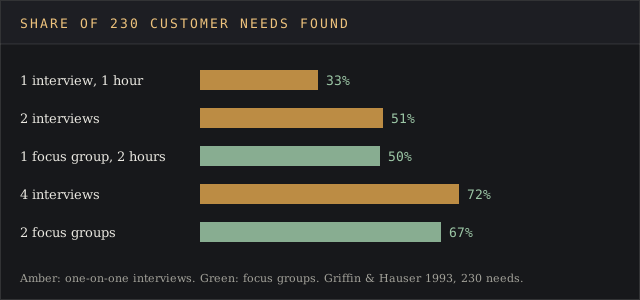
Abbie Griffin & John Hauser's "The Voice of the Customer", published in Marketing Science in 1993, compared eight two-hour focus groups with nine one-hour one-on-one interviews on office equipment. Six analysts pulled 230 distinct customer needs from the transcripts.
One interview found 33% of the needs. Two interviews found 51%, against 50% for a single group, and four interviews reached 72% against 67% for two focus groups. The authors wrote that "group synergies do not seem to be present in this data" and that one-on-one interviews "may be more cost-effective than focus groups."
The result narrows the job focus groups should get. A survey tells you what share of buyers picked option A; an interview tells you why one person did; a focus group shows you what happens to that reason when someone across the table disagrees. To gather insights on the right question, buy the format whose output matches it, and don't put all your eggs in one basket on a study that needs two methods.
When a focus group earns its cost
Focus groups pay off in early product development and in creative testing, where the reaction is the data. Typical jobs include:
Concept & packaging tests on new product ideas, where participants react to specific features side by side and argue about them.
Marketing campaign copy, to hear which claims draw doubt and which phrases participants repeat back.
Brand perception against named competitors, where one participant's comparison prompts the next and overall impressions shift as the group discussion goes on.
Hidden objections and unmet needs, which surface when a group member challenges the room.
Survey design, as Pew does, to find the words a questionnaire should use.
UW-Madison's guide lists the cases where focus groups miss the mark: when participants are divided or angry, when the goal is factual information, and when an organization is running the group to improve its image. Sensitive topics such as health or money belong in one-on-one interviews, where nobody has to disclose in front of seven other participants.
The test before conducting focus groups is short. If the answer you need would come out the same from ten separate interviews, pay for the interviews. If you need to watch an idea survive contact with disagreement, a group is the right tool, and that evidence feeds directly into a customer intelligence framework that has a slot for buyer language.
Conducting focus groups with a small research team
Conducting focus groups is within reach of a two-person research team, which can run the whole research process: one moderates, one takes notes, and both code. Krueger and Casey's note-based route, at 1 to 3 hours of analysis per group, is built for that size.
Making focus groups pay on a small budget comes down to three important considerations. Recruit from your own customer list to cut recruiting fees, run online focus groups to drop the facility line, and cap the study at three focus groups per segment, the point where Guest and his co-authors found every one of the most prevalent themes.
The focus group approach has several advantages over other forms of qualitative research for a team of two. Three focus group discussions of 90 minutes each collect data from 24 participants in four and a half hours of moderator time; 24 one-hour interviews take 24 hours. Griffin and Hauser's numbers say the interviews would find a similar share of needs, so the group format buys speed and pays for it in depth per person.
Plan the data collection before the first focus group session. Map each key question to a decision the business strategy depends on, and cut any question nobody will act on. Then fix how you'll gather information from each discussion: one shared note template with the theme, the speaker's segment, the quote and the overall impressions of the room.
Traditional focus groups in a facility, with a moderator-assisted discussion and a back room, still produce results online sessions can't match for packaging & physical products. For software, messaging and pricing pages, a video call with screen share covers the same ground, since the thing participants react to is already on a screen, and the moderator can dig deeper with a follow-up message after the call.
Done this way, focus group research gives you the target audience's reasons in their words and the insights behind marketing strategies. Paired with a survey, it lets a team make informed decisions on both the why and the how many, and it's the cheapest way to show why market intelligence matters to a team that has never paid for research.
How many focus groups and how many participants
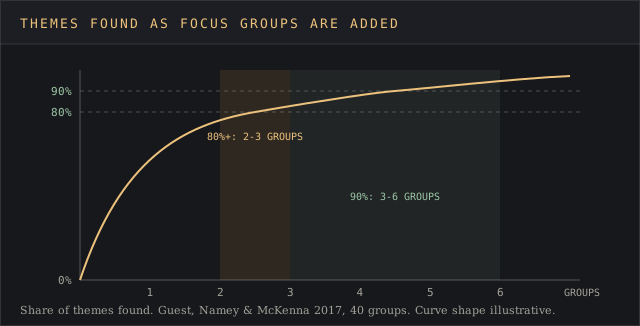
Krueger & Casey's rule is three or four focus groups per type of participant, stopping once new focus groups stop producing new information. UW-Madison sets a minimum of three. The evidence behind that number comes from Greg Guest, Emily Namey and Kevin McKenna, who analyzed 40 focus groups for a 2017 paper in Field Methods.
More than 80% of all themes appeared within two to three focus groups, and 90% within three to six. Three focus groups were enough to find every one of the most prevalent themes. The curve flattens fast, so a seventh group in the same segment is a drop in the bucket for new findings.
Segments multiply the count. A study comparing current customers with lapsed customers in two regions is four segments, so it needs 12 to 16 focus groups at Krueger's rate. Pew's late-2022 study of young adults ran 16 focus groups, four in each of France, Germany, the UK and the US, with typically eight participants aged 18 to 29 per group, per its methodology page.
Clinical researchers size focus groups with the same arithmetic. A 2003 osteoporosis study in Canadian Family Physician ran four focus groups with 32 family physicians, eight per group, from a semistructured guide.
Recruitment runs through a screener questionnaire that checks the shared trait and filters out participants who know each other or who sit in the same reporting line. Krueger & Casey warn against power differentials in the room. Drive Research recommends over-recruiting to cover no-shows, so book more seats than the group needs.
Writing focus group questions
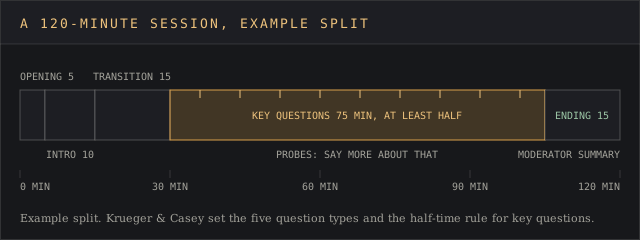
Good focus group questions are few, open-ended and ordered, and the insights they return depend on that order. Krueger & Casey expect about a dozen questions in a two-hour session and call the 20 to 30 that beginners write "far too many." Simple questions take about five minutes of discussion each; a key question takes 15 to 20.
| Question type | Job in the session | Example |
|---|---|---|
| Opening | Everyone speaks once, fast, with facts | Tell us your name and the last tool you bought for your team. |
| Introductory | Bring up the subject and how people relate to it | When you hear "competitor tracking," what comes to mind? |
| Transition | Move from general experience to the study's focus | Think back to the last time a rival changed its price. How did you find out? |
| Key | The questions the study exists to answer; at least half the time | Here are three versions of the alert. Which would you act on, and why? |
| Ending | Confirm & close | Of everything we discussed, what matters most to you? |
Introductory questions break the ice and set the norm that everyone talks. Transition questions bridge into the core. Ending questions let the moderator read back the key points and ask if the summary is right, which catches a misreading while the group is still in the room.
Leading questions do the most damage. "How much do you like the new dashboard?" assumes liking; "What did you notice on this screen?" doesn't.
The devil's in the details here, so pilot the guide on two colleagues and cut every question that names the answer you want.
Running the focus group session
A successful session depends more on the moderator than on the discussion guide. The job is active listening, short probes ("Say more about that"), and balance: drawing out the quiet participant and holding back the one or two participants who'd otherwise talk for the entire discussion. UW-Madison's guide describes the same balancing job for the moderator.
The opening minutes of the discussion decide the tone. A moderator who reads the room, explains that disagreement is welcome and that no answer is wrong builds the open environment where participants feel comfortable expressing doubts about a product its makers are watching through the glass.
The assistant moderator stays out of the discussion unless invited. Their field notes record who said what, nonverbal reactions and quotes worth checking against the tape, which saves hours at analysis.
Online focus groups versus in-person sessions
Video-call focus groups are now a standard format. Pew's 2024 study used nine online focus groups with 44 adults, four or five per group, for 90 minutes each between 24 September and 10 October 2024, recruited by PSB Insights. That's about half the eight per group Pew seated for its 2022 study, a size that suits a video call, where two people can't talk over each other the way they can across a table.
Traditional focus groups held in person still win for physical products and packaging, where people need to handle the item. Drive Research notes that focus groups run on video carry no facility fee or travel. In-person focus groups also give the client team the back room, which is useful for watching and a problem when observers start passing notes to the moderator.
What a focus group costs
Budget the project, then the group. Drive Research, a Syracuse research firm, puts a standard focus group project at $10,000 to $30,000. The lines that move the total are recruiting, incentives, the facility or video platform, the moderator, transcription and the report, and the focus group cost breakdown prices each one.
Incentives are the line with public benchmarks. User Interviews' January 2025 incentives report, built on nearly 20,000 completed projects, recommends these hourly rates for moderated focus groups:
Consumers, remote: $50 an hour.
Consumers, in person: $85 an hour.
Professionals, remote: $95 an hour.
Professionals, in person: $135 an hour.
The same report puts the average in-person B2B focus group incentive at $160. Drive Research quotes $75 to $150 for consumers and $500 or more for 90 minutes with senior industry professionals. Pew paid $125 per participant in 2024.
Eight surgeons at $500 each is $4,000 before anyone books a room, so B2B focus groups cost an arm and a leg next to consumer focus groups.
Recruiting hard-to-find audiences is the hidden cost. Drive Research notes that mixing customers with non-customers adds hours and resources.
Biases built into the focus group setting
Group dynamics are what focus groups sell, and their main source of error. Four biases recur, and each one bends the opinions the group voices away from what each member thinks, which taints the insights downstream.
Dominance comes first. One confident participant sets the frame and other group members fit their answers around it. Conformity follows: group members who disagree with the first three speakers often keep quiet or soften their view, so a unanimous room is a red flag that calls for a written vote.
Moderator bias is the third. A moderator who nods at answers they like or rewords a question to steer it produces the result the client paid for. Recruits who opt in are the fourth: participants who sign up for paid studies are a narrow slice of any market, and frequent participants learn what moderators want to hear.
Each bias has a counter. Ask participants to write their answer on a card before anyone speaks, so the first opinion can't anchor the rest. Rotate the order of concepts between focus groups. Cap repeat participants at the screener. Then read between the lines of the transcript and weigh a view by how many people held it before the debate started.
Analyzing focus group data
Analysis should start within hours of each discussion and finish within days of the last, per Krueger and Casey. Note-based analysis takes 1 to 3 hours per group. Transcript-based analysis takes about 2 days per group, and transcribing a 60-minute recording takes about 8 hours.
Coding qualitative data is the work: tag each comment to a theme, count how many focus groups and how many participants raised it, and keep the strongest quote in the speaker's own words, since a verbatim line carries insights a paraphrase loses. A theme raised in every group by people who disagreed about everything else is stronger evidence than a theme one articulate person repeated four times.
Record where each finding came from, so a slide quote can be traced to a group, a segment and a timestamp. Data source attribution is the same discipline applied to a market estimate, and it stops a moving quote from one participant being presented as what customers think.
The deliverable is a short report: the themes, how widely each was held, the deeper insights behind the top three opinions, and the open questions a survey should measure next. That's where focus group research feeds marketing strategies & business strategy, as one input to a decision, alongside the numbers it can't produce.
FAQ
What is a focus group in simple words?
It's a guided discussion with a small group of people who share a trait, run by a moderator who asks open-ended questions about one topic. Six to ten participants talk for 90 minutes to two hours, and the team studies what they say and how they react to each other.
What does the focus group do?
It produces qualitative data and insights: the reasons behind opinions, the words people use, and the objections that come out in debate, which are the deeper insights a survey misses. Teams use it to shape a product, test a marketing campaign or write better survey questions. Measuring how common a view is takes a survey.
Do people get paid for focus groups?
Yes. User Interviews recommends $50 an hour for remote consumer focus groups up to $135 an hour for in-person professionals, and Pew paid $125 per person for 90-minute focus groups on video in 2024. Senior professionals can earn $500 or more for one session.
What are examples of focus groups?
Pew's 16 groups of young adults across four countries in 2022, a 2003 study of 32 family physicians in four focus groups on osteoporosis care, and the radio audiences Merton questioned at Columbia in 1941 and 1942. In business, packaging tests and ad copy reviews are the common forms.
What is a focus group questionnaire?
Two documents get that name. The screener questionnaire qualifies recruits before the session. The discussion guide is the moderator's script of about 12 focus group questions in five types: opening, introductory, transition, key and ending.
What are some focus group questions?
"What comes to mind when you hear this brand name?" "Walk us through the last time you bought a tool like this." "Which of these three versions would you act on, and why?" Each one names no preferred answer, and invites other participants to agree or disagree.
What are some good topics for a focus group discussion?
Focus group discussions work on topics where reactions differ and people enjoy debating them: a new product concept, packaging, an ad, a brand compared with its rivals, or a buying process. Topics that need private disclosure, such as health or personal debt, belong in one-on-one interviews.
Bottom line
A focus group is a two-hour, moderated test of how six to ten strangers react to an idea and to each other. It's the right purchase when that reaction in the discussion is the evidence you need, and the wrong one when ten separate interviews would answer the question for less.
Run three or four focus groups per segment, write a dozen focus group questions, pay incentives at market rate, and code the transcripts against the biases a group setting creates. Then treat every theme and every insight as a hypothesis. Teams that skip that last step put eight opinions in front of a board as market fact, and go back to the drawing board after launch.
When the findings are coded, write them up with the method, the segments and the limits stated on page one, using the market research report template.