3C Analysis Template
 By Jan Suski. I go deep on every review, checking every number against its source and digging up details other coverage misses, a habit from six years of SEO and link building for tech companies. Bylines at Surfer, Brand24, and Senuto. How the scoring works.
· Prefer this source on Google
The 3C analysis template lays Company, Customer, and Competitor side by side, so a marketing strategy doesn't ride on whichever one of the three you happened to research first.
Product managers, consultants, and marketers use it before a launch, a repositioning, or a pricing change, whenever the plan depends on customers preferring the business over a named alternative.
This page carries a free download, the reasoning behind each section, a worked example priced in real numbers, and the mistakes that turn a 3C analysis into three disconnected lists with no shared argument. Explore the rest of the set in our market intelligence templates library.
Kenichi Ohmae, a Japanese organizational theorist and former McKinsey partner, built the framework to explain why some companies out-executed rivals running the same technology and budget. The answer sat in the overlap of the three Cs: Company, Customer, and Competitor together.
Download the free 3C analysis template
Download the 3C analysis template (DOCX)Company, Customer, and Competitor each get their own section, and a worked example ships pre-filled, so the first real entry has a pattern to copy.
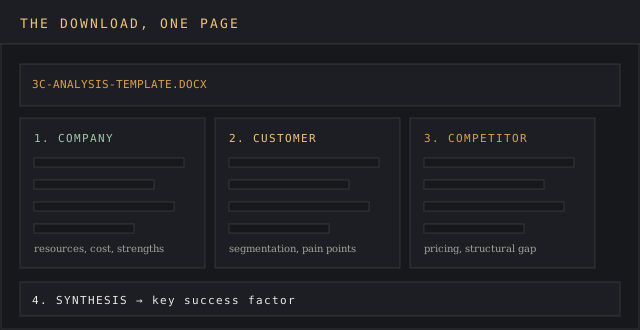
It opens the same in Word and Google Docs; nothing in the file depends on a macro or a Windows-only font.
What a 3C analysis is
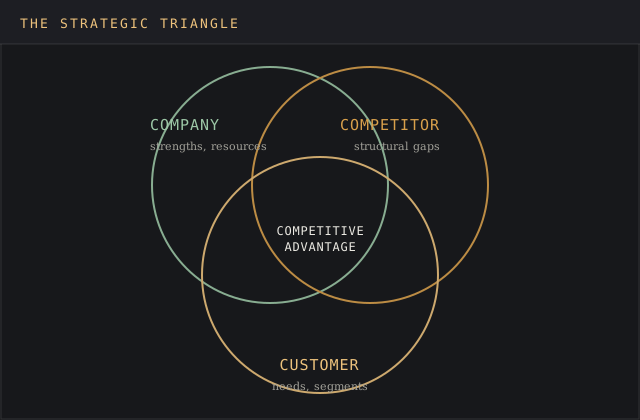
A 3C analysis is a business strategy exercise built on three questions asked in sequence: what the company can do, what customers want, and what competitors are already doing about it. Ohmae published the model in 1982 and called the three factors the strategic triangle.
His claim was specific: a sustained competitive advantage exists only where a company's strengths, a customer's needs, and a competitor's weaknesses line up at once. Three elements make up the model, Company, Customer, and Competitor, and treating any one of the key factors as sufficient on its own is the model's most common misuse; getting all three key factors right at once, and keeping them aligned, is what makes the advantage repeatable.
The framework sits alongside other frameworks for situation analysis. A PEST-style environmental analysis covers macro trends; a PEST analysis template handles that layer. A SWOT analysis names strengths and weaknesses in isolation. A 3C analysis then feeds a broader market analysis with real customer and competitor detail.
Why run one before you commit resources
Skipping the exercise doesn't remove the risk; it moves the discovery to a lost deal. A company analysis on its own tends to read like a pitch deck, all strength and no gap, and the customer and competitor legs are what catch that before a marketing strategy locks in.
Run it ahead of a go-to-market plan, a digital transformation investment, or any decision where a shift among named competitors decides if the plan pays back.
The Company: resources and what the business can do
The company leg starts with an honest self-assessment: core products and services, revenue by line, and the resources on hand to fund a new move.
Cost structure and the Hito-Kane-Mono resource order
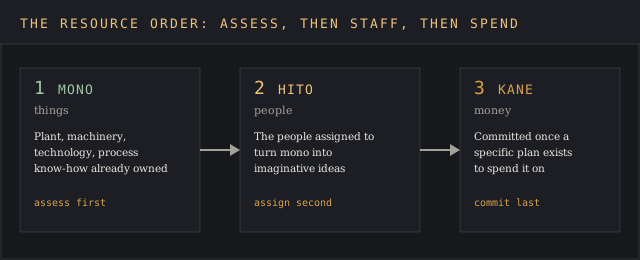
Ohmae split resources into three: mono (plant, machinery, technology, process know-how, and functional strength), hito (people), and kane (money). The sequence is critical: assess the things the company already owns first, assign the people who turn them into imaginative ideas second, and commit money last, once someone has a specific plan to spend it on.
Cost structure belongs in the same section: the size of the gap between fixed and variable cost decides who captures the profits when a price war starts. The company doesn't have to excel everywhere to stay ahead of the competition; outsourcing costly functions with no direct payoff frees up the one function that builds the edge.
Customer analysis: segmenting by objective and customer coverage
Customer analysis starts with the target market, then narrows to target customers through segmentation. Ohmae named three segmentation methods: by objective (why various customers use the same product differently), by customer coverage (the trade-off between market coverage and marketing cost), and by re-segmentation, once main competitors dissect the market in similar ways.
An initial strategic segmentation decays as market dynamics shift the buyer mix; pick a small group of customers and re-examine what they're buying when it does.
Surveys, in depth interviews, user tests, and Google Analytics data supply the raw material; a customer analysis built on guesswork ends up describing the person who wrote it, and the actual buyer stays unexamined. The primary goal is deeply understanding why the existing customer base buys, so the section surfaces customer needs, customer concerns, and pain points a sales team already hears but never writes down.
Segmenting by customer coverage means picking a coverage level, geographically and channel wise, and testing it against the marketing-cost curve: past a point, each added segment costs more to reach than it returns. Our customer segmentation template and market segmentation guide both go deeper on this step alone.
Competitor analysis: finding the differentiation gap
Competitor analysis in the 3C model searches for the gap a rival's own cost structure or positioning won't let it close.
Ohmae pointed to differentiation through purchasing, design, engineering, sales, and service functions; companies also differentiate through brand strength and constant investment in technology. A rival with a leaner cost structure can match a price cut; a rival selling through different distribution channels can't match a service model built around one.
List direct competitors, their pricing, and market share, then note what each one's business model makes structurally hard to copy. Our competitive intelligence tools ranking covers the tools that keep that column current, and every finding should feed the competitor battlecard sales reads.
How to fill in the template, step by step
Fill the three sections in a fixed order, then close with a fourth.
Company: list products and services, revenue by line, cost structure, and the mono-hito-kane resources on hand; focus on the one strength worth funding first.
Customer: define the target market, then split it by objective and by customer coverage; pull industry reports and Google Analytics data first.
Competitor: identify main competitors, their pricing, and the structural reason each can or can't match a move.
Synthesis: mark where a company strength, a customer need, and a competitor gap overlap, then analyze that overlap for the key success factor the strategy should chase first.
Skip the synthesis step, and the three sections stay three separate documents.
Worked example: a cold-chain monitoring launch decision
Here's how the three sections read for a hypothetical scenario: a 46-person B2B SaaS vendor selling route-optimization software to regional trucking fleets, weighing a temperature-monitoring add-on for cold-chain distributors.
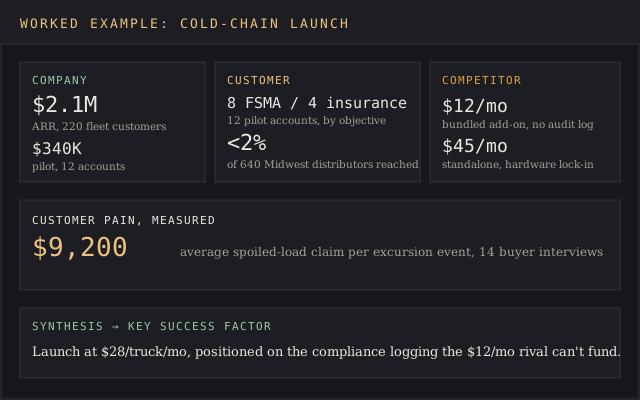
Company. The core routing product carries $2.1 million in annual recurring revenue across 220 fleet customers. A cold-chain pilot module already earns $340,000 from 12 accounts. The module's costs split 68% cloud infrastructure and support, 22% R&D, and 10% sales and marketing. Resources on hand: three sensor-integration engineers, an existing hardware-gateway partnership, and $1.2 million of runway earmarked for the launch.
Customer. The 12 pilot accounts split by objective: eight bought to avoid Food Safety Modernization Act temperature-excursion violations, four bought to cut insurance premiums.
By coverage, the pilot sits entirely in the Midwest against an estimated 640 same-size distributors nationally, so it reaches under 2% of the target audience. Fourteen buyer interviews logged an average of $9,200 in spoiled-load claims per excursion event, the number that ended up driving the pitch.
Competitor. Two structurally different rivals compete for the same budget: an established fleet-telematics vendor bundling a basic sensor for $12 per truck a month that skips audit-grade logging, and a standalone cold-chain specialist charging $45 per truck a month whose hardware-only model makes cancellation expensive for its own customers.
Synthesis. The overlap: customers need FSMA-grade audit logging, the bundled competitor's low-margin add-on can't fund building it, and the vendor's 220-fleet base is a channel neither rival has. The launch priced at $28 per truck a month, positioned on the compliance logging the cheap option lacks and a price the specialist beats.
Common mistakes that flatten a 3C analysis
The most common failure: writing the company section like a pitch deck, all strength and no weakness, leaving the customer and competitor sections nothing to argue against.
Second: customer analysis reduced to a demographic list, when the section calls for a segmentation exercise. Age and job title describe various customers; they don't explain why one picks a vendor over another.
Third: a competitor list with names and prices but no structural reasoning attached. Without the "why can't they copy this" column, competitor analysis adds facts but no argument.
The fourth mistake erases the other three: skipping the synthesis. A finished 3C analysis produces one key success factor; skip that step and the three sections stay three separate reports.
Turning the 3C analysis into marketing strategies
The synthesis feeds two decisions directly: which marketing strategies and marketing activities get funded, and which get left alone. A key success factor that sharpens the value proposition is worth funding first; everything else competes for resources it won't get.
Effective marketing strategies built from a 3C analysis name the competitor in the positioning statement, because differentiation only means something next to the specific alternative a buyer is weighing.
Update the analysis on the same cadence as a pricing review: every quarter, at minimum. Teams that run competitor analyses quarterly catch a rival's price change before stale market trends age the synthesis past use.
Word, Excel, or Google Docs
The template ships as a DOCX: the three sections and the synthesis read as prose and short lists, a shape rows of formulas don't fit. A spreadsheet suits a deal log or a scoring matrix better than an analysis this qualitative.
Teams running several 3C analyses at once sometimes move the synthesis table into a spreadsheet to sort and compare; the document stays the master copy.
FAQ
What do the three C's stand for?
Company, Customer, and Competitor: what Ohmae called the strategic triangle. A sustained competitive advantage exists only where a company's strengths, a customer's need, and a competitor's weakness overlap.
What is the 3C framework used for in consulting?
A management consultant uses it as an early situation-analysis step, before recommending a marketing strategy, a pricing move, or a market entry. It forces the same three questions onto every engagement: what the client's know how can do, what the customer wants, and what competitors already offer.
How is a 3C analysis different from a SWOT analysis?
A SWOT analysis lists a company's strengths, weaknesses, opportunities, and threats on their own. A 3C analysis puts the company's strengths and weaknesses through two more filters, a real customer segment and a named competitor, before calling any of them strategic.
Can you give an example of customer insights from a 3C analysis?
In the worked example above, fourteen buyer interviews found an average $9,200 in spoiled-load claims per temperature-excursion event, a specific figure that ended up anchoring the pricing pitch.
Is a 3C analysis a type of situation analysis?
Yes, alongside SWOT and an environmental analysis like PEST: PEST covers the macro environment, SWOT covers the company alone, and a 3C analysis checks the company's findings against a real customer and competitor.
How often should a 3C analysis be updated?
Update it when a competitor changes price or positioning, when a customer segment shifts, or at minimum every time a pricing or marketing-strategy review happens. A stale competitor analysis is the fastest way the synthesis stops matching the market.
Bottom line
Reach for the 3C analysis template when a decision, a launch, a repositioning, a pricing change, hinges on customers choosing the business over one named, specific alternative.
Skip it, or shorten it, when the decision is internal with no competitor to answer to: an operational fix, a cost cut, a tooling change. Pair it with a competitive analysis when the competitor leg needs more depth than one section holds.
The three sections only pay off together. A company analysis without a customer or competitor check reads like a pitch deck; a strategy needs all three.