Lean Canvas Template
 By Jan Suski. I go deep on every review, checking every number against its source and digging up details other coverage misses, a habit from six years of SEO and link building for tech companies. Bylines at Brand24 and Senuto. How the scoring works.
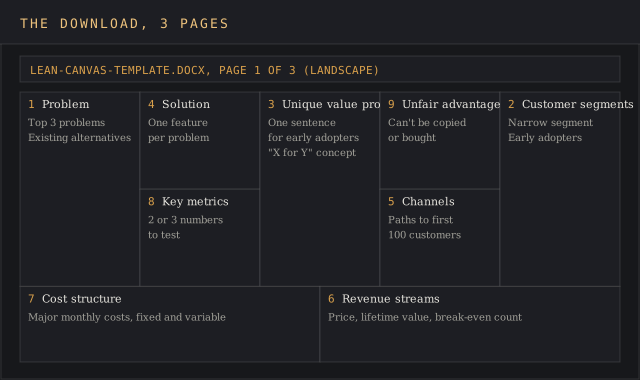
Get the lean canvas template
A landscape Word file: the blank nine-box canvas with prompts, a filled worked example, and an assumptions tracker with break-even math.
Download DOCXA lean canvas template is a one-page business model built for an idea that hasn't met its customers yet. Nine boxes cover the problem, the customer segments, the unique value proposition, the solution, channels, revenue streams, cost structure, key metrics and unfair advantage, and each box holds a guess the founder still has to test.
This page covers what the lean canvas is and where it came from, how it differs from the business model canvas, what goes in each of the nine boxes, the order to fill them, a worked example for a restaurant shift-swap app with its break-even math, and the common mistakes that turn a canvas into a wish list.
It's for founders, product managers and anyone testing a business idea before writing a business plan or raising money. Ash Maurya designed it for startups; corporate teams use the same lean canvas business model to pressure-test a new product line before a budget gets approved.
The format targets the most common cause of startup failure. CB Insights read 111 startup post-mortems and found 35% named no market need as a reason they failed. A canvas that starts with the problem forces that question onto page one.
Download the free lean canvas template
Download the lean canvas template (DOCX)Three landscape pages: the blank canvas with a prompt in every box, the shift-swap worked example, and an assumptions tracker with a break-even calculation.
The file opens in Word, Google Docs and LibreOffice Writer, and the canvas prints on one sheet of A4 or US Letter.
What a lean canvas is: the lean business model on one page
Ash Maurya introduced the Lean Canvas in 2010 and describes it on his own blog as "my adaptation of Alex Osterwalder's Business Model Canvas". Osterwalder's canvas had been released under a Creative Commons license that invited others to share and remix it, which is why Maurya extended it and kept its layout.
The lean canvas approach takes its logic from the lean startup methodology: treat the business model as a set of key assumptions, test the riskiest first with real customer feedback, and change the model as evidence comes in. Maurya's 2026 essay calls the canvas "a living collection of key beliefs where every item starts out as a guess".
In a nutshell, that framing is the whole point of the lean canvas model. The lean business model canvas, as some guides call it, compresses business strategy into one sheet: a lean canvas enables a founder to see nine critical elements of the business on one page, mark which ones are guesses, and pick the one that would sink the company if it turned out wrong.
Lean canvas vs the business model canvas
Both formats share five boxes: customer segments, value proposition, channels, revenue streams and cost structure. Those key elements carry over unchanged from the traditional business model framework. Maurya swapped out the other four of the traditional business model canvas, and he explains each swap in "Why Lean Canvas versus Business Model Canvas".
| Business model canvas box | Lean canvas replacement | Maurya's reason |
|---|---|---|
| Key partners | Problem | Startups fail from poor problem understanding; partners pursued before the product is tested are waste |
| Key activities | Solution | Activities follow from a tested solution; the box stays small to limit falling for a first idea |
| Key resources | Key metrics | Only a few numbers matter at any stage, and tracking the wrong one wastes months |
| Customer relationships | Unfair advantage | Direct customer interviews come first, and channels cover the path to customers |
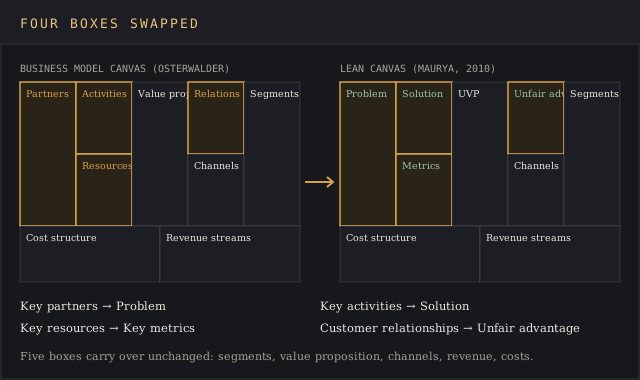
The practical rule: use the business model canvas for a business that already runs and needs describing, and the lean canvas for one that doesn't exist yet. Our business model canvas template covers the first job, including key partners and key activities for companies that have them.
The nine boxes: key components of the lean canvas template
Each box answers one question. The table lists them in the order Maurya's canvas places them on the page, left to right.
| Box | Question it answers | What a good entry looks like |
|---|---|---|
| Problem | What are the top one to three problems customers face? | Problems stated as the customer would say them, plus the existing alternatives they use today |
| Customer segments | Who has those problems? | A narrow segment and its early adopters, the people who feel the problem hardest right now |
| Unique value proposition | Why should they pay attention? | One sentence a stranger understands, plus a high-level concept such as "X for Y" |
| Solution | What's the smallest thing that solves each problem? | One feature per problem, three maximum |
| Channels | How will you reach target customers? | Named paths with a cost per customer, free and paid |
| Revenue streams | How does the business make money? | Price, revenue model, and lifetime value |
| Cost structure | What does it cost to run? | Major costs per month, fixed and variable, to set a break-even target |
| Key metrics | Which numbers prove it's working? | Two or three numbers tied to the riskiest assumption |
| Unfair advantage | What can't a competitor copy or buy? | Often blank on day one, and that's fine |
Key problems and customer segments
Problem and customer segments get filled together, because each one defines the other. Start by asking customers to identify what they do today, then list the competitors and workarounds they name. A list of 12 problems usually means the segment is too wide; narrow the segment until two or three problems stand out.
Unique value proposition
The unique value proposition sits dead center on the canvas. It's the line on the landing page, written for early adopters, and it should name the result a customer gets. Value proposition copy that could describe any product in the category needs another pass.
Key metrics and cost structure
Key metrics turn the canvas into something testable. Cost structure sets the bar those metrics have to clear: monthly costs divided by the price per customer gives the number of paying customers needed to break even, which the worked example below calculates.
Unfair advantage
Maurya quotes Jason Cohen's definition: "A true unfair advantage is something that cannot be easily copied or bought." Insider knowledge, an existing community or proprietary data qualify, because each one keeps a competitive edge after a rival copies the product. "We work harder" and "first mover" don't, because a funded competitor can buy both. Most first canvases leave the box empty, and the jury's still out on most candidates until a rival tries to copy them.
How to fill in a lean canvas: step by step guide
Left-to-right is the wrong order. Maurya suggests starting with Problem, then Customer Segments, then the Unique Value Proposition; the template's prompts number the rest.
- Problem and customer segments. Write the top three problems and who has them. Add the existing alternatives.
- Unique value proposition. One sentence for early adopters.
- Solution. One feature per problem.
- Channels. How the first 100 customers will find you.
- Revenue streams and cost structure. Price, monthly costs, break-even customer count.
- Key metrics. The numbers that prove or kill the riskiest box.
- Unfair advantage. Last, and blank if nothing qualifies.
- Rank the risks. On page three, mark each entry 1 to 3 for risk and write the test for every 3.
Speed matters more than polish on the first pass. Maurya wrote that a one-page model lets founders "outline multiple business models in an afternoon" where a plan takes weeks, and his site runs a 20-minute business model challenge built on that idea. The time limit does the work, forcing entrepreneurs to write what they believe today about the product or service and the market. Teams working on a whiteboard can add sticky notes to each box and move them between versions.
Worked example: a shift-swap app for independent restaurants
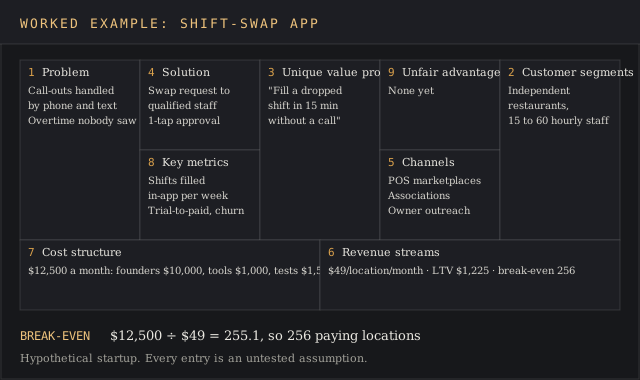
Page two of the template carries a hypothetical startup: two founders building an app that lets restaurant staff swap shifts without the manager making phone calls. Every figure below is an assumption the founders haven't tested yet, which is what a first canvas holds.
| Box | Worked example entry |
|---|---|
| Problem | A call-out leaves the manager texting staff one by one; schedules live in spreadsheets and group chats; last-minute swaps push staff into overtime nobody saw. Existing alternatives: group texts, phone calls, a paper rota. |
| Customer segments | Independent restaurants with 15 to 60 hourly staff. Early adopters: owner-operators who run the schedule in a spreadsheet and lost a shift last month. |
| Unique value proposition | "Fill a dropped shift in 15 minutes without making a phone call." High-level concept: a group text that knows who's qualified. |
| Solution | Swap request pushed to qualified, available staff; one-tap manager approval; overtime warning before approval. |
| Channels | POS app marketplaces, local restaurant associations, direct outreach to owners, staff referrals. |
| Revenue streams | $49 per location per month after a 14-day trial. At 4% monthly churn, lifetime value is $49 ÷ 0.04 = $1,225. |
| Cost structure | Founder pay $10,000, hosting and software $700, SMS and store fees $300, channel tests $1,500: $12,500 a month. |
| Key metrics | Shifts filled through the app per location per week; trial-to-paid conversion; monthly location churn. |
| Unfair advantage | None yet. Candidate: an exclusive listing on the POS marketplace most target restaurants already use. |
The break-even line is $12,500 ÷ $49 = 255.1, so 256 paying locations. That number sets the bar for channels: if outreach costs more than a few hundred dollars per signed location, the revenue model doesn't work at this price, and the founders can cut their losses before writing a line of code. Signing 256 restaurants with two founders doing sales is easier said than done, which is why Channels gets its own test.
The riskiest box is the problem. If owners don't lose shifts often enough to care, nothing else on the canvas matters, so the first test on page three is 20 owner interviews asking how many shifts went uncovered last month.
Testing the canvas: the assumptions tracker
Page three turns the canvas into a test plan. Each row takes one box entry and records the assumption, a risk score from 1 to 3, the evidence so far, the test, the pass mark and a deadline.
| Box | Assumption | Risk | Test | Pass mark |
|---|---|---|---|---|
| Problem | Owners lose at least two shifts a month to call-outs | 3 | 20 owner interviews | 12 of 20 report two or more |
| Revenue streams | Owners will pay $49 per location | 3 | Pre-sale page with a card form | 10 deposits from 200 visits |
| Channels | Associations will feature the app | 2 | Pitch three associations | One newsletter slot |
| Key metrics | Pilot restaurants fill three shifts a week in-app | 2 | Five-location pilot for four weeks | Average of three or more |
Results feed back into the canvas. Interviews bring new insights, and the tracker helps pinpoint areas where the model is weakest. Once interviews surface a pattern, a research survey template sizes it across a few hundred owners.
Maurya's own advice in that 2026 essay is to update the canvas as each interview or experiment lands, and a dated version on page two after every round shows the significant changes over time. When a box fails, it's back to the drawing board for that box alone: founders can quickly pivot it and keep the rest, which is how the canvas keeps them on the right track.
Common mistakes with a lean canvas
- Targeting everyone. A target audience of "restaurants" can't be reached or priced. Write "independent restaurants with 15 to 60 hourly staff".
- Starting with the solution. Filling Solution first bends the problem to fit the product, and the product misses the mark.
- Too many features. Three problems, three features. A founder listing ten bites off more than they can chew; a longer list is a roadmap.
- Vanity metrics. Track shifts filled, the number that moves only when the problem is real; signups and page views move with ad spend.
- Writing it once. A canvas that never changes after the first interview is decoration.
- A fake unfair advantage. Passion and a head start fail Cohen's copy-or-buy test.
Most of these come from treating the canvas as a pitch document. A list of guesses works only when the founder is willing to be wrong in public on page three, and that willingness is among the key aspects of the method no template can supply.
Lean canvas, business plans and the business plan template question
Unlike traditional business plans, the lean canvas fits on a page and changes weekly. Lengthy business plans earn their keep when a bank or investor requires one, or when a business is past the guessing stage and needs a financial model. Boring business plans written for a drawer don't, and Maurya's blog notes that "most Plan As are likely to be proven wrong anyway".
The two work in sequence. Fill the canvas, test the riskiest boxes, and write the full plan once the canvas stops changing every week. A feasibility analysis and a market sizing model are the usual bridge between a validated canvas and a fundable one-page business plan or full plan.
Word, PowerPoint or a whiteboard
The template ships as a Word file because a canvas gets printed, emailed and annotated, and Word's table grid holds the nine-box layout on one landscape page. Copy the table into PowerPoint for a pitch slide, or into Google Docs to share with a cofounder.
Whiteboard tools such as Miro and FigJam suit a team session where people add sticky notes and argue about them live. Paper and real sticky notes work just as well and cost nothing. The format matters less than the habit of dating each version. A picture is worth a thousand words here: a printed canvas on the office wall keeps a founding team on the same page between meetings.
FAQ
What is a lean canvas in a business plan?
It's a one-page replacement for the early part of a business plan: nine boxes that state the problem, customer segments, value proposition, solution, channels, revenue, costs, key metrics and unfair advantage as assumptions to test.
How many pages should a lean canvas be?
One. If an entry doesn't fit its box, it's too long. The template adds a second page for the worked example and a third for the assumptions tracker, but the canvas itself is a single page.
Does Microsoft Word have a business plan template?
Word's own template gallery includes business plan layouts. For the lean canvas specifically, the download on this page is a Word file with the nine-box grid, prompts, a worked example and an assumptions tracker.
Which lean canvas component describes how a business idea solves customers' problems?
The Solution box, one feature per listed problem. The unique value proposition then states the result in one sentence a customer understands.
What are the 9 elements of the BMC?
Key partners, key activities, key resources, value propositions, customer relationships, channels, customer segments, cost structure and revenue streams. The lean canvas keeps five and replaces four.
What are some examples of revenue streams?
Subscriptions, usage fees, one-off sales, licensing, advertising and transaction commissions. The worked example uses a per-location monthly subscription.
Bottom line
The canvas is a valuable tool for early business concepts and less useful once a company has customers, partners and processes to describe. Founders can create a new version in ten minutes when market conditions shift.
Use the lean canvas template when the business idea is still a set of guesses and the next step is finding out which guess is wrong. Fill it in one sitting, rank the risks on page three, and test the problem box before anything else. Business success and startup success both start with a problem someone will pay to fix.
Once the canvas stops changing, move to the business model canvas to describe the running business, and to a go-to-market plan to launch it.