Jobs to Be Done Template
 By Jan Suski. I go deep on every review, checking every number against its source and digging up details other coverage misses, a habit from six years of SEO and link building for tech companies. Bylines at Surfer, Brand24, and Senuto. How the scoring works.

Get the jobs to be done template
An Excel workbook that turns switch interviews into a ranked list of unmet needs: a job statement builder, an eight-step job map with live opportunity scores, a forces-of-progress sheet and a switch timeline.
Download XLSXA jobs to be done template is a worksheet that records the jobs customers are trying to get done, step by step, and scores each step on how much it matters and how well today's options handle it. The file here is a five-tab Excel workbook: a job statement, a job map with live opportunity scores, a forces-of-progress sheet and a switch-interview timeline.
This page covers the jobs to be done framework, the outcome driven innovation ODI method built on it, how to write a job statement, the three kinds of jobs, the four forces that push or stall a switch, how to run the interviews, and how the opportunity score turns 1-to-10 ratings from customers into a ranked list of customer needs. The worked example scores eight desired outcomes for a product marketing manager's quarterly competitive briefing.
It's built for product managers, product teams, product marketers and founders who have to decide what to build next and can't afford to guess. It also suits user research teams who already run interviews and want the notes to end in a number the roadmap meeting will accept.
The reason to bother with jobs to be done is the failure rate. A McKinsey poll cited in Harvard Business Review's September 2016 article by Clayton Christensen, Taddy Hall, Karen Dillon and David Duncan found 84% of executives called innovation important to their growth strategies, and 94% were dissatisfied with their own innovation performance.
Download the free jobs to be done template
Download the jobs to be done template (XLSX)Five tabs: instructions, a job statement builder, a job map with eight outcome rows and a live opportunity-score formula, a forces-of-progress sheet and a switch-interview timeline, pre-filled with the Northpine worked example.
The jobs to be done workbook opens in Excel, Google Sheets and LibreOffice Calc. The scoring uses plain MAX, IF, ROUND and RANK formulas, so nothing breaks on import, and the worked example sits in italic rows you can overwrite or delete.
What jobs to be done means
Jobs to be done theory explains why customers buy: customers hire products and services to make progress in a specific situation, and they fire them when something else does the job better. The Clayton Christensen Institute describes a job as "the progress they're trying to make as they strive toward a goal or aspiration within particular circumstances."
Jobs to be done moves the unit of analysis from the customer to the job. A 2006 Harvard Business School Working Knowledge piece puts it in one line: "the job, not the customer, is the fundamental unit of analysis for a marketer who hopes to develop products that customers will buy." Demographics describe who buys; jobs describe why.
That's the center of the jobs to be done theory, and the reason it ages well. Products and services change every few years; the jobs they serve barely move. Ask customers to design the solution and they describe a faster horse, the old line about transport. Ask customers about the job and they give you the measures they'd use to judge any solution: time, effort, cost, the chance of getting it wrong.
Two schools of jobs theory
The jobs to be done framework has two lineages, which is why jobs theory reads differently depending on who wrote it, and most of the confusion in blog posts comes from mixing them.
- Jobs as progress (Christensen, Moesta). Clayton Christensen popularized the idea in his 2003 book The Innovator's Solution, per Strategyn's history of the method. Bob Moesta and Chris Spiek built the switch interview and the forces-of-progress diagram on top of it. This school asks why customers switch.
- Jobs as a process (Ulwick). Tony Ulwick conceptualized jobs to be done theory in 1990 by applying Six Sigma thinking to the innovation process, and in 1999 he named his version outcome-driven innovation (ODI). His innovation consulting firm Strategyn runs it. This school asks how customers measure success at each step of the entire job.
The jobs to be done template uses both. The forces and timeline tabs come from the Moesta school; the job map and opportunity score come from Ulwick's outcome-driven innovation process. Read between the lines of any jobs to be done theory argument online and you'll find people defending one school against the other, when the two answer different questions.
The core principles of the jobs to be done framework
Five core principles of jobs to be done theory hold across both schools, and every tab of the file enforces at least one of them.
- Customers hire products and services to get a job done. Strategyn quotes Harvard Business School professor Theodore Levitt: "People don't want a quarter-inch drill; they want a quarter-inch hole." The hole is the job customers are trying to accomplish, and the drill is one way to get the job done.
- The job is solution agnostic. A job statement names no product, brand or technology, so it still holds when the technology changes and the jobs stay put.
- Circumstances define the job. The same customers hire a different product for a different job at a different time of day, which is why customer jobs beat customer averages as a unit of analysis.
- Jobs have functional, emotional and social sides. Christensen's HBR article: "Jobs are multifaceted. They're never simply about function; they have powerful social and emotional dimensions."
- Customers measure success in their own metrics. The metrics customers use (time, likelihood, number of errors) to judge if a job done well become desired outcomes, and the desired outcomes are what the team scores.
Principle three is the one product teams skip most often, and it's the one the milkshake study behind the jobs to be done theory proved.
The milkshake study
The best-known jobs to be done case started with a fast-food chain that wanted to sell more milkshakes. Christensen's researchers watched the counter and found that 40% of all milkshakes were bought in the early morning, per HBS Working Knowledge (January 2006). The buyers "faced a long, boring commute and needed something to make the drive more interesting," and they wanted something that kept hunger away until 10 a.m.
The morning shake's real competitors were bagels, bananas and doughnuts. In the afternoon the same product was a treat for children, a different job with a different set of competing solutions. Making the shake thicker would help the commuter and annoy the parent, which is why a single average customer profile missed both customer jobs.
Functional, emotional and social jobs
Every job in the jobs to be done framework has three layers, and the job statement tab gives each its own row so the emotional and social ones don't get dropped.
| Job type | What it describes | Example from the HBS Online article |
|---|---|---|
| Functional job | The practical task the customer is trying to accomplish | A protein bar that curbs hunger |
| Emotional jobs | How the customer wants to feel while doing it or after | Buying a protein bar to lose weight |
| Social job | How the customer wants to be seen by others | Buying a brand with prestige in the bodybuilding community |
The examples come from Harvard Business School Online's jobs to be done examples by Kelsey Miller. The core functional job is the anchor of the JTBD framework; the emotional and social rows explain why two products and services that do the same functional job sell at different prices to the same customers.
PayPal is the post's emotional-job case: CEO Dan Schulman told the Motley Fool the company creates "trust and security" for customers, a feeling the checkout button has to deliver.
Related jobs and consumption chain jobs
Ulwick splits the customers around a product into three customer types, per Strategyn: the job executor who uses it, the product lifecycle support team who installs, maintains, repairs, upgrades or disposes of it, and the buyer, the group "responsible for making the financial purchase decision." The support team performs what Strategyn calls consumption chain jobs.
In B2B software and services the purchase decision maker is often a vice president who never touches the tool, the job executor is an analyst, and IT runs the consumption chain jobs. A jobs to be done template that records only the main job of the executor misses two of the three customers who can kill the deal. The job statement tab has a row for each, plus a row for related jobs the executor does right before or after the main one.
How to write a job statement
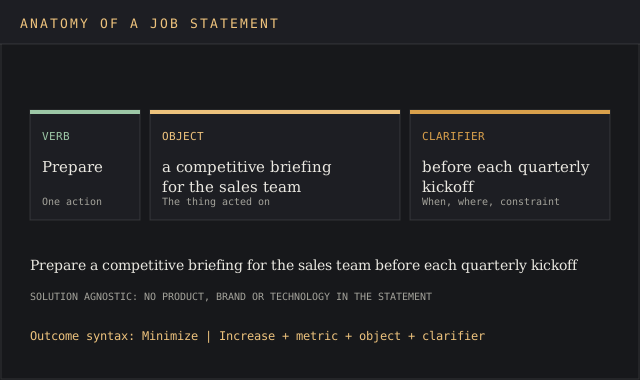
A jobs to be done job statement has three parts: an action verb, the object of the action, and a clarifier that sets the context. MIT's Industrial Liaison Program rules for need statements require the job to begin with an action verb and to relate to a defined customer and context.
| Part | What goes in it | Northpine example |
|---|---|---|
| Verb | One action, present tense | Prepare |
| Object | The thing acted on | a competitive briefing for the sales team |
| Clarifier | When, where or under what constraint | before each quarterly kickoff |
Keep it solution agnostic; the devil's in the details here. "Use a battlecard tool to brief sales" names a solution and dies with that tool. "Prepare a competitive briefing for the sales team before each quarterly kickoff" was a job in 1995 and will still be one in 2035. Define jobs at the level customers would recognise, one level above the product and one below their whole role.
Desired outcomes follow a stricter syntax. The MIT ILP rules state outcome statements "must be introduced with only one of two words: minimize (90%) or increase (10%)," followed by a measurable metric such as time, likelihood or number. "Minimize the time it takes to find a competitor's current pricing" passes. "Better pricing data" doesn't.
The forces of progress
Customers switch when the forces pulling toward a new solution beat the forces holding them in place. Bob Moesta and Chris Spiek walk through the four forces in a February 2012 episode of Jobs to be Done Radio.
| Force | Direction | What it sounds like in an interview |
|---|---|---|
| Push of the current situation | Toward switching | What they do today isn't working |
| Pull of the new solution | Toward switching | A concrete picture of the new way |
| Anxiety of the new solution | Against switching | Fear the new thing won't work or will cost face |
| Habit of the present | Against switching | Moesta: "the emotional energy attached to what they already do" |
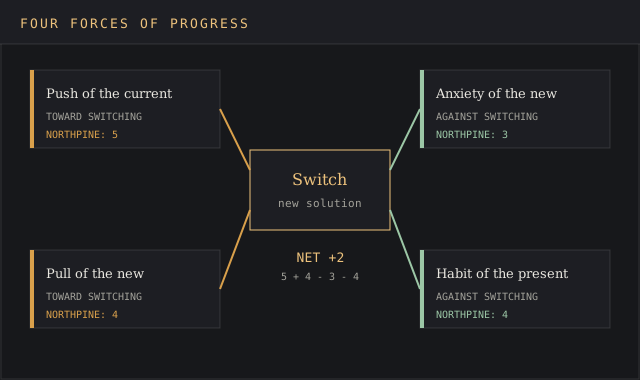
Moesta calls anxiety one of "the hidden forces" in the jobs to be done framework. The forces tab scores all four from 1 to 5 and subtracts the two resisting forces from the two driving ones, so a weak spot shows up as a number. Customers switch products when the new solution looks attractive and the current option is unsatisfying; the net score says which side is winning today.
How to run a jobs to be done interview
The switch interview, in Moesta's description, "walks a customer back through the story of an actual switch." The page lays out the timeline from first thought, through passive looking and active looking, to the decision and first use. That's the shape of the timeline tab.
- Recruit recent switchers. Customers who bought or cancelled in the last 90 days remember the details; customers who bought two years ago remember the story they've told since. Lost deals count too; a win-loss analysis covers the same ground from the vendor's side.
- Start at first thought. Ask what happened the day they first thought the current way wasn't good enough.
- Walk forward, slowly. Passive looking, active looking, deciding, first use. Ask what they did on each date, and write down the answer word for word.
- Record every force as a quote. Straight from the horse's mouth beats a paraphrase; the forces tab has a quote column for that reason.
- List the outcomes at the end. For each job step, ask customers how they'd know the job done at that step went well. Each answer becomes a desired outcome statement.
Finding the switch moment in a generic satisfaction survey is a needle in a haystack, and the timeline interview goes straight to it.
Twelve to twenty interviews usually surface the job map. The scoring needs more customers: Strategyn says its ODI surveys run to "typically 180 to 3,000 respondents," and a single market typically contains 50 to 150 measurable desired outcomes. The template holds eight, which is enough for a first pass on one job and small enough to read on one screen.
The job map and desired outcomes
In jobs to be done theory, a job map breaks the entire job into the steps the job executor goes through, in order, with no product in the picture. Strategyn's map has eight universal steps: define, locate, prepare, confirm, execute, monitor, modify and conclude. It also says the average job has 10 to 20 steps, so a step on the map often holds two or three of the customer's own actions.
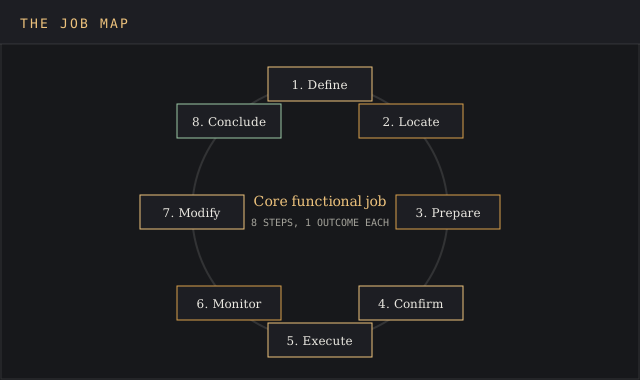
This is the stage where outcome driven innovation earns its name. Each step gets one or more desired outcomes, and each desired outcome gets two ratings from customers. A complete set of need statements, Strategyn claims, can be developed "in days" with its ODI process. That's Strategyn's own figure for its paid process; the template is the do-it-yourself version of the innovation process, so budget weeks.
The opportunity score
The opportunity score ranks desired outcomes by how important they are to customers and how badly existing solutions serve them. The formula, from the outcome-driven innovation entry describing Ulwick's opportunity algorithm, is importance + max(importance - satisfaction, 0), with both inputs rated 1 to 10. It lets a team zero in on the two or three outcomes worth a release.
Because of the MAX term, satisfaction above importance never drags the score below the importance figure. An outcome rated 9 for importance and 3 for satisfaction scores 15. One rated 9 and 9 scores 9. One rated 3 and 7 scores 3, and that's the overserved corner where established companies keep adding features nobody asked for.
| Opportunity score | Template status label | What to do |
|---|---|---|
| 12 or higher | Top priority | Build against it first |
| 10 to 11.9 | Underserved | Next in line |
| Under 10, satisfaction at or below importance | Served | Keep an eye on it |
| Under 10, satisfaction above importance | Overserved | Cut cost or features here |
The 12 and 10 cutoffs are this template's own bands, set so a 1-to-10 survey splits into four readable groups; change them in one cell if your data clusters differently. Ulwick's 2002 Harvard Business Review article "Turn Customer Input into Innovation" introduced the method to a wide audience, per the same entry.
How to fill in the template, step by step
- Write the job statement. Verb, object, clarifier on the Job Statement tab. Add the emotional and social jobs, the buyer, the support team and any related jobs.
- Run the switch interviews. Fill the Switch Timeline tab, one row per stage, with dates and quotes. It reads like a customer journey map for a single purchase.
- Score the forces. Rate push, pull, anxiety and habit from 1 to 5 on the Forces tab. The net score fills itself.
- Map the job. Put the customer's actions under the eight steps on the Job Map & Outcomes tab.
- Write one desired outcome per step. Minimize or increase, a metric, an object, a clarifier.
- Survey for ratings. Ask customers who do the job to rate each outcome's importance and current satisfaction from 1 to 10, and paste the averages in.
- Sort by opportunity score. The status column labels each row; the top two or three rows are the product strategy brief.
Step six is where most teams cut corners. Ratings typed in by the product team measure the team's opinion of customers, and the score inherits that bias.
Worked example: a competitive briefing job at Northpine
Northpine is a fictional 140-person company built for this jobs to be done example. It sells a competitor-tracking tool to product marketing managers and wants to know which part of their quarterly briefing job to improve next. It ran 12 switch interviews, wrote one outcome per job-map step, then surveyed 210 product marketers, its customers and prospects, for ratings.
Core functional job: prepare a competitive briefing for the sales team before each quarterly kickoff. The core functional job sits with the product marketer. The emotional job is to walk into kickoff confident the numbers hold up; the social job is to be seen by sales as the person whose competitor battlecards win deals. The buyer is the vice president of marketing.
| Job step | Desired outcome | Importance | Satisfaction | Opportunity | Status |
|---|---|---|---|---|---|
| Define | Minimize the time it takes to decide which competitors the briefing covers | 7.2 | 6.1 | 8.3 | Served |
| Locate | Minimize the time it takes to find a competitor's current pricing | 9.1 | 3.4 | 14.8 | Top priority |
| Prepare | Minimize the likelihood of mixing figures from different dates in one comparison | 8.4 | 4.0 | 12.8 | Top priority |
| Confirm | Minimize the time it takes to confirm a claim with the product team | 6.8 | 5.9 | 7.7 | Served |
| Execute | Minimize the time it takes to turn findings into a one-page battlecard | 8.0 | 5.5 | 10.5 | Underserved |
| Monitor | Minimize the likelihood of missing a competitor price change after the briefing ships | 8.7 | 2.9 | 14.5 | Top priority |
| Modify | Minimize the time it takes to update a battlecard after a competitor launch | 7.9 | 4.8 | 11.0 | Underserved |
| Conclude | Minimize the time it takes to archive last quarter's briefing | 3.1 | 6.5 | 3.1 | Overserved |
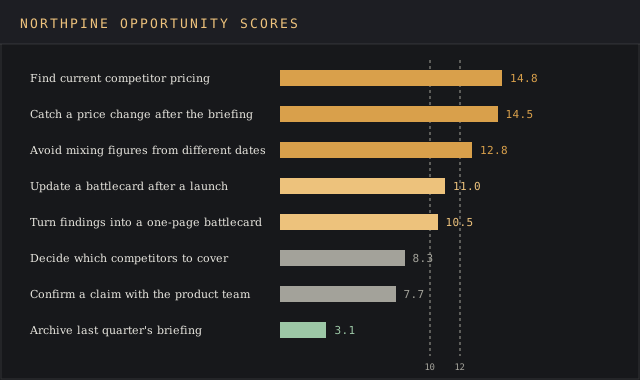
Three outcomes clear 12, and two of them (find current pricing, catch price changes after the briefing ships) are the same unmet need seen at two steps. Northpine's existing products already handle archiving well for customers, and the 3.1 says to stop spending there. The forces tab explains why buyers hesitate: push 5 ("rebuilt the pricing tab by hand three quarters in a row"), pull 4, anxiety 3 ("sales might distrust scraped figures"), habit 4, for a net of +2.
A net of +2 means the progress forces lead, but only just. The anxiety quote is the red flag: Northpine's next release needs a visible source date on every price, which answers the 12.8 "mixing figures from different dates" outcome and the anxiety in one feature. Without it, every scraped price sends the product marketer back to the drawing board before kickoff.
Real world examples of jobs to be done
Most published jobs to be done framework examples are reconstructions after the fact. These four are the ones with checkable figures behind them.
- Cordis. Ulwick's first major project, in 1992, reworked Cordis's angioplasty balloon line. Strategyn says Cordis's market share rose from 1% to more than 20%.
- Zoom. HBS Online uses Zoom as a job example. The underlying figure, from TechCrunch on 2 June 2020, is 265,400 customers with more than 10 users on their account, a 354% rise, alongside $328.2M in quarterly revenue.
- Netflix and Blockbuster. Blockbuster ran more than 5,000 US stores in the early 2000s for people who wanted new releases on the way home. Netflix's DVD-by-mail served a different job: discover films that fit your taste, on your schedule, with no late fees.
- Nike Cortez. Bill Bowerman designed it in the mid-1960s with a soft sponge midsole to absorb road shock for distance runners, per HBS Online citing Nike.
HBS Online also cites DoorDash's partnerships with more than 310,000 restaurants, from a Statista figure. The Christensen Institute's condo case is the cleanest B2C one: developers who reframed their product as moving a life added two years of storage and moving help, raised prices by $3,500, and grew 25% in 2007 while industry sales fell 49%.
Why product teams use the jobs to be done framework
The jobs to be done framework gives product teams a common understanding of customer needs that survives a change of product, owner or market. Personas and feature requests from customers drift every quarter; the job statement written for customers in 2026 still describes what they're trying to accomplish in 2030.
JTBD focuses decision making on unmet needs. A backlog of 140 feature requests turns into eight scored outcomes, and the team can say why item three beats item four. Strategyn pitches its ODI process as bringing predictability to innovation, and it cites "an independently verified 86% success rate" against an industry average of roughly 17%. That's the vendor's own figure for its paid engagements, so treat it as Strategyn's claim about Strategyn.
- Customer insights that hold. Desired outcomes are worded by customers and measured by customers, so the customer insights don't depend on which researcher ran the interview.
- Value creation you can locate. The opportunity score shows where customer value is missing, step by step, which is where a deep understanding of the job pays off.
- Hidden segments. Splitting survey results by customer jobs and customer group shows potential customers whose unmet needs differ from the average, a group a demographic customer segmentation template would never surface.
- A shared brief for marketing. The same job statement feeds the marketing strategy, the positioning statement and the customer experience team, so pain points are named once and used everywhere.
The cost is time. To deeply understand the underlying process of a job, teams need interviews and a survey before they develop products, and user research budgets rarely cover both. Bringing predictability to product innovation takes weeks of fieldwork per job. User needs written as outcomes also read dry next to a feature demo, and someone has to defend those customer needs in the roadmap meeting.
Common mistakes with jobs to be done
- Writing the product into the job. The most common jobs to be done error. "Use our dashboard to track competitors" is a feature request. Strip the product out until the statement would have made sense ten years ago.
- Scoring outcomes from the team's own guesses. The score is only as good as the customer data behind it, and customer needs guessed in a meeting room aren't customer data. Fifteen internal votes miss the mark every time a real survey disagrees.
- Treating jobs to be done as a persona. A persona describes specific characteristics of a person. A job describes the progress they want. Pair them; a user persona template answers who, the job answers why.
- Skipping anxiety and habit. Teams build pull and wonder why the trial-to-paid rate stalls. The forces tab makes the resisting side a number.
- Mapping too many jobs at once. One main job per workbook. Different jobs (onboarding a new rep, say) get their own copy, because customers judge each of those jobs and services by different measures.
- Stopping at the insight. A ranked list of jobs and outcomes that never reaches the roadmap is a research report. Put the top three outcomes into the product development process as acceptance criteria, so the development process tests against customer needs.
Excel, Google Sheets or a dedicated tool?
For jobs to be done work a spreadsheet handles one job, eight to 30 outcomes and a few hundred survey responses without strain. Excel and Google Sheets both run the MAX formula for jobs that size, sort by the opportunity column and chart it.
Past roughly 50 outcomes, several jobs and several customer segments, a dedicated platform starts to pay for itself. Strategyn sells ODIpro for outcome driven innovation ODI at that scale, and survey tools handle the 180-plus responses the scoring needs. For a first pass on one job, the workbook is enough, and product teams get on the same page in an afternoon. A new product manager gets up to speed on the job from one tab.
FAQ
What are examples of jobs to be done?
The faster horse customers ask for is a solution; the job is getting somewhere sooner. Other jobs: the milkshake bought for a long, boring morning commute; the hole behind the drill; Cordis's angioplasty balloons, where Strategyn says share rose from 1% to more than 20%. In B2B, preparing a competitive briefing for the sales team before each quarterly kickoff is a job; the battlecard tool is one way to do it.
What is the JTBD method?
The JTBD framework runs in six moves. Interview customers who recently switched, write the job as verb, object and clarifier, map it into steps, write measurable desired outcomes for each step, survey customers for importance and satisfaction, and rank outcomes by opportunity score. The template follows that order tab by tab.
What is the meaning of job to be done?
The progress customers are trying to make in a particular circumstance. Customers hire a product when it gets the job done better than the alternatives and fire it when it doesn't, so jobs outlast every product made for them.
What is the purpose of jobs to be done by Clayton Christensen?
Christensen used jobs to be done theory to explain why most new products and services fail: companies build for customer attributes and averages, and customers buy to get a job done in a specific situation. Jobs to be done theory moves the analysis to that situation. His milkshake study showed the same product doing two different jobs at two times of day.
What is the difference between jobs to be done and outcome-driven innovation?
Jobs to be done is the theory; outcome-driven innovation is Tony Ulwick's jobs to be done framework in process form, named in 1999. The ODI process adds the job map, desired outcome statements and the opportunity score.
Bottom line
Reach for this jobs to be done template when product teams argue about features and nobody can say which customer needs each one serves. Writing the job statement settles the argument about scope; the opportunity score settles the argument about order.
The jobs to be done template won't size a market or tell you who the customers are. Those questions belong to a market sizing template and an ideal customer profile template, and the job map is the step that tells you what to build for them once you know.