One Page Business Plan Template
 By Jan Suski. I go deep on every review, checking every number against its source and digging up details other coverage misses, a habit from six years of SEO and link building for tech companies. Bylines at Brand24 and Senuto. How the scoring works.
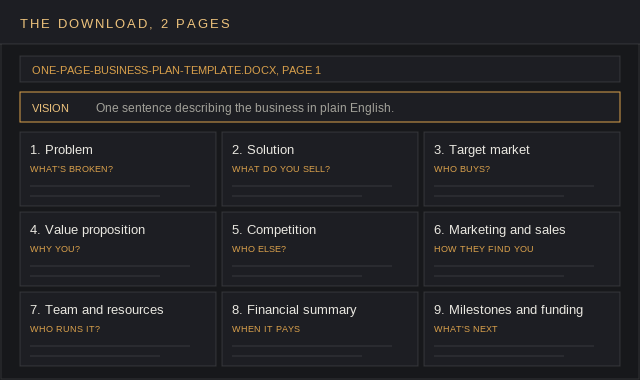
Get the one page business plan template
A Word document with a blank one-page plan of nine boxes, each carrying the question it answers, and a second page showing the same plan filled in for a restaurant bookkeeping startup.
Download DOCXA one page business plan template is a single sheet that holds the whole business on one page: the problem you solve, who buys, why they pick you over competitors, how you reach them, who runs it, and the numbers that say when it pays for itself. It's the short form of a business plan, built to be read in two minutes.
This page gives you a free one page business plan template in Word, then covers how the format compares with a traditional business plan, what each of the nine sections should hold, how to write one step by step, a one page business plan example for a bookkeeping startup with its break-even math worked out, the common mistakes, and which tools to write it in.
The template is designed for entrepreneurs testing an idea, small business owners who need a plan they'll update every quarter, and founders preparing a first conversation with investors or a bank. Team leads use the same page to pitch a new service line inside a larger company.
Writing it down pays. Francis Greene and Christian Hopp tracked US entrepreneurs and found that those who wrote a formal plan were 16% more likely to achieve viability than otherwise identical founders who didn't, per the University of Edinburgh Business School. A one-page version gets those ideas on paper in an afternoon.
Download the free one page business plan template
Download the one page business plan template (DOCX)Two pages: a blank one-page plan with nine boxes and a prompt in each, and the same plan filled in for Ledgerline, the worked example below.
This one page business plan template ships as a two-page Word file. Page one is the blank plan. Each box carries a grey italic prompt that tells you what to enter, and you type your answer over it. Page two is the Ledgerline example, so you can read a finished plan before starting your own.
The file opens in Microsoft Word, Google Docs, LibreOffice Writer and Apple Pages. The layout is a single table, so you can modify box sizes by dragging a border, and the page prints on US Letter or A4.
What a one page business plan is
A one page business plan distills a business strategy into a single, scannable page. It keeps the key aspects of a full plan in one place, the market, the offer, the team and the money, and drops the supporting depth: the long market research write-up, the five-year projections, the appendices.
The U.S. Small Business Administration calls this format a lean startup plan. Its business plan guide says a lean plan is typically one page, can take as little as one hour to make, and suits owners who need to start quickly, run a simple business or expect to revise the plan often.
Writing on the Edinburgh school's site, Greene said an effective plan has to cover the opportunity, the customers, the reason competitors should worry, and how the company operates and earns money. Those four items fit on one page, and the template's nine boxes split them into answerable parts.
One page business plan vs traditional business plan
Two formats appear in the Small Business Administration's guide, and they differ in depth and audience.
| One page (lean) plan | Traditional business plan | |
|---|---|---|
| Length | Typically one page | Can run dozens of pages |
| Time to write | As little as one hour, per the SBA | Weeks, with research and projections |
| Sections | Eight to nine blocks | Executive summary, company description, market analysis, organization and management, service or product line, marketing and sales, funding request, financial projections |
| Read by | Founders, partners, a first investor meeting | Lenders and investors, who commonly request it |
| Update cycle | Monthly or quarterly | Yearly, or for a funding round |
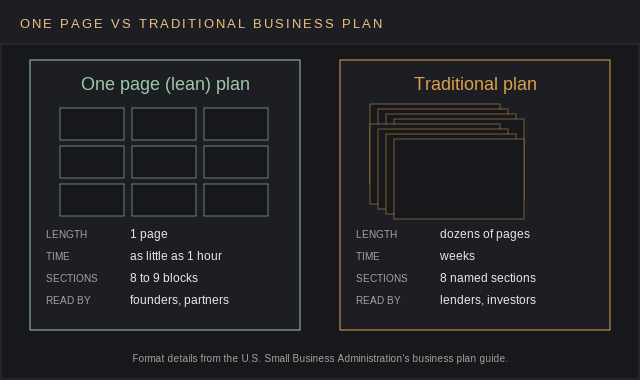
Some lenders and investors still ask for more information after reading a lean plan, the SBA notes. Funding requests submitted to a bank need financial projections in depth, and that's when you expand the one page into the full document. The one page becomes the executive summary of the long version, so the work carries over.
For examples, the SBA publishes a lean plan for Andrew's toy company next to traditional plans for the same toy company and for Rebecca's consulting firm. Reading the pair side by side shows what the long form adds.
What a one page business plan should include
The template has a vision line across the top and nine boxes below it. Each box answers one question, and the answer should fit in three to five lines.
| Section | What goes in it | The question it answers |
|---|---|---|
| 1. Problem | The specific pain points your target customers have today, and what they do about them now | What's broken? |
| 2. Solution | Your products and services, their pricing and distribution, and how each one fixes a named problem | What do you sell? |
| 3. Target market | Customer segments by demographics or firmographics, plus market size | Who buys, and how many of them exist? |
| 4. Value proposition | One sentence on what makes the business different from competitors | Why you? |
| 5. Competition | Direct and indirect competitors, their pricing, and your unfair advantage | Who else could they pick? |
| 6. Marketing and sales | Channels to reach and acquire customers, and the cost to acquire one | How do they find you? |
| 7. Team and resources | Who does what, critical roles still to fill, key partners | Who runs it? |
| 8. Financial summary | Pricing model, revenue streams, startup costs, monthly costs, break-even point | When does it pay for itself? |
| 9. Milestones and funding | Targets for the next 12 months, the next action, key metrics, and the funding ask | What happens next, and what does it cost? |
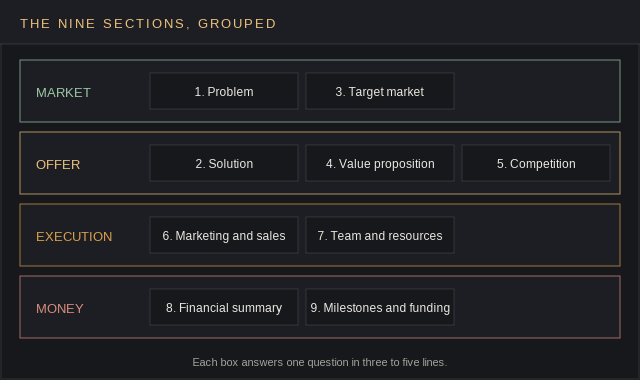
The vision line on top is one sentence describing the business in plain English, the way you'd say it to someone at a dinner table. The company description from a traditional plan, its mission, values and goals, gets compressed into that line and the milestones box.
If the boxes look familiar, the SBA's lean plan uses the nine blocks of the business model canvas, and the business model canvas template covers that layout. This template keeps the canvas's market and offer boxes and adds the parts a plan needs and a canvas leaves out: a competition box, dated milestones, a break-even point and a funding ask.
How to write a one page business plan, step by step
- Write the problem first. Name the customer and the pain point in their words. Talk to five to ten of them before writing, and you'll discover which pain they pay to fix. Every other box depends on this one.
- Size the target market. Count the buyers you can reach, from a licence list, an industry directory or a trade association. The total addressable market template walks through the arithmetic.
- Describe the solution and the price. List your products and offerings and what each costs the customer. Pricing goes here and again in the financial box.
- Map the competition. List two or three direct competitors with their prices, and the indirect option the customer uses today, which is often a spreadsheet or doing nothing. A competitive analysis template holds the longer version.
- Write the value proposition last of the market boxes. With the competitors on the page, the difference is easier to state in one sentence.
- Choose two or three marketing and sales channels. Give each a monthly budget, so customer acquisition cost becomes a number.
- Do the financial math. Price minus variable cost per customer gives the contribution. Fixed monthly costs divided by that contribution gives the number of customers you need to break even.
- Set dated milestones and the funding ask. Four quarterly targets and the metrics you'll review against them.
- Review it monthly. Treat the plan as a living document. Within a few days of month end, replace estimates with actuals, then create a dated copy so you can compare versions.
Steps 1 to 5 are market research and business strategy, and steps 6 to 8 are the financial plan. The quick way through is to fill every box roughly in one sitting, then highlight the weakest one and revisit it. The devil's in the details, and the financial box is where a rough number hides most easily.
Download the one page business plan template (DOCX)
One page business plan example: a restaurant bookkeeping startup
Ledgerline is a fictional two-founder startup that keeps the books for independent restaurants in one mid-size US county. The template's second page carries this plan, box for box. Every figure below is part of the example, picked to show how the boxes connect.
- Vision. Weekly bookkeeping for independent restaurants, with food and labor cost percentages in the owner's inbox every Monday.
- Problem. Owners close their books three to six weeks after month end, so they learn food cost went over budget a month too late. Tip reporting and sales tax filings eat their Sunday nights.
- Solution. A weekly close, a Monday cost report, payroll with tip pooling, and sales tax filing, for a flat $450 a month.
- Target market. The county licence list shows 1,200 independent restaurants. The year-one goal is 40 clients, 3.3% of that list.
- Value proposition. Your food and labor cost percentages every Monday, for a flat monthly fee.
- Competition. Two regional accounting firms charge from $800 a month and close monthly. National online bookkeeping services close monthly and use a generic chart of accounts. The indirect competitor is the owner's own spreadsheet. Ledgerline's unfair advantage is a co-founder with eight years running a restaurant group's back office.
- Marketing and sales. Restaurant association meetups, referral fees to point-of-sale resellers, and a free food cost calculator on the website. Budget: $1,000 a month, with a target acquisition cost under $300 per client.
- Team. One co-founder handles bookkeeping and client management, the other is a CPA who signs off on tax filings. A contract payroll specialist covers peak weeks.
- Financial summary. $450 price, $90 variable cost per client, $360 contribution. Fixed costs $9,500 a month. Startup costs $18,000. Break-even at 27 clients.
- Milestones and funding. 10 clients by month 3, 20 by month 6, 27 by month 9, 40 by month 12. Monthly churn under 2%. Funding ask: a $30,000 loan.
Put in plain English, the plan says the business needs 27 restaurants to cover its costs and expects to reach that in nine months on a $30,000 loan. Anyone reading it, a bank officer or a co-founder's spouse, can check that claim against the numbers in the boxes.
The financial plan on one page
The financial box carries five numbers, and each one feeds the next. Here's the Ledgerline math in order.
| Line | Calculation | Ledgerline |
|---|---|---|
| Price per client | Monthly fee | $450 |
| Variable cost per client | Software seats plus contractor review hours | $90 |
| Contribution per client | Price minus variable cost | $360 |
| Fixed monthly costs | Founder pay $7,000, marketing $1,000, insurance and office $900, software $600 | $9,500 |
| Break-even clients | Fixed costs divided by contribution, rounded up | 27 |
| Startup costs | Equipment and software setup $4,000, website $3,000, legal and licensing $2,000, working capital $9,000 | $18,000 |
| Month-12 revenue | 40 clients at $450 | $18,000 a month |
| Month-12 profit | 40 times $360, minus $9,500 | $4,900 a month |
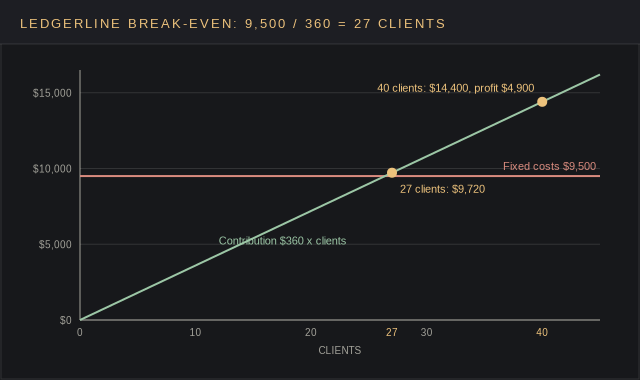
At 26 clients the contribution is $9,360, which leaves the business $140 short each month. At 27 it's $9,720. The break-even calculator runs the same arithmetic with your own figures.
The $30,000 ask covers the $18,000 in startup costs plus $12,000 of runway for the months before client 27 signs. Marketing at $1,000 a month and a target of three to four new clients a month puts acquisition cost between $250 and $333, and one client's $360 contribution pays that back in under a month.
Download the template with the Ledgerline example (DOCX)
Who a one page business plan serves
The one-page format serves four kinds of readers well:
- Founders testing an idea, who want to explore if the numbers close before they spend months on research
- Co-founders and partners who need to agree on the same targets
- Investors at a first meeting, who benefit from a page they can read before they ask for a deck
- Owners of a running small business who review the plan every quarter to stay focused on business growth goals and test new strategies
A plan submitted with a bank loan application, an SBA-backed loan or a large equity round calls for the traditional business plan with three years of financial projections. Start with the one page and expand it when a lender asks, since the boxes map onto the long plan's sections.
Common mistakes in a one page business plan
- A target market of everyone. Small businesses is a category. 1,200 independent restaurants in one county is a market you can count and reach.
- Claims with no number. A line like best service in town gives a reader nothing to check. A price, a turnaround time or a client count gives them three things.
- No competition box. Every customer has an alternative, even if it's a spreadsheet. Leaving the box empty reads as homework skipped.
- Revenue without costs. A financial box with only a revenue target can't show a break-even point, which is the important number for a lender. Enter fixed and variable costs as well.
- Shrinking the font to fit. If the page overflows, cut words. A plan nobody can read at 9 points has the same impact as no plan.
- Writing it once. The plan goes stale within a quarter. Date every version and compare it with the last one.
Download the free one page business plan template (DOCX)
Word, Google Docs or a business plan tool
The business plan template provided here is a Word document because a one-page plan is mostly text content in boxes. Word and Google Docs both handle that, and both keep a version history you can review. If you prefer Google Docs, upload the .docx to Drive and open it, and the table layout carries over. Anyone with edit access can then comment on a box.
Business plan software and AI writing tools can draft the text of each box from your notes. The figures, the prices, costs, customer counts and market size, have to come from your own research, and a chatbot will fill a gap with a figure that sounds right. Read every number it writes against a source you can name.
Keep images, charts and logos off the one page. If an investor wants a chart, the break-even graph goes on page two or in the deck.
FAQ
What should a one page business plan include?
The problem, the solution, the target market, the value proposition, the competition, the marketing and sales channels, the team, a financial summary with a break-even point, and milestones with the funding ask. This template gives each its own box under a one-sentence vision line.
How to write a lean business plan?
Fill each box in a few lines, starting with the problem and the target market and finishing with the financial summary. The SBA's lean plan format uses nine blocks and says the first draft can take as little as an hour.
What is lean business planning?
Lean business planning keeps the plan short, often one page, and updates it as real results come in. The SBA recommends the lean format for owners who expect to revise the plan often.
How many pages is an average business plan?
The SBA says a traditional business plan can run dozens of pages, and a lean plan is typically one page. The traditional format adds full market research, an organization section and multi-year financial projections.
What are the main parts of a business plan?
The SBA's guide names eight sections for a traditional plan: executive summary, company description, market analysis, organization and management, service or product line, marketing and sales, funding request, and financial projections.
Can ChatGPT write a business plan?
It can draft the wording of each section from notes you give it. The prices, costs and market figures still have to come from your own research, and every number it produces needs checking against a source.
Where can I find one page business plan examples?
Page two of this template is a filled-in example for a restaurant bookkeeping startup, with the break-even math worked out. The SBA's business plan guide also links sample plans, including a lean plan for a toy company.
Is there a business plan template in Word?
Yes. The one page business plan template on this page is a Word .docx file with the blank plan on page one and a filled-in example on page two, free to download with no sign-up.
Bottom line
Use this template when you need a plan you can write in an afternoon, read in two minutes and update every month. It forces the five numbers that decide if a small business works, price, variable cost, fixed cost, break-even and funding, onto the same page as the customer and the competition.
When a lender asks for the full document, expand each box into the matching traditional section and add three years of projections. For bigger strategies, such as which market to enter next, a SWOT analysis template or a go-to-market plan covers ground the one page leaves to them.