Source to pay software: top 10 S2P platforms ranked for 2026
 By Jan Suski. I go deep on every review, checking every number against its source and digging up details other coverage misses, a habit from six years of SEO and link building for tech companies. Bylines at Surfer, Brand24, and Senuto. How the scoring works.
· Prefer this source on Google
Quick comparison of the 10 source to pay platforms
Ten platforms in ranked order, with how many of the six S2P stages each vendor’s own product page lists as a module, the entry price a buyer can check before a demo, and the buyer each fits.
| # | Provider | S2P stages listed | Entry price | Best fit |
|---|---|---|---|---|
| 1 | Coupa | 6 of 6 | $95,000/yr Vendr median* | Mid-market and enterprise buyers on any ERP |
| 2 | SAP Ariba | 6 of 6 | $61,513/yr Vendr median* | Companies already running SAP ERP |
| 3 | Ivalua | 6 of 6 | Quote only | Teams that want to configure their own workflows |
| 4 | JAGGAER | 6 of 6 | Quote only | Universities, research and direct-materials buyers |
| 5 | Zip | 5 of 6 | $88,000/yr Vendr median* | Tech companies fixing intake first |
| 6 | Esker | 5 of 6 | Quote only | AP-led teams adding sourcing later |
| 7 | GEP SMART | 5 of 6 | Quote only | Global enterprises buying software plus managed services |
| 8 | Zycus | 5 of 6 | Quote only | Sourcing-heavy teams on SAP, Oracle or NetSuite |
| 9 | Workday | 4 of 6 | Quote only | Workday Financials customers |
| 10 | Oracle Procurement | 3 of 6 | Quote only | Oracle Fusion Cloud ERP customers |
* Vendr’s anonymised buyer data, median annual contract value. Stage counts and every other figure come from the vendor’s own pages or its G2 listing.
Where these figures come from
Stage counts come from each vendor’s own S2P or procurement product page, linked from its entry below and read in October 2026. Ratings and review counts are G2’s. Medians marked * are Vendr’s anonymised buyer-reported contract values. Ivalua, JAGGAER, Esker, GEP, Zycus, Workday and Oracle print no price and carry no public S2P median on Vendr, so their rows read Quote only.
Two sibling rankings score the same vendors on narrower jobs. Indirect procurement software ranks Coupa, JAGGAER, Zycus, SAP Ariba and Ivalua on non-production spend, and procurement orchestration software ranks Zip, Coupa, SAP Ariba Intake Management and Ivalua on intake-to-procure.
Source to pay software runs a purchase from the first spend report to the last supplier payment inside one system. IBM's guide to source-to-pay (S2P) splits the source-to-pay process into six steps: cost analysis, supplier sourcing, contract management, procurement execution, receiving and invoice management, and payment processing.
This ranking scores ten source-to-pay platforms on four tests a buyer can rerun: how many of those six steps each vendor's own product page lists as a module, how much anonymised price data exists, how deep the review base is, and which ERP connections are documented.
It's written for procurement teams and finance leads with a shortlist of three and a supplier base spread across business units. If your team buys from a single department, read the P2P comparison section before you book a demo.
The timing matters for a plain reason. Esker's source-to-pay page cites a 2026 Gartner Magic Quadrant for Source-to-Pay Suites, and every vendor here now sells AI agents on top of its suite. Those agents read the same supplier data and contract records the older modules created, so the data model underneath decides what the agents can do. Organizations seeking agents should check the modules first.
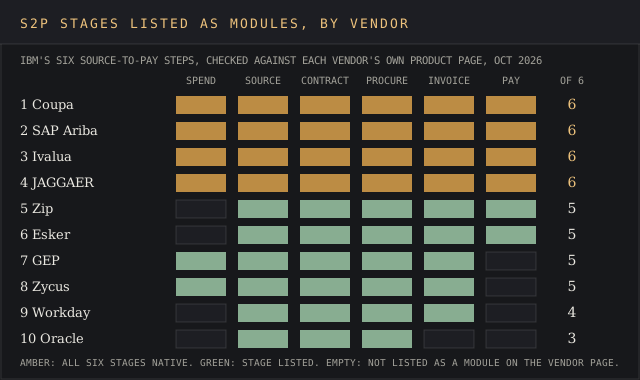
Evaluation criteria for source to pay software
Four criteria decide the shortlist of source to pay solutions, and the ranking below applies them in this order. Criterion one sorts the tools into groups; criteria two and three order the tools inside each group; criterion four separates near ties.
1. Stage coverage across the source to pay lifecycle
Count how many of IBM's six steps appear as a named module on the vendor's own S2P or procurement product page. A suite that lists all six keeps spend analysis, sourcing, contracts, purchasing, invoices and payments on one data model. A suite at four sends at least two steps to another system, and somebody pays for that integration.
2. Third-party price evidence
Look up the vendor on Vendr's marketplace and record the median annual contract and the number of purchases behind it. None of the ten publishes a rate card. A median built on 127 tracked purchases tells a buyer what a negotiation lands on. Quote-only vendors put a number on paper at the proposal stage, and comparing quotes with no benchmark is a wild goose chase.
3. Review base on G2
Record the G2 review count and star rating for the S2P product listing. Count matters more than stars here: SAP Ariba's 4.1 rests on 799 reviews, Zycus's 3.6 on 13.
4. Documented ERP connection
Check which ERP systems the vendor names, or how many prebuilt connectors it claims. JAGGAER claims 1,000-plus connectors and Zycus names three ERPs; an invoice that can't post to the general ledger without middleware means a second integration project and a second invoice.
The 10 best source to pay software platforms in 2026
Coupa
Best fit
A procurement organization of 1,000-plus employees on a non-SAP ERP that wants all six stages from one vendor.
Coupa sells the widest module list of the ten. Its products page lists Spend Analysis, Sourcing, Sourcing Optimization, Contract Lifecycle Management, Supplier Information & Risk Management, Procurement, Invoicing, Payments and expenses, and claims "$10 trillion of real-world spend data from a network of 10M+ buyers and suppliers over 19 years."
Coupa's pitch is to optimize spend across every category on that data. Thoma Bravo completed its acquisition in February 2023, covered in our Coupa review. For a buyer on Oracle or NetSuite, that list is the best of both worlds: six-stage coverage with no SAP ledger attached.
Key features
- Coupa Navi agents, including an Analytics Agent and a Supplier Assistance Agent
- Intake & Orchestration routing requests across procurement, IT and finance teams
- A supplier risk module covering supplier onboarding and supplier risk scores
- Payments, Virtual Cards and Treasury Management on the same platform
- Direct Material Sourcing and Supply Chain Collaboration for PO and forecast data
Pricing
Coupa publishes no rate card. Vendr's anonymised buyer data puts the median contract at $95,000 a year across 127 purchases, with a range of $20,761 to $331,445, last updated February 2026.
Pros
- All six source to pay stages listed as native modules
- The deepest public price evidence of the ten, at 127 Vendr purchases
- 570 G2 reviews at 4.2, the second-largest base here
- Payments and expenses included, so finance teams close the loop on one system
Cons
- The $95,000 median sits above SAP Ariba's $61,513
- Setup friction shows up even in small accounts
- Module count drives the bill, and nothing on the site prices a module
Purchase orders draw the praise. Harish S., an enterprise SME and trainer, wrote on G2 in January 2026 that "Creating a PO is easy from start to finish." The setup complaint comes from a small-business user on the same G2 listing in August 2026: "I spent 30 minutes trying to get it to properly connect."
Why it’s ranked #1. Coupa ties SAP Ariba at six of six stages and wins on criterion two: 127 Vendr purchases against Ariba's 16. A buyer can benchmark a Coupa quote against real contracts before signing.
SAP Ariba
Best fit
A company already running SAP S/4HANA that wants procurement and finance teams on the SAP data model.
SAP Ariba holds the largest review base of any source to pay platform: 799 reviews at 4.1 on G2. Its modules cover spend analysis, sourcing, contracts, buying, invoice management and supplier lifecycle management, and SAP's network page says standard supplier accounts can exchange "an unlimited number of documents such as purchase orders and invoices." Our SAP Ariba review page carries the rest.
Key features
- SAP Business Network, formerly Ariba Network, for supplier collaboration
- SAP Ariba Sourcing and SAP Ariba Contracts for strategic sourcing
- Invoice approval that posts straight into SAP financial systems
- Supplier lifecycle and performance modules
- SAP Taulia for early payment and supply chain finance, the payment stage
- Joule, SAP's AI assistant, across SAP Business AI
Pricing
Vendr's anonymised buyer data puts the SAP Ariba median at $61,513 a year across 16 purchases, range $15,531 to $371,134.

Pros
- 799 G2 reviews, the deepest base of the ten
- Native posting into SAP ERP removes middleware cost
- Lowest Vendr median of the three tools with buyer data, at $61,513
Cons
- Price evidence rests on 16 purchases, against Coupa's 127
- Session limits block parallel browser tabs under one login
- The ERP advantage disappears for a company on Oracle or NetSuite
"The user interface feels dated and imposes a noticeable ‘click tax’ on administrators."
Akansha C., infra managed service analyst, enterprise, G2 review, May 2026
Mirna B., a senior financial specialist, wrote in a September 2026 G2 review that the session limits don't allow "multiple parallel browser tabs under the same login." Darpan S., a digital adoption consultant, countered in March 2026 that "its strong integration with our existing enterprise systems makes the overall transition well worth it." SAP shops bite the bullet on the interface because posting into S/4HANA saves a middleware project.
Why it’s ranked #2. Ariba matches Coupa's six of six and beats Ivalua on criterion two with a $61,513 Vendr median, where Ivalua has none. It loses to Coupa because 16 purchases is a thin benchmark against 127.
Ivalua
Best fit
A procurement team that wants to build its own workflows across direct and indirect spend.
Ivalua's source-to-pay platform page lists Spend Analysis, Sourcing, Contract Management, Supplier Management, eProcurement, AP Automation and Payments, and says it is "Trusted by 500+ Leading Companies." On G2 it holds 4.3 across 116 reviews. Our Ivalua review page is the place to go deeper.
Key features
- IVA, an Intelligent Virtual Agent built in IVA Studio
- AI agents for sourcing events and award decisions
- AI-assisted contract authoring
- Intake Management feeding eProcurement
- AP Automation with AI capture for invoices
Pricing
Quote only. Ivalua prints no price and Vendr shows no public median for it, so budgeting before the sales proposal is a needle in a haystack.
Pros
- Six of six stages on one data model
- 4.3 on G2, the highest rating among the six-stage suites
- Configuration freedom praised by enterprise reviewers
Cons
- Price evidence limited to the vendor's own quote
- Partner-led implementations draw complaints
- Change history on PRs and POs is missing, per a March 2026 reviewer
A mid-market telecom reviewer on G2 in October 2026 wrote: "I like the contract storage and integration with DocuSign, as well as the RFQ capabilities." Gabriele R., an IT process manager, flagged the audit gap in March 2026:
"History data are missing in PR/PO. It should be possible to see which changes are done by whom and when."
Gabriele R., IT process manager, enterprise, G2 review, March 2026
Why it’s ranked #3. Ivalua covers six of six stages and beats JAGGAER on criterion three, 116 G2 reviews at 4.3 against 86 at 4.1. It trails SAP Ariba, which has a $61,513 Vendr median where Ivalua has no public figure.
JAGGAER
Best fit
Universities, research institutions and manufacturers whose procurement processes run on direct materials and supplier relationships with labs.
JAGGAER publishes more operating figures than any rival here. Its source-to-pay page claims "13M+" suppliers in its network and "1,000+" prebuilt connectors, and puts implementation at "12–16 weeks" for a single source to contract module and "6–9 months" for a full S2P program. The full picture sits in our JAGGAER review.
Key features
- JAGGAER AI (JAI) with Spend Classification AI and PO & Invoice Matching
- Source-to-Contract: Spend Analytics, Category Management, Sourcing, Contract Management
- Research Material Management for lab and university buyers
- Supplier Evaluation, supplier risk and Supplier Onboarding modules
- Accounts Payable Automation with Invoicing and Payments
Pricing
Sales-led and quote only, priced by module, company size and user count.
Pros
- The only vendor here that publishes a deployment timeline
- 1,000-plus connectors for ERP and financial systems
- Catalog buying with contract pricing draws praise
Cons
- 86 G2 reviews, a thinner base than Ivalua's 116
- Implementations can run a year
- Price evidence limited to the vendor's own quote
"The initial setup of Jaggaer was quite difficult and the implementation took a year until the system ran stably."
Phyllis H., enterprise, G2 review, May 2026
John N., a mid-market user, wrote on G2 in May 2026 that "The easy purchasing catalogs with compliant pricing make things smoother." Buyers who need to hit the ground running should price the single-module route, at 12 to 16 weeks, first.
Why it’s ranked #4. JAGGAER covers six of six stages and outranks Zip, which lists five. It trails Ivalua on criterion three, 86 G2 reviews at 4.1 against 116 at 4.3.
Zip
Best fit
A fast-growing tech company whose first problem is intake and approvals.
Zip started as an intake-to-procure tool and has grown toward full source-to-pay (S2P). Its homepage lists Sourcing, AI Contract Orchestration, Procurement, P2P, AP automation and a Global Payments add-on, and claims "$1T" in total spend processed and "$10.5B" in total platform savings. Our Zip review page carries the detail, and Zip also leads our AI procurement software ranking.
Key features
- Intake-to-Procure request forms routed across legal, security and finance teams
- AI Contract Orchestration for supplier contracts
- PO and invoice workflows feeding AP automation
- Global Payments as an add-on
- Purpose-built AI agents across intake and review
Pricing
Vendr's anonymised buyer data puts the median at $88,000 a year across 75 purchases, range $26,586 to $214,750, last updated February 2026.
Pros
- 4.6 on G2 across 139 reviews, the highest rating of the ten
- 75 Vendr purchases of public price evidence
- Finance teams adjust workflows without vendor help
Cons
- Spend analysis left to another tool
- Payments cost extra as an add-on
- Mass coding and split billing are missing
Kate H., a finance manager, wrote on G2 in July 2026: "We can adjust workflows without involving our Zip team." The same month an enterprise broadcast-media reviewer wrote:
"I find the system can be glitchy, and not having mass coding and split billing are issues for our folks."
Verified user, broadcast media, enterprise, G2 review, July 2026
Why it’s ranked #5. Zip lists five of six stages, one short of JAGGAER, and leads the five-stage group on criterion two with 75 Vendr purchases. Esker, below it, has no public median.
Esker
Best fit
An accounts payable team that automated invoice processing first and now wants sourcing and contracts on the same vendor.
Esker's source-to-pay (S2P) page lists seven modules across sourcing, supplier management and payment: Sourcing, Supplier Management, Contract Management, Procurement, Expense Management, Accounts Payable, and Payment & Supply Chain Financing. It cites the 2025 Gartner Magic Quadrant for Accounts Payable Applications, which matches where its 60 G2 reviews at 4.4 come from.
Key features
- Esker Synergy AI across sourcing, contracts, purchasing and invoices
- Accounts Payable automation for invoice approval
- Payment & Supply Chain Financing for early and timely payments
- Travel and expense claims inside the same suite
- Multi-ERP support for business units on different ledgers
Pricing
Quote only, with no public Vendr median. AP teams that already automated invoices can keep an eye on sourcing here without switching vendor.
Pros
- Payment and supply chain financing native, the source to pay automation step most five-stage suites lack
- 4.4 on G2
- Configurable to the buyer's AP process
Cons
- Spend analysis left to another tool
- One invoice, one user at a time
- Price evidence limited to the vendor's own quote
Amanda H., a finance shared services manager, wrote on G2 in September 2026 that "Esker has the flexibility to allow us to build the system the way we require it to work best for our business." A mid-market environmental services reviewer in July 2026 hit the limit: "an invoice can only be assigned to one user at a time."
Why it’s ranked #6. Esker lists five of six stages and beats GEP on criterion three, 60 G2 reviews at 4.4 against 27 at 4.3. It loses to Zip, which carries a $88,000 Vendr median where Esker has none.
GEP SMART
Best fit
A global enterprise that wants software and outsourced procurement operations from one firm.
GEP now sells its suite under GEP Quantum Intelligence. Its software page lists Intake & Orchestration, Sourcing, Contract, Supplier, Category and Spend, Procure to Pay, Third-Party Risk, ESG Tracking and Supply Chain Management, and says the platform "supports over 100 enterprise deployments." More sits on our GEP review page.
Key features
- Qi Studio, a low-code builder for custom agents
- A model gateway supporting Azure OpenAI, Google Gemini and Anthropic Claude
- Model Context Protocol support for integration
- Category and Spend module for category management
- Third-Party Risk and ESG Tracking for supplier risk
Pricing
Quote only. No public Vendr median exists.
Pros
- Market intelligence and category management in the same suite
- Claims 60–70% faster deployment of new source-to-pay (S2P) connections, its rapid deployment pitch
- Spend dashboards praised by enterprise users
Cons
- 27 G2 reviews, a thin base
- Payments left to the ERP
- Reporting draws complaints
Reviewers aren't on the same page about reporting. Parv P., an enterprise account manager, praised "The ease of creating dashboards to overlook Spend data" on G2 in September 2024. Bernardo S., a procurement specialist, wrote the opposite a year later, in September 2025: "Reports are not intuitive, dashboards cluttered."
Why it’s ranked #7. GEP lists five of six stages and beats Zycus on criterion three, 27 G2 reviews at 4.3 against 13 at 3.6. Esker, above it, has 60 reviews.
Zycus
Best fit
Procurement teams on SAP, Oracle or NetSuite that run sourcing, supplier management and contracts first and want autonomous negotiation agents.
Zycus's source-to-pay (S2P) page lists eProcurement, eInvoice, Supplier Network, Spend Analysis, eSourcing, Contract Management and Supplier Management, and names SAP, Oracle and NetSuite integrations. Its G2 listing holds 3.6 across 13 reviews. Our Zycus review page is the landing spot for the detail.
Key features
- Merlin Agentic Platform with Merlin Intake and Merlin Autonomous Sourcing
- Autonomous Negotiation Agents
- eInvoice for invoice processing
- AppXtend for custom apps
- Named SAP, Oracle and NetSuite connectors
Pricing
Quote only, with no public Vendr median.
Pros
- Five of six stages, with spend analysis included
- Three ERPs named on the product page
- PR-to-PO-to-invoice automation praised by enterprise users
Cons
- 3.6 on 13 G2 reviews, the weakest base of the ten
- Most G2 reviews date from 2018 to 2022
- Payments left to the ERP
A financial services reviewer on G2 in May 2018 wrote: "No API, the only way to integrate is through flat files, welcome to 1986." An enterprise consumer goods reviewer in January 2019 praised "Automation on PR - PO - Invoice with less manual intervention." Both predate the Merlin agents, so treat them as history.
Why it’s ranked #8. Zycus lists five of six stages and outranks Workday, which lists four. It trails GEP on criterion three, 13 G2 reviews at 3.6 against 27 at 4.3.
Workday
Best fit
A company already on Workday Financials and HCM.
Workday's spend management product page lists Strategic Sourcing, Contract Lifecycle Management, Supplier Management, Procure to Pay, Inventory Management and Travel & Expense, and says the suite "connects sourcing, contracting, purchasing, and payables." On one tenant, procurement and finance teams are all in the same boat. KeyBank, one of its customer stories, reports "$40M" in yearly savings. Workday Strategic Sourcing rates 4.5 across 35 reviews on G2.
Key features
- Workday Strategic Sourcing, built from the Scout RFP acquisition
- Contract Lifecycle Management in the same tenant
- Purchasing that posts into Workday financial records
- VNDLY for contingent labor procurement
- Supplier Management feeding vendor records to finance
Pricing
Quote only; Workday's Vendr listing covers the whole Workday contract, so no S2P-specific median exists.
Pros
- One data model with Workday HCM and Financials
- 4.5 on G2 for the sourcing product
- Contracts, approvals and documents in one place
Cons
- Four of six stages listed; no spend module named
- Detailed analysis means exporting to Excel
- Value depends on already owning Workday Financials
Destiny D., a lab service specialist, wrote on G2 in January 2026 that "It makes contract life cycle management much easier by keeping documents, approvals, and workflows in one place." Vipul K., a system engineer, wrote the same month that "when you need more detailed insights, you have to export everything to Excel."
Why it’s ranked #9. Workday lists four of six stages and outranks Oracle's three, with a 4.5 G2 rating against Oracle's 4.1. It loses to Zycus, which lists five, including a spend module.
Oracle Procurement
Best fit
A company running Oracle Fusion Cloud ERP that wants cloud based procurement on the same ledger.
Oracle's procurement page lists Sourcing, Contracts, Purchasing, Self-Service Procurement, Supplier Management and Environmental Sustainability, plus three AI agents: Sourcing Command Center, Procurement Policy Advisor and Quote to Purchase Requisition Assistant. Payables lives in Oracle Fusion Financials. The G2 listing holds 4.1 across 38 reviews.
Key features
- Sourcing Command Center agent
- Procurement Policy Advisor agent for compliance
- Self-Service Procurement with delivery receipts
- Supplier Management with supplier qualification
- Oracle AI Agent Studio for building custom agents
Pricing
Quote only, sold as part of Oracle Fusion Cloud ERP.
Pros
- Native to Oracle financial systems, no middleware
- Three named AI agents on the product page
- 38 G2 reviews, more than Workday's 35
Cons
- Three of six stages on the procurement page
- Accrual accounting in Payables draws complaints
- Most G2 reviews date from 2023 or earlier
An enterprise user wrote on G2 in August 2023: "The UI is outdated and provides limited options." Samantha F., a mid-market user, added in September 2023 that "Use of the Accrual Accounting feature in Payables has been painful."
Why it’s ranked #10. Oracle lists three of six stages on its procurement page, one fewer than Workday's four, and its 38 G2 reviews mostly predate 2024. It makes the list as the default S2P route for the Oracle installed base.
What source to pay solutions do at each stage of the source to pay process
Source to pay solutions cover the entire procurement lifecycle in the six steps IBM lists. The source to pay process below follows that order, and each step maps to one column of the coverage chart above.
Cost analysis and spend analysis
IBM puts cost analysis first. Spend data classifies past purchases by supplier and category across direct and indirect spend, which gives cost control a baseline before the team runs a sourcing event. Ivalua's page promises to "Aggregate and classify 100% of spend."
Supplier sourcing and supplier selection
The sourcing process covers identifying suppliers, running RFQs and e-auctions, then supplier selection. GEP's source-to-pay guide says e-auctions "can save 18 to 40% on costs." Evaluation scores vendors on price, quality and reliability, and supplier onboarding collects tax, bank and compliance documents into the supplier data the rest of the suite reads.
Contract management and contract lifecycle management
Contract management covers the legal protections and compliance requirements written into supplier contracts. IBM's guide says NLP is used to "analyze contract language, flag inconsistencies." Managing contracts inside the same suite lets a PO check its price against the contract before it goes out.
Procurement execution
Procurement execution is the hand-off to purchasing: requisition, approval, PO and delivery receipts. Policy checks here stop unauthorized purchases before they reach a supplier and add operational efficiency to approvals, which is where the compliance controls IBM and GEP describe sit.
Invoice processing and invoice automation
AI now automates invoice matching. JAGGAER names "PO & Invoice Matching" as an AI capability and Ivalua names "AI capture" in AP Automation, so invoice processing moves from keying to exception review.
Payment processing and paying suppliers
Payment processing is the final payment step, and it closes the source to pay cycle. Timely payments produce improved supplier relationships, because supplier relationships run on predictable cash. Early-payment programs like Esker's supply chain financing and SAP Taulia turn paying suppliers into a cash lever.
Supplier management, the S2P form of vendor management, runs alongside all six steps. One supplier record with risk scores, supplier performance data and financial stability checks centralizes what every module reads, which is why Coupa sells supplier information and risk as one module.
Source to pay (S2P) vs procure to pay
Procure to pay covers transactional purchasing from requisition to payment. Esker's explainer says P2P covers "the operational steps that happen after suppliers have already been selected," while source-to-pay "encompasses the full procurement lifecycle." Source to pay adds the source to contract half in front: spend analysis, strategic sourcing and contract lifecycle management.
The difference shows up in the ranking. Zip and Workday started on the P2P side and added sourcing; Zycus and GEP started on sourcing and added P2P. A team whose pain is slow approvals and procurement workflows gets more from a P2P-first tool. A team whose pain is supplier selection, sourcing strategies and contract leakage needs the sourcing half.
SAP sells both: SAP Ariba covers S2P, and P2P runs inside SAP S/4HANA for companies that don't license Ariba's sourcing modules. That answers the common question "Is P2P part of SAP?" with a yes, in two products.
Key benefits of a source-to-pay (S2P) platform, with the numbers checked
The leading providers all publish benefit figures, and most come from vendors, so check the source line before quoting one for informed decisions internally.
GEP's guide says "invoice processing can help save up to 80%" and that S2P "can automate 70% of tasks," with no study or method cited for either. Zip's homepage cites a Forrester Total Economic Impact study with a "70%" cycle time reduction and "386%" ROI. JAGGAER's page claims "60%" faster sourcing cycle times and "32%" cycle-time reduction with AI, drawn from its own value assessments.
IBM's figures carry footnotes. Its guide says AI "resulted in a 28% lower total annual cost to perform procurement processes" and that "59% of respondents" use AI for sourcing governance, both from IBM's 2023 CEO's guide to generative AI for supply chain. It also says "80% of executives expect generative AI to enable better management" of supplier performance, citing an April 2024 IBM Institute for Business Value benchmark.
The cost savings worth modelling, and the strategic value a CFO will sign off on, come from three places: price compliance against contracts, fewer manual invoice touches, and spend moved under management. JAGGAER puts maverick spend realigned to contract at "18%" in its KPI benchmarks; that is the figure to test in a pilot, because it shows up in the ledger. Procurement efficiency claims that can't be traced to a ledger line belong in the appendix.
Source to pay software pricing across the category
Only three of the ten have public buyer data, and Coupa holds the lion's share of it, 127 of the 218 tracked purchases. Vendr puts Coupa at a $95,000 median, Zip at $88,000 and SAP Ariba at $61,513, with Ariba's tracked range running from $15,531 to $371,134. Module count, supplier count and spend volume move the bill inside those ranges.
Implementation adds to it, and only one vendor prints a timeline. JAGGAER's own page puts a single module at 12 to 16 weeks and a full S2P program at 6 to 9 months, which costs an arm and a leg in internal time before the first consultant invoice lands.
Three traps eat into cost savings. Multi-year terms trade a lower rate for less room to leave. Payments and expense modules often sit outside the base bundle. And a sourcing-only first phase pushes supplier onboarding into a later change order, which strains supplier relationships when the invoice module finally arrives.
How to run a source to pay software evaluation
Start with the stage map. Write down which of the six steps your current financial systems handle and which business process owner runs each, then test only the gaps; buying all six from one vendor makes sense when four or more are missing.
Then run a scripted demo of the shortlisted source to pay solutions on your own data and procurement processes. Hand each vendor 50 real invoices, three live supplier contracts and one recent sourcing event, and time how long each takes to match, flag and post. The devil's in the details here: a contract clause that won't map to a PO field shows up on day one of the pilot, and on day 200 of a rollout.
Check the ERP connection last but hardest. Ask for the named connector, the field mapping and one reference customer on your ERP version. Iron out the details of field mapping before signature, while the vendor still wants the deal.
Common source to pay buying mistakes
Buying the suite before fixing intake is the first. If requisitions arrive by email, six modules will process the same mess faster; teams that skip intake end up back to square one a year later.
The second is putting all your eggs in one basket on a suite's weakest module. Score each module separately against your procurement strategy, and keep a specialist open for the weakest stage. The third is ignoring staffing: JAGGAER's own page budgets 6 to 9 months for a full program, and a JAGGAER reviewer describes a year to stability.
Source to pay platforms and AI agents
Every vendor here now names agents: Coupa has Navi, Zycus has Merlin, JAGGAER has JAI, Ivalua has IVA and GEP has Qi Studio. These advanced technologies read what the suite stores, so six stages on one data model give an agent the contract, the PO and the invoice in one query. Our AI procurement software ranking covers the AI-first tools that sit on top of these suites, and the procurement intelligence ranking covers supplier and market data feeds.
Source to pay software FAQ
What is source to pay software?
Source to pay software runs a purchase from the first spend report to the last supplier payment inside one system. IBM splits that cycle into six steps: cost analysis, supplier sourcing, contract management, procurement execution, receiving and invoice management, and payment processing.
What is the difference between source to pay and procure to pay?
Procure to pay covers purchasing from requisition to payment, after suppliers are chosen. Source to pay adds the source to contract half in front of it: spend analysis, strategic sourcing and contract lifecycle management.
Is P2P part of SAP?
Yes, in two products. SAP Ariba covers the full S2P cycle, and P2P runs inside SAP S/4HANA for companies that don’t license Ariba’s sourcing modules.
Which source to pay platforms cover all six stages?
Coupa, SAP Ariba, Ivalua and JAGGAER each list all six as modules on their own product pages. Zip, Esker, GEP and Zycus list five, Workday lists four and Oracle Procurement lists three.
How much does source to pay software cost?
Vendr’s anonymised buyer data puts Coupa at a $95,000 median a year across 127 purchases, Zip at $88,000 across 75 and SAP Ariba at $61,513 across 16. The other seven vendors on this page quote only.
How long does an S2P implementation take?
JAGGAER is the only vendor here that prints a timeline: 12 to 16 weeks for a single source to contract module and 6 to 9 months for a full S2P program. One JAGGAER reviewer on G2 described a year to reach a stable system.
Bottom line
Coupa wins for a mid-market or enterprise buyer on a non-SAP ERP: six of six stages and 127 Vendr purchases to benchmark the quote. SAP Ariba wins for an SAP shop, at a $61,513 median. Ivalua wins for a team that wants to configure everything and can live without a public price.
JAGGAER fits universities and research buyers who value a published 6 to 9 month timeline. Zip fits a tech company whose first fix is intake, and Esker fits an AP-led team. GEP, Zycus, Workday and Oracle make sense mostly for buyers already committed to that vendor's services, agents or ERP.