Dataminr review: what $22,000 to $65,000 a year buys a security team
 By Jan Suski. I go deep on every review, checking every number against its source and digging up details other coverage misses, a habit from six years of SEO and link building for tech companies. Bylines at Brand24 and Senuto. How the scoring works.
Best for
Corporate security, employee safety, crisis and emergency management teams that need the first signal on physical events near their locations and people, and can staff someone to tune alerts.
Not for
Small teams on a monitoring budget, PR teams that need sentiment and share of voice, and buyers who want a price before the first call.
What it costs
Vendr's anonymised buyer data puts the median at $22,000 a year, from $15,000 to $62,500. Dataminr's own AWS Marketplace listing prices one Pulse team at $65,000 for 12 months, non-refundable.
- Public data sources
- 1M+
- Languages read
- 150+
- Countries covered
- 220+
- Proprietary LLMs
- 50+
- Alerts processed
- 2M+ a month
- Historical data
- 12+ years
- Vendr median
- $22,000 a year
- Vendr range
- $15,000 to $62,500
- One Pulse team on AWS
- $65,000 per 12 months
- Refunds
- Fees non-cancellable and non-refundable
- Founded
- 2009, New York, NY
- Layoffs
- 20% of staff, about 150 jobs, November 2023
- Raised in 2025
- $85M round plus $400M convertible debt
- ThreatConnect deal
- $290M, announced October 2025
- Department of War award
- $318M over 5 years, August 2026
- G2
- 4.5 of 5 from 48 reviews
- Capterra
- 5.0 from 2 reviews
- Indeed employer rating
- 3.6 of 5
- Indeed job security
- 2.8 of 5
Not forA physical security team watching protests, storms and incidents near offices, since Recorded Future covers cyber risks deeper than physical ones.
Not forA security desk that needs alerts on storms, protests and incidents near its sites, where Dataminr's sensor signals and 150+ languages reach further.
Where these Dataminr figures come from
Coverage counts come from Dataminr's Pulse listing on AWS Marketplace and its Black Hat 2026 blog post. The $65,000 per Pulse team and the no-refund clause come from the same AWS listing, the only rate card Dataminr publishes.
The $22,000 median and the $15,000 to $62,500 range are Vendr's anonymised buyer data. Ratings come from G2, Capterra and Indeed, checked 21 November 2026.
Dataminr sells every buyer the same product, an alert that lands before the news story does. The New York, NY company, founded in 2009, runs what it calls Multi-Modal Fusion AI across public data in text, images, video, audio and sensor signals, then pushes breaking events and real-time events to corporate security, crisis and newsroom staff as they unfold.
This review covers the four product lines, where the data comes from, what a contract costs, the alert-noise complaints users repeat, company stability after the 2023 layoffs, and the surveillance reporting that follows the brand. It's written for corporate security and risk leads weighing a five- or six-figure risk intelligence contract to track emerging threats and physical risks to their people and locations.
In August 2026 Dataminr won a $318 million, five-year Pentagon contract, and in 2025 it agreed to buy ThreatConnect for $290 million. The product a buyer signs for in 2027 will carry both.
What Dataminr does: First Alert, Pulse, Cyber Defense and News
Dataminr splits one detection engine into four products, each sold to a different department.
- First Alert: public sector and defense. Dataminr says its AI "cuts through the noise of public data to detect breaking events faster than ever before possible." The 2026 upgrade, First Alert Advanced, is sold as Autonomous Real-Time Intelligence.
- Pulse: corporate teams, an AI-powered feed sold as Pulse for Corporate Security, Pulse for Cyber Risk and a Brand Risk team that overlaps with brand intelligence software.
- Dataminr for Cyber Defense: cyber threats, vulnerabilities and exposure management, now joined with ThreatConnect.
- Dataminr for News: used by journalists in over 1,500 newsrooms around the world, launched in 2014 with CNN and Twitter. Newsroom budgets compare against our media monitoring pricing report.
The homepage describes the stack as "Multi-Modal Fusion AI for discovery, Generative AI for description, and Agentic AI for context." In practice that means the system spots an event, writes a short brief on it, then adds context about its business impact for each customer. Buyers zero in on the areas and topics they set, and alerts outside them stay out of the feed.
For a security department, the output is a short list of threats tied to its own locations. Staff can respond while events unfold, and executives can make informed decisions before the story reaches the evening news.
Users point at the generative layer first. An Airlines and Aviation reviewer on G2, syndicated to AWS Marketplace, March 2024, wrote that "The recent addition of AI integration to Pulse provides a quick narrative of most events." A retail reviewer the same month described the gain as time: "the recent addition of AI has saved valuable minutes in crucial situations."
On the cyber side, the pitch is that external data arrives before official disclosures. A World Wide Technology post, written by a Dataminr partner, says Dataminr has surfaced vulnerability signals "up to 38 days before CISA published a disclosure." Treat that as a partner's best case for early signals on cyber threats. The full cyber threat intelligence field, from Recorded Future to OpenCTI, sits on our cyber threat intelligence tools ranking.
Where Dataminr's real-time intelligence data comes from
Dataminr reads public data only. Its Pulse listing on AWS Marketplace gives the inputs: over 1 million publicly available sources, over 150 languages, more than 220 countries, 50 large language models and over 12 years of historical data.
Dataminr calls the output real-time intelligence, and Multi-Modal Fusion AI is its name for reading the inputs together. Each AI-powered alert on real-time events is built from text, images and sensor data, and its role is to cut the time between a first post and a response. The technology reads text in each of those languages before the models score it.
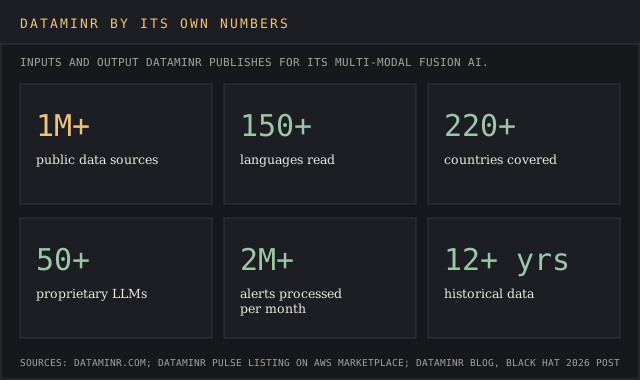
Output is just as large. Dataminr's Black Hat 2026 post says its mid-year threat report drew on 4,500 threat actors tracked, 73,000 vulnerabilities detected and over 2 million alerts processed per month. The same report repeats the Verizon DBIR finding that median time-to-patch stretched from 32 to 43 days in the first half of 2026.
The detection layer is machine learning, and an LLM is a natural language processing model, so the 50+ proprietary LLMs do the reading. Breaking Defense, interviewing CEO Ted Bailey in September 2026, described the inputs as internet content plus "plane and ship transponders" alongside images, video and sound. Bailey called NATO Dataminr's second largest customer, running it inside Palantir's Maven Smart System.
Dataminr sells the alert and the brief. Buyers who want to explore the underlying articles through an API, billed per call, can compare eight vendors in our market intelligence API ranking.
Dataminr pricing and the contract terms
Dataminr sells by quote, and two public records show the range. Vendr's anonymised buyer data puts the median at $22,000 a year, with deals from $15,000 to $62,500, and describes a per-user/seat model with add-ons such as Live Briefs and Company-Specific Alerting.
The vendor's own rate card sits on AWS. Dataminr lists three 12-month Pulse dimensions there at $65,000 each:
- Pulse Team - Corp Risk: "AI-powered event and risk detection for Corporate Security Risk"
- Pulse Team - Brand Risk: "AI-powered event and risk detection for Brand & Reputational Risk"
- Pulse Team - Cyber Risk: "AI-powered event and risk detection for Cyber Risk"
Dataminr's listing also says "All fees are non-cancellable and non-refundable except as required by law." Buying all three teams on that card comes to $195,000 a year.
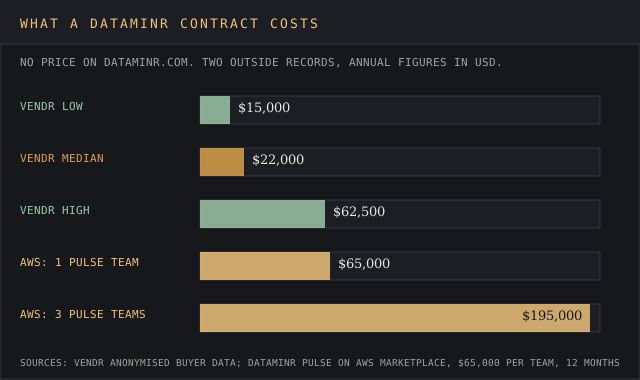
Seat count and module mix explain the gap between $22,000 and $65,000. Money doesn't grow on trees for a two-person security function, and a Capterra reviewer, Director of Security Brian S., April 2020, wrote that "Cost is a little high for the size of my company." A G2 reviewer in February 2026 put it in capitals: "ITS HIGH COST AND COMPLEXITY MAY BE DRAWBACKS FOR SOME USERS."
For a wider view of what risk intelligence costs across vendors, our risk intelligence software ranking lists Vendr medians for eight platforms side by side.
Who uses Dataminr: corporate security, physical security and risk intelligence teams
Dataminr's customer list leans to governments and large corporations. Its homepage counts more than 100 U.S. government agencies, 20+ international governments and two-thirds of the Fortune 50. The risks they buy it for fall into corporate security, crisis management, cyber-physical risk and finance.
Reviewers on G2 come from retail, insurance, aviation, banking and apparel. Their reviews cover emergency management at an airline, flight tracking at a retailer and market risks at an apparel brand. Dataminr's First Alert listing on AWS describes "Real-time geolocation-based threat monitoring across global locations," and the Pulse card splits risks three ways: corporate security, brand and cyber.
Employee safety work happens on phones. The April 2024 retail reviewer wrote that "The App is great as well as it provides me with almost all of the info I need near me." A security lead sees threats near the people and sites on a watch list, and can discover an incident and take action within minutes, when minutes matter.
What users praise: speed and support
Reviewers praise speed most often. G2 shows 4.5 of 5 from 48 reviews, 71% of them five-star on the AWS syndication. A G2 reviewer, Justina S., January 2026, wrote:
"it delivers real-time alerts really fast before it even hits the news"
G2 review, January 2026, via AWS Marketplace
Those minutes are the time a security desk gets to respond before real-time events become headlines.
An operations leader with teams across India, Arnab Kumar C., late 2025, named a competitor: Dataminr is "faster at detecting potential risk situations compared to other products like Feedly." An Apparel and Fashion reviewer, October 2025, wrote that "Dataminr enables us to quickly identify market risks and industry news."
Both run international operations from one screen. Retail and apparel teams watching supplier regions can set that against our supply chain risk management ranking.
Support scores well too. A retail reviewer, April 2024, wrote that "The team that supports our account has been great at helping us customize alerts to cut down on noise." Brian S. on Capterra liked the licensing model: "This is an ideal tool for me because it allows me to monitor multiple sites without site licenses." For a physical security and safety desk guarding many locations, that's the best of both worlds.
Alert noise, setup time and the learning curve
Alert volume draws the most complaints. Arnab Kumar C. followed his praise with "there are too many notifications that need to be filtered out." Justina S. called her review "Real-Time Alerts with a Cluttered Interface" and wrote:
"The interface can feel overwhelming, especially with numerous alerts."
G2 review, January 2026, via AWS Marketplace
Relevance is the second complaint, and on a safety desk watching real-time events it matters most. An Insurance reviewer on G2, May 2022, wrote that "Sometime the alerts are not sorted by relevance or sourced checked." Brian S. warned that "You will see alerts that sound critical with no follow up," so an analyst still has to verify before escalating to executives. A desk that jumps the gun on a safety alert about risks that turn out minor pays for it in credibility.
Tuning takes hours up front, because filtering relevant alerts from the rest needs careful configuration. The April 2024 retail reviewer wrote that "Setting up Dataminr requires some time commitment from the end user to really customize it." A Banking reviewer, May 2022, found "The platform is not very intuitive." That setup work falls on the buyer. Budget a named owner for alert rules, or tuning goes on the back burner and the noise lands on the whole security staff.
Company stability: funding, layoffs and the ThreatConnect deal
Dataminr has raised big money twice in two years. Wikipedia's company record lists $85 million from NightDragon and HSBC in March 2025, then $100 million and $300 million in convertible debt from Fortress and NightDragon in April and September 2025. The lion's share, $400 million of $485 million, is debt.
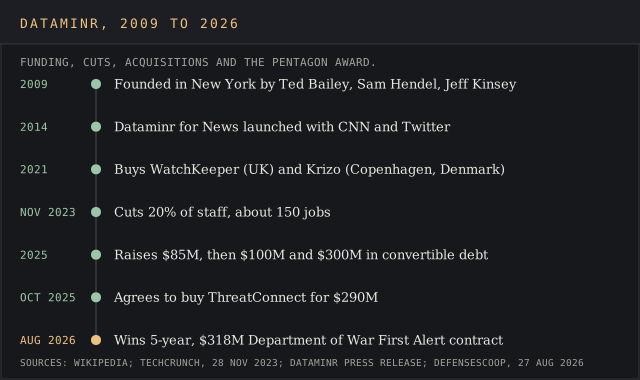
Growth came with cuts, and those cuts are among the risks a multi-year buyer takes on. On 28 November 2023, TechCrunch reported that Dataminr, last valued at $4.1 billion, was laying off 20% of staff, about 150 jobs. Employees on Indeed rate job security and advancement 2.8 of 5. A Sales Associate in New York, January 2024, wrote:
"The biggest issue I ran into was the lack of transparency from leadership on goals and priorities."
Indeed employee review, January 2024
Going public is the burning question employees keep asking. One Glassdoor reviewer wrote that the "CEO makes it a habit of dangling an IPO as a possibility, layoffs every 2-ish year." Dataminr remains private.
The acquisitions point the company at cyber defense. Dataminr's ThreatConnect announcement says the deal fuses "Dataminr's leading AI platform for public data signals with ThreatConnect's deep internal data capabilities."
Dataminr describes the result as "Agentic AI-powered Client-Tailored intelligence" that fuses external data with each client's internal data on threats and vulnerabilities. Its suite now sells as Cyber Defense. Dataminr also bought WatchKeeper in 2021 and Krizo, a crisis response platform in Copenhagen, Denmark, the same year.
The Pentagon deal is the stability signal. DefenseScoop describes it as a contract for "AI-powered situational awareness technology," and reports the award "provides situational awareness, force protection, and indications and warnings on global events," with work running to June 25, 2031. Eight offers were received.
Government use and the surveillance reporting
Dataminr's public data reach has drawn reporting on how police use it. The Intercept reported in July 2020 that police used Dataminr to monitor George Floyd protests. In May 2023 it reported social media surveillance of lawful abortion rights protests for the US Marshals.
The third report is the most specific. From October 2023 to April 2024, per The Intercept in March 2025, Dataminr alerted the LAPD to more than 50 pro-Palestinian demonstrations, a dozen of them before they took place. Twitter's response in 2020, quoted by Gizmodo, was that Dataminr was doing "news alerting." Corporate security buyers with public-facing ESG commitments should read the sourced timeline before signing.
Dataminr alternatives
Three risk intelligence platforms cover the same risks from different directions. Figures below come from each vendor or from Vendr, checked 21 November 2026.
Recorded Future
Recorded Future wins for a threat intelligence unit with budget. Vendr tracks a $72,703 median across 40 purchases, more than three times Dataminr's median, and Mastercard completed its $2.65 billion purchase on 20 December 2024. G2 shows 4.5 from 257 reviews, level with Dataminr.
It covers cyber risks deeper than physical ones, so it loses for a physical security team watching protests, storms and incidents near offices.
Everbridge 360
Everbridge wins when the alert has to trigger a response. Its Visual Command Center pulls risk data "from over 100 different sources," and names Dataminr among its data partners, so a buyer can get Dataminr events inside Everbridge's mass notification workflow and turn physical threats into a staff warning. It loses on raw detection speed, since Dataminr feeds it.
Signal AI
Signal AI wins for reputation and regulatory risks. Its homepage claims 5.5M+ articles a day in 120+ languages and 800+ enterprise customers, and its risk product scans for emerging threats such as regulatory change. G2 shows 4.3 from 217 reviews.
Signal AI loses on physical events, where Dataminr's sensor signals and 150+ languages reach further. Media-led teams can also compare our media monitoring tools ranking.
Dataminr reviews: common questions
Is Dataminr a real company?
Yes. Dataminr was founded in 2009 by Ted Bailey, Sam Hendel and Jeff Kinsey, is headquartered in New York, NY, and lists more than 100 U.S. government agencies among its customers. Capterra shows only two reviews of it, and our Capterra legitimacy report explains how much weight a count that small carries.
How much does Dataminr cost?
Vendr's anonymised data puts the median at $22,000 a year. Dataminr's AWS Marketplace listing prices each Pulse team at $65,000 for 12 months. Our G2 pricing report explains why G2 itself shows no Dataminr price.
Is Dataminr doing well?
By contract size, yes. The $318 million Department of War award runs to 2031, and NATO runs First Alert Advanced. It also cut about 150 jobs in 2023, and our third-party risk management tools ranking shows how vendor stability gets scored.
Is Dataminr a good company to work for?
Employees rate it 3.6 of 5 on Indeed, with work-life balance at 4.1 and job security at 2.8.
Is Dataminr going public?
Dataminr is privately held. Its 2025 funding came as an $85 million round plus $400 million in convertible debt.
Verdict
Dataminr is for corporate security, crisis and emergency management teams at large corporations and government agencies that track physical threats and physical risks to people across many locations. Reviewers clock alerts arriving before the news, the AI briefs save "valuable minutes," and the $318 million Pentagon contract says the defense market agrees. That earns 85 on time to first useful alert and 80 on enterprise fit.
It isn't for a small team on a monitoring budget. The $65,000 per Pulse team on AWS, non-refundable, and a Capterra director calling the cost "a little high for the size of my company" put a 10-person team at 45. Price transparency scores 40 because the only rate card sits on AWS, and contract flexibility scores 30 for the no-refund clause.
It might suit a mid-sized security team that can name one owner for alert tuning. Users repeat "too many notifications," so the learning curve scores 45. The April 2024 retail buyer, who tuned alerts with Dataminr's account team, is the reviewer who reports the noise coming down.