Nasdaq TotalView review: full order book depth for $15 a month, and the Level 2 feed it replaces in 2027
 By Jan Suski. I go deep on every review, checking every number against its source and digging up details other coverage misses, a habit from six years of SEO and link building for tech companies. Bylines at Brand24 and Senuto. How the scoring works.
· Prefer this source on Google
Best for
Active day traders and scalpers in Nasdaq-listed stocks who read the order book before order execution, at $15 a month on the non-professional rate.
Not for
Anyone who needs the whole US stock market in one view. TotalView carries Nasdaq's own order book, and NYSE Arca, NYSE OpenBook and dark pools sit outside it.
What it costs
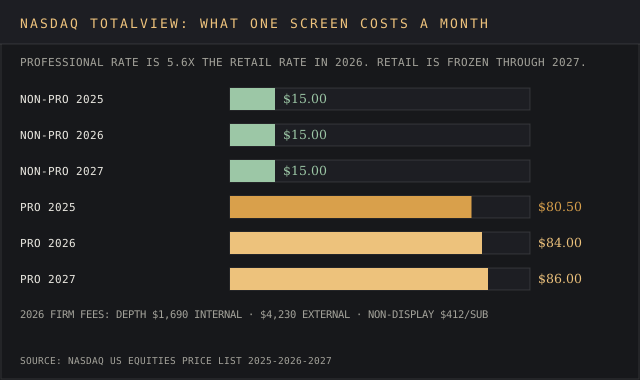
$15 a month non-professional through 2027. Professionals pay $84 a month per screen in 2026 and $86 in 2027, and firms that redistribute depth data add $1,690 to $4,230 a month.
- Book contents
- Every displayed quote and order at every price level
- Securities
- Nasdaq, NYSE, NYSE American and regional listed securities trading on Nasdaq
- Attribution
- Two Add Order message types, with and without MPID
- Auction data
- Net Order Imbalance Indicator for the opening, closing and IPO/Halt crosses
- Hidden orders
- Off the book, reported by a trade message when they execute
- Order type field
- None in the feed, per Nasdaq's ITCH FAQ
- Retiring products
- Nasdaq Level 2 and TotalView Aggregated
- Announced
- 20 July 2026, Data Technical News #2026-14
- Switch-off date
- 2 July 2027
- Replacement
- TotalView 5.0 or TotalView Plus, same licensing cost
- Routes
- Brokers and vendors, Nasdaq Data Link APIs, direct ITCH feed
- History on Data Link
- From April 2014
- Daily ITCH 5.0 file
- 5 to 10 GB compressed, 15 to 25 GB uncompressed
- Depth at Interactive Brokers
- One symbol per 100 quote lines, 3 to 60 symbols
- Non-professional
- $15 a month in 2025, 2026 and 2027
- Professional
- $80.50 (2025), $84 (2026), $86 (2027) a month
- Depth distributor, 2026
- $1,690 internal, $4,230 external, per firm a month
- Non-display, 2026
- $412 per subscriber up to 39, $75,000 flat at 250 or more
Alternatives to Nasdaq TotalView
Databento
Not forA trader who only wants depth on a broker screen, where TotalView costs $15 a month.
Bloomberg Terminal
Not forA trader who only needs the Nasdaq book, at 178 times the retail price.
Pairs well with Nasdaq TotalView
Nasdaq TotalView is the exchange's full depth-of-book data feed. On Nasdaq's own TotalView product page, it displays the full order book depth on Nasdaq, "every single quote and order at every price level" for securities listed on Nasdaq, the New York Stock Exchange, NYSE American and regional exchanges. A retail trader pays $15 a month for access to this real time market data, and a professional pays $84 a month per screen in 2026.
This article covers what the Nasdaq data feed shows, what it leaves out, what it costs at each user classification, the three routes to access it, and the change most coverage hasn't caught up with yet. On 20 July 2026, Nasdaq announced that its Level 2 service retires on 2 July 2027, which puts every Level 2 user in the market on a twelve-month clock and makes 2026 the year to compare depth feeds again.
It's written for serious traders weighing the standard Nasdaq data feed against the market depth their trading platform already shows, for developers wiring order book depth into an app, and for market data managers licensing the feed for clients or a trading desk. Every price links to Nasdaq's price list or a broker's fee table, and every quote to its thread.
↑ FACT SHEETWhat Nasdaq TotalView shows on the order book
Level 1 market data is the best bid, the best offer, the current price and the last sale. Nasdaq Level 2 adds the top price levels by market participant. Nasdaq TotalView data covers every order at every price on the Nasdaq order book, each one tracked from add to cancel or fill as its own message. Our market data pricing report lays out the three levels side by side.
Nasdaq's Data Link listing calls it "the standard Nasdaq data feed for serious traders" and claims "more than 20x the liquidity of Level 2". The product page adds a second liquidity figure, 3X the liquidity within 0.05% of the top of book.
Both come straight from the horse's mouth, so the more than 20 times the liquidity of Level 2 and the 3X figure are Nasdaq's own market numbers. The smaller one is the advantage that matters to day trading at the inside price, since that's where most liquidity changes hands.
MPID attribution and anonymous interest
Nasdaq lists three benefits on Data Link, and the Nasdaq Trader website carries the feed's specifications. A subscriber can view all displayed quotes and orders attributed to specific market participants, access total displayed anonymous interest, and see the total size of all displayed quotes and orders at each price level. Read between the lines and note the word displayed in all three.
The TotalView-ITCH specification carries that split in two message types: Add Order with MPID attribution, and Add Order with no MPID attribution.
Market participant attribution tells a trader which market makers and brokers are showing size, and orders from market participants entered without attribution show up only in the anonymous total, market makers included. Orders attributed to a firm carry its four-letter MPID, and anonymous interest shows up under Nasdaq's own label.
Nasdaq's depth data guide says that detail lets traders follow pockets of liquidity over time and spot shifts in displayed quotes before they reach the trading price, and the start-of-day market participant position message shows which market makers are registered in each issue. Traders who follow pockets of liquidity across a session watch that list change.
For example, take a trader who sees 5,000 shares bid at the current price on a Level 2 screen. Nasdaq TotalView shows that size split across specific market participants and market makers, every order queued behind it, and the sell interest stacked three levels up. A single quote at the top hides that book depth on Nasdaq. The full view lets a scalper access total size and price before trading.
Traders who use it say the difference shows up the first time they compare trading screens. A NexusFi member posting as Neo1, a US equities trader on Interactive Brokers, wrote on 28 February 2017:
"IB is the only provider currently supported by Bookmap that offers level 2 data worth looking at, they report the consolidated book from each exchange/ ECN( NASDAQ TotalView, NYSE OpenBook + data from some other exchanges eg BATs, BEX etc)"
Neo1, NexusFi Bookmap thread, 28 February 2017.
The Net Order Imbalance Indicator and the crosses
Nasdaq TotalView also disseminates the net order imbalance indicator for the Nasdaq opening cross, the closing crosses and the IPO/Halt cross. The NOII message carries paired shares, imbalance shares and a reference price, so a trader sees buy and sell interest that hasn't matched yet ahead of the Nasdaq opening print.
Order imbalance data runs alongside real time quotes and real time trading messages in the same feed, in real time through the market session, an advantage for anyone trading the Nasdaq opening or the close.
Nasdaq's 19 August 2026 TotalView explainer describes the NOII as the difference between buy and sell orders waiting to execute in the opening and closing crosses. A large imbalance into the close is the clearest sign of institutional order flow in stocks that Nasdaq TotalView gives, since index funds and large holders route closing orders into the cross. It points to near-term price direction at the auction, and the trading day ends a few minutes later.
What Nasdaq TotalView leaves out
The name oversells the market coverage, and users call a spade a spade about it. A trader posting as Temujin79 put it in seven words on Elite Trader on 3 February 2021: "Totalview is not total, missing Arca data." Nasdaq TotalView shows one venue's order book, and regional listed securities appear only where they trade on it.
It carries NYSE-listed stocks and the other regional listed securities, limited to the orders resting on Nasdaq's own execution system. For NYSE names, the feed carries Nasdaq's slice of the trading, and the Nasdaq NYSE split leaves the NYSE's own book out.
Nasdaq's own 2022 TotalView whitepaper put its share of US equity volume at 15.7%, against 8.8% for NYSE Arca. Nasdaq is the largest single liquidity pool, and the other 84% of volume trades on venues the feed doesn't see. For Nasdaq listed securities the share is higher, and Nasdaq's 2026 explainer puts its share of trading in its own listings at 66.8%, so the Nasdaq NYSE gap matters most on NYSE names.
Three more gaps matter at the screen:
- Hidden orders, iceberg orders and reserve orders stay off the order book until execution. ITCH sends a separate trade message when a non-displayed order matches, so a trader learns about them at execution.
- Order type stays unknown. Nasdaq's ITCH FAQ says no message in the feed carries a field that identifies it.
- Stub quotes are real orders. Nasdaq's FAQ calls a large ask far above the market, or a bid far below it, a "stub quote", "which is a real order", and says filtering it depends on the use case.
Displayed liquidity can also vanish before order execution, a known risk in day trading, since a large order can be cancelled before it trades and the market reads it as real until the cancel message arrives. A poster as tomkat22 on Elite Trader wrote on 11 July 2025 that one well-known day trader "is a believer in watching L2. Even with all the spoofing that goes on apparently he still thinks there's value in it."
Some trading desks and traders on the order book have stopped paying for depth altogether, on the view that algorithms took away the level playing field for market participants on retail screens. ScottyA, replying on the MotiveWave forum on 17 January 2023 to a post arguing that algorithms had cancelled out the edge depth data used to give, wrote: "This summarizes well the environment that led me away from Level 2."
↑ FACT SHEETNasdaq TotalView pricing
Nasdaq publishes its Nasdaq TotalView rate card free for anyone to read, which puts it ahead of most market data vendors. Refer to the price list before calling Nasdaq data sales, and note the year column. The Nasdaq US Equities Price List 2025-2027 sets every fee three years out. Pricing depends on user classification, and a subscriber signs a data subscription agreement that classifies them as professional or non-professional.
| Fee line | 2025 | 2026 | 2027 |
|---|---|---|---|
| Non-professional display, per month | $15.00 | $15.00 | $15.00 |
| Professional display, per month | $80.50 | $84.00 | $86.00 |
| Depth internal distributor, per firm per month | $1,610 | $1,690 | $1,743 |
| Depth external distributor, per firm per month | $4,020 | $4,230 | $4,359 |
| Non-display, 1 to 39 subscribers, each | $396 | $412 | $421 |
| Non-display, 250 subscribers or more, per firm | $75,000 | $75,000 | $75,000 |
The professional rate runs 5.6 times the retail rate in 2026. That gap is the elephant in the room on the price list, and a retail user who trades for a firm, or holds certain licences, falls on the expensive side of it. Refer any doubt about classification to the broker's market data desk before subscribing.
Retail traders buy through a broker for trading stocks, and the broker presents Nasdaq's subscriber agreement and classification message at sign-up. Brokers pass the fee through to clients with their own bundling, and the market data API rankings cover vendors that resell exchange licences in one subscription.
Brokers also ration depth. Interactive Brokers gives depth on one symbol for every 100 lines of market data an account is allowed, with a minimum of 3 and a maximum of 60 symbols at a time. Third-party feeds have priced the same book higher for years, which is par for the course for resold exchange data. QQQult wrote on Elite Trader on 13 February 2021:
"afaik IB are the only retail level providers of ARCA / NYSE Open Book that don't ask for a couple thousand a month, while there are a few datafeeds that offer Nasdaq TotalView for around $100/m."
QQQult, Elite Trader, 13 February 2021. Third-party data feeds priced above Nasdaq's own $15 retail line.
For a non-professional trading active stocks, the subscription costs less than the commissions on a handful of trades at a typical price, a point users make themselves. A member of the MotiveWave forum posting as more wrote on 22 January 2023: "If we consider L2 of an non-professional level, it is not so expensive. Especially in comparison with brokerage and exchanges commissions".
↑ FACT SHEETHow to access the Nasdaq TotalView data feed
Nasdaq offers three routes to access the feed, and each one fits a different user and a different kind of trading. Developers should read the real time market intelligence guide before picking one. The data feed providers ranking places Nasdaq fifth of ten because it sells depth from the venue that lists the stock at the lowest retail price in the field.
- A broker or market data vendor. Nasdaq's site lists Bloomberg, Charles Schwab, E*TRADE, Fidelity, Interactive Brokers, Robinhood, TradeStation and Webull among its authorized distributors and sales partners. This is the route for individual traders on a retail trading platform, since full depth needs a broker or vendor with market access to the feed.
- Nasdaq Data Link APIs. TotalView is accessible through Nasdaq Data Link APIs over REST and streaming Kafka, with history back to April 2014. Nasdaq says on the same site that a team can be "up and running within days instead of weeks or even months."
- The direct ITCH feed. Binary message traffic over MoldUDP64, built for co-located servers and algorithmic trading firms running their own execution. Each trading day opens with a system event message and a stock directory message for all active stocks, then streams add order message, order executed message, cancel, delete, replace, trade and NOII message types until the end-of-messages event.
The direct route is a data-centre project. A Hacker News commenter, Kranar, wrote on 25 August 2013 that "Both TotalView and OpenBook are multicast feeds that are strictly disseminated to a small handful of data centers," with NY4 the most notable. The volume adds its own cost. A developer posting as blacklion wrote on 7 September 2021 about "one old server which is unable to process NASDAQ Total View in real-time anymore."
The archive is heavy too, a note for anyone building backtests on stocks, where finding one order is a needle in a haystack. Nasdaq's ITCH FAQ puts an average version 5.0 trading day at 5 to 10 GB compressed and 15 to 25 GB uncompressed. Depth data also stays tied to a live subscription, and Sierra Chart's support board tells users it isn't permitted to provide Nasdaq TotalView market depth on delayed-only data.
↑ FACT SHEETThe 2027 change: Nasdaq Level 2 retires
Nasdaq NYSE traders on Level 2 have one date to plan for. Nasdaq's Data Technical News #2026-14, posted on the Nasdaq Trader website on 20 July 2026, retires two depth products: Nasdaq Level 2 and Nasdaq TotalView Aggregated. Both run until 2 July 2027, and after that the service ends for every customer. Nasdaq ties the move to its 23/5 trading expansion, pending SEC review, and customers are encouraged to migrate.
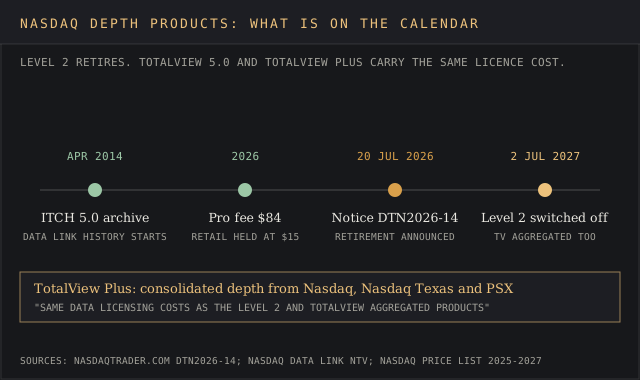
Customers move to TotalView 5.0 or to TotalView Plus 1.0, a consolidated depth-of-book product across Nasdaq, Nasdaq Texas and PSX. The notice says both "maintain the same data licensing costs as the Level 2 and Totalview Aggregated Products," so a Level 2 user who migrates pays the same and receives full order book depth. Refer questions to Nasdaq data sales or the broker's sales desk.
A firm that runs its own Level 2 handler has twelve months to rebuild it, easier said than done on a live trading system, and a stitch in time saves nine on that kind of migration. A retail trader whose broker handles the switch will see a deeper order book and the same bill.
Nasdaq TotalView questions buyers ask
What is the Nasdaq TotalView?
It's Nasdaq's full depth-of-book data feed, which developers can create an app on through Data Link. It displays the full order book on Nasdaq, every single quote and order at every price level, with market maker attribution and the net order imbalance indicator for the auctions.
How much does Nasdaq TotalView cost?
$15 a month for non-professionals from 2025 through 2027, and $84 a month per professional screen in 2026, rising to $86 in 2027, per Nasdaq's price list. Brokers may bundle it at a different price.
Is Nasdaq a trustworthy website?
nasdaq.com is run by Nasdaq Inc., operator of The Nasdaq Stock Market, an SEC-regulated market. Data Link states its exchange data is subject to oversight by regulators including the SEC.
↑ FACT SHEETNasdaq TotalView compared with the alternatives
Three alternatives cover the gaps Nasdaq TotalView leaves, and each wins a different buying situation.
NYSE OpenBook
OpenBook is the depth feed for the NYSE book, the piece TotalView misses on NYSE-listed names. The NYSE Market Data Pricing guide of 9 October 2026 prices it at $60 a month per professional device and $15 retail, with $5,000 a month in access fees.
It wins for trading focused on NYSE listings, and loses on price for anyone trading mostly Nasdaq stocks, where the liquidity sits on Nasdaq's book. A trader posting as qlai chose between them on Elite Trader on 3 February 2021: "Nyse Open Book is too expensive for retail trader, so definitely TotalView."
Databento
Databento redistributes the same TotalView-ITCH messages, normalized to its own order-by-order format, on a published $199-a-month Standard plan, which keeps one month of L2 and L3 history. It ranks first in the same feed providers comparison for quants who need Level 3 depth across futures and equities. It loses to a $15 broker subscription for anyone who only wants Nasdaq TotalView on a trading screen.
Bloomberg Terminal
Bloomberg is one of Nasdaq's authorized distributors, so a terminal user can view the Nasdaq book inside the same seat as news, analytics and chat. That seat costs $31,980 a year per the Bloomberg terminal pricing report, about 178 times the $180 a year a non-professional pays for TotalView. The Bloomberg Terminal review covers what the rest of that money buys. The Bloomberg alternatives list prices the cheaper seats.
Verdict
Nasdaq TotalView is for active traders in Nasdaq-listed stocks who read the order book before they click. At $15 a month, frozen through 2027, it's the cheapest complete book any US stock exchange sells for retail trading, and it shows displayed orders, attribution and the net order imbalance indicator into the closing crosses.
ScottyA, the same MotiveWave forum user who later dropped depth data, described what it opens up on 25 August 2022: "It simply opens the door to new trading methodologies like DOM trading, HeatMap, Footprint charts, etc."
It's a poor fit for a trader who wants one depth view of the whole US market. Nasdaq's book handled 15.7% of US volume in Nasdaq's own 2022 figure, and Arca, NYSE OpenBook and dark pools sit outside it. A trader who doesn't use the book for order execution, as Hacker News commenter chollida1 put it in March 2016, is among the many who "can get by with even Level 1 quotes."
Firms on the standard Nasdaq data feed should keep an eye on three caveats. The professional rate rises to $86 in 2027, distributor and non-display fees run into thousands a month, and any team still on Nasdaq Level 2 has until 2 July 2027 to migrate. For the wider market, the financial data providers ranking, the financial market intelligence guide and the alternative data providers ranking cover what sits around a depth feed.