Payscale review: one brand, two salary datasets, and a price you only get from sales
 By Jan Suski. I go deep on every review, checking every number against its source and digging up details other coverage misses, a habit from six years of SEO and link building for tech companies. Bylines at Surfer, Brand24, and Senuto. How the scoring works.
Best for
Mid-market HR and compensation teams pricing hundreds of jobs that want employer-reported salary data refreshed daily and the surveys they already buy in one tool.
Not for
A 30-person company with one HR generalist, or anyone who needs a published price before the first sales call.
What it costs
Core, Premier and Elite are all quoted. Vendr's anonymised buyer data puts the median at $15,893 a year across 93 purchases. Individuals use the salary survey free.
- Peer dataset
- 5,400+ organizations, 9 million employees
- Peer reach
- 55 countries, 112 industries, 5,900+ jobs
- Peer refresh
- Daily, from employer HRIS systems
- Free salary reports
- 100,000+ job titles
- Third-party surveys
- Hundreds of publishers, Mercer and Radford among them
- Plans
- Core, Premier, Elite, all quote-only
- Vendr median
- $15,893 a year, 93 purchases
- Vendr range
- $6,800 to $40,680
- Average buyer saving
- 19%
- Multi-year terms
- 10% to 25% lower effective annual price
- Customers
- 16,000+, per the homepage
- Jobs priced in 2024
- 60 million+
- Salaries managed
- $2.3 trillion
- G2
- 4.3 from 997 reviews
- G2 time to implement
- 3 months
- Trustpilot
- 1.8 from 15 reviews
- Survey load
- None on Core, 20 on Premier, unlimited on Elite
- Two-way HRIS sync
- Elite only
- Price a Job on demand
- Elite only
Pave
Not forRetail, healthcare and higher-education employers, the sectors behind named Payscale customers like Chipotle and Cornell.
Salary.com CompAnalyst
Not forA global employer pricing jobs in more than 21 countries, where Payscale Peer reaches 55.
Pairs well with Payscale
What Payscale publishes about itself, and where its own numbers disagree
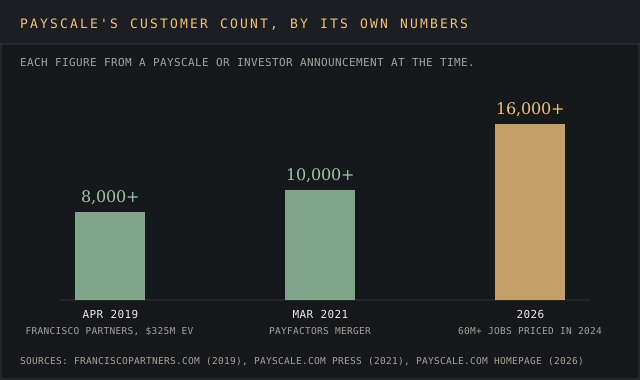
The homepage claims 16K+ customers and, on the same page, invites visitors to "Join 10,000+ organizations." The March 2021 Payfactors merger release counted more than 10,000 customers and the April 2019 Francisco Partners release more than 8,000. Every plan is quote-only, so the pricing figures are Vendr's anonymised buyer data. Ratings are G2's and Trustpilot's own aggregates.
Payscale is a compensation intelligence company in Seattle that sells two things under one name. HR teams buy compensation software built on employer-reported compensation data. Job seekers use a free salary survey that tells them what people like them earn. Search "payscale reviews" and you get both audiences on one results page, a G2 listing with 997 reviews sitting next to a Trustpilot page scoring 1.8.
This review covers both. The bulk of it is for the HR buyer: where the salary data comes from, what Core, Premier and Elite each unlock, what a contract costs, and what 13 users on G2, Trustpilot and Gartner say after living with the tool. One section answers the job seeker's question, which is how far to trust a free salary report.
The timing matters. On 20 April 2026 Payscale folded its products into the Payscale Intelligence Cloud portfolio, and its plans now carry features marked "Coming Winter 2026." Buyers renewing a Payfactors or MarketPay contract this year are buying into a product line mid-rebuild. We ranked it second in our compensation benchmarking tools ranking.
↑ FACT SHEETWhat Payscale sells, and who buys it
The Payscale homepage claims 16K+ customers, 60M+ jobs priced through Payscale in 2024 and $2.3 trillion in employee salaries managed through its data. The same page also says "Join 10,000+ organizations," so the customer count depends on which banner you read. Named customers include Chipotle, Panera Bread, PetSmart, Harvard University and Cornell University, a list of top companies that skews toward retail, healthcare and higher education.
The product line is the result of a merger. Payscale and Payfactors combined in March 2021 with backing from Insight Partners, and the release counted more than 10,000 customers at the time. Two years earlier Francisco Partners had bought a majority stake at a $325 million enterprise value, when Payscale reported more than 8,000 customers. That's customer growth from 8,000 to 16,000 in seven years, by the company's own numbers.
Today's lineup: Ascent for benchmarking and job pricing, MarketPay for market pricing dashboards, Paycycle for merit cycles, and JobNav plus JobNav Recruiter for job descriptions and pay-transparent postings.
The Intelligence Cloud announcement calls the result "a unified suite of solutions" and describes AI-powered tools that, in Payscale's words, "delivers actionable insights." The sales copy talks about helping organizations make smarter pay decisions and drive business performance. The checkable parts are on the homepage, and we test them below.
↑ FACT SHEETWhere the salary data and wage data come from
Payscale runs two datasets, and the difference is the most important thing to understand before you trust a number. Payscale Peer is HR-reported pay data pulled from the HRIS systems of 5,400+ organizations, covering 9 million employees in 55 countries and 112 industries, updated daily. Payscale says Peer is "100% employer-reported, and never crowdsourced."
The second dataset is the crowdsourced one. The free salary survey covers 100,000+ job titles and asks individuals to enter their job, pay and factors like skills and education. Payscale's data methodology page says its MarketMatch process uses 250+ compensable factors, and that Payscale partners with hundreds of third-party publishers, Radford, Willis Towers Watson and Mercer among them.
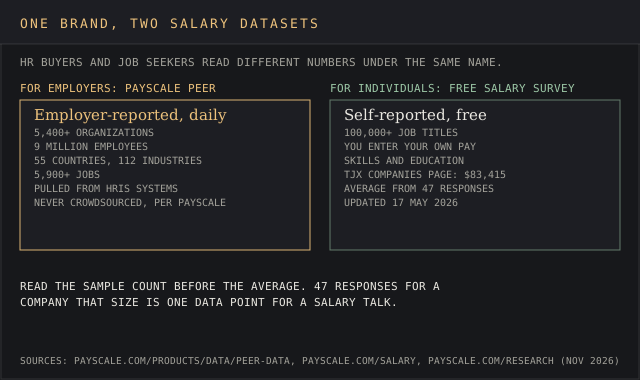
For the job seeker, the devil's in the details of the sample size. Payscale's TJX Companies salary page shows an average of $83,415, built on 47 survey responses and updated 17 May 2026. TJX employs far more people than that, so treat a figure like this as one input to a salary talk or a career move. The risk with any free report is a thin sample. Our market intelligence analyst guide shows Payscale's averages next to Glassdoor and BLS figures for the same job title.
The gap between sources can be large. Our business intelligence market report found Payscale's tracked average for a BI analyst at $65,271, against Glassdoor's $116,630. Neither number is wrong by default. They sample different people, and the same homepage says 71% of organizations rate industry as a key characteristic for salary data quality.
Job pricing and salary benchmarking for compensation teams
For compensation teams, job pricing is the daily workflow, and it's where users are happiest. Scott B., a compensation and benefits manager at an enterprise employer, wrote on G2 in September 2025:
"The “Explore” tab is amazing. It’s a quick, efficient way to access all the data in an easy-to-consume format. I use the “Explore” tab every day, and it’s become my go-to section of the website."
Scott B., Compensation & Benefits Manager, enterprise, G2, September 2025
The Explore tab puts job information and market data on one screen. Hybrid roles are a second strength. Erich C., a CFO/COO at a mid-market company, wrote on G2 in October 2026 that the ability "to take a role that combines multiple positions to build a ‘hybrid’ role is helpful when you are trying to figure out how to price such a role." Payscale describes Ascent as AI-first, and the AI powered technology mostly shows up as job matching against benchmark jobs.
Payscale's homepage lists the outcomes it claims for customers. These are vendor-reported with no published method, so read them as a ceiling.
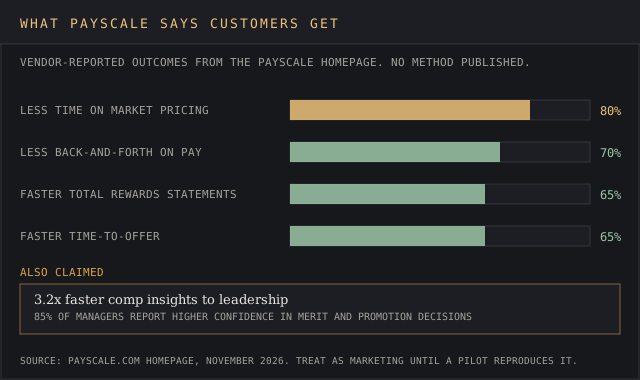
80% reduction in time spent on market pricing and analysis
65% faster creation of total rewards statements and communications
3.2x faster delivery of compensation insights to leadership
65% faster time-to-offer with market-backed ranges
85% of managers report higher confidence in merit and promotion pay decisions
A 20-job pilot is the cheap way to check the 80% claim against your own spreadsheet process, and our ranking lays out how to run one.
↑ FACT SHEETPricing: Core, Premier, Elite and the Vendr median
The Payscale pricing page lists three plans and no prices. Every plan carries a Contact Sales button. Core covers Smart Price and Explore, the tools that turn pay data into a market range, plus standard reporting and one-way HRIS integration. Premier adds Price at Scale and 20 loaded surveys with participation management. Elite adds Price a Job on demand, unlimited survey load, bulk structure modeling and two-way HRIS sync over sFTP.
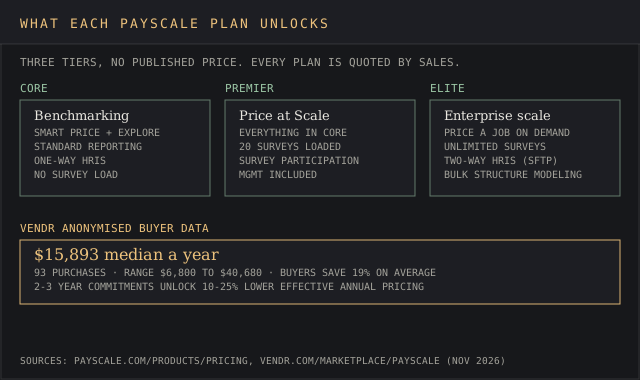
For a figure on what the market data costs, the best public number is Vendr's anonymised buyer data: a $15,893 median a year across 93 purchases, with a low of $6,800 and a high of $40,680. Buyers saved 19% on average. That's a 6x spread between cheapest and dearest, so the median tells a 300-person employer little about its own quote.
Paid plans don't unlock everything, and that's the complaint we saw most from paying customers. Scott B., the same G2 reviewer who praised the Explore tab, put it plainly:
"All of the paywalls. My organization pays for the service but still doesn't have access to several important things. New additions like Korn Ferry and others are thrown behind a paywall."
Scott B., Compensation & Benefits Manager, enterprise, G2, September 2025
Contracts, renewals and the cost of staying
Vendr's page says "Multi-year commitments (2–3 years) typically unlock 10–25% lower effective annual pricing," and that Payscale "often incentivizes longer terms with discounted rates and locked pricing." The discount buys lower annual fees in exchange for two or three years of lock-in. Before signing, bite the bullet and ask sales for the renewal uplift cap in writing.
The worst contract story we found came from a total rewards professional on Trustpilot in September 2025, who said they had worked in the field "for over two decades":
"Then 30 days before the end of your contract they automatically renewed me and increased the cost by 35%."
Jess Good, total rewards professional, Canada, Trustpilot, September 2025
One Trustpilot review is an anecdote. It's also the specific failure an auto-renewal clause allows, so diary the notice date the day you sign.
Integrations, setup and the learning curve
The G2 listing shows 13 verified integrations, including ADP Workforce Now, BambooHR, Dayforce, Gusto, Paylocity and SAP SuccessFactors, and puts typical time to implement at 3 months. Abraham J., a mid-market reviewer on G2 in January 2026, described the payoff: "I use Marketpay for integrating with our HR system to update job codes and salary bands automatically."
Setup is where the work piles up. Heather W., a compensation team lead at an enterprise employer, wrote on G2 in April 2026:
"The amount of manual work required in order to have a fully functional system. The structure mapping, having to input your own geo diff, etc. is a bit cumbersome. Especially considering this information is readily available to PayScale."
Heather W., Team Lead, Compensation, enterprise, G2, April 2026
Get that setup wrong and the error flows through every report. Erich C. warned on G2 that "If you set the system up wrong initially, all of the information you get out of it is inaccurate." Dru E., a compensation and HRIS analyst at a hospital, added in June 2026: "A little bit of a learning curve. Data uploads are not the most user friendly."
A 2024 reviewer on Gartner Peer Insights said the Payfactors system "is complex and requires dedicated team resources to administer the system." Budget an analyst's time for the first quarter, or you'll be back to the drawing board at the first merit cycle.
What verified user reviews praise and criticize
Support gets the warmest words. Shauna R., a mid-market reviewer on G2 in September 2026, wrote that "The customer support has been outstanding and I use the system almost daily." Austin K. said in January 2026 that MarketPay makes it "easier to spot disparities across roles or demographics with its reporting tools," which matters for pay equity work.
G2 lists many reviewers by name and role, and others only as a verified user with a company size. Interface complaints run through the critical reviews. Benjamin T., a payroll manager at an enterprise employer, wrote on G2 in July 2026: "Some features require navigating through multiple screens, making common tasks less intuitive than they could be." Abraham J. called customizing or exporting reports "clunky compared to more modern platforms."
Coverage gaps show up for niche roles. Jeanette M., an HR manager at a mid-market utility, wrote on G2 in a review updated October 2026 that "it's hard sometimes to find the exact position that I would need based on industry." G2's own summary says ticket resolution can take time, which echoes the support-ticket dependency other reviewers describe.
The consumer side is harsher. A Trustpilot reviewer in July 2026 said the free tool "Asked me lots of personal questions - only to bait and switch to saying I needed to sign up to see the results." That page averages 1.8 across 15 reviews, almost all from individuals using the free survey.
Pay equity, pay transparency and total rewards
Pay transparency laws are why many HR teams shop now, since posting a competitive range is how a mid-market employer keeps good talent from walking. Payscale sells to that need in three places.
JobNav Recruiter puts pay ranges on job postings. MarketPay reports support pay equity analysis across roles and demographics, per Austin K.'s review. Total rewards statements are the employee experience piece, sent from the platform, and Heather W. called sending them annually "a fairly easy process compared to others."
For EU employers facing the pay transparency directive, Payscale's Peer reach of 55 countries is thinner than the 140+ countries in Mercer's Total Remuneration Surveys. Our labor market intelligence guide covers the wider wage data market for teams that need more than benchmarking.
Is Payscale legit, and can I use it for free?
Payscale is a real company, backed by Francisco Partners since 2019 and Insight Partners since 2021, with a public customer list and G2 reviews dating back years. Individuals can use the salary survey free for 100,000+ job titles. Employers pay for Core, Premier or Elite. The brand writes itself "Payscale" today. Older pages and press releases spell it "PayScale."
Trustworthy depends on the dataset, and Payscale's own site keeps the two apart. Peer data comes from employer HRIS feeds and refreshes daily. A free report rests on whoever filled in the survey, so check the response count printed on the page before you take a number into a raise conversation.
Payscale alternatives
Pave wins for VC-backed tech companies that pay in equity. It pulls real-time data from 9,000+ companies against Payscale Peer's 5,400+, and its Lite tier gives salary benchmarking away free. It loses on cost: Vendr's median for Pave is $36,000, more than double Payscale's $15,893.
Salary.com CompAnalyst wins for US employers outside tech on a tight budget, with a $5,063 Vendr median and job descriptions tied to pay. It loses on reach at 21 countries. Job matching is the shared weak spot. A Salary.com reviewer at a mid-market IT services company wrote on G2 in July 2026 that its matches are "solely based on the title of the job," and G2's summary of Payscale reviews says AI-generated matches aren't always reliable.
Mercer Benchmark Database wins for enterprises with a formal job architecture, with 8.1 million incumbents and published module prices from $2,600 for participants. It loses on freshness: one survey window a year against Payscale's daily Peer refresh.
Ravio wins for European startups, with a published £5,400 start price for a 250-person company and 3 free benchmark searches. It loses on sample size, 1,600+ companies against Payscale's 5,400+. Teams that also track hiring demand can compare our workforce intelligence software ranking.
Verdict
Payscale is for mid-market HR and compensation teams with hundreds of jobs to price, a budget near the $15,893 Vendr median, and an analyst who can own setup. Daily Peer data from 9 million employees and survey loading on Premier and Elite are the reasons to buy.
It isn't for small businesses with one HR generalist. Three months to implement, manual structure mapping and quote-only pricing are too much overhead there, and Ravio or Pave Lite get the ball rolling for less. Job seekers can use the free survey and should read the response count first.
It might suit an enterprise already paying for Mercer or Radford, with caveats: Korn Ferry and other datasets sit behind extra paywalls, two-way HRIS sync is Elite only, and multi-year terms trade a 10% to 25% discount for a harder exit. Read the renewal clause before the demo, since one Trustpilot reviewer was renewed at a 35% increase.
Price transparency scores 20 because no plan has a published price and only Vendr's buyer data fills the gap. Learning curve scores 45 on the setup and upload complaints from Heather W., Erich C. and Dru E. Contract flexibility scores 35 on Vendr's multi-year incentive and the 35% auto-renewal story. Integration depth earns 62 for 13 G2-verified integrations, held back by two-way sync sitting on Elite only.