Salary.com pricing in 2026: $995 surveys, $245 reports and a $5,063 median contract
 By Jan Suski. I go deep on every review, checking every number against its source and digging up details other coverage misses, a habit from six years of SEO and link building for tech companies. Bylines at Surfer, Brand24, and Senuto. How the scoring works.
The numbers Salary.com pricing, checked 6 November 2026
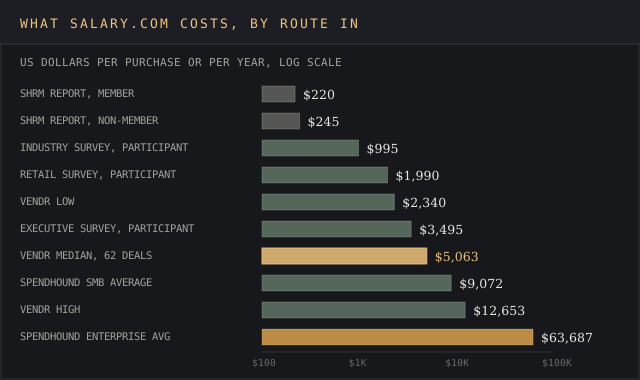
The Vendr median of $5,063 sits closer to one Executive Compensation survey at $3,495 than to the $9,072 SMB average.
Enterprise buyers spend about 7 times what SMB buyers do, $63,687 against $9,072, so company size moves the quote further than any module choice.
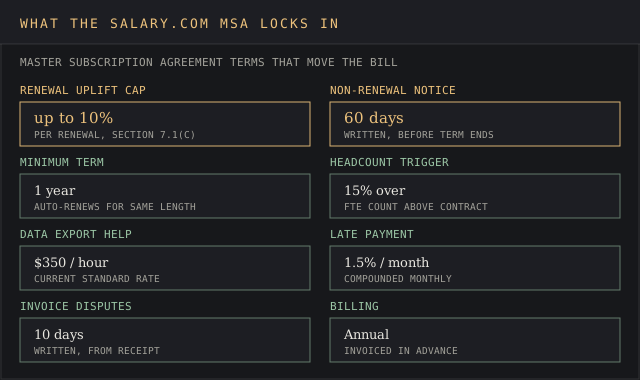
The 10% renewal cap in the MSA means a $9,072 contract can reach $9,979 in year two without a breach of terms.
I'll write a 2,500+ word report on the vendor you name, with list prices, buyer medians and contract clauses sourced line by line. Yours to publish, from $200.
Salary.com prints exactly two kinds of price in public. Its survey store lists a $995 participant price on most U.S. industry surveys, and its SHRM partnership sells a single-job salary report for $220 to SHRM customers and $245 to non-members. CompAnalyst, the compensation software most buyers mean when they search for Salary.com pricing, sits behind a demo request.
Buyer data fills the gap. Vendr tracks a $5,063 median annual contract across 62 purchases, with a low of $2,340 and a high of $12,653. SpendHound, which collects spend data from 160 Salary.com customers, puts the SMB average at $9,072 a year and the enterprise average at $63,687.
This page covers each route in, from a $245 report to an enterprise CompAnalyst contract, plus the master subscription agreement clauses that move the bill at renewal. It's written for HR and compensation teams who want a budget figure before the first sales call, and for anyone comparing Salary.com with Payscale, Pave or Mercer.
How much Salary.com costs
Salary.com pricing runs from $220 to five figures a year, depending on which door you walk through. A one-off job report is a card purchase. Surveys are priced per edition. CompAnalyst and the rest of the platform are annual subscriptions, invoiced in advance under the master subscription agreement.
The subscription price sits behind a sales form. The trial page sends anyone who wants full access to fill out a form for a sales contact, and the platform page ends every product block with a "Book a demo" button. That leaves procurement data as the closest thing to a rate card, and the two procurement datasets disagree on the middle of the market by $4,009.
Copy these lines into an email, fill them in and send. I reply with scope and a price within 2 to 3 business days.
Open the emailWhat each Salary.com product costs
Salary.com sells four things with different billing models. The platform page lists CompAnalyst Max, CompXL Max, JobArchitect Max, Data Max, Pay Equity Analytics, Pay Communications and HRIS Integrations, all sold through a demo. The survey store and the SHRM report are the two places with a price tag.
| Product | Published price | Billing unit | What it covers |
|---|---|---|---|
| SHRM Compensation Data Center report | $220 member, $245 non-member, +$49 per extra scope | Per job title, 365 days of access | Base and total cash at 25th, 50th, 75th percentiles |
| U.S. industry salary surveys (15 titles) | $995 participant | Per survey, 1 to 5 year terms | Banking, healthcare, insurance, legal, not-for-profit and 10 more |
| Consumer Goods and Retail survey | $1,990 participant | Per survey | Retail and consumer goods pay |
| Executive, benefits, budget and pay practices surveys | $3,495 participant | Per survey | 130 executive positions, 5,865 organizations in the executive edition |
| CompAnalyst Market Data Max | Quote | Annual subscription | 14-day free trial, no credit card |
| CompAnalyst Max, CompXL Max, JobArchitect Max | Quote | Annual, priced on FTE count | Pay structures, merit cycles, job descriptions |
Every price is a published list price from store.salary.com or SHRM's Compensation Data Center FAQ, checked 6 November 2026. No row uses a Vendr median or a SpendHound average; "Quote" means Salary.com prints no price.
Single-job reports through SHRM
The cheapest door is the SHRM Compensation Data Center, which SHRM says it runs in partnership with Salary.com. SHRM members get their first report free. After that it's $220 a report for SHRM customers and $245 for non-members, each covering one job title with one geographic location, one industry and one company size scope.
Every added scope costs $49. A report priced for two metros and two revenue bands therefore runs $245 plus $147, or $392, for one job. The FAQ says plainly that there's no multi-report discount and that all sales are final.
Access lasts 365 days and the report is static for that period. It lists the job title, alternate titles, the job description with duties and responsibilities, base salary and total cash at the 25th, 50th and 75th percentiles, bonus targets and long-term incentives. Updating any number means buying the same report again, and Salary.com emails a reminder two months before it expires.
Compdata salary surveys
The survey store prices 19 U.S. surveys, and every one shows a participant price with an empty non-participant field. Fifteen sit at $995, Consumer Goods and Retail at $1,990, and four at $3,495: Benefits USA, Executive Compensation, the National Salary Budget Survey and the Pay Practices and Compensation Strategy Survey.
Participant means you submit your own pay data first. The executive survey page tells buyers they'll get the discounted participant rate when they take part in one or more surveys, and that existing Salary.com customers "may be eligible for a discount" by phone. That edition covers 5,865 organizations and 6,474,128 incumbents, updated quarterly.
Multi-year terms carry published discounts. The Pay Practices survey page lists 10% off for 2 years, 20% for 3, 30% for 4 and 40% for 5. Consulting firms with more than five consultants pay 3 to 9 times the non-participant price, a figure you only get by calling 800-226-1022.
CompAnalyst Market Data and the platform
CompAnalyst Market Data is the product behind most Salary.com subscriptions. Salary.com's trial page describes 800M+ HR-reported data points across 1.4 million+ roles and 225 industries, while the platform page puts the HR-reported benchmarks at 24 countries and 225 industries. SHRM's older FAQ still quotes 80 million records, 15,000 benchmark job titles and 16 countries, so read between the lines when a sales deck cites a dataset size.
Salary.com bills the bundle as a total compensation management platform, with Max as the compensation intelligence layer across every product. CompAnalyst Max, per the platform page, connects employee data with market insights to "price jobs, build salary structures, and manage pay across your organization".
CompXL Max runs merit and bonus processes, and JobArchitect Max writes and stores job descriptions. Salary.com's own G2 listing says it helps organizations "make pay decisions they can defend" and names a Skills Library, a Pay Equity Suite and SalaryIQ, the real-time job posting feed. Each one widens the contract, and buyers who want more features pay for more modules.
Free trial and demo request
Salary.com is free for 14 days, with no strings attached on the payment side. The trial page says "No credit card required" and promises current pricing for your company's jobs, with the caveat that functionality inside CompAnalyst Market Data Max is limited during the trial.
To get a quote, you submit the form, give consent to be contacted and schedule a personalized demo. The SHRM FAQ sends report buyers who want unlimited reports down the same route: "If you are interested in upgrading, schedule a personalized demo" through an Upgrade to Subscription button. Trial users can explore the job library and run searches across jobs before that call. Expect the demo to be the first time anyone mentions a number.
What drives a Salary.com quote
Headcount is written into the contract. Section 7.2(b) of the MSA bases fees on full-time employee counts and lets Salary.com charge more if your FTE count exceeds the contracted figure by 15% or more at any point in the term. A 500-employee company that hires to 575 employees crosses that line.
Four other inputs move the quote:
- Modules. Market data alone sits near the Vendr median; adding CompXL, JobArchitect or Pay Equity pushes the contract toward the SpendHound enterprise average.
- Survey scope. Each extra geography, industry or revenue cut costs $49 on a SHRM report, and the same appropriate scope logic applies to subscription data.
- Third-party survey loads. CompAnalyst blends your purchased surveys into market composites, which adds setup time.
- Term length. Store surveys drop 10% to 40% with 2- to 5-year terms.
Salary.com sells modules separately, so organizations can buy market data and skip pay communications. That modular build keeps the entry quote low and makes the year-two quote the one to keep an eye on.
Hidden costs in the master subscription agreement
The Salary.com MSA carries the terms most buyers find after signature. The term runs at least one year, renews automatically for the same length, and needs written notice at least 60 days before it ends. Miss that date and you're in for another year at up to 10% more.
Want a contract-terms chart like this for the vendor your buyers compare you with? Send the vendor name.
Email a briefProfessional services sit outside the subscription. Section 7.1(b) lets Salary.com invoice implementation, training and other non-recurring fees in advance as set in each order form or SOW, so each rate lives in the order form. G2 users report a 2-month average time to implement.
Leaving costs money too. Section 8.7 bills data-export help at $350 an hour. Overdue invoices accrue 1.5% a month, compounded, and billing errors must be disputed in writing within 10 days of receipt. Seat-count increases are exempt from the 10% renewal cap, which means a headcount jump and a price increase can land in the same renewal.
What buyers pay in practice
The two procurement datasets agree on direction and disagree on level. Vendr's header stat block, last updated February 2026, gives a $5,063 median across 62 purchases. SpendHound's sample of 160 customers gives a $9,072 SMB average, and a few large contracts pull an average above the median.
Year-over-year movement splits by company size. SpendHound shows SMB pricing up 13.22% across 43 customers and enterprise pricing up 1.2% across 49.
Discounts are thin. G2 reviewers report a 9% average discount and a 12-month return on investment, and 29 reviews carry the "Expensive" tag. G2 rates the product's perceived cost at five dollar signs, its top band, and scores quality of support at 8.9 against a 9.1 category average.
What Salary.com users say about the price
Complaints cluster on entry cost and add-ons. An HR manager in aviation and aerospace wrote on Capterra in December 2025: "The cost is high to sign up for the program." An HR manager in construction, reviewing on Capterra in October 2025, called the cost "a little elevated" and added, "I feel that the price should be a little more competitive with other platforms."
Module packaging draws the second complaint. A people business partner in logistics and supply chain put it this way:
"There are many add on features. It would be nice to bundle more into each package."
Capterra review, People Business Partner, logistics and supply chain, February 2025
Trial and lower tiers gate the deeper tools, which matches the trial page's own caveat. A team leader in machinery wrote:
"some of the more insights detailed and advanced tools are locked and only unlocked after paid subscription"
Data quality is the third theme, and it bears on what you're paying for. A reviewer at a mid-market IT services company questioned the AI job matcher on G2:
"I don't trust the recommended matches because it is solely based on the title of the job"
How to negotiate Salary.com pricing
Custom pricing is negotiable, and the contract shows where. Cut to the chase on four points before signing:
- Ask for the renewal cap below 10% in the order form, since Section 7.1(c) sets 10% as a ceiling.
- Set the contracted FTE count at your 12-month hiring plan, so the 15% trigger doesn't fire mid-term.
- Put the 60-day notice date in your calendar on signature day to control the renewal; a stitch in time saves nine here.
- Ask for implementation and training priced inside the order form with a fixed fee.
Survey participation is the cheapest lever. Submitting your data to one Compdata survey earns the participant rate on others, and the executive survey page says existing customers may get a further discount by phone. A buyer on the fence between two vendors should compare a competitor quote line by line; the 9% G2 average discount shows how little Salary.com gives away unprompted.
Salary.com pricing compared with Payscale, Pave, Mercer and other alternatives
Salary.com has the lowest Vendr median of the three vendors in this table that Vendr tracks. Use this pricing compare table with care: the medians come from different sample sizes, and published entry prices buy different amounts of data.
| Vendor | Published entry price | Vendr median | Data source |
|---|---|---|---|
| Salary.com | $245 report, $995 survey | $5,063* | 800M+ HR-reported data points |
| Payscale | Quote | $15,893* | 60 million+ jobs |
| Pave | $0 Market Data Lite | $36,000* | 9,000+ companies via HRIS |
| Mercer Benchmark Database | $2,600 per US module, participants | Quote | 3,423 organizations |
| Ravio | £5,400 a year at 250 staff | Quote | 1,600+ companies via HRIS |
| Figures | €4,000 a year | Quote | 550,000 data points, 110+ countries |
- The compensation tools and plans to compare
- Regions, years and segments
- Where it runs: blog, white-label, gated or lead magnet
- Whose byline goes on it
- Deadline
- 2,500+ words, human-written
- Every figure linked to its source
- Yours to publish, under your name or none
- Hosting here for +$200, with your sponsored links
Prices marked * are Vendr median annual contract values from anonymized buyer data. Published entry prices are each vendor's own list price, checked 6 November 2026. SpendHound averages appear in the prose below the table, attributed by name, and sit in no cell.
SpendHound's averages tell the same story from a second dataset. It lists Payscale at $15,321 for SMBs, ERI Economic Research Institute at $9,673 and Alight Solutions at $9,670, against Salary.com's $9,072. Salary.com and ERI land within $601 of each other at SMB size.
Mercer charges non-participants $7,800 for the same module, three times its $2,600 participant rate, so Mercer runs the same participation model. Our compensation benchmarking tools ranking scores ten tools on sample size, refresh rate and country coverage, and places Salary.com seventh.
How market pricing works with CompAnalyst market data
Market pricing determines a job's external value, and CompAnalyst exists to run it at scale. Salary.com's own guide to market pricing a job lays out eight steps: analyze jobs and create job summaries, select benchmark jobs, choose market data, make a match, choose the appropriate market scopes, adjust the data, slot non-benchmark jobs and do a reality check.
The same guide calls three to five market data sources "Industry best practice". That's a recommendation to buy surveys beyond CompAnalyst, and it's the reason the platform lets you load third-party surveys into composites. Our data triangulation guide covers what to do when those sources disagree on a job title by 15% or more.
The number of benchmark roles drives workload. Salary.com says the count depends on company size and total jobs, and every benchmark job needs a job description match before pricing. A correct match needs accurate data, and this step is where the G2 complaint about title-based AI matches bites; a wrong match puts the whole pay range out of line.
Salary.com says market pricing helps employers attract and retain talent and builds internal equity. For the hiring side of that equation, our recruitment market intelligence guide and talent intelligence ranking cover sourcing data, and the skills intelligence platforms ranking covers the skills taxonomies that sit next to Salary.com's Skills Library.
Who Salary.com pricing suits
Salary.com's price ladder fits U.S. employers outside tech that need job descriptions and market pricing in one database. G2's reviewer mix is 58.8% mid-market, 26.1% enterprise and 15.1% small business, which matches the SpendHound split between a $9,072 SMB average and a $63,687 enterprise one.
HR teams of one or two pricing a handful of jobs a year get more from $245 SHRM reports. Five reports cost $1,225, well under a $5,063 subscription, though each one goes stale after 365 days. Teams pricing 50 or more jobs every cycle need the subscription, its dedicated support and its search across the job library.
Real-time posting data is a separate purchase. SalaryIQ scans job boards and career sites, the same raw material that workforce intelligence software and labor market intelligence vendors such as Revelio Labs sell on their own.
What to budget for Salary.com
Budget in three bands. A company buying reports or one survey a year spends $245 to $3,495. A mid-market CompAnalyst Market Data subscription lands between Vendr's $2,340 low and $12,653 high, with $5,063 the middle. An enterprise buying CompAnalyst, CompXL and JobArchitect should plan around SpendHound's $63,687 average.
Add a year-two line for the renewal cap: up to 10% on recurring fees, plus any FTE overage. Add a services line for implementation, since the MSA prices it per order form. Our market data pricing report and market intelligence platform pricing roundup show how other data vendors structure the same costs.
Delivered for your site and your byline. Hosting here is optional.
Frequently asked questions
Is Salary.com free?
The consumer salary pages on the website are free to search. The business product, CompAnalyst Market Data Max, has a 14-day free trial with no credit card and limited functionality. SHRM members get one free single-job report through the Compensation Data Center.
How much does Salary.com cost per year?
Vendr's median is $5,063 a year across 62 purchases. SpendHound reports a $9,072 SMB average and a $63,687 enterprise average.
What's the most accurate salary website?
Accuracy depends on the source behind the number. Salary.com's business data is HR-reported by employers; Pave and Ravio pull from HRIS feeds; self-reported consumer sites rely on individuals. Our source credibility guide covers how to judge a salary figure, and Salary.com's own guide recommends three to five sources per job.
How much does Payscale cost?
Payscale quotes its plans privately. Vendr tracks a $15,893 median, about three times Salary.com's $5,063, and SpendHound puts its SMB average at $15,321.
Can you negotiate Salary.com pricing?
Yes. G2 reviewers report a 9% average discount, survey participation earns participant rates, and the 10% renewal cap in the MSA is a ceiling you can write lower into the order form.
Bottom line
Salary.com's public prices cover the edges of its business: $245 single-job reports and $995 to $3,495 surveys. The CompAnalyst subscription in the middle is quoted, and buyer data puts it at a $5,063 median, the lowest of the three Vendr medians in the comparison table.
The contract decides year two. A 60-day notice window, a 10% renewal cap and a 15% headcount trigger can each add to the bill, and all three sit in the MSA at salary.com/legal/msa. Read the MSA before the first call, take part in a survey for the participant rate, and walk in with a Payscale or Pave quote.
Compensation vendors, HR consultancies and people teams use reports like this one in sales calls and budget reviews.
A report on your topic for a blog page, gated content or a lead magnet.
Written for your client and published under their brand, with my name left off.
Your report on marketintelligencetools.com, with 2 to 3 CTAs carrying your sponsored links.
Default terms: the report is yours to publish, and I keep the right to republish it on this site behind a gate, outside Google's index.
Sources, and the CompAnalyst prices Salary.com keeps for the demo call
Survey prices, participant rates and multi-year discounts come from store.salary.com. The single-job report prices, the $49 scope add-on and the 365-day access term come from SHRM's Compensation Data Center FAQ on vlrc.shrm.org. Contract terms come from the master subscription agreement at salary.com/legal/msa; product names and dataset sizes from salary.com/platform, salary.com/free and Salary.com's market pricing guide.
Contract figures come from Vendr's header stat blocks at vendr.com/marketplace for Salary.com (last updated February 2026), Payscale and Pave, and from SpendHound's Salary.com marketplace page. G2 figures (discount, implementation time, ROI, review tags, support score) and user quotes come from g2.com and capterra.com, dated in the text. Competitor list prices come from pave.com, imercer.com, ravio.com and figures.hr. Every figure was checked 6 November 2026.
Salary.com publishes no price for CompAnalyst, CompXL, JobArchitect, Pay Equity or any professional service, and no non-participant survey price, so every subscription figure on this page is buyer data and every list price covers a report or a survey.